
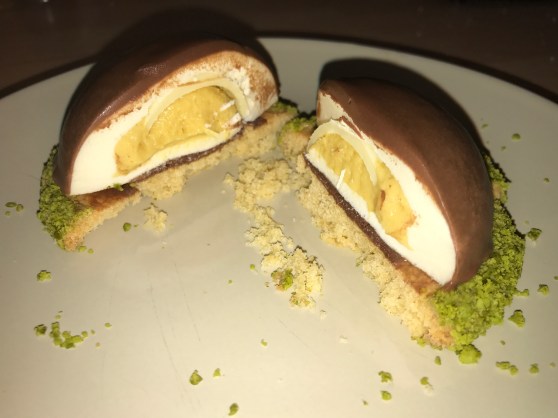
 Having recently attended a Chocolate School with the very talented Mark Tilling, I was encouraged to ‘stretch’ myself a little bit and broaden my skills beyond making a properly tempered bar of Chocolate!
This is a personal thing, learn something new and then keep going until I get to a point where I cannot go any further and call it a day. I am still on that journey and each month find myself picking up a new skill or learning about a new ingredient or technique in the international world of food. As my regular readers will know, I was diagnosed with Type I Diabetes last year so I have made subtle changes to my diet, no Sugar in Tea is the main one, and Desserts are an occasional treat, which to be honest is the way it has always been, I don’t have a really sweet tooth. So I was looking to stretch myself again and decided to have a go at a ‘Dome’ cake, they look a bit challenging and having tried one of William Curley’s from his Boutique in Richmond a while back, if I was 50% as good it would be a result.
Looking through various sources like William Curleys’ Chocolate book, the internet etc. I could not find a complete recipe for the flavour profile I wanted to achieve so decided to have a go at designing my own, but using snippets from all the resources I could. I was learning on the way as much of what was required I had not done before. There was also an issue of equipment, I did not have much as I am a ‘savoury’ person so started to research what would make life easier and the essentials I needed and looked to find out where It could be purchased.
Please Read the whole blog post 1st as I have split it into the elements that make up the complete Dome Cake. Each Section will describe what it is, the ingredients, what equipment I used (so you might need to buy) and the technique. It IS my longest post… through necessity though.
It wasn’t easy, my other half though I was having a mid life crisis but if you take it step by step it can be achieved by anyone who is methodical and can follow recipes. The results are well worth it as my testers said when they sampled the results earlier this week, one asking for the recipe. Have a read and if you feel like a challenge, have a go. Sablé Breton
- 350g Flour
- 250g Butter (Salted)
- 20g Baking Powder
- 3 egg Yolks
- 125g Sugar
I decided I wanted a texture on the base, not sponge or a variant of which there are several so went for a french version of shortbread, Sablé Breton. On it’s own its a lovely buttery slightly salty biscuit, utterly delicious. Mine has an added edge of Pistachio nuts that have been through a processor, and ‘glued’ around the edge with some Chocolate, yumm. The recipe is from my good friend Richard Bertinet, published in his book Pastry, which is well worth getting.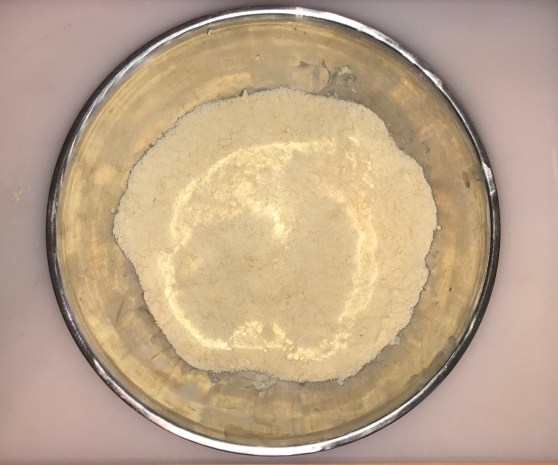 If you have warm hands I would wash them under cold water, we want to grate all the Butter into the Flour which has been sieved with the Baking Powder and Sugar. Do it in stages so you can lift the flour with your hands and coats the butter so they become like breadcrumbs, as in the picture. Someone in the house had used the Brittany Salted Butter I had planned to include so had a ‘lightly’ Salted Butter and just added a little extra.
Add the eggs yolks and combine carefully, you don’t won’t to work the mixture too much, it should combine together if you apply some gently pressure into a dough and end up like below. Stick it into the fridge wrapped in clingfilm overnight, or for at least 4 hours. You can then gently roll it to a thickness of 3-4mm and cut with a 6mm round cutter and place on a lined baking tray. This is where I made my 1st mistake, it needs to go back into the fridge to firm up and I used a fluted cutter that was slightly bigger.
After cooking at 180 degrees for 18 minutes they ‘spread’ out a bit and ended much larger than I wanted, you can see this in the picture of the final product, the visible gap between the dome and the edge of the Pistachio crumb, it’s all part of the learning!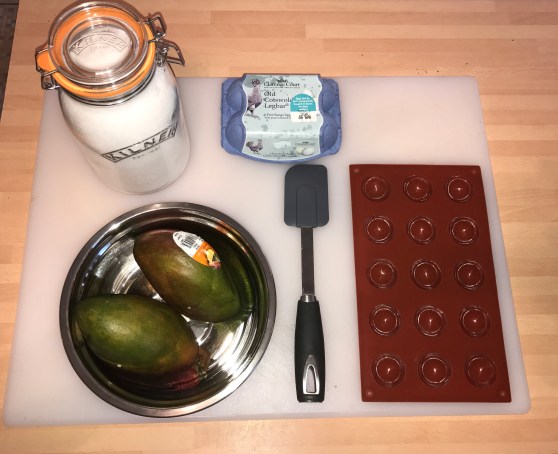 Mango Créme Brûlée
- A Mango (not 2 as in the picture)
- 200ml Whipping Cream
- 3 Egg Yolks
- 2 Tbl Caster Sugar
I made the Brûlée the same day as the biscuit base as they both need some time to rest, or in the case of the Brûlée, freeze in little moulds. The moulds are 15 Cavity 3D Semi Sphere Silicone 29.8*17.4*1.9cm and available from Amazon for about £4. They took several weeks to arrive so you need to get an order in quick. We need to cook the Mango after it has been peeled and sliced. Mine took about 40 minutes on a low heat, I added a dash of Water half way through to stop the Mango sticking and burning on the base. We do this because Mango is quite fibrous and we want to break it down as much as possible. Brûlée’s should be smooth and silky so we will be sieving the final product anyway, but it’s worth going through this stage to get a much flavour as possible.
 Once the Mango is cooked it needs some serious blitzing. We have a ‘Ninja’ which made the Mango into a puree in no time at all. Brûlée means burnt or scorched Cream so we have to heat the Cream, Mango and Sugar up to a point that it has just boiled and started to rise up the sides of the pan, then take it off the heat.
We can then tip a little of the mixture into the Egg Yolks and whisk fast, and then add that mixture into the remaining Cream and Mango, like making a Custard. We have to be careful that we don’t end up with scrambled eggs so take time over this.
You then have to pass the mixture through a sieve, it will need some help with the back of the spoon, you need a smooth silky texture so we have to remove all the fibrous Mango from the mixture otherwise it will be grainy. As we have in effect made a custard, we need to GENTLY cook it so set the oven to about 130-140 degrees add some water to the tray like a Bain Marie, and cook for about 18 minutes. Don’t overcook or it will split and you will end up with scrambled eggs!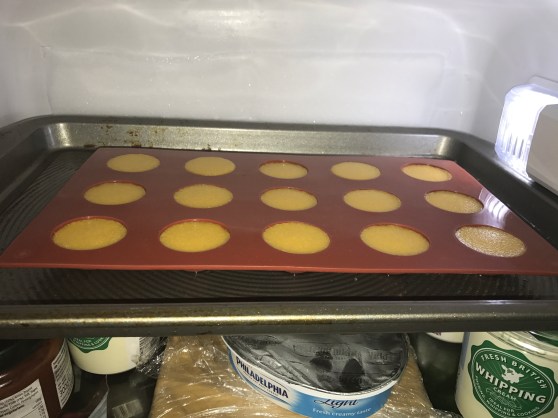 Then, pop in the fridge to set. After an hour or two, pop into the Freezer, we need them frozen to get their White Chocolate and Lime coating before going into the Coconut Mousse.
You will notice one of the Brûlée missing in the picture below, although I only needed 7 Dome cakes I made 12 and had some spare Mango inserts as I wanted to test each stage in case I went wrong, and have a couple spare for the family of course!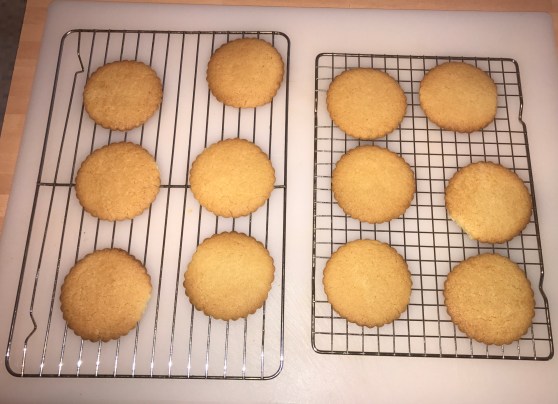 These are the Sable Bréton after 18 mins at 180 degrees, golden and delicious they need to cool right down and go into an air tight tin as we won’t need them for a day or so.
 So we have our Frozen Brûlée. You could miss this next step but I wanted to add another textural component into the dish along with a subtle surprise of citrus in the form of Lime.
Firstly, Let’s talk Chocolate, well actually Couverture. Couverture chocolate is a very high-quality chocolate that contains a higher percentage of cocoa butter (32–39%) than baking or eating chocolate. This additional cocoa butter, combined with proper tempering, gives the chocolate more sheen, a firmer “snap” when broken, and a creamy mellow flavour.
I get my Chocolate from Chocolate Trading Co, they have a good deal on at the moment HERE 3 x 1Kg Callebaut Plain, Milk and White (really good Chocolate) for just over £21.
The plan was to coat the frozen Brûlée in a layer of tempered White Chocolate with the addition of some Lime Zest. Using a wire cooling rack, demould the Brûlée and place the rack over a baking tray to catch the drops and stick back into the freezer until the Chocolate is ready. The tempering process used provides the textural ‘snap’ that would not happen if you just ‘melted and poured’. Traditionally quite complex tempering has been simplified by the use of something called MyCryo, which is readily available online and is in reality powdered Cocoa Butter.
You need to use 1% of MyCryo by weight so as you can see above, 195 Grams of Chocolate needs 1.95 Grams of MyCryo, hence the ‘posh’ scales which allow really small measurements to be made. The scales are an investment and cost about £30 but will last you a lifetime if looked after and can manage 0.01 gram increments which is also useful if you are looking at using MyCryo or agar agar gelling agent. As you can see from the notes above, for White Chocolate we need to heat to 40-45 degrees, err on caution and keep to the lower end. Use a Metal bowl over hot water, a Digital Thermometer is needed to do this properly, again easily available online for a few pounds.
Stir the Chocolate with a spatula not forgetting to add some Lime zest until the Temperature drops to 33-34 degrees, add the MyCryo and keep stirring. When the Chocolate reaches 29-30 degrees grab the frozen Brûlée from the freezer and gently pour over. It’s a bit fiddly as the Chocolate wants to set straight away but persevere and it will be ok, albeit maybe a little thick (2-3 mm).
Next time I will probably paint on using a small pastry brush to ensure a thinner layer, unless I can work out how to thin the chocolate without affecting its flavour and setting strength (i.e. not runny)!
Time to take a break until the following day……………………………………….
Coconut Mousse
- 6-7 Sheets Gold (Bloom 200) Gelatin (Available from Sous Chef online)
- 300 ml Double Cream
- 300 ml Tin 70% Minimum Coconut Milk (Needs to be in the Fridge Overnight)
- 1 1/2 Tbls Malibu
- 2 Tbls Castor Sugar
- Pinch Salt
Apologies but I didn’t manage to capture a couple of the pictures for the next stages as I was partly doing things as I went and it was becoming a bit mentally challenging. I had to convert American cup measures and work out how to use professional gelatin which I had not done before, and some of the volume calculations were interesting!
Searching the web, the majority of Coconut Mousse recipes also contained Chocolate something I didn’t want as it would be too sweet so ended up looking at a couple of ideas and ‘knocking up’ my own!  The Gelatin Sheets I used from Sous Chef are 23cm x 7 cm and weigh 2.5 grms (approx). Each sheet can set 100ml of fluid into a soft texture, but are affected by milk products, sugar (sets firmer) and alcohol (too strong sets looser).
You may recall in the recipe the Coconut Milk needs to go into the fridge, this helps the Cream rise to the top and the Water to the bottom. Carefully remove the Cream from the top into a measuring jug as we need to know the quantity to work out how much Gelatin we will add. Note the Cream quantity add the Coconut Cream quantity round up to the nearest 100ml and use 1 sheet per 100ml plus 1 extra to take into account of the alcohol we are using, we will end up with a firm set Mousse (hopefully)!
Whisk 3/4 of the Double Cream with the Sugar, Malibu and Salt until firm, over whipping and you will have Butter! Fold in the Coconut Cream and put into the fridge. The Gelatin needs to ‘bloom’ or swell in cold water (5 times its weight) for 5- 8 minutes before squeezing and adding to a small pan with the remaining Cream on a low heat to melt. Heat to 37-40 degrees stirring all the time. Take off the heat and let it cool for a few minutes, then fold into the Coconut Cream mixture and put back in the fridge.You can see in the picture above the Mousse layer, with the White Chocolate covered Mango Brûlée in the centre of the cake. You will now need 2 x Large Hemisphere dome silicone pan 6 holes 29.5 x 17.5 x 3.3cm, about £3 from Amazon.
Take the Brûlées out of the Freezer, lay your moulds on a baking tray and 1/2 fill with the Mousse. Place a Brûlée dome side down in each ‘hole’ and fill to the edge with the Mousse. Be CAREFUL not to overfill as thy will not sit on the base properly as some of mine didn’t. Place in the Fridge for an hour or two until set, then into the Freezer overnight.
Next day……………………………..
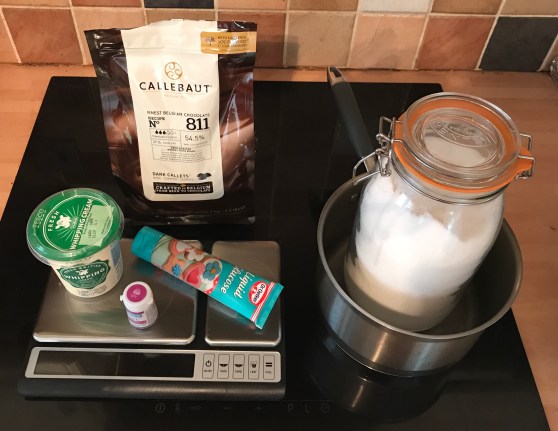 The Dome Cakes need a glaze, a shiny coating to finish them off. I looked at several, White Chocolate, Milk Chocolate, Cocoa based but opted for a recipe in William Curleys‘ Book ‘Patisserie‘, this time using the Callebaut Dark Chocolate. It’s a brilliant book, buy it!
Dark Chocolate Glaze
- 260 ml Whipping Cream
- 50 grm Caster sugar
- 40 grm liquid glucose
- 250 grm dark chocolate (chopped)
Add the Sugar, Cream and Glucose to a pan, heat until boiling, slowly add the Chocolate stirring all the time until melted, pour into a jug and put in Fridge to cool a bit. That’s it. Let’s sort out the Sablé Breton next. Take a good handful of Pistachio Nuts and blitz them in a blender, not too fine as we want a bit of texture. I use Pistachios a lot, in Middle Eastern Cooking and find the ones in the shops are ‘ok’ but usually have a brown skin which will not look (or taste) nice. They are also quite expensive so I made an investment and purchased a Kilo of skinned Iranian Pistachios as in the picture above, again from Sous Chef who are a very good online supplier.
Melt a handful of Milk and White Chocolate and gently roll the edge of each biscuit in the crumb, press gently and set aside to set. They are moorish on their own, you could also use Hazelnut’s but the flavour profile will be different, this is a sort of Far Eastern concept.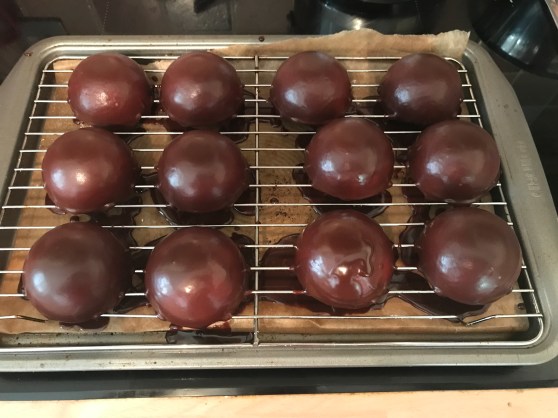 This bit was challenging as I had never done it before. The glaze needs to be at about 70 deg F (runny but not hot). Take the domes out of the Freezer, de-mould and place flat side down on a cooling rack over a baking tray. I had a sheet of baking paper underneath to capture the excess. Gently pour over, I started at the middle and used a gentle circular motion slowly moving to the outside. Put back into the Freezer for 5-10 minutes. Repeat the the process and back into the Freezer. Almost done!!!
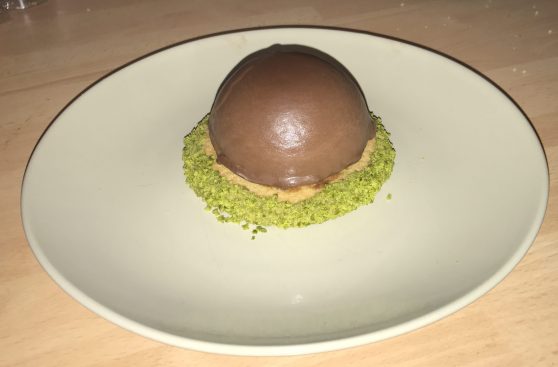 To serve I put a bit of the leftover glaze in the middle of the Sablé Breton and using a small offset stepped palette knife gently placed the dome on top. Then Enjoy.
At the beginning of this exercise I was hoping to achieve 50% of what William Curley does with his amazing patisserie, and think I was pretty close. Lots of learning on the way which is always good and the end result is quite impressive in looks and tastes delicious.
……………….Until next time……………….L8ers…………………..

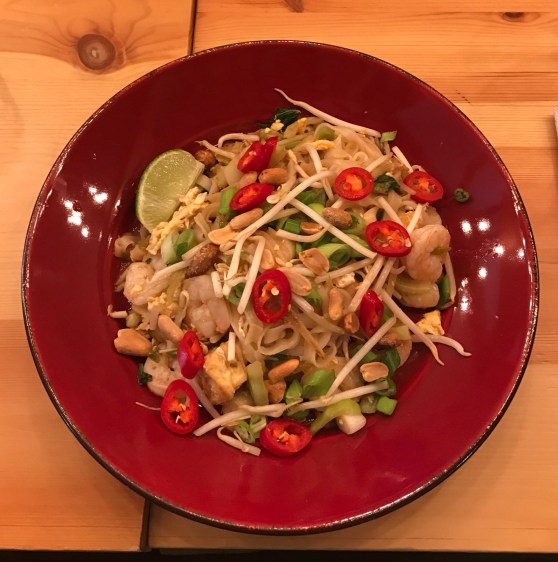 I was watching Masterchef (UK) the other night after a long day at work. It’s a usual routine for me, GBBO Créme del a Créme, Rick Stein, anything but the soaps which I started to turn off over 20 years ago as they were just too depressing!
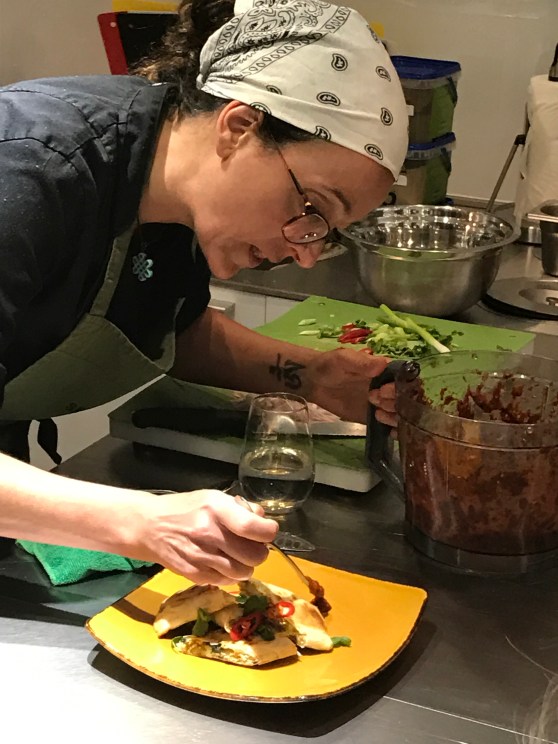 This was a VERY popular course, over twenty of us paired up around the numerous workstations, the Season Cookery School is extremely well equipped and Jackie gave everyone time and attention as we worked our way through the various dishes.
 I have cooked both Malaysian and Thai food before, you will find numerous recipes on this blog but I am still glad I invested the money to attend as I learnt so much more around technique which was one of the reasons for booking in the first place.
 You can see that each person has a good amount of workspace with a shared Induction Hob and Oven, Knives are VERY sharp, supplied by
  The Rendang was started at the beginning of the day as it had to cook for several hours, and two variants were prepared. One with Beef for the meat eaters and the other with
  We had our Jackfruit in cans, it looks a little bit like Pineapple and when we got to taste the Rendang Curry it had a very subtle fruity taste but also savoury at the same time, it was quite delicious and something I will be looking out for in the future.
 Jackie was great fun and very engaging, her life story is fascinating starting in the NHS and then deciding to ‘chuck it all in’ and move into the food industry via some serious trips abroad with the family. Some of the stories she told were really very funny and she was able to cook and talk at the same time which is actually quite difficult if you watch Saturday Kitchen, and see some of the presenters falter!
 ‘
‘ As usual, there were a number of ‘helpers’ clearing stuff away and making sure we had everything we needed, and Sylvain who runs the Season School was an active participant also getting stuck in when needed.
 I had an amazing day with Jackie, Sylvian and the rest of the ‘pupils’ it was hard work, great fun and highly recommended.
 The weather was miserable as I jumped onboard the train to Bath Spa station, on arrival the sun was shinning out of The Bertinet Cookery School as Spanish Chef Supremo Omar Allibhoy was in town, teaching 12 eager cookery enthusiasts and I was on the list!
 We were going to prepare several dishes from different parts of Spain and at the end sit down on the communal table and ‘feast’, which is always a pleasant and fitting end to several hours graft in the kitchen! On the menu was Gazpacho de Sandia (chilled Watermelon soup), Higaditos al Jerez Dulce (Chicken Livers with Sweet Sherry and Spices), Arroz Melosos de Seta (Paella with Mushrooms and Cod),
 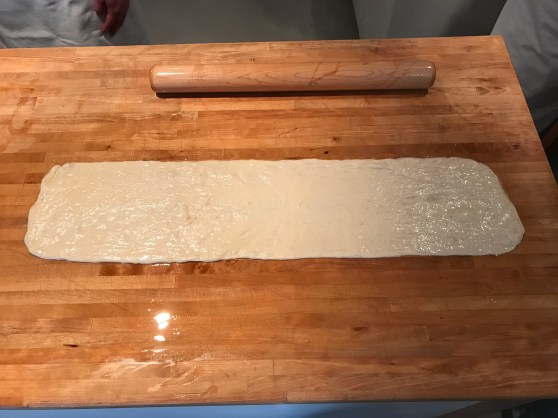 Blimey, apart from the really tasty and slightly un-familiar menu some new techniques to get to grips with, we started on the Mallorcan dessert. An enriched dough was made using an ‘industrial’ grade mixer purely due to the quantity we were making, you could do this in a Kenwood or Kitchen Aid quite easily. We had to get the gluten working hard so this was not a 5 minute process, once done (about 10-15 minutes), the dough was left to rest whilst we worked on the other dishes.
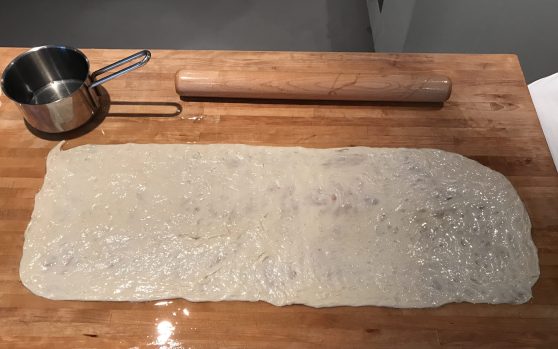 As we followed through the menu, Omar spent lots of time explaining some of the interesting facts about Spanish Cuisine, it’s ‘subtle’ not in your face and I personally think it’s a shame that a vast number of tourists only seem to focus on fast food chains and ‘British fry up’s’, Spain has so much more to offer if you make a little effort.
 The
The  We had some prepared Stock on the hob which was going to be used to make the Paella dish. This was not a traditional ‘dry’ Paella so familiar to tourists but a ‘sloppy’ one even beyond the wetness of a Risotto.
 So, we are making a dessert and then add
  Who loves Chicken Livers? Surprisingly Omar put his hand up as he asked the question. Fine in Parfait and pâté but cooked, nope, except this way. This was to be an appetizer to get the taste buds singing before the Gazpacho. Marinated in some ‘special’ ingredients you can find the recipe in Omar’s new book
  Rather than just show and tell, Omar was also hands-on, assisting and guiding all 12 of us during the 5-6 hours of cooking we were to complete before sitting down and eating our efforts. He was very enthusiastic and great fun, telling us more about his experiences in the restaurant industry and giving us hints and tips as we prepared each dish.
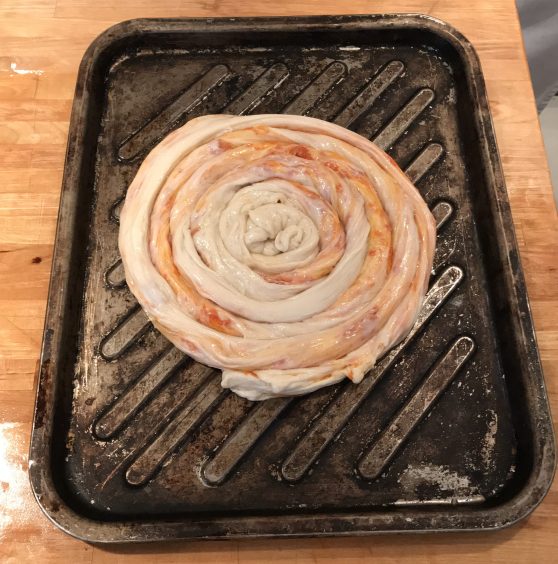 You have to stretch the Ensaidmada before ‘gently’ coiling and allowing to prove for a couple of hours, traditionally this would be done overnight to develop more flavour but our time was limited. Once risen it goes into a hot oven until a deep brown, not the light golden colour we are normally used to when baking.
 Ignore the ‘rustic’ look of the Chicken Livers, they were to die for, absolutely delightful, tangy, sweet and soft. We served them on some toasted Sour Dough and decided to crack open the wine at the same time as dinner was nearly ready and quick taster of these would get us over the line.
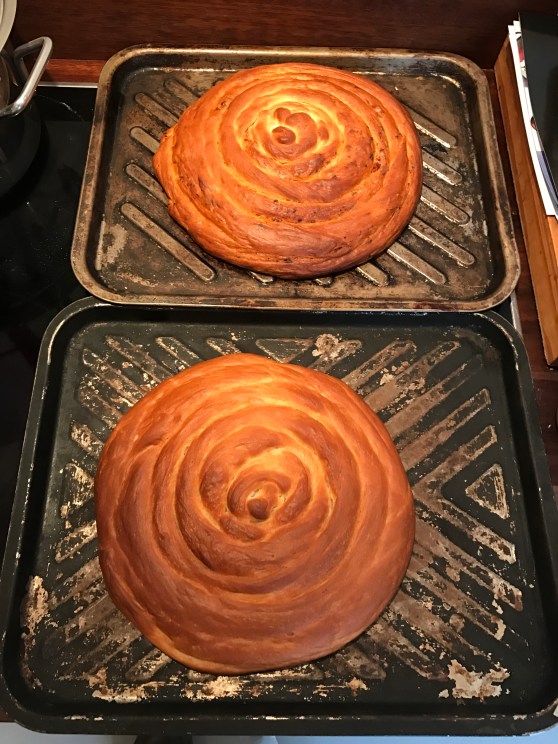 The Ensaidmada’s were ready in about 19 minutes at 190deg, the top one is the savoury version, you can seen small pieces of Sobrasada speckled on the surface. The Gazpacho was probably the easiest dish we made, assemble the ingredients and whizz in a blender. Adding Melon was unusual but it was not long before we sat done and started tasting, chatting and talking about the techniques we had learnt and discussing food in general.
 The Gazpacho was delicious, it was quite hot in the cookery school so a cool refreshing slightly sweet starter did the job perfectly. Bomba Rice is very picky, you HAVE to get the timings correct otherwise you end up with over cooked grains that are like sludge. Shortly after finishing our starter the Arroz Melosos De Seta was ready for the final ingredient to be added, Salt Cod. This only needed a few minutes and we were ready to serve.
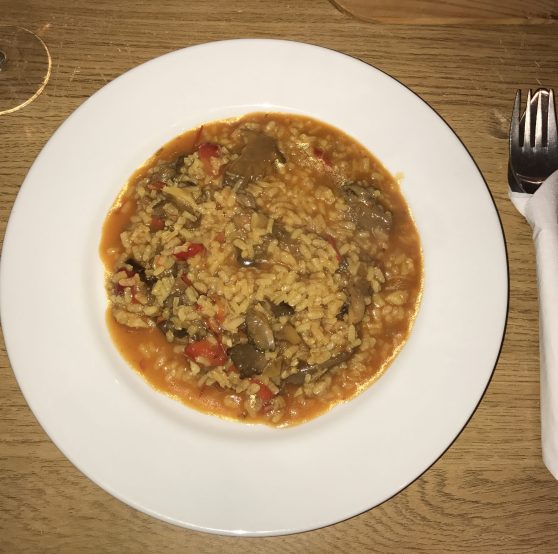 You can see the slightly ‘sloppy’ nature of the dish in the picture above. It is supposed to be like this, wetter than a Risotto it did taste subtle and was also delicious, the Paprika creating warmth and smokiness, the mushrooms meatiness and the Rice had textures but probably not the al dente described in Italian Cuisine, it was slightly beyond that stage.
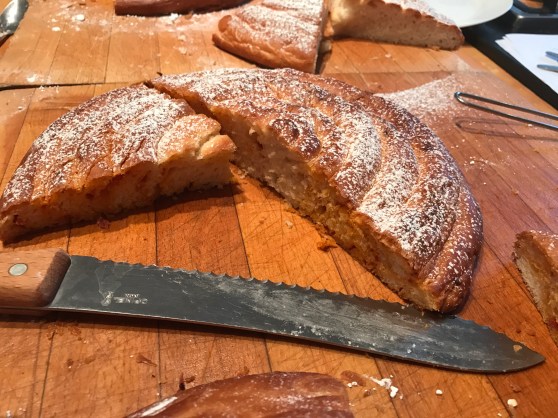 Once the Ensaidmada is cooked both versions are given a good coating of Icing sugar. The savoury version might be considered a bit like the Moroccan Pastilla dish, Pigeon Pie with Cinnamon and Icing Sugar in Filo Pastry, but in this case we are using Sobrasada which is a cured spicy Pork. It was unusually delicious again, difficult to describe unless you can taste it yourself.
 It’s been a tough couple of months with our little one taking up a lot of time through illness. The chance to ‘escape’ for a day was offered by the missus and searching for an interesting cooking course at the last minute, (my way of completely relaxing) was proving a challenge in itself. My usual haunt was fully booked so an alternative was needed, a creature of habit, looking at the various descriptions and options available I finally remembered
  I have never worked with Chocolate before as I am more of a savoury person, there are a couple of sweet entries in the blog but my recent (last year) diagnoses of Type I Diabetes means I tend to keep away from such food, but I do like learning new skills and this was to be no exception. We started the day with drinks and pastries, the school can hold up to 24 people from memory but as there were only 5 of us it was quite intimate.
 You would not believe what goes into producing the ‘callets’, tiny buttons of
 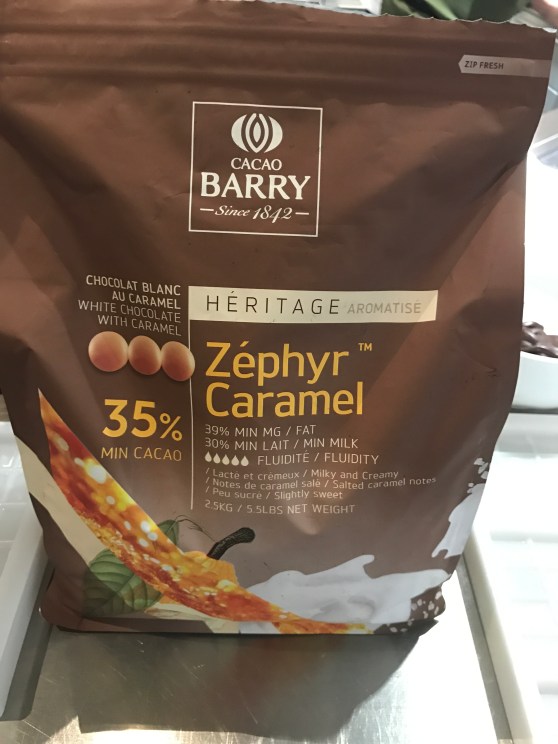 As we went about making bars of flavoured Chocolate, Champagne Ganache, filled moulds to make the shells for the Ganache, learned how to used Chocolate transfers………. we learnt LOADS, and had fun getting covered in the stuff at the same time. Stopping for a really delicious lunch we carried on debating, asking questions and generally chatting about food and …… Chocolate, it was really very good.
 Making the Shells for the Ganache was really tricky, and messy for those of us that had not done this before, ladling the warm, sweet, sticky delicious liquid into the Mould the right way, inverting the mould, tapping to release enough, and then laying to set before going in the fridge so as to not ‘shock’ the Chocolate, my attempt above was ok, the results came out quite well for a beginner!
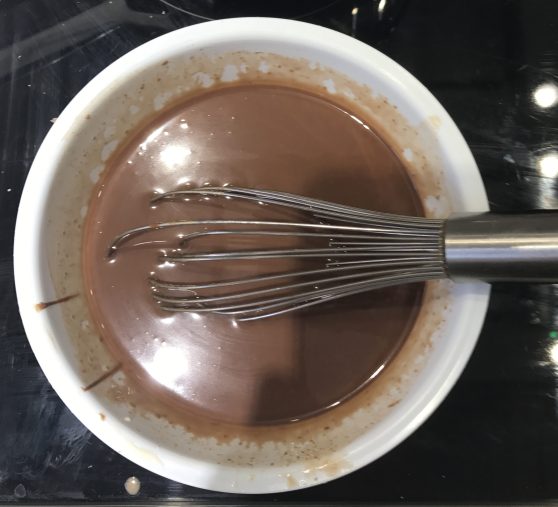 We used quite a few piping bags during the day too, the Cookery School is VERY well equipped with everything needed, and there was no washing up required, all the clearing and cleaning was done for us as we did use quite a few bowls. Tea’s and Coffees, Water and Soft Drinks were all available as and when you needed a quick respite!
 Mark is the UK Ambassador for
 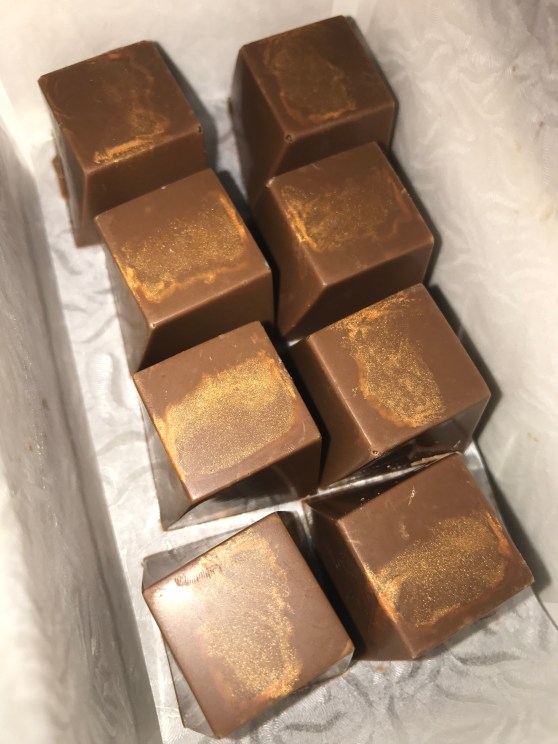 This is an AMAZING course, I did have my doubts initially as I had never been to this Cookery School before, but we learnt so much during the day it was EXCELLENT value for money. I did pay full price and the comments are my own personal reflection of the experience. The morsels above are the Champagne Ganache filled Chocolate Shells, with a Gold Dust effect on the top and one side, I was well chuffed with them considering how ‘challenging’ they are to make.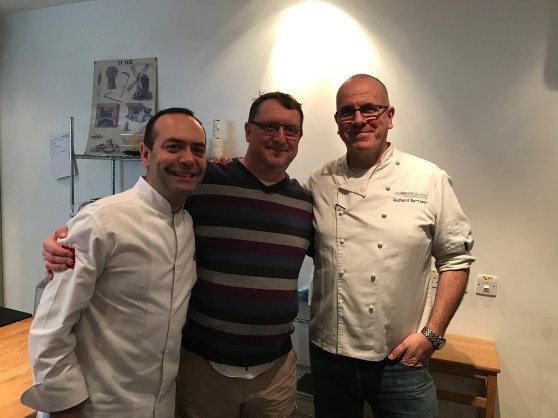
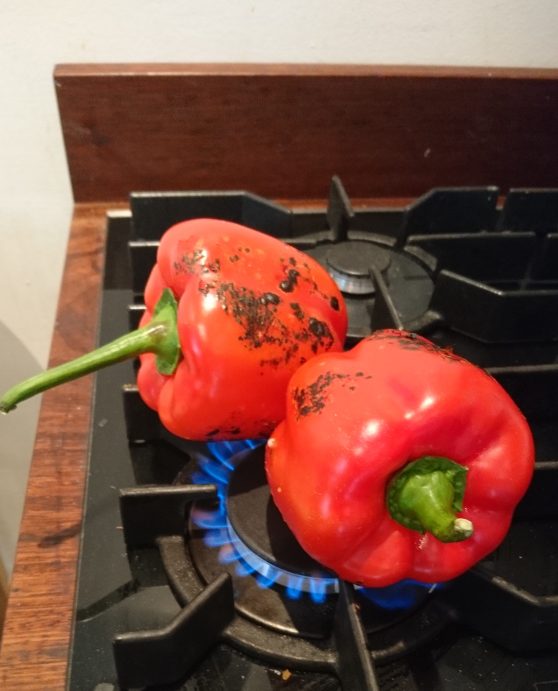 The course was fully booked, 12 of us with good mix of people of all ages and nice to see some other guys on a cookery course for a change. There were some friendly faces from previous events that many of us new, it was a bit like a school or family reunion and in no time at all we were all chatting about food and looking forward to settling down and getting stuck in.
 Things started with an introduction and a couple of demonstrations. After being told about
 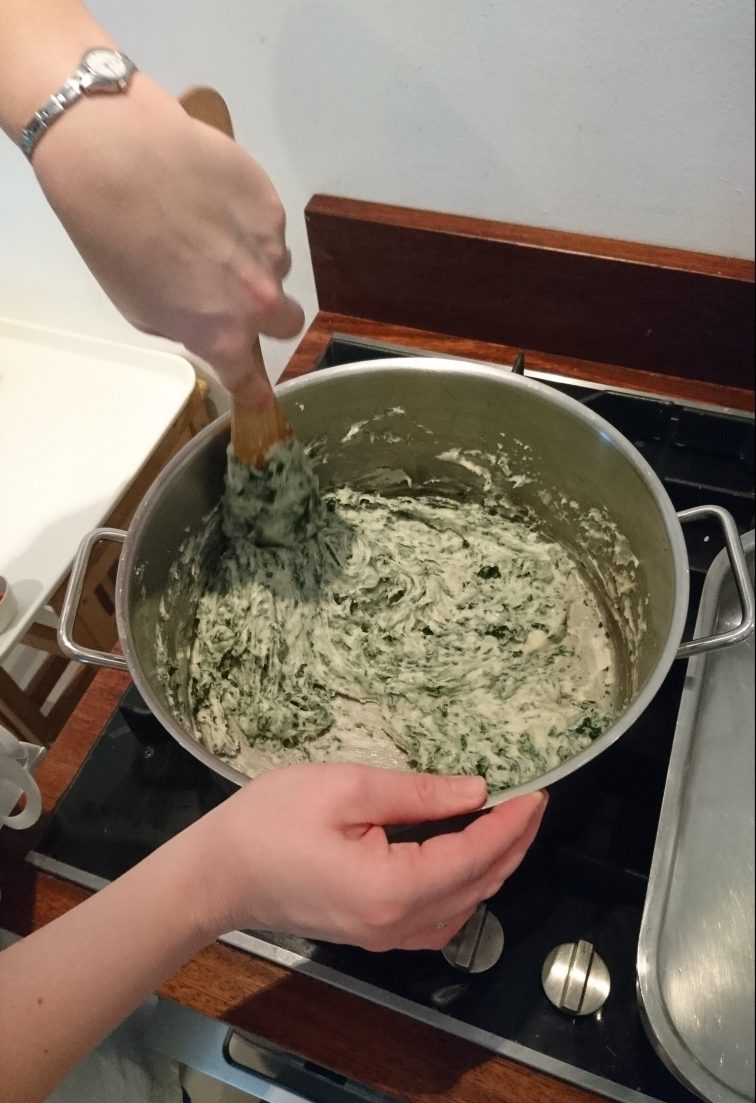 We learnt a few hints and tips but you will have to try and get on a course to find out the tricks of the trade. Trying to manipulate a
 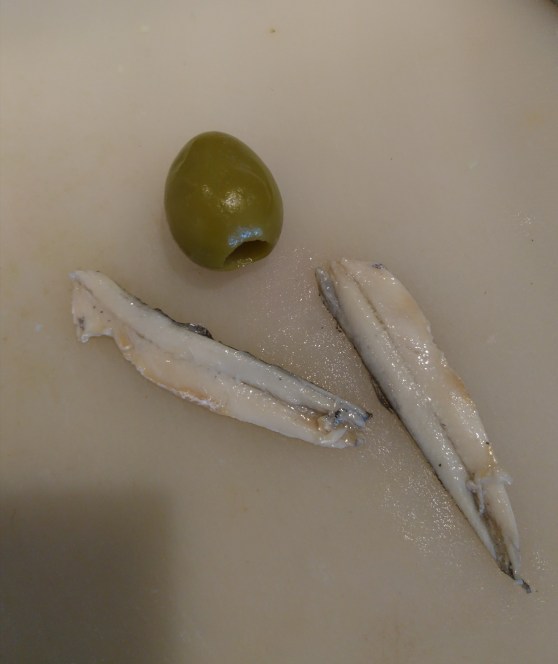 San Sebastián appears to have a lot going for it, apart from the Michelin starred restaurants it is one of the most famous destinations in Spain, which looking at the annual rain chart seems rather surprising! Along with some quality restaurants the area is also famous for
 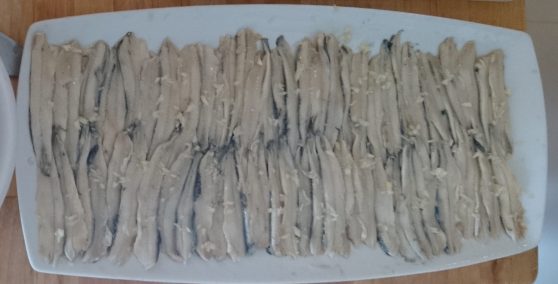 We had a couple of Boquerone left (actually loads, José had bought along a big tub!) so also prepared some marinated, sprinkled with finely chopped Garlic and given a good douse in Extra Virgin Olive Oil which were divine on some of Richards famous bread, given a quick toast and sprinkle of Olive Oil too. We had a quick taster during one of the famous coffee breaks (well, more than a taster actually as they were delicious).
 To make this Cookery School so good, apart from having an awesome range of regular and guest Chefs, Richard Bertinet has a well organised and experienced team of smiley happy people who are on hand to help, guide, advise, fetch, clean, make me Earl Grey Tea and the others coffee! and fill in where we need to get things done.
 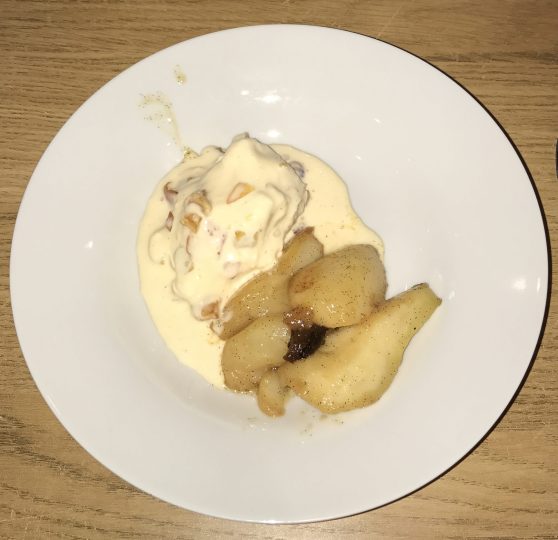 Dessert was to be an absolutely delicious Caramelised Vanilla Pear Dish with Hazelnut Ice Cream and as we had to keep an eye on other dishes, two of the team made sure the Ice Cream was finished and the Hazelnut praline was suitably ‘crunched’ (sorry, these two lovely ladies were new and I did not get their names!). We were split up up into 3 groups of four for the day and ours decided to sneak in some of Richards famous Rum soaked Dates to add a bit of ‘zing’ to the dessert and glad we did too, very very tasty.
 José Pizzaro, what a absolutely lovely teacher and thoroughly decent chap. As we were preparing the dishes (7 if you include the Pintxos) he would come round and assist, guide and chat, always with a big smile and lots of encouragement. During the numerous times he showed us particular techniques he prompted us to ask whatever questions we liked, and we certainly learnt a lot about his background, coming to England over 16 years ago and the restaurant trade in general.
 So, on the menu today is;
 The Day at the school always finishes with a communal meal, everyone sitting down to enjoy the labours of the day, copious amounts of wine on flow (unless you are driving like me) and chatting about the food, what we had learnt, what course we were going to book next etc. This was my Sixth visit, others had been on over 10 courses, it’s very good indeed.
 The last time I cooked Monkfish was in 2015, whilst in France at the French House Party Cookery School. Having checked back, Médallions de Lotte Safrantées, Arlequin du Jardin was on the menu, Medallions of Monkfish with Saffron & Seasonal Vegetables, you can see the results below. Our teacher was a Michelin starred Chef, I have the pleasure of his company again this year in May, very exciting.
 Being the start of the new year, trying to find some ‘healthier’ lighter dishes has been on the agenda which can be difficult when the weather is cold and blustery, nights draw in quickly and the tendency is to focus on Stews, Casseroles which are heartier and more fulfilling.
 Whichever Fish you decide to use, it needs marinating for at least 2 hours. Smoked Paprika, Garlic, Sherry Vinegar, Oregano, Cumin, Pepper and Salt along with a bit of water make up the marinade, Spanish Flavours which add a delicious piquancy.
 You can also work on the sauce beforehand, frying some thinly sliced button mushrooms in Olive Oil and a little butter before adding a small amount of Vegetable Stock Cube and a dash of water to dissolve it. The sauce was a ‘cook by andaza’ or estimation, something taught to me by Sumayya Usmani who wrote the very successful cookery book ‘Under the Tamarind Tree’. I had the great pleasure to attend a couple of her day courses, great fun and a real insight into the foods of Pakistan and the lesser known parts of ‘Middle Earth’.
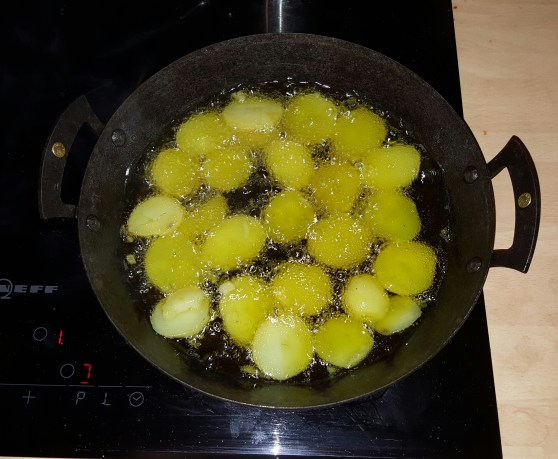 The Potatoes had cooled and skins removed, boiling with the skins on definitely imparts a better favour and is my preferred technique for mash as well as fried. I used Olive Oil from Puglia, Organic and great value for money from Riverford Organic, and delivery is free if ordered with a Veg box!
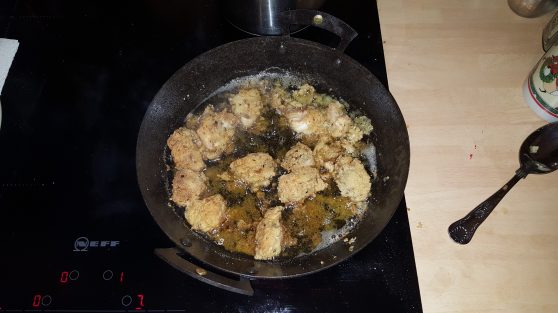 Almost done, The Fish needs draining and dredging in Semolina before frying in the Olive Oil. You may have noticed I have only used one pan for this recipe, my new friend the
 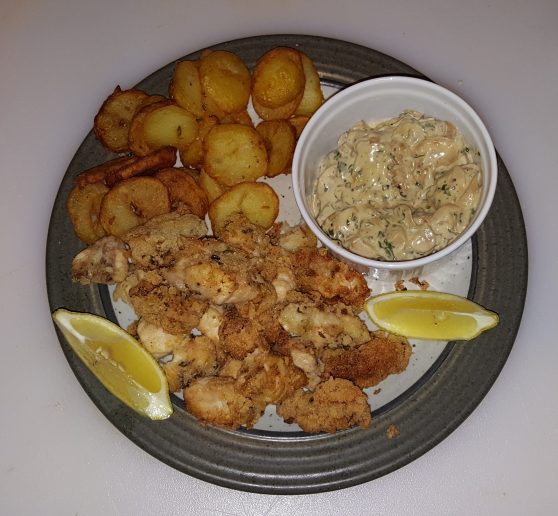 Yes, I know I need to work on my presentation a lot (unlike my previous attempt at the top of the page), but the meal was very tasty indeed. I opted to serve the sauce in a ramekin as it was a bit neater, it really worked with the Monkfish (the bosses words, not mine). This dish is easy to make, very very tasty and quite light, and could be served with a salad of Red Onion and Tomatoes if you can get some decent ones with a bit of flavour this time of year.
 It’s been an interesting few weeks as the year slowly draws to a close, and I have managed to eat in some really good restaurants as my work takes me from Norfolk to Cornwall and back home again to Newbury.
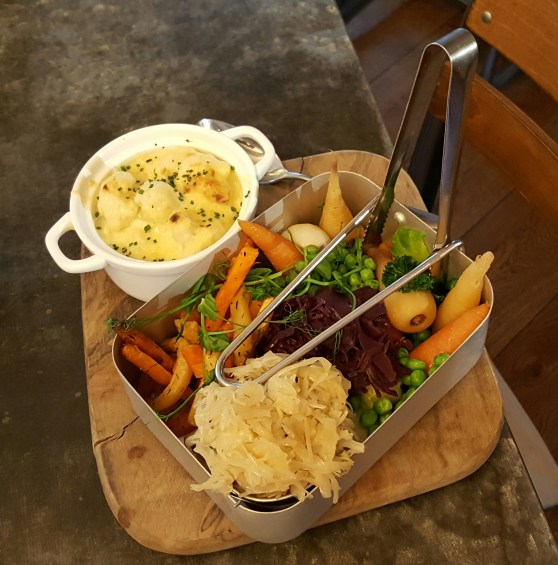 So back to the food, in no particular order the 1st award goes to
 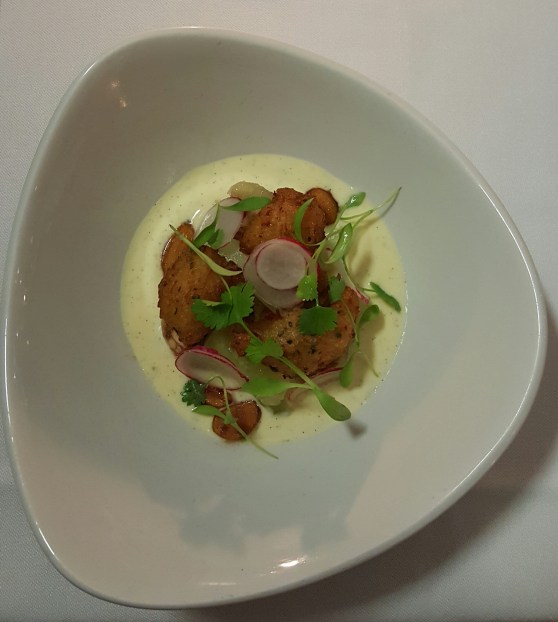 The next dish was a surprise, Satay Chicken & Crab, Vanilla Lime Custard, Spiced Peanuts and Cucumber served at the
  Next, it was a trip to ‘
 Still ‘Hooked’! I was a bit extravagant with the main. I should explain that my employer does not pay for all these meals, I get a small daily subsidy when I am travelling which would cover a typical meal, but I choose to use the opportunity to ‘invest’ my own cash in something a bit more extravagent, in this case 1/2 a Lobster!, Crevettes, Scallops, Frites, home made Tartare Sauce, and a fresh dressed salad. It was stunning, sweet, perfectly cooked and well worth the investment.
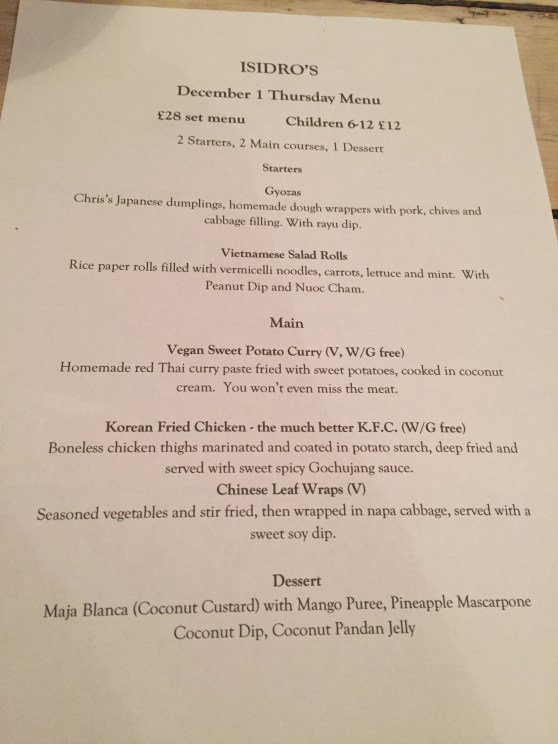 Now for the star performer, not that the others were bad, they were all excellent and I would have no hesitation is recommending them but Isidro’s is something a bit special.
  The menu consisted of 5 Courses (well 6 actually, the Filipino spring rolls above were an extra surprise), not rushed, beautifully presented, packed full of flavour and not ‘tuned’ to english tastes (chilli is chilli).
 Never had Japanese Gyoza’s before, they were a triumph perfectly cooked, melt in the mouth and just delicious.
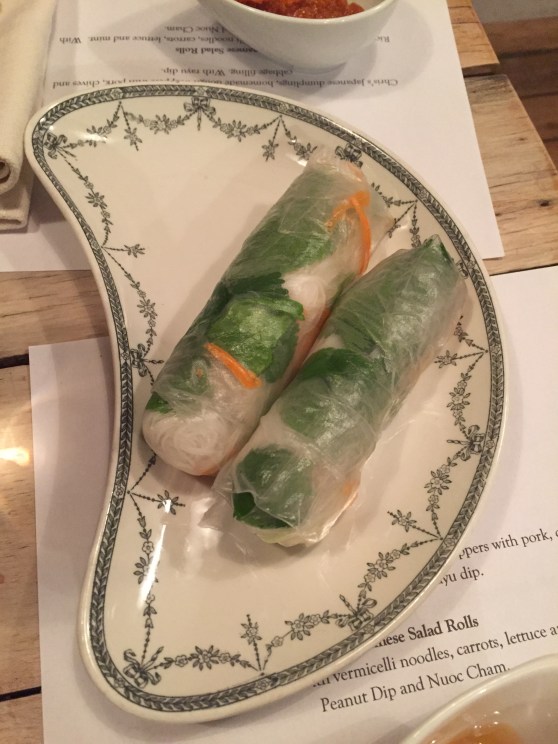 The Vietnamese Salad Rolls were just as tasty, one had already been eaten before I remembered to capture the moment, served with a proper Peanut sauce and Nuoc Cham, this food was not out of jars or tins and it just kept coming (but at a nice steady pace).
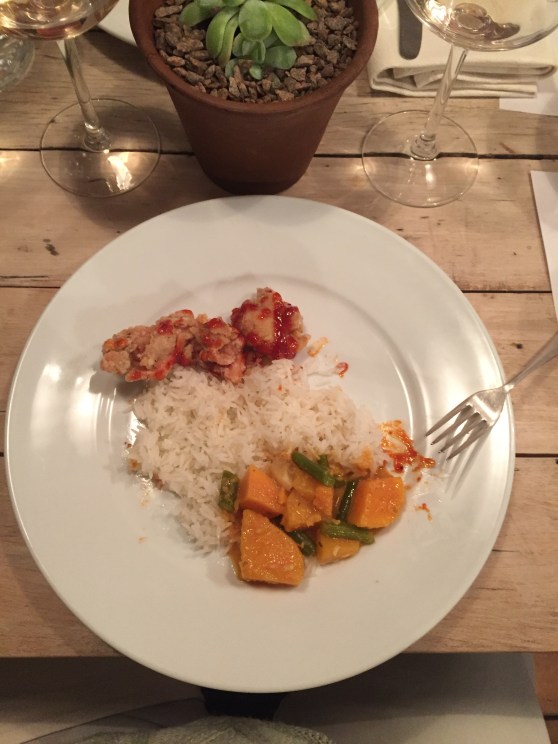 So, I don’t ‘get’ Sweet Potato, it just seems wrong and is something I steer clear of with a passion. Not tonight as one of the mains was a Sweet Potato Red Thai Curry, damn it was sooooo good. The other main for us meat eaters was KFC (Korean Fried Chicken). Now I have made this myself, a recipe from Judy Joo’s book with Gochujang Sauce, this put mine to shame so I will be speaking to them and gaining some clues as to how they cook theirs, it was brilliant.
 Dessert was finally here and we just had enough room to eat it, light, tasty fragrant Pandan, Coconut, Pineapple, Marscapone and Mango Puree, which arrived after I took the picture above.
 It’s been a tough week, mostly due to a nasty virus and being off food which for a ‘foodie’ is somewhat challenging. Our induction hob recently gave up on us, and it has taken some time to get a new one sorted, we’ve been using a portable gas stove with those ‘hair spray like’ blue cylinders in the interim which has been interesting!
 Another reason for picking this recipe is that I wanted to try a new pan I had just purchased from
  Once you have browned the Beef to seal, put to one side and start work on the Onion and Carrot, I added a small leek to my dish as I had one that needed using up and thought it would add another dimension and increase our 5 a day intake.
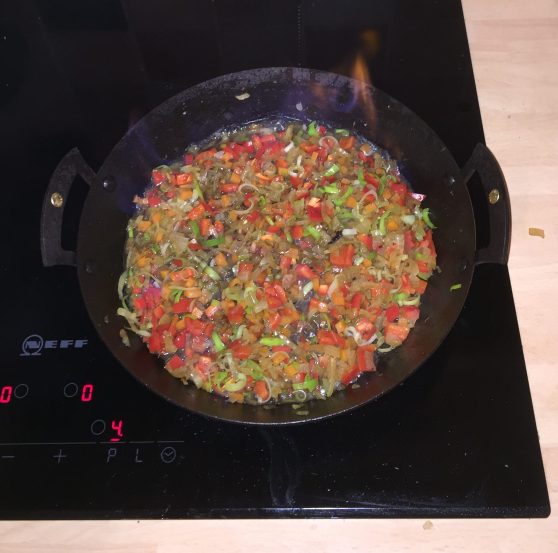 The vegetables need a decent glug of Cognac, 150ml if you are cooking for 6 – 8 people. I did vary the recipe slightly, the leeks were not in the original, and I used one of those long sweet peppers usually stuffed which I finely chopped, and also a teaspoon of sweet pimentón to the mix.
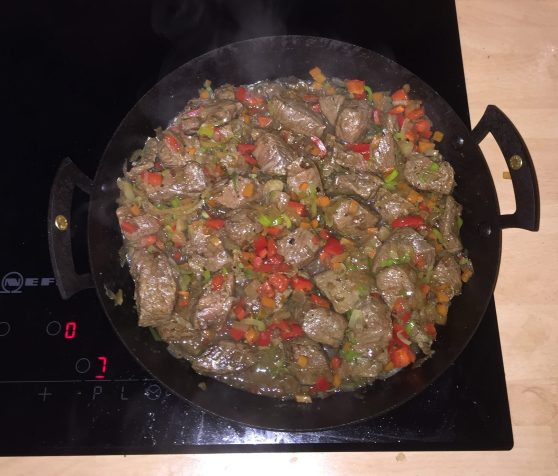 Add the Beef to the Vegetable mixture and carefully mix, the Sukalki is going to be braising for 3 – 3 1/2 hours slowly, once you have added some Beef stock to the pan. To accompany the dish I decided to prepare some ‘rustic’ Garlic Bread. Largish ‘chunks’ of bread, rough cut Garlic, LOTS of Olive Oil and seasoned well with Maldon Sea Salt and Pepper.
 The smells that were coming out of the kitchen were making both me and the boss very hungry. I hadn’t eaten much during the week due to the bug so I was really looking to eating something simple but wholesome and hopefully tasty.
 Towards the end of the braising, you need to add some Potatoes, a waxy variety that does not break up. This, to me is always a bit of challenge as potatoes don’t obey the instructions in cookery books and the cooking time depends on so many variables. Mine were sliced about 5 c.m. thick and needed a good 45 – 50 minutes to get to a point of perfect, just soft. Finally some Pea’s are added at the end to finish things off.

 If you ask anyone who has followed the TV food series ‘Great British Menu” over the years despite the 100’s of great dishes presented to the judging panel consisting of Pru Leith, Oliver Peyton and Matthew Fort, there is probably ONLY ONE dish that everyone remembers, ‘Stargazy Pie’.
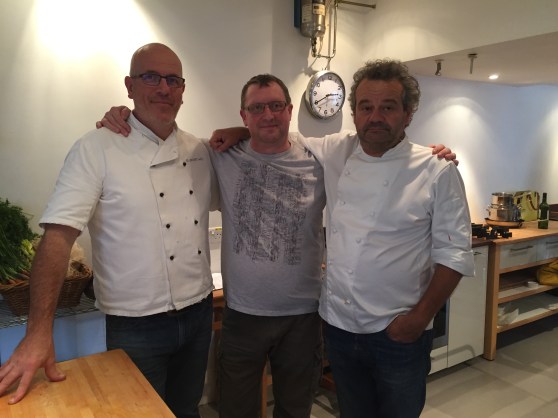
 ‘Does anyone not eat meet’? started the banter as we took advantage of the Sourdough and Brioche toast prepared by Richard Bertinets’ able team, I was back at the Bertinet Cookery School in Bath for the 5th time, it’s VERY good and the range of different guest Chef’s, convivial nature of the location, and limited number of attendees make for an excellent experience. Mark Hix was our tutor for the day and everyone was bubbling with excitement as to what we were going to cook.
 After a demonstration of handling Partridge, removing the legs, taking the crown off, removing the thighbone from the legs and starting a game broth we quickly prepared the ‘Far Breton’, an amazing dessert made with Prunes steeped in spiced Rum, a speciality of Normandy.
 Dessert done, we focussed on the rest of what was going to be a very special lunch for us all. Mark explained his philosophy of using everything in his cooking method, and providing some fascinating facts as to how much produce that could be used to good effect, ends on the scrap heap.
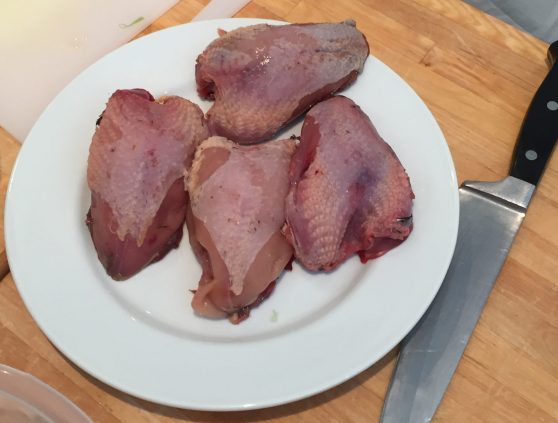 Having had the demonstration earlier it was now our turn to prepare the partridge, Mark gave us a quick repeat of the process again and we all set to the task in hand, slicing and cutting within a few minutes we all proudly had our crowns prepared and more flavour in the Broth pot.
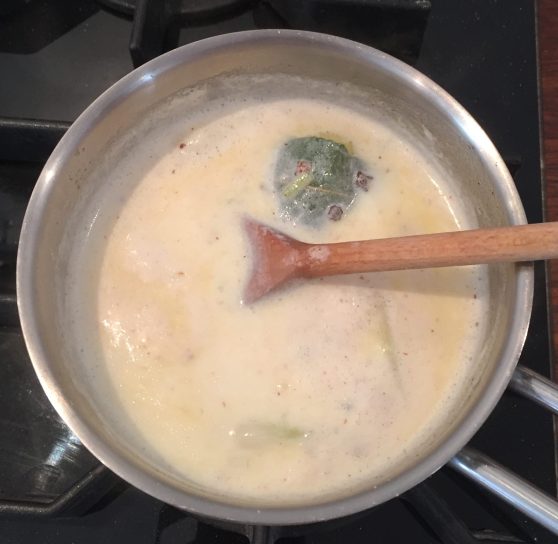 Our Roasted Partridge was going to sit on ‘Yorkshire Toast’. You will have to go on the course and hope Mark shows you how to prepare it, think of Bread Sauce fried in breadcrumbs! I now have three of his books and the recipe is not in any of them so I feel kind of honoured to have learnt something that is not mainstream, and tastes seriously good.
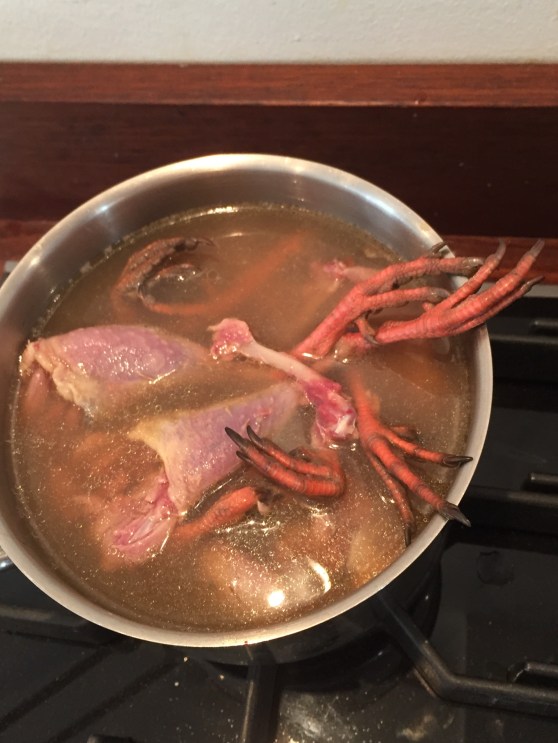 No apologies for some of the pictures, all the processes we went through ensured we wasted nothing and continually added flavour as much as possible. Remember the Partridge legs I mentioned earlier, that we removed and took out the thigh bone. They needed poaching for about 15 minutes so they also went into the Broth pot. They were then going into a mixture of Buttermilk and spices before being floured and frying to crisp up.
 There is always a break or two during the cookery school sessions, and the ‘Bertinet Girls’ produce some amazing delights to whet the tastebuds. As these beauties came out the oven the room filled with the smell of chocolate and fudge, and as we drank Coffee and Tea they were demolished in minutes!
 The Partridge legs cooked and dried, then got the Buttermilk treatment with some added spices. The legs are often ignored or wasted, we were going to have them as a tasty snack, dipped in a Membrillo sauce which we made later in the session.
 Our menu for the day was going to be;
 I didn’t manage to get a ‘pretty’ picture of the Partridge legs as they were gone in seconds, Richard fried them and presented them ‘chef style’ on a plate. Dipped in the Membrillo sauce they were absolutely delish, washed down with some wine which started to flow for those that wanted as we neared dinner.
 As we finished the various courses, the table was prepared for lunch by Richards’ team. He epitomises a ‘convivial’ lunch, long table, wine, and the result is a party like atmosphere despite the fact we had all been on our feet for several hours, listening intently to Marks wisdom as we prepared our gourmet menu.
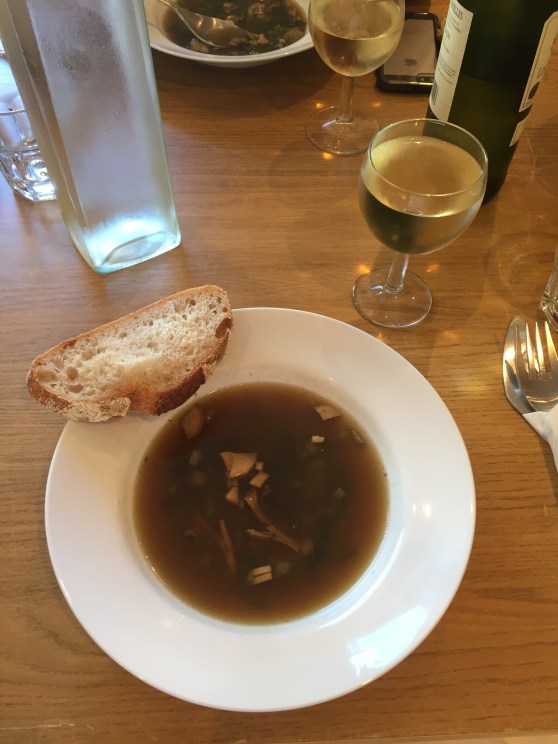 The Partridge broth was completed by adding the ‘garnish’ and served by the lovely team that support Richard, Fionn and Co., who work tirelessly making coffee and tea, cakes and helping clear up and making the day go so smoothly. It was just amazing, full of flavour, texture from the Mushrooms and Celery, and supported by lots of fresh homemade Bertinet bread.
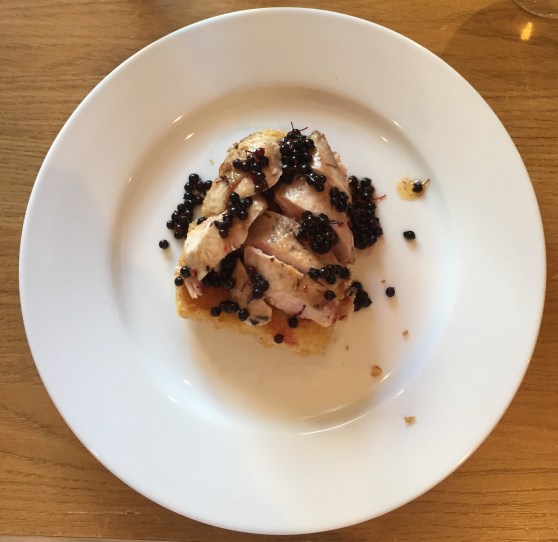 Next was the Partridge on ‘Yorkshire Toast’ with Elderberries. At the start of the day we had a debate on whether Game was popular with the students, several found Game Ok, some not so keen and part of the experience was to prove that when cooked properly, it was delightful. Guess what? It was Bl@@dy delicious both succulent and tender, lovely flavour and enhanced by the Yorkshire Toast and Elderberries, we all complemented the Chefs in the kitchen and patted ourselves on the back, the party was in full swing.
 I need to start this quick blog with an apology! Some time ago (last year), the lovely people at Steenbergs sent me a sample box which included a small jar of
 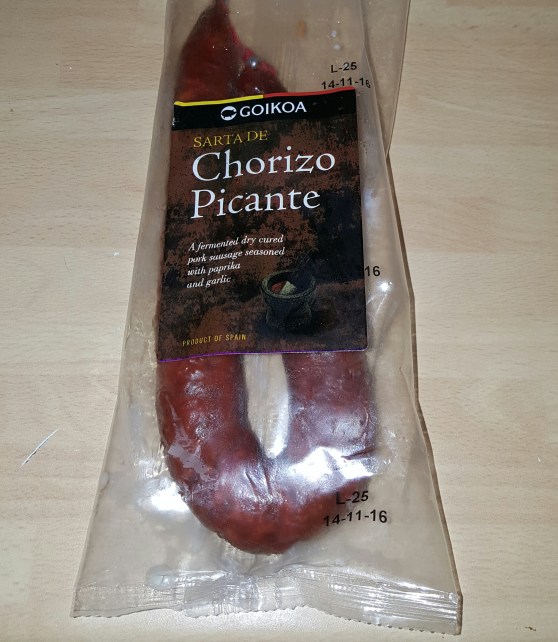 So the 1st stage (for me), was to get some Olive Oil into a pan and start to fry the
 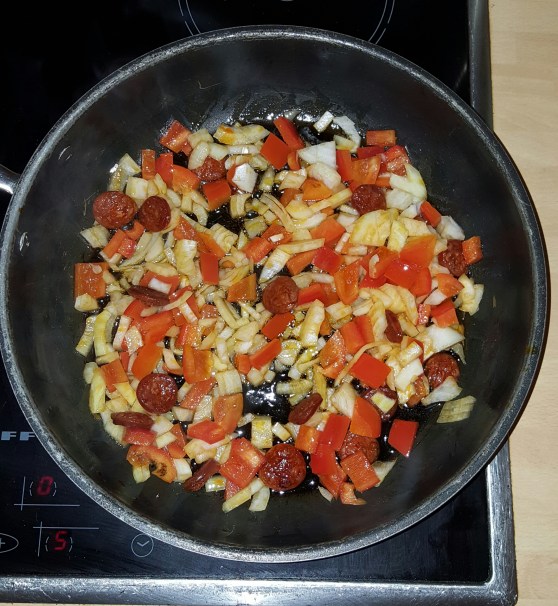 Now add the chopped Pepper and fry for a couple of minutes then the Onion. You can see the Red Chorizo flavour doing its stuff on the Onions above. You want to soften things so allow about 5 – 8 minutes for this stage on a medium heat. The next few stages (in my humble opinion), are where you need to take a lot of care with the timing.
 For me, the knack with this dish is to make sure each element is cooked to its best, but nothing is overcooked, we have Chicken, Prawns and Rice which all cook for different times to get right and so some thought needs to go into what we do and when.
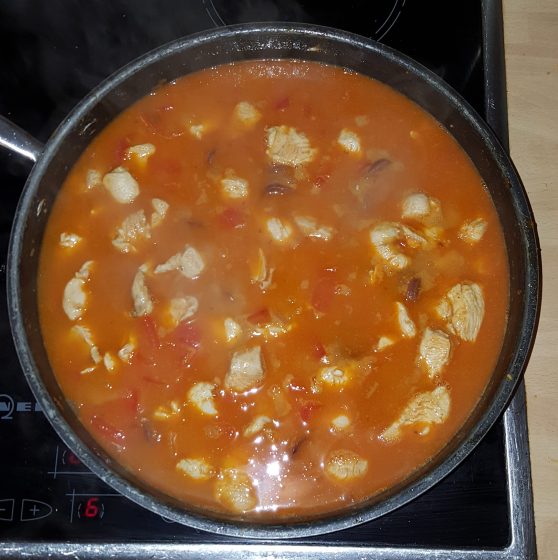 Now add the Rice, stir a bit, then add the Chicken Stock and mix again. Check for seasoning at this point, mine needed some more salt, taste again and check it’s right. DON’T mix anymore from now on. We want to be as original as possible, apparently the finished dish should have ‘holes’ in the surface and a crispy base (I didn’t manage this and suspect I could have used a higher heat), stirring will prevent this from happening and you could end up with mushy Rice.
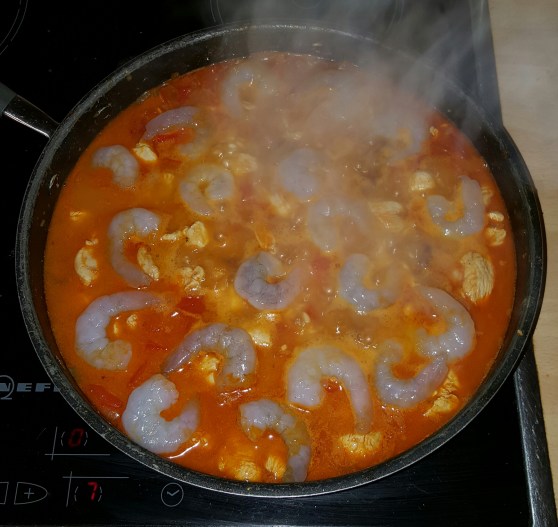 Finally, add the prawns and push them down slightly so they are as covered as much as possible, the heat needs to be reduced to a medium simmer at this point so the Rice can ‘sponge’ up the stock and other flavours, if you remember the Rice only needed 18 minutes to cook so at this point, I needed another 14 minutes for the dish to be ready.
 When the 14 minutes is up turn off the heat, cover the dish with tea towels and leave for another 5 minutes and get your plates etc. ready. You can see the final results above, I forgot to take a ‘piccy’ of the plated results as it was just too tasty to leave alone!!
 Julian Rolfe