Orecchiette, Braciole and Limoncello – Day One at the Masseria Montenapoleone

After a good nights sleep, I was ready for breakfast.

On arriving at the separate breakfast dinning room which is part of the main building I opted to sit outside on long sharing table (I love this option).  There was a selection of fresh juices including melon, orange and pear.  Fresh croissants, pastries, tarts, homemade compote (I had the mandarin which was awesome). Nearly all the food came from the farm.

Giuliano was excellent again explaining some of the more unusual fruits that grow as the Masseria, especially one called loquat or Japanese Plum. Its like an small oval light orange fruit with a couple of seeds. When peeled it has a soft texture like pear and is light in flavour but slightly tart, which really made your mouth water. During our conversation Giuliano explained that the fruit turns black after a few days and they were going to have a go at making a jam from them. There was also home made cheese, and also fresh eggs, the best bit was NO FULL ENGLISH, yippee.

After breakfast I had some free time to relax before the 1st cooking lesson, so took time to wander around part of the farm. Beforehand, Giuliano explained about how the Masseria had been purchased 9 years ago after 45 years of neglect, and pointed out the different areas and their crops. We were stood by a ‘wild area’ which supported the most fragrant thyme, rosemary and wild rocket. We picked some, brushed off the dust and ate some, more bitter than the farmed stuff we get, but just amazing to be able to taste something so fresh and wild.
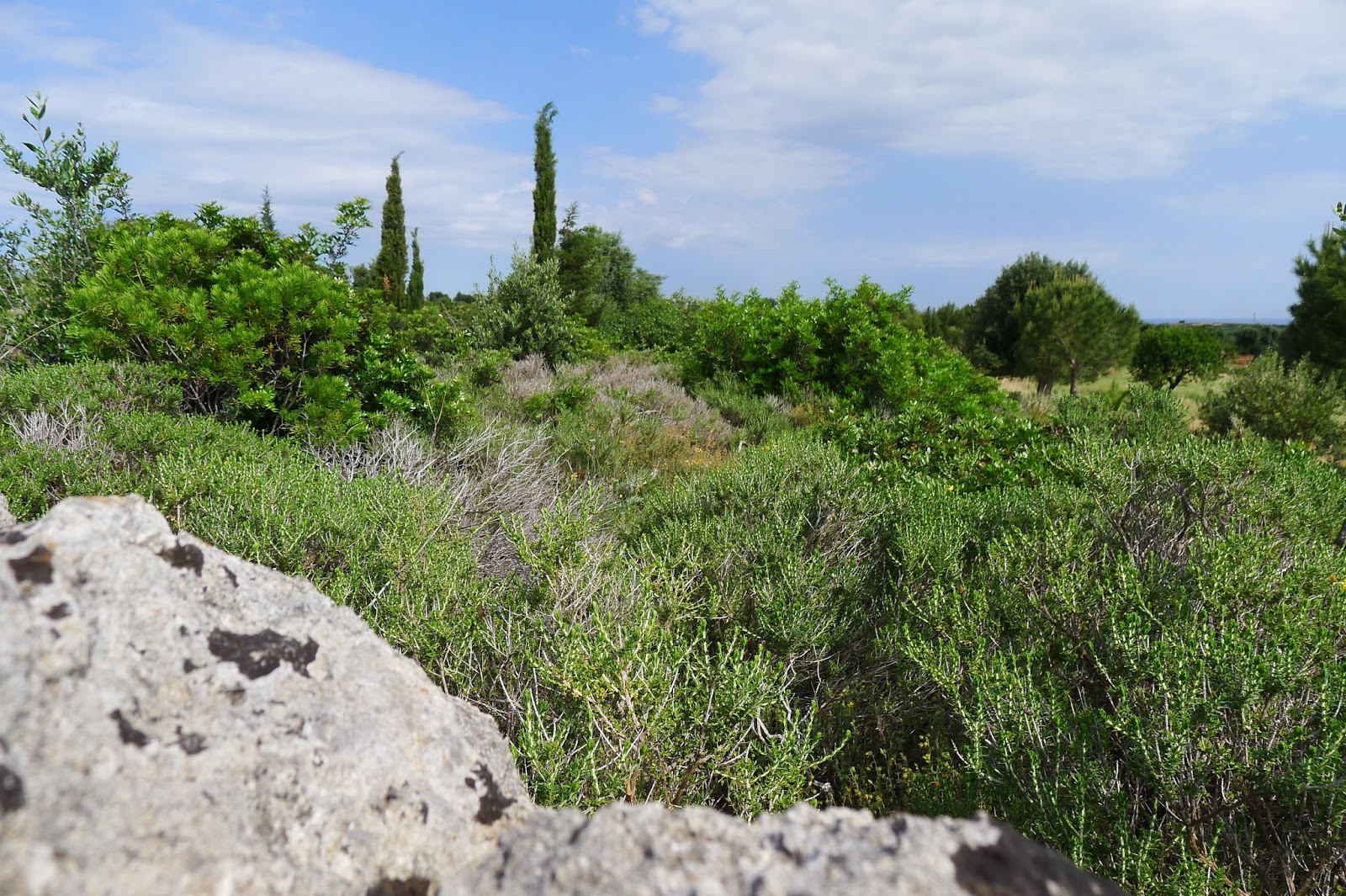
The abundance of Poppy is purposeful in Organic culture and is used as an insect magnet to draw nasties away from the ‘real’ plants, in this case the special grapes that are being grown to recreate a unique wine.

I walked for nearly and hour, and observed everything from Almond Tree’s to Figs.

At 11:00 o’clock I was met by Giuliano, Angelo and my tutor Anna-Rita for the start of the course, I was the only guest attending as its early in the season so I was in for a real treat as they had prepared a bespoke course just for me.
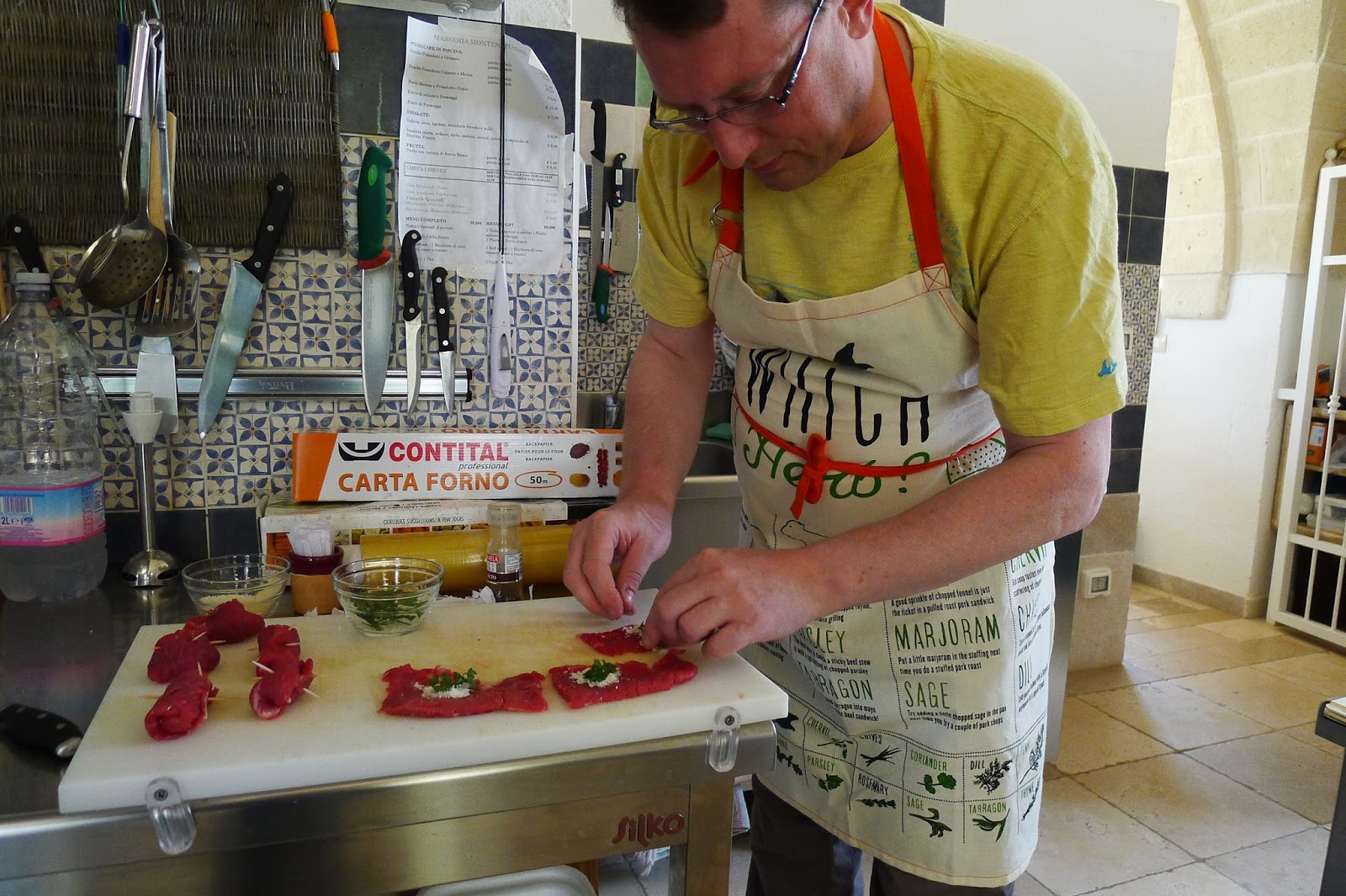
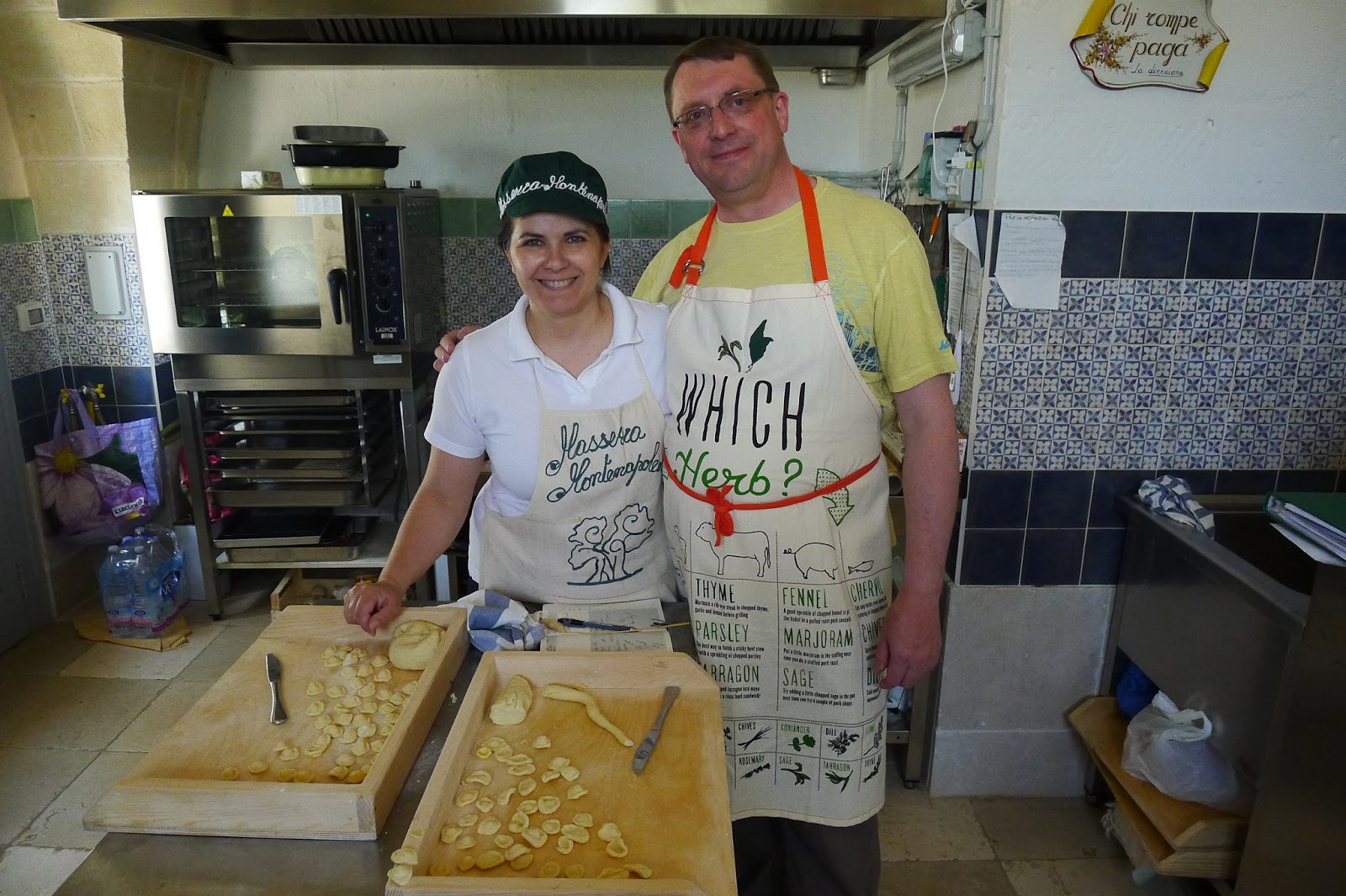
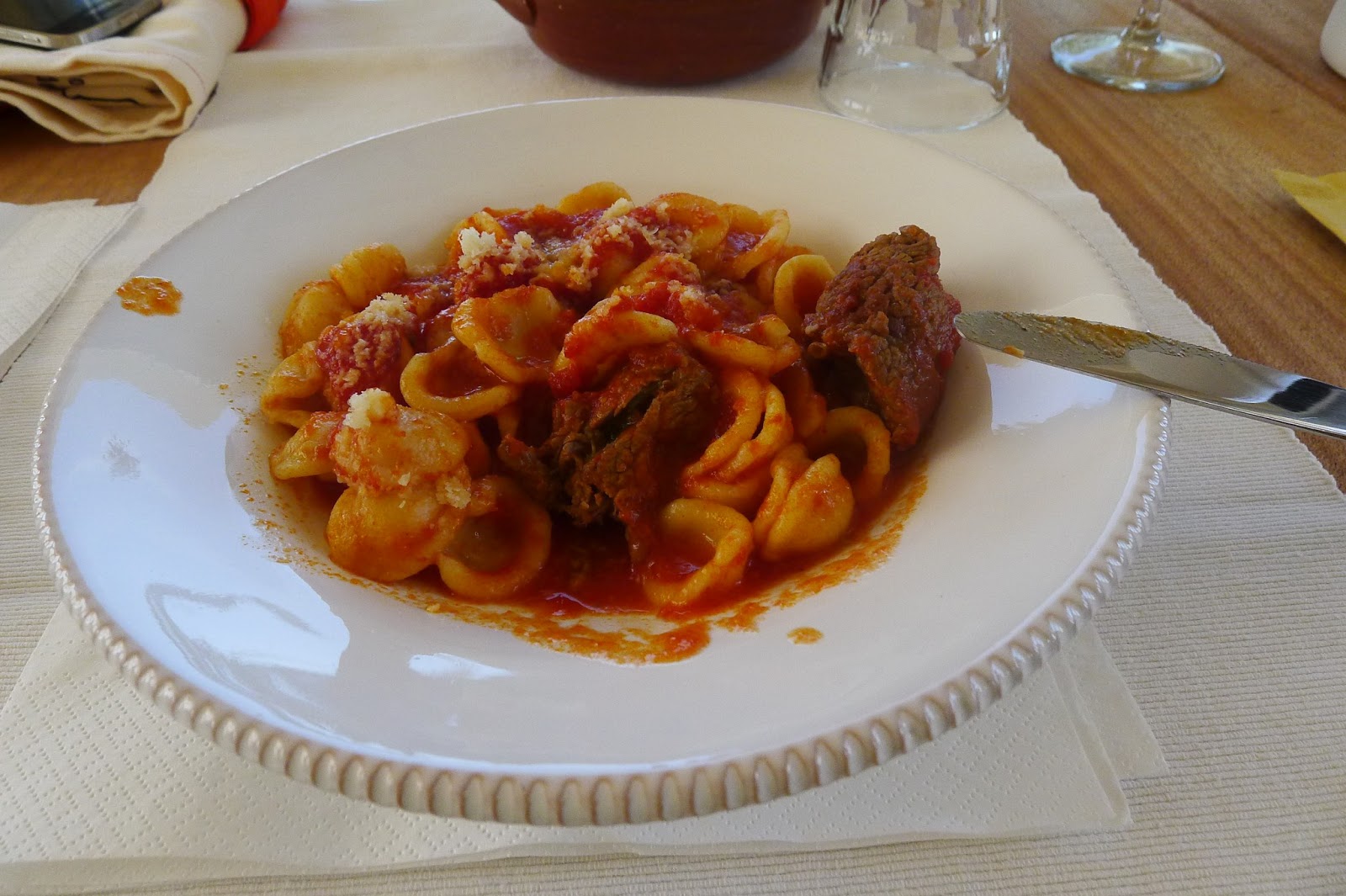
This morning we were making Orecchiette, a pasta made from Semolina and Warm Salty Water and shaped like a hat, a tomato sauce for the Braciola/Orecchiette , Braciola (Stuffed Veal), A Lemon Tart and Limoncello.

I was shown all the different stage and had my own area where I could observe and practice, there is a real skill in shaping the Orecchiette, book the cooking holiday to find out!

We went into the garden and picked the most amazing lemons fresh of the tree’s for the tart and Limoncello, the skins were quite thick and Giuliano made a simple salad, removing the center and dressing the skin/pith with Olive Oil, it was just unbelievably tasty.
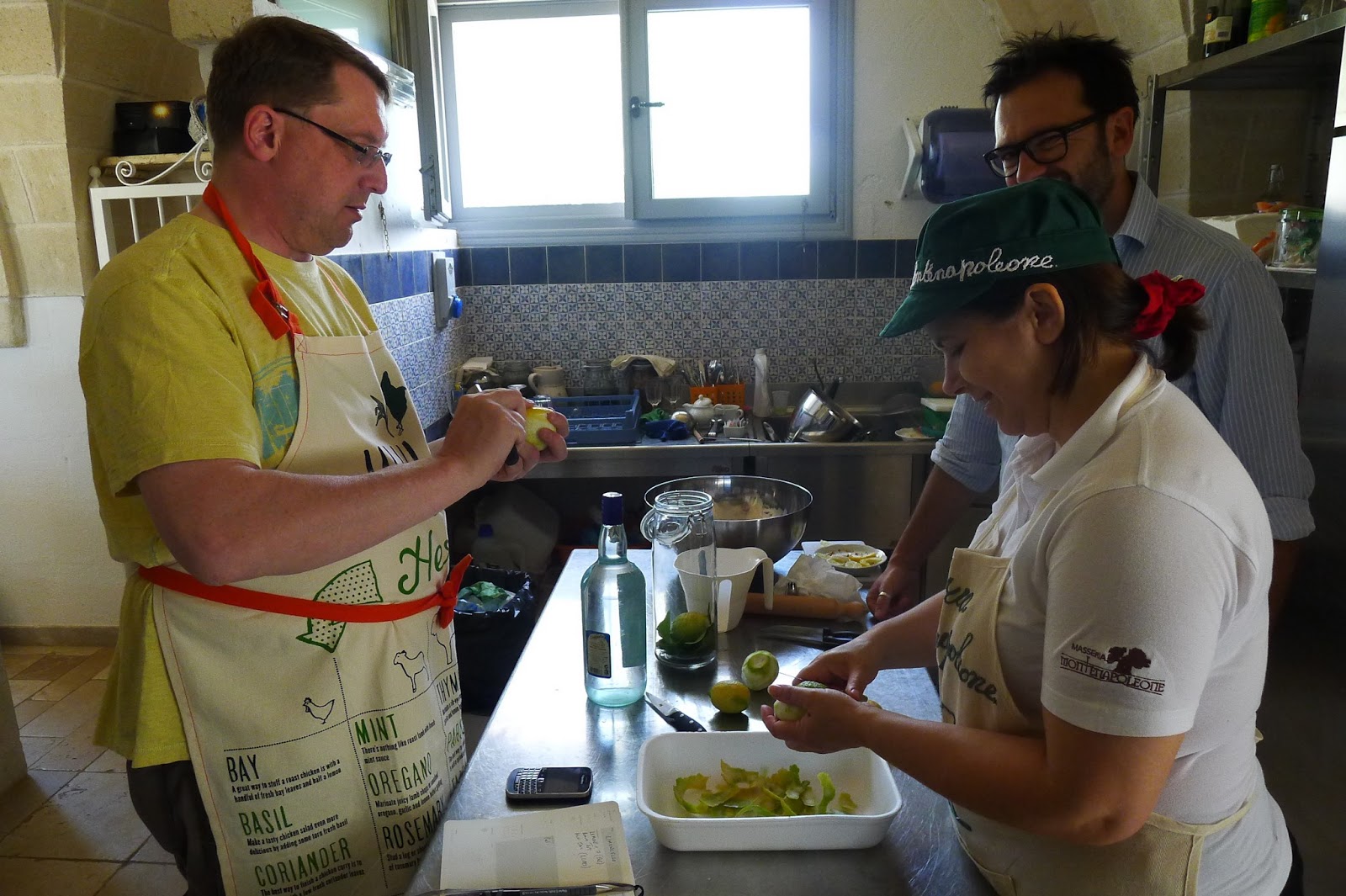
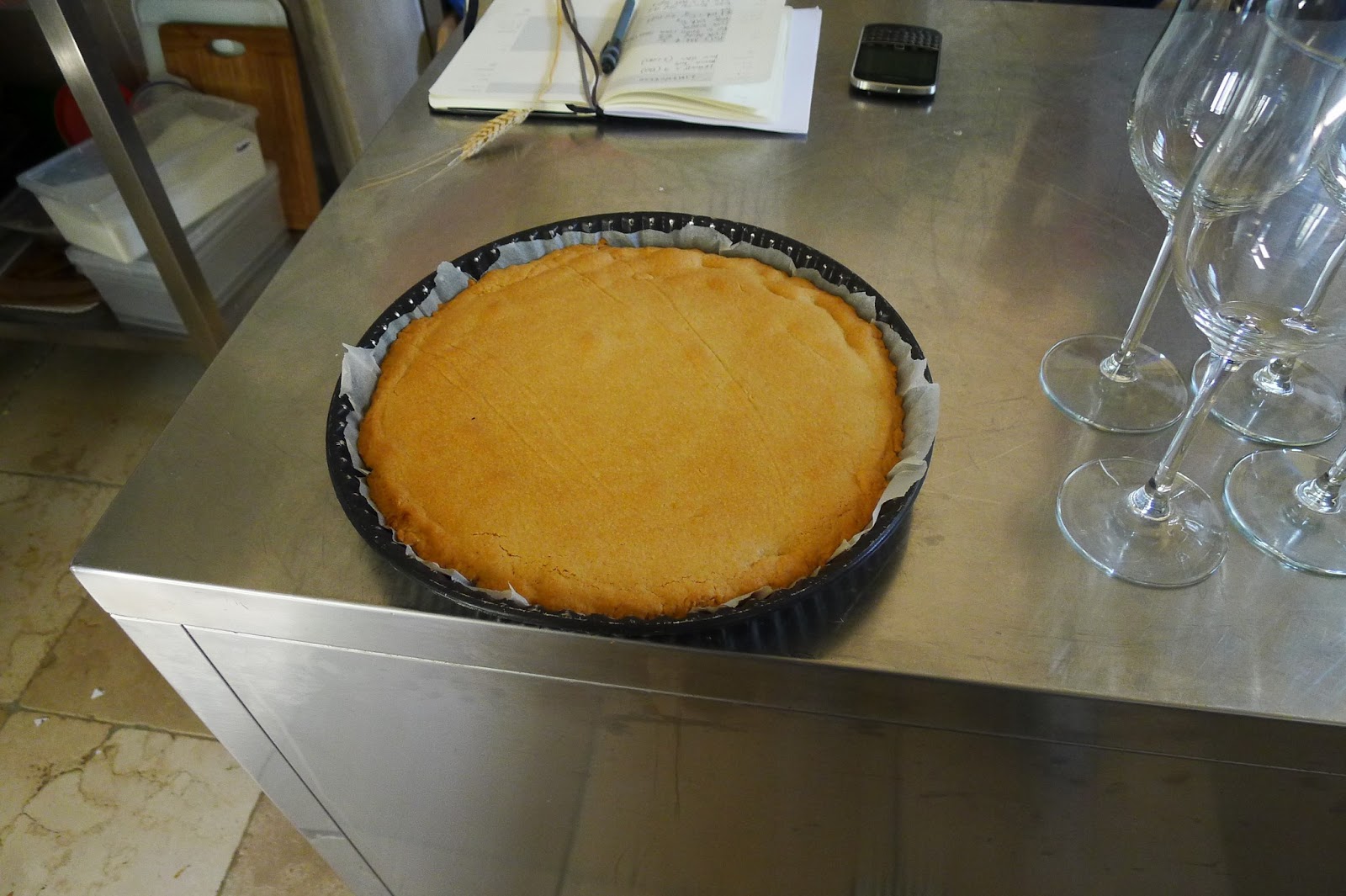
The Tart was served in squares, still warm and dusted with icing sugar and a caramelized lemon slice in sugar syrup. The pastry was of the sweet variety, but with added yeast that gave it a light airy texture. We peeled the skins for the Limoncello, and added some of the leaves from the tree’s which add some colour. 95% proof alcohol is added to the skins and its left in a sealed jar for two weeks IN THE DARK. After, its filtered at least twice before added a sugar syrup solution to temper the alcohol.
Orecchiette with Braciola and tomato sauce. We sat down and Giulians’s brother and mum and the receptionist joined us for lunch. It was a real pleasure to be able to learn some new skills and have some conversation about Puglia and the Masseria Montenapoleone.  I am off to Alberobello later today, a UNESCO site famous for Truillo, dome shaped houses. We are also visiting a Wine Museum and doing some tasting, and then for dinner at Braceria Fasano. 
Buona Salute

Masseria Montenapoleone – Heaven In the Middle of Nowhere

It was early December and I was really depressed. Work was not going as expected although plans were in place to change things for the better. A suggestion and a weeks pass from the Mrs enabled me to book an 8 day cookery course at Masseria Montenapoleone, a restored fortified organic farm in Pezze di Grecco, southern Italy. Flights were arranged online with AlItalia, via Milan on the out trip and Rome on the way back. There were other airlines available that went direct, but my choice was worth it as the leg room on the A320 was first class.

The course was booked via golearnto, and is a combination of practical lessons, and ‘foodie’ trips to local restaurants, producers and markets. On arrival at Bari airport, local to the Masseria, I was greeted by my ‘driver’ Angelo who sped us to the Masseria in about 45 minutes. Angelo manages a local restaurant and filled me in with local history on the way.

OMG, was an amazing place. This is NOT a tourist destination, it has charm, tranquility, and is set in the middle of nowhere, just what I needed. I was met by the local ‘agent’ Maura, who had been in contact via email since the booking, to make sure I was collected at the right time.We went to reception to collect the keys and I was taken to my ‘apartment’ Arancio, and told about breakfast arrangements and given a general tour.

We then sat down by the pool and was served Prosecco, and some local nibbles including the largest capers I have ever seen, olives and a small bread like coiled snake called Taralli. Giuliano is the owner and he joined us for over an hour,  to explain the history of the Masseria, and answer any questions I had about farming, organic systems and agro-tourism in general.

Dinner was set for 8 pm, what an experience. Local cured meats and cheese for the 1st course with home made chutneys, the onion was particular good. Followed by a beautiful home made pasta, with a green pepper and cream sauce, then another plate with shaved fennel, carrot, melon all organic and tasted wonderful. I was sat on a large communial table with an English couple and their 6 month old daughter as we ate and talked about the Masseria food and wine. Giuliano is an amazing host, he joined us for a while and continued to explain his philosophy and about his love for food and wine.

Dessert was a beautiful selection of fruits, grown on the farm, followed by tea and a glass of Grappa that I could not resist.

So off to bed, and looking forward to the 1st day.  Arrividerci for now.

Fussy about meat!

There is much excitement abound at the moment. This time next week I will be on the way to the province of Bari in Apulia staying in the town of Pezze Di Grecco at Masseria Montenapoleone. The reason for this trip is a 8 day cooking course on an organic fortified or walled farm. I hope to post some blogs of my attempts at the end of each day if time allows!

My wife of 25+ years is not a fussy eater, but we both share a view (that we have recently proven on numerous occasions), that buying meat from a decent local supplier is both cheaper, and better.  Having tried a range of protein from beef, lamb to chicken and bacon we are really lucky to have found such an excellent supplier in Casey Fields Farm Shop. A trip this weekend after the boss said she fancied something of a treat and the following was the result!


Côte de bœuf

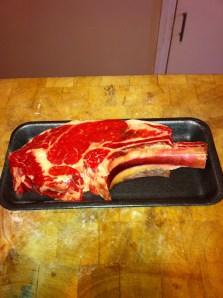
Côte de bœuf for us is THE best cut of meat from the humble cow. A slice of RIB, bone in weighing about 650 Grams is a serious piece of beef, and cooking it right was going to be a challenge. Looking through various books and the trusty (sometimes) Internet there were various methods and timings. We like our beef rare to medium, cooked on the outside, but pink in the middle, so this is what I did.

Switch on your oven and set to 200 Deg C (Ours is a fan oven so would be 220 on gas/electric).

With some butchers string, tie a loop around the longest part of the joint, then, bring the string back round and put a couple of loops over and under. You can see the starting point on the picture above, when the rib is on the top right, with the two loops towards the bottom left.

Heat your frying pain, and add about 125 Grams of unsalted butter, and a good glug of oil (to prevent the butter burning). I fried the Côte de bœuf for two minutes at a high heat (8 on a NEFF Induction Hob). You can see the result below.

Turn the Côte de bœuf over and fry for another 2 minutes. The meat was about 1 1/2 inches thick, and once the frying stage was completed, I added 4-5 sprigs of fresh thyme and the meat then went into the oven for 15 minutes. If you have a double oven, put in a plate and warm to 90 deg, this is used for resting the meat.

After 15 minutes has passed, take out the joint, and put on the warm plate, and into the cooler oven to rest for 10 Minutes. 


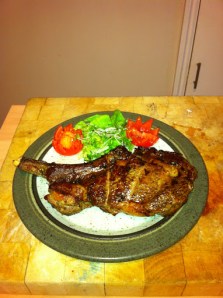
Job Done, Côte de bœuf, with a salad garnish.  The result was WoW, not a cheap cut of meat but you don’t need anything to go with it, except maybe some Bearnaise sauce. The meat still pink in the middle, and was really tender due to the resting. When you are told “its the best steak I have ever had”, it made me smile inside 😉

Please go and try to find that local butcher or abattoir and get a real taste of food and at the same time, support the small producers who need that extra bit of help to survive, but bring you the best and usually cheaper produce without the middle man taking an un-necessary cut.

चटणी, ചമ്മന്തി or To Lick!

Firstly a big thank-you to all my visitors, since staring this blog in February I have had over 270 people view these pages, from America, to Russia, Germany and Spain.
 

Family and friends that I have shared much time with know I have a couple of addictions (of the food variety!), Sausages and Cheese!

As a child, I would regularly scoff down some cheese and biscuits, usually with a large glass of milk, at ridiculous times of the evening. The taste for sausages developed slightly later in life, if you can get good ones that is, the usual suspects still seem to have horrible casings even though quoted as natural!

Now I am a bit(!) older I have become much more fussy about where I get my favourites. In my own mind, there is only one place to buy sausages, I have been using Gardeners of Ludgershall for over 10 years, its a trip worth taking, they have won over 120 national and international awards for their sausages. For Cheese, Greys of Pangborne offer a quality a range unsurpassed for miles around.

With age I think tastes do develop and get refined, the well known Pickles are OK, but for me, having a go at home made makes things more interesting. 

The heading of this entry is about………………….Chutney!

The word “chutney” is derived from the Sanskrit word caṭnī, meaning to lick. When munching a Gardeners Championship Pork sausage, or Lincoln Poacher cheese from Greys a decent chutney or pickle can make a big difference.

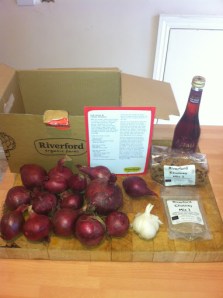
Our well loved organic veg box supplier Riverford promoted a Red Onion and Sultana Chutney kit last week, so I ordered one to have a go.

Chop up loads of red onion, my mandolin did that as quick as a flash (with parental assistance), slowly fry to soften, add some of the sugar and continue, then add the vinegar, garlic spices and cook on a low heat to evaporate most of the moisture.

Mine looked like this after a 1 1/2 hours of slow bubbling, it filled the house with lovely smells. So there you have it, a tasty accompaniment to go with your favourite ham, cheese or sausages.  This made 5 jars which should last a few months (hopefully)!

 If you like good cheese, quality ham or sausages, have a go at making some chutney as it’s really easy and the results are fab.

Forme of Cury – Crustardes Of Flessh

So, what is this all about, old language and confusing to say the least!
The weather has been getting warmer, interspersed with rain! With a sudden rise in temperature, the humble salad becomes one of my favourite things to eat. It was a family tradition, every sunday evening after having a roast for lunch, to have a salad in the evening, often served with bread and dripping fresh from the lunchtime roast beef, yumm!
The Forme of Cury (Forms of Cooking, cury being from French cuire) is an extensive recipe collection of the 14th century. Its authors are given as “the chief Master Cooks of King Richard II. Contained within are 205 recipes such as :

CRUSTARDES OF FLESSH. XX.VII. XIIII.

Take peiouns, chykens, and smale briddes smyte hem in gobettes.& seeþ hem alle ifere in god broþ wiþ veriaws do þerto safroun, make a crust in a trape. and pynche it. & cowche þe flessh þerinne. & cast þerinne Raisouns coraunce. powdour douce and salt. breke ayrenn and wryng hem thurgh a cloth & swyng þe sewe of þe stewe þerwith and helde it uppon the flessh. couere it & bake it wel. and serue it forth.
You can find the complete book here !
So, I was thinking about salad and what to have with it, and the humble Quiche, actually german in origin sprung to mind. Quiche Lorraine is partly referenced in the ‘Forme of Cury’ Crustardes being pastry or bread lined tarts with an egg custard filling.
I fancied some original Quiche (Bacon, Eggs, Cream), so set about making the pastry ala Rachel Khoo, simplicity itself, soft butter, mixed with flour sugar and salt, mix for as little as possible, chuck in a couple of eggs and a spoonful or two of ice cold water and bring together. Stick it in the fridge and its good to go in an hour!
 
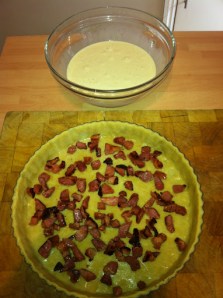
I was in a well known super market the other day, and they were charging £2.99 for the smallest packet of lardons, which did not look that great. I got mine from my favourite meat supplier Casey Fields Farm Shop in Ashamstead. I got six times the weight for the same price and the quality was awesome. You can see them above, waiting for the egg and double cream mixture.
I followed Rachel’s receipe and you can see the results for yourself, it took about 15 mins to make the Quiche (excluding resting/cooking time) and it tastes fab (its nearly all gone within 24 hours of baking!).
 
You can see a video how Rachel Khoo makes the quiche herealong with the rest of the receipe. Considering the time taken, size of the finished quiche its quicker to make than go to the supermarket and find a dodgy one on the shelf, and it tastes seriously good if you can find half decent lardons or bacon.
I urge you to  have a go, its simple, quick and well worth it.

Jane Austin, Good Friday & The Chelsea Bun!

One of my lasting childhood memories was the tradition of home baked Chelsea Buns at Easter, so guess its my turn to pass onto the next generation and have a go myself.

Doing some research, it seems in Jane Austin’s time, the Chelsea Bun was a favourite treat and if you were lucky enough to live in London, ‘The Bun House’ was the place to go as they were apparently invented at this fine establishment, with crowds of 1000’s milling outside waiting to purchase some.

Looking for a suitable recipe I turned to The Great British Book of Baking. There are some lovely recipes in this book and particularly one for Chelsea Buns. So where is my Kenwood Chef?

The Chelsea Bun is a simple rolled dough, risen with yeast and filled with dried fruit and spices. Tradition seems to suggest early versions used Lemon Peel, cinnamon and spices to provide a nice sweet spicy flavour. Brushed with cold water and sugar, a sticky glaze covers the top.
I allowed an hour for rising, parking the bowl by our open fire to provide some needed warmth, its rather cold for this time of year! Thinking of the lemon peel, I also decided to soak the dried fruit in some lemon juice as an experiment, and added a decent quantity of mixed spice too.
On the cooling rack!

The dough is left to rise once rolled, and layered with the fruit and sugar, after brushing with melted butter to act as a glue. Cut into strips and placed into a suitable baking tray for a second rise and then into the oven for baking.

About 5 minutes before the end, brush with a mixture of honey, castor sugar and milk, i decided to replace the milk with lemon juice to add a bit of zing.
They are truly delicious and worth the effort, and you know what has gone into making them, they look home made and no artificial’s in this recipe.
Happy Easter everyone……

The Barber of Seville

We’ve just come back from a week in Cyprus, 20 degrees and a quite a lot of sun was just what the doctor ordered. A week’s indulgence in a family orientated all-inclusive holiday was a fantastic experience, re-charging the batteries and vitamin banks on the freshest tomatoes, peppers, Feta cheese, Swordfish and the usual local delights made you feel really good. I’m proud to say I only had 1 full english breakfast during the week.

Driving around in our hire car was a truly fantastic experience, with the windows open, you could take in the aroma of fresh wild herbs, oranges, lemons and the wonderful smells of smouldering charcoal, used to cook Souvlaki and Sheftalia, a Cypriot skinless sausage.
So back to the UK, and this weeks organic veg box. Being inspired by the fruit trees in Cyprus, and seeing an offer for a “Seville Orange Marmalade” kit I decided to order one, having never made a preserve before and loving the bitter/sweet tang of  this particular variety it was a ‘no brainer’.

The Peel of 1.5kg’s Seville Oranges!
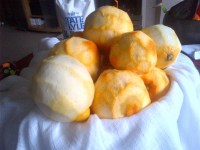
Oranges & 2 Lemons
Almost everything was to hand, except muslin, Google came in and after a few minutes looking at various options, a well known supermarkets baby section provided the desired result, cheaper than a cooking shop and on the shelf!

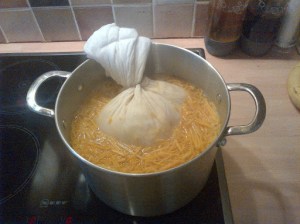
Following the instructions was dead easy, the smell of Orange filled the house during the 2 hours of simmering needed to soften and cook the peel.

After the simmer
    
2 Hours of Simmering with all the bits!
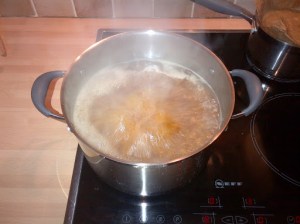
Once you have completed the simmering process you need to rapidly boil the mixture to get the pectin to work and set the marmalade.  As we are ‘au natural’, and using the pectin in the fruit to set the marmalade, we need to check every 15 minutes on a cold plate to see if a skin develops. depending on the fruit, this can take some time. When the setting point is reached, turn the gas off and let stand for 15 minutes removing any scum that may rise the the surface.
Rapid boil to get to a setting point.
Homemade ORGANIC marmalade.
To sterilise the jars, I put them in a cold oven and set the heat to 130 degrees. After 20 mins, I turned the oven off. The lids can be boiled in hot water for a few minutes and then dried, or in my case following the instructions on the Riverford website, once the jars were filled, put on the lids and inverted the jars for 5 minutes. The hot sugary jam does the job for you!
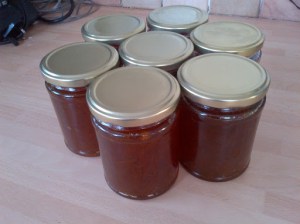
So there we go, a house filled with the aroma’s of orchards and 7 jars of proper organic seville orange marmalade, no artificial colours, flavourings or preservatives, go on have a go!

I am Not Horsing Around!

Se rappellent de la France

With so many stories of horse meat in the press this week, and the weather turning cold again it seemed a good idea to cook something hearty. That mixed with unexpected news, time in the kitchen to escape things was just what the doctor ordered. Some excellent beef from Casey’s Farm Shop (guaranteed to really be beef!), has been marinating for over 24 hours in red wine, cognac, juniper berries and a bay leaf.
This dish is featured in Ripailles, an excellent book written by french chef Stéphane Reynaud.
I love this tome, traditional french food, intertwined with whimsical content, its stretches to 480 pages and really leads you into the french passion for food. This classic Boeuf Bourguignon used veal stock, luckily I had some in the freezer, but your could always use beef stock instead.
Le Boeuf Bourguignon sorted, what to accompany it. 
At the back of Rick Steins French Odyssey, there are over 10 different ways to cook the humble spud. One of my favourites involves using a Persillade, a mix of in this case garlic, parsley and truffle oil.  When added to sliced potatoes cooked in duck fat you have “Pomme Sarladaise” a truly scrumptious and tasty potato dish that’s going alongside Le Boeuf Bourguignon to add some crunchy texture and even more flavour.
To finish things off, green beans with a tomato Concasse and black pepper, tossed in a little butter.

So that’s it, Le Boeuf Bourguignon, Pomme Sarladaise et Hericot Vert, Concassé de tomatoes jeté dans le beurre.

C’est tout, délicieux.

Plenty!

Winter is the time for wholesome stews, curries and stomach lining food.  A recent food hero of mine is Yotam Ottolenghi, his ability to mix unusual ingredients a get a fantastic outcome is truly inspiring. Originally from Israel, he has teamed up with Palestinian Sami Tamimi and opened several eateries in London, as well as writing some excellent cookery books.

When I think of a stew, its usually Beef with Dumplings, a French Daube (preferable Boar if i can get it), or a Belgian Carbonnade. So this Yotam inspired stew really mixes it up with Butternut Squash, utterly delicious. The recipe is here. I am not keen on chick peas so replaced them with green beans for some added texture.

Butternut Squash Stew

It’s really easy to make, and uses mostly store cupboard ingredients, the interesting thing is the use of Madras Curry Powder to add punch!

So what to serve with this tasty dish………………?
Apple and Celeriac Salad with Quinoa,  red onion (soused in white wine vinegar sugar and salt, and rapeseed oil added to make a dressing after its steeped for at least 30 minutes). The addition of coriander and poppy seeds finishes things off nicely. You can find the recipe here.
Apple & Celeriac Salad
I first tried this about a month ago, but apparently according to the family, this time it was better. I used a Mandolin to cut the apple and celeriac this time round, so it was finer, guess that did it. 
The two dishes served together really have a feel good factor, you feel really ‘healthy’ after eating these two, and if like us you are getting over a winter cold really just hits the mark.
Enjoy….