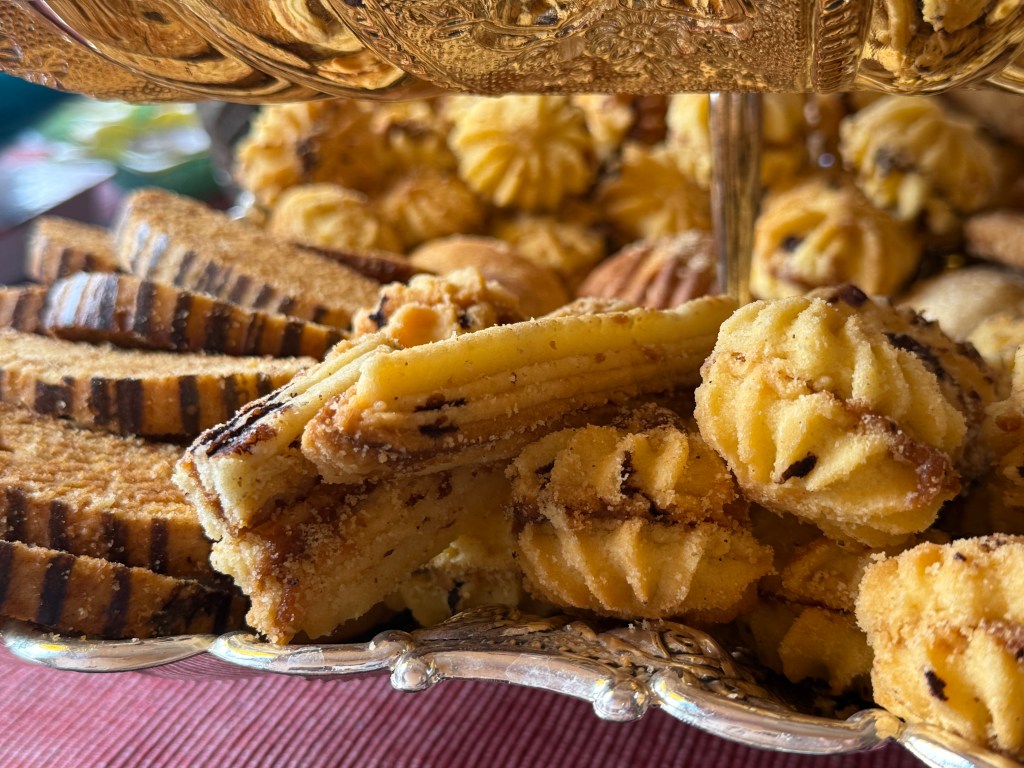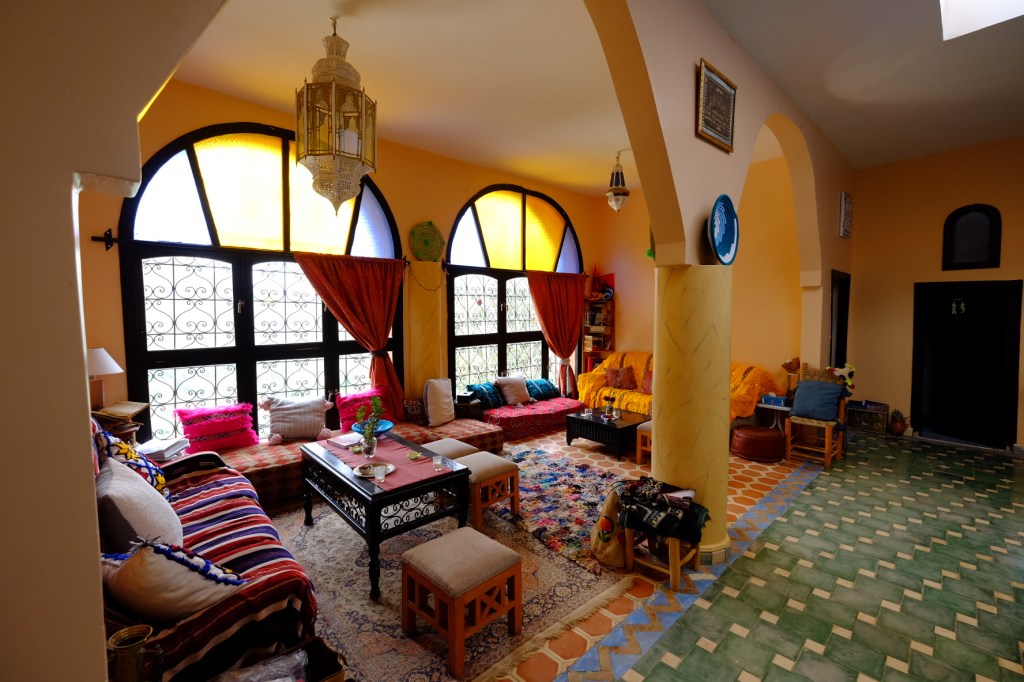
نهار زين طيبنا مع عايلة تونسية في سوسة A Beautiful Day Cooking With a Tunisian Family in Sousse

I rose before dawn, the gentle promise of a Tuesday awakening, the fourth day of my fifth journey to Tunisia – a country whose sun-drenched memories began for me on my twenty-first birthday. While others celebrated with fleeting parties and the haze of hangovers, I chose a week wrapped in the golden warmth of 27 to 30 degrees, wandering timeless corridors beneath El Jem’s ancient arches and tracing cinematic dreams at the Star Wars set at Matmata. There’s a quiet magic here; each return only deepens my fascination for this mystical country.

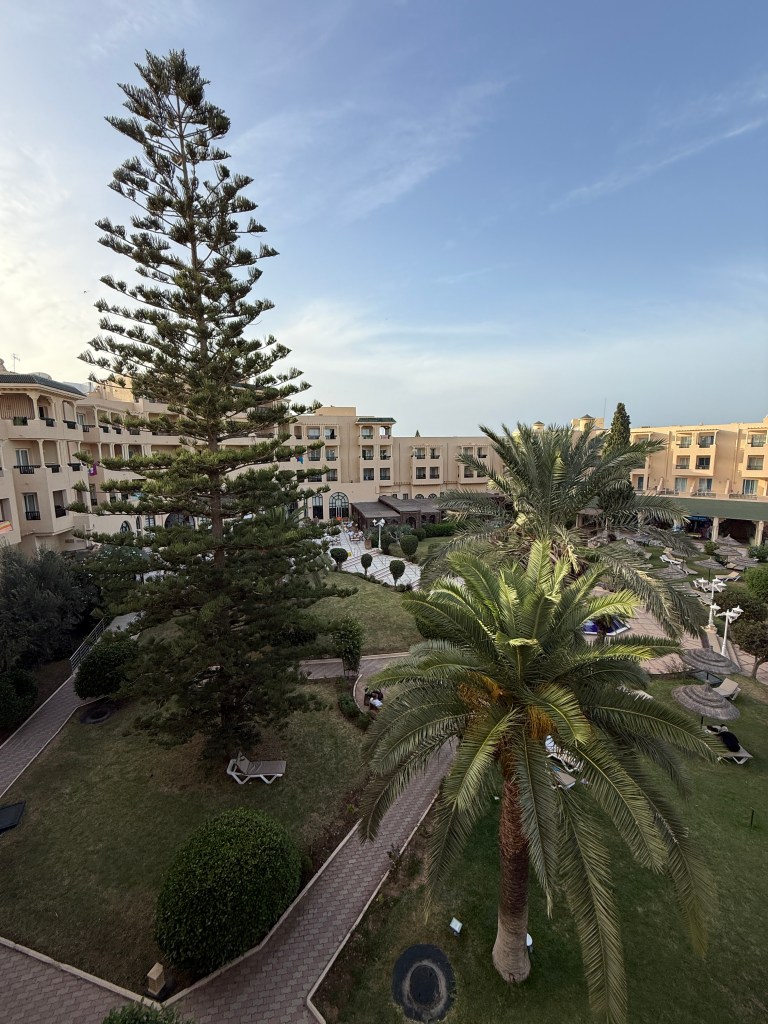
Our hotel was north of Port El Kantaoui, the port had just been completed the 1st time I travelled here nearly 40 years ago, we were staying in Sousse, but visited the port on one of our days out.

Port El Kantaoui, just north of Sousse, stands as one of Tunisia’s most ambitious tourism projects—a meticulously planned resort born from a vision to transform the nation’s appeal for international visitors. Inspired by the allure of Western Mediterranean marinas, its creation in the late 1970s drew on chic Moorish design and an artificial harbour as the centrepiece, instantly setting it apart from the more traditional hospitality found in Sousse’s city centre.

Before Port El Kantaoui, Sousse’s hotels primarily catered to classic beachgoers and travellers eager to soak up local sights, but this integrated resort marked a turning point—ushering in an era of luxury, modern amenities, and a distinctively European flavour in Tunisian tourism. The impact on the region has been profound: not only did it redefine the local hotel scene and create thousands of new tourism jobs, but it also established Sousse as a year-round destination for package holidays and marina lifestyles.

Today, Port El Kantaoui’s elegant streets and bustling quays continue to attract visitors seeking a fusion of North African warmth and Mediterranean sophistication.

I was welcomed by the delightful Nabil at 09:30, with booking and communication made effortless thanks to Tunisian Flavour – a true pleasure from start to finish. My culinary day was private, just for me, although there’s always the option to join a group if that suits your style. As someone whose enthusiasm sometimes overflows, I cherish the chance to immerse myself in tours or classes alone, allowing me to absorb every moment.

After parking, and before we entered the storied lanes of the Medina, I was invited to select the day’s menu from a dazzling list of thirty Tunisian dishes. The decision set the tone for our adventure. Among the offerings was Tajine Malsouka – a much-loved treasure of Tunisian cuisine, reminiscent of a quiche but wrapped in delicate malsouka pastry, crisped to golden perfection and filled with a savoury mixture of chicken, lamb, eggs, cheese, and fresh herbs. Another tempting choice was Nwasser, a cherished Tunisian pasta delicately cut into tiny squares, steamed until perfectly tender, and often served beneath a blanket of succulent chicken in rich tomato sauce, with chickpeas and vibrant vegetables woven through. That lingering moment of selecting my dishes before entering the Medina set a gentle rhythm for the day – one shaped by flavour, tradition, and the warmth of shared experience.

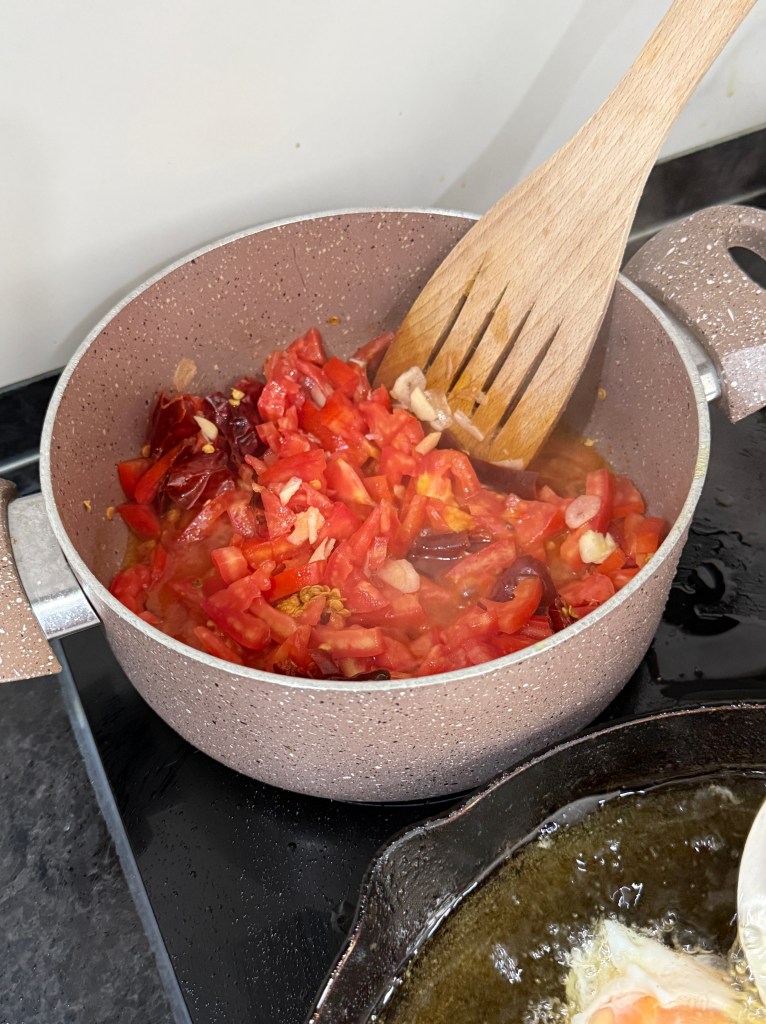
My menu reflected my longing for authenticity. Ojja was to be the star: beloved in Tunisia, this dish features eggs gently poached in a fiery tomato sauce, with green peppers, onions, and plenty of harissa. Most famously paired with merguez sausages, ojja brings together the hearty notes of cumin, paprika, and garlic, bubbling away until perfect for scooping up with crusty bread – a true celebration of Tunisian home cooking.

And because I couldn’t resist, I shared my fondness for brik, the iconic crispy treat I once saw Keith Floyd cook on TV at the El Jem amphitheatre – Nabil kindly offered to show me how to make it a special extra.

For my second choice, I selected Kafteji: a classic Tunisian street food where fried potatoes, tomatoes, peppers, pumpkin, and sometimes zucchini are chopped together, mixed with eggs, and seasoned with cumin, coriander, and a touch of harissa. Served with warm bread, Kafteji is both rustic and comforting – a staple of Tunisian kitchens and snack bars, enjoyed any time of day and loved for its bold, colourful flavours.

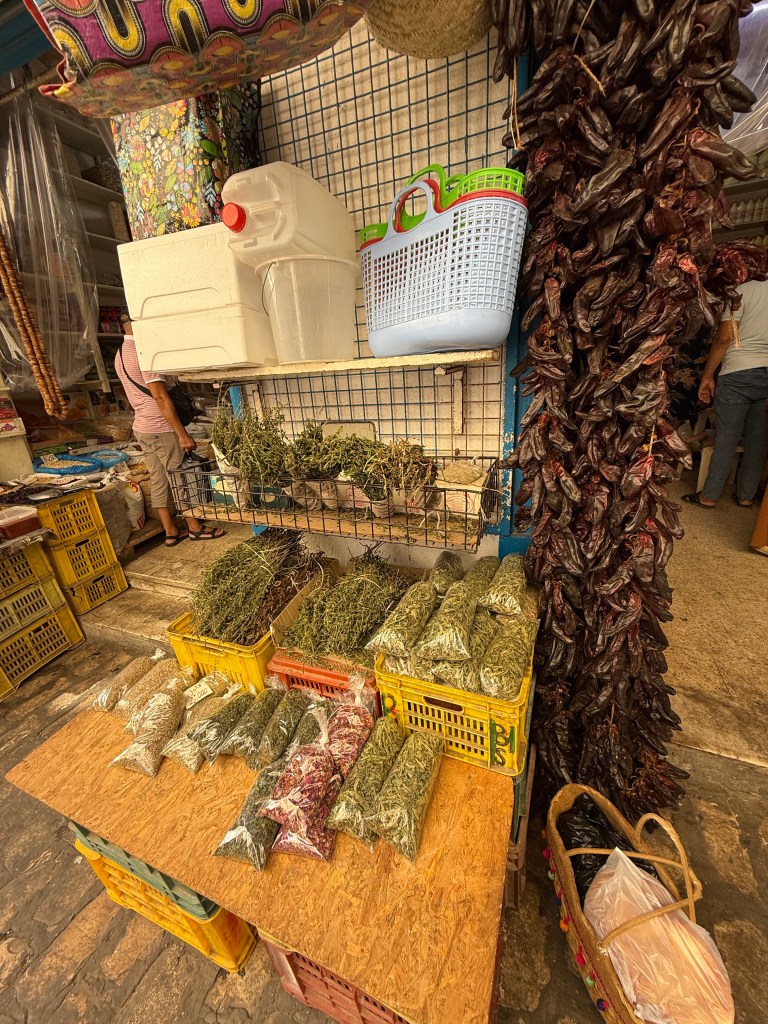
The shopping trip into the heart of the Medina was nothing short of epic. Stepping into a world alive with colour and scent, I found myself surrounded by piles of freshest herbs – dill, mint, coriander, parsley – each leaf and sprig bursting with promise and flavour. Much like my adventures through the hidden corners of Morocco, I purposefully wandered beyond the tourist trail with Nabil to where real life unfolded: bustling market stalls, vendors calling with pride, the air thick with the fragrance of earth and spice.
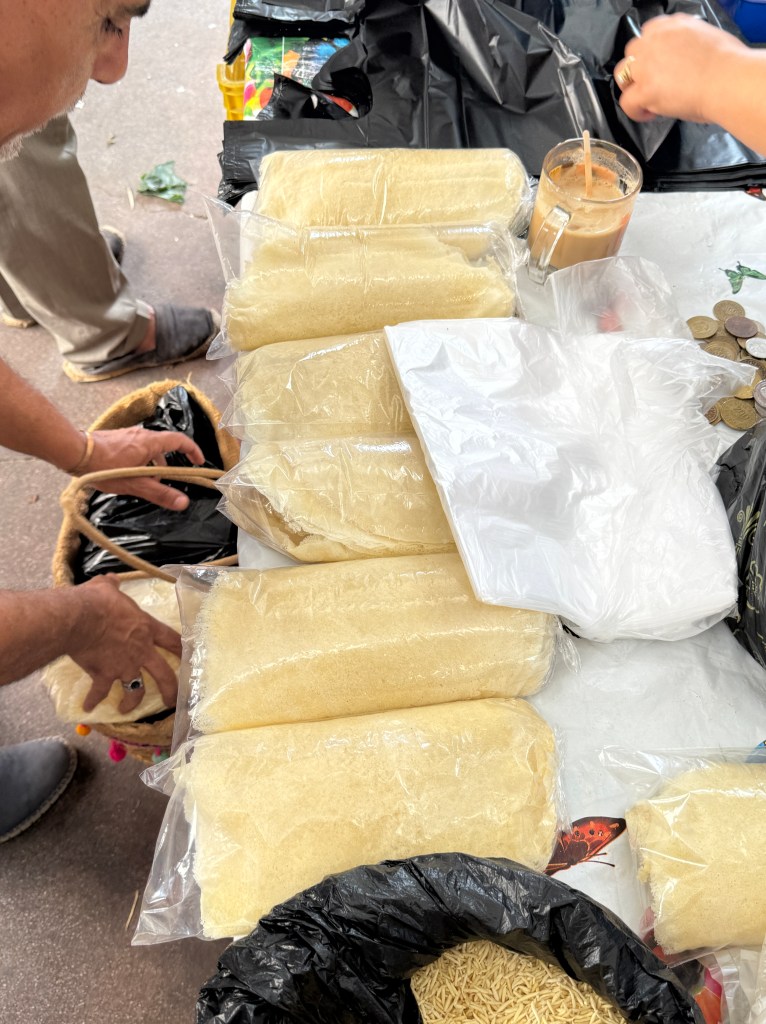
Shopping where locals shop, I revelled in the ritual of tasting, smelling, and with Nabil, carefully selecting ingredients, seeking only the most vibrant and perfect for the dishes ahead. There is an undeniable thrill to browsing food markets – each stall a feast for the senses, every display telling a story. Familiar greens mingled with new discoveries, the market’s energy and abundance filling me with delight. It was just brilliant, the kind of experience that cooks up lifelong memories alongside the day’s recipes.
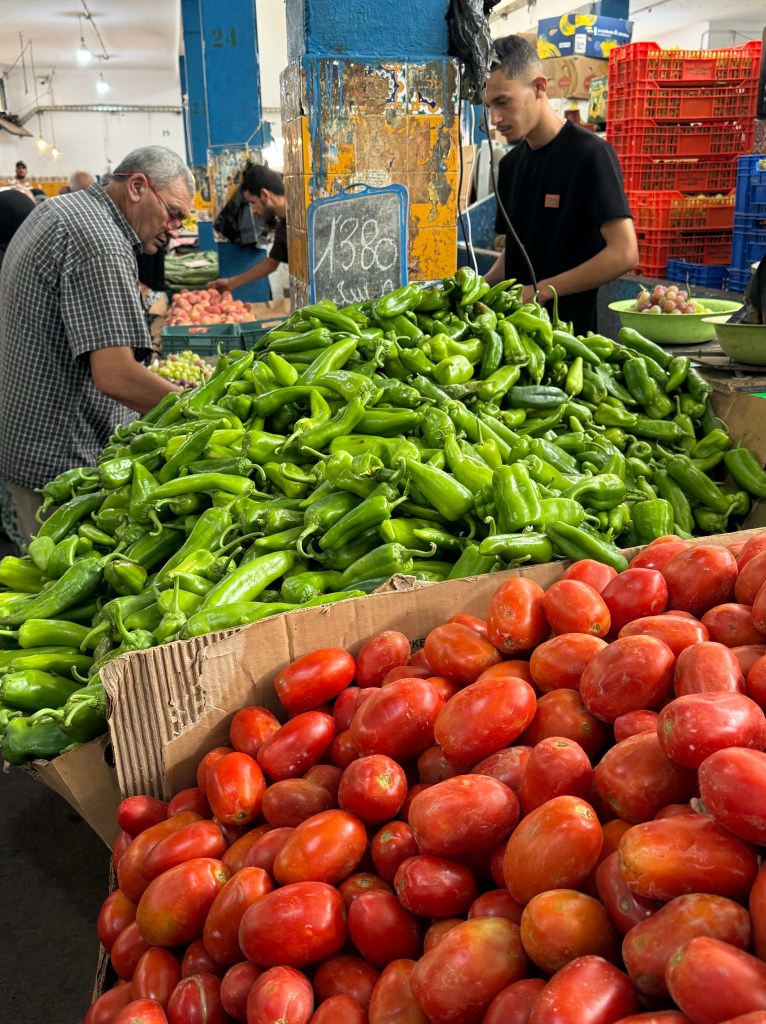
If there is one ingredient that always seems more vibrant and irresistible when travelling, it’s the tomato. Abroad, their sun-ripened sweetness and fragrance surpass anything I’ve tasted at home – I simply cannot get enough. During my stay at the hotel, juicy, crimson tomatoes found their way onto my plate at least twice a day, an essential centrepiece in salads bursting with authentic flavour – so unlike the pale, bland offerings I’ve grown used to back in the U.K.

The market was overflowing with them: plump and glistening, heaped in glorious abundance, the scent hanging thick in the air. Each tomato promised the taste of sunshine and earth, a simple perfection that felt almost impossible to capture outside these travels.

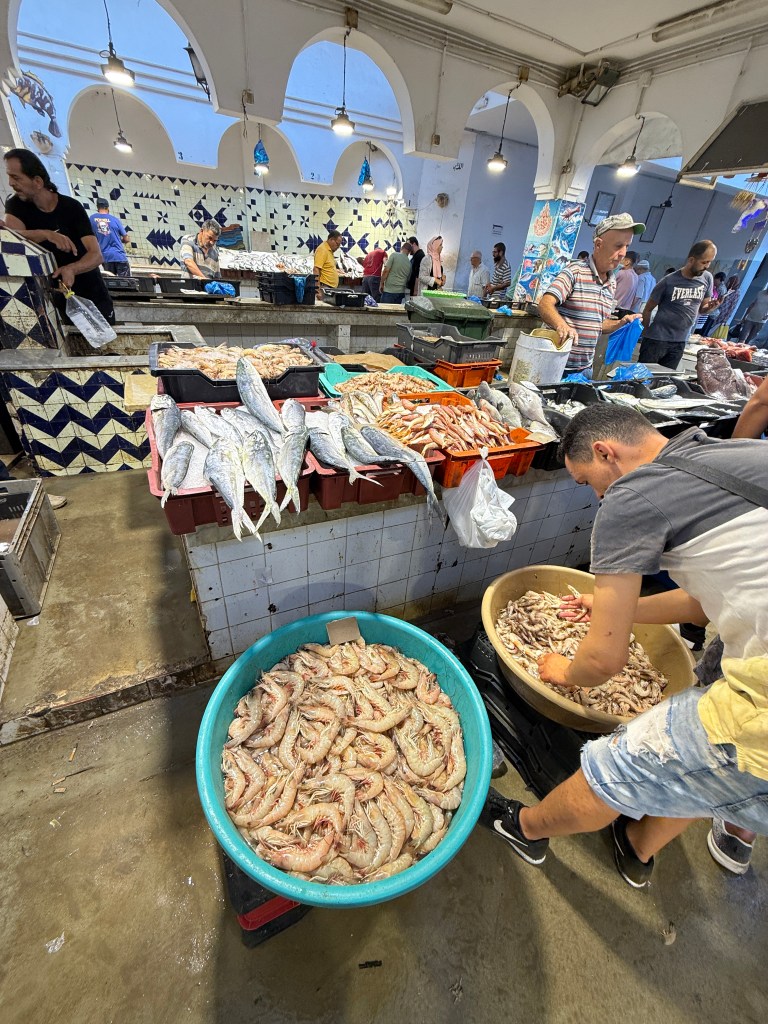
We continued our journey through the winding alleys of the Medina, stopping at vibrant market stalls to gather the day’s essential ingredients. Each pause brought another burst of colour and aroma – bright herbs, fresh vegetables, spices so fragrant they lingered in the air. The rhythm of local life pulsed around us, every purchase infused with intention and excitement for the cooking to come.

After the market, we retraced our steps to the car, our bags now heavy with promise. Yet the adventure wasn’t done: on the way to Nabil’s home, we visited a delightful series of specialist shops, each one a treasure trove in its own right. There, we picked up freshly made harissa, fiery and aromatic, plump merguez sausages, and glistening olives. These final, carefully chosen ingredients would tie the meal together, their flavours echoing the spirit of Tunisia – generous, bold, and unforgettable.
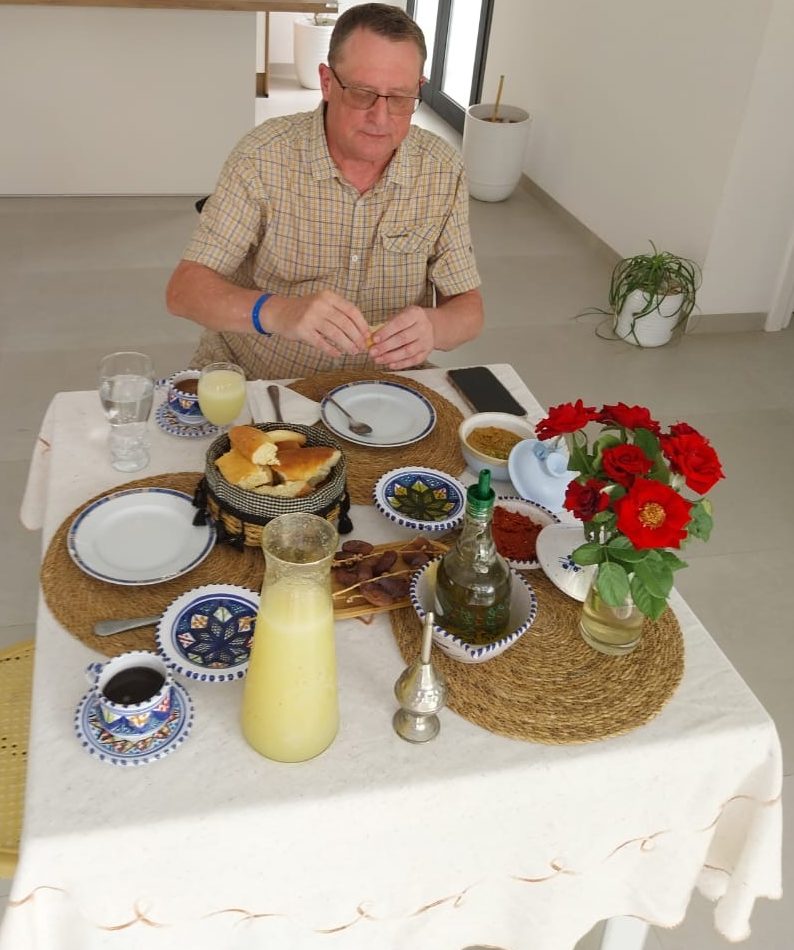
After a short drive, we arrived at Nabil’s family home where I was introduced to his wife and professional chef Nisaf, my guide for the cooking lessons to follow – the home was a tranquil oasis enveloped in greenery and the gentle shade of leafy trees. The house exuded a cool serenity, with its inviting patio and comfortable chairs set out to savour the softness of the Tunisian breeze. The sheltered garden offered a quiet escape, promising a sense of peace and familial warmth.

Stepping inside, I was welcomed not as a guest, but as a long-awaited member of the household – greeted by genuine smiles and a hospitality that felt deeply rooted in Tunisian tradition. A table was thoughtfully being prepared with refreshments, an offering that was both generous and heart warming. In this private sanctuary, I felt a true sense of privilege, as if I were rediscovering distant family after many seasons apart.

Bread and deep green extra virgin olive oil graced the table – did you know Tunisia’s olive groves span nearly a third of the country and place it among the world’s top five producers. Renowned for organic, flavourful oils like Chemlali and Chetoui, Tunisia’s harvest is largely exported and garners global acclaim, its reputation now standing proudly beside Spain, Italy, and Turkey.

Alongside were figs and bssisa – a beloved Tunisian staple made from roasted grains and legumes, ground and blended with spices, then enriched with olive oil or milk into a nourishing paste or drink. Steeped in tradition and family ritual, bssisa embodies the essence of Tunisian hospitality, uniting generations through its wholesome flavours and generous spirit. Harissa was there too, the ever-present, fiery chilli paste crafted from sun-dried peppers, garlic, olive oil, and aromatic spices – a condiment that captures the vibrant soul of Tunisian cuisine. Completing the spread, coffee gently scented with rose petal essence offered fragrant, delicious comfort.

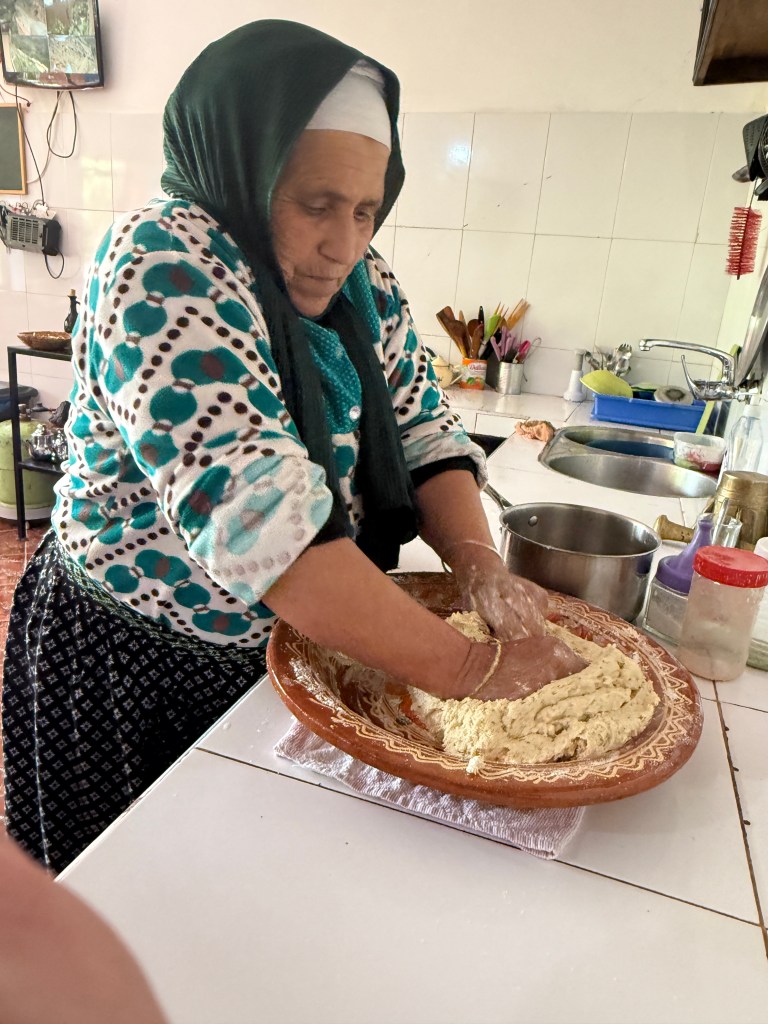
The spacious family kitchen was ready for an afternoon of discovery. Here, I was welcomed into the secrets of time-honoured Tunisian cooking, sharing those cherished moments that make one feel utterly at home, if only for a sweet, fleeting afternoon—the anticipation humming with the promise of unforgettable memories.

So, back to my menu, Ojja, Kafteji and Brik, a selection of dishes unknown to me (with the exception of Brik. Nisaf was going to show me how to create this traditional Tunisian dishes and I was excited to learn some new techniques.

Ojja
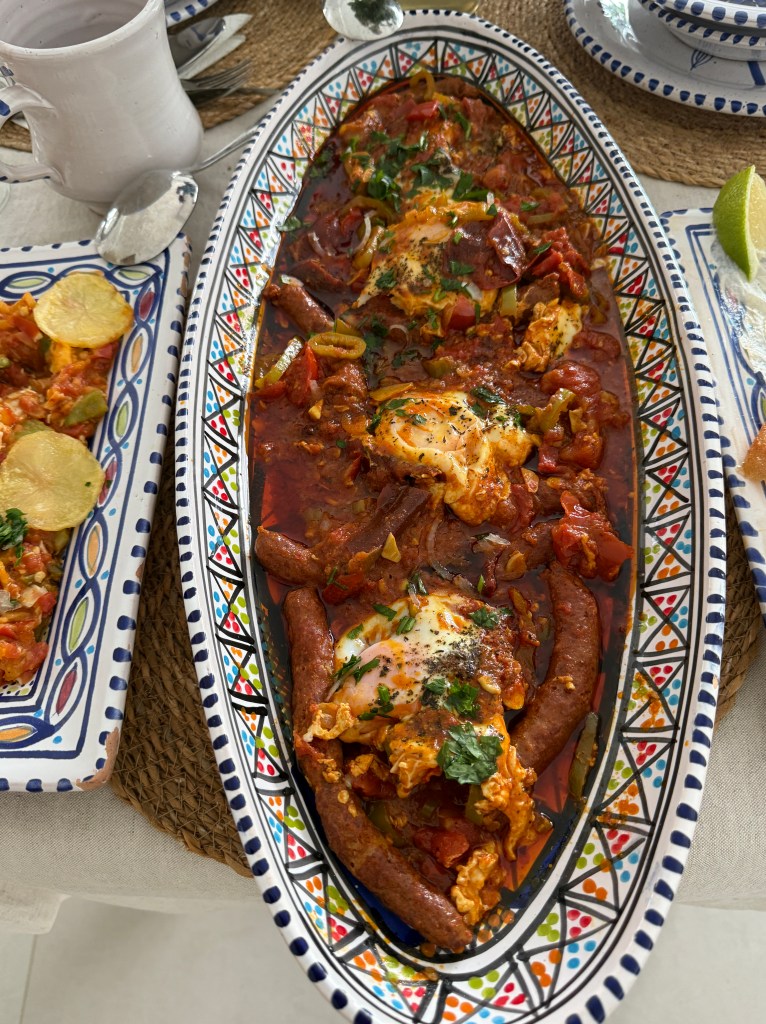
Ojja is a deeply traditional Tunisian dish with humble roots in home kitchens, reflecting the fusion of Berber, Arab, and Mediterranean culinary influences over centuries. Its signature mix of eggs, tomato, peppers, harissa, and spicy merguez sausage embodies the bold flavours of Tunisia, while adaptations vary regionally and by family. The dish is regarded as a cornerstone of authentic Tunisian comfort food, celebrated for its ability to adapt and unite diverse tastes and ingredients.

Kafteji

Kafteji, now a Tunisian staple found in street stalls and home kitchens, began as a creative way to use available vegetables – potatoes, peppers, tomatoes, pumpkin—chopped and fried, mixed with eggs, and spiced generously. Its preparation style, where all ingredients are diced and mixed, is reflected in its name, derived from the Arabic for “chopped”. While some elements may echo Mediterranean and even Turkish traditions, kafteji’s evolution and widespread popularity are distinctly Tunisian, symbolizing hospitality, creativity, and the communal pleasures of everyday meals.

Brik

Brik’s origins are a tapestry of influences: its ultra-thin pastry (warqa or malsouka) and fried fillings likely evolved from Turkish börek – introduced via the Ottoman Empire – while the classic runny egg filling may owe its presence to Andalusian Jews who arrived in Tunisia after the 15th-century expulsion from Spain. Over centuries, brik became a uniquely Tunisian delicacy, made with potato, egg, seafood, or meat, and featured at holidays, Ramadan, and festive gatherings. Its enduring appeal lies in Tunisia’s layering of culinary traditions, each bite echoing the country’s role as a crossroads of Mediterranean culture.

The artistry of Tunisian cooking reveals itself dish by dish, beginning with the bold flavors of ojja. The process starts by pricking merguez sausages with a fork and cooking them separately with some chopped dried chilli, allowing their spicy oils to seep out and deepen their flavour as they brown. Once done, the sausages are set aside, their aromatic fat reserved.
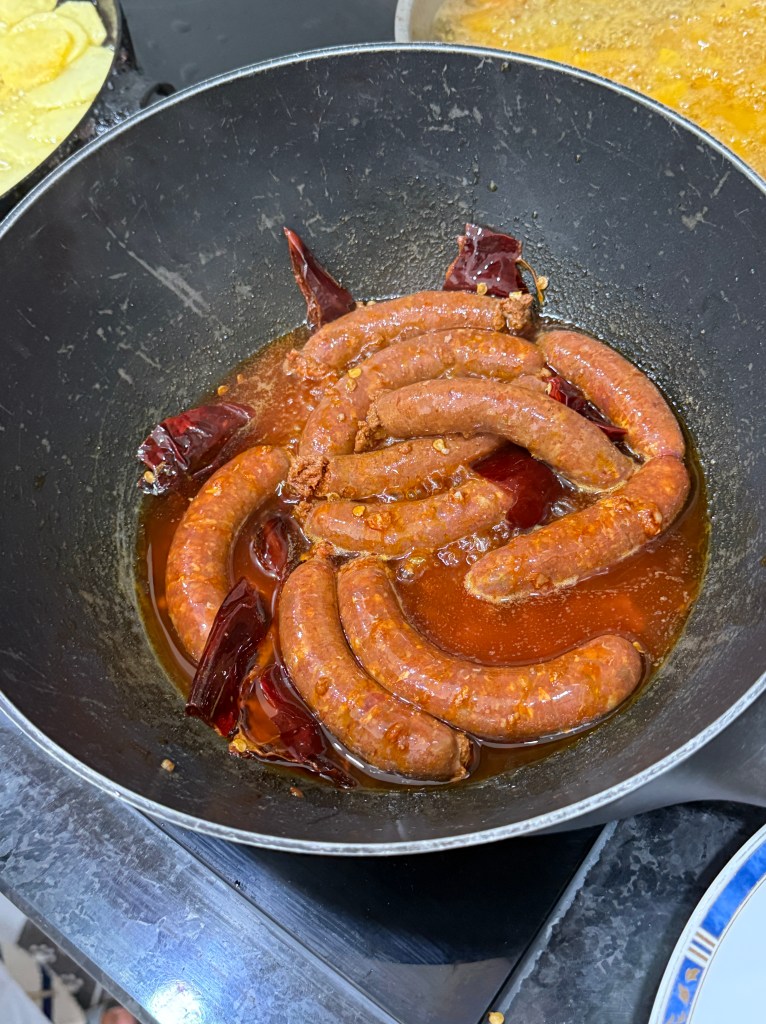
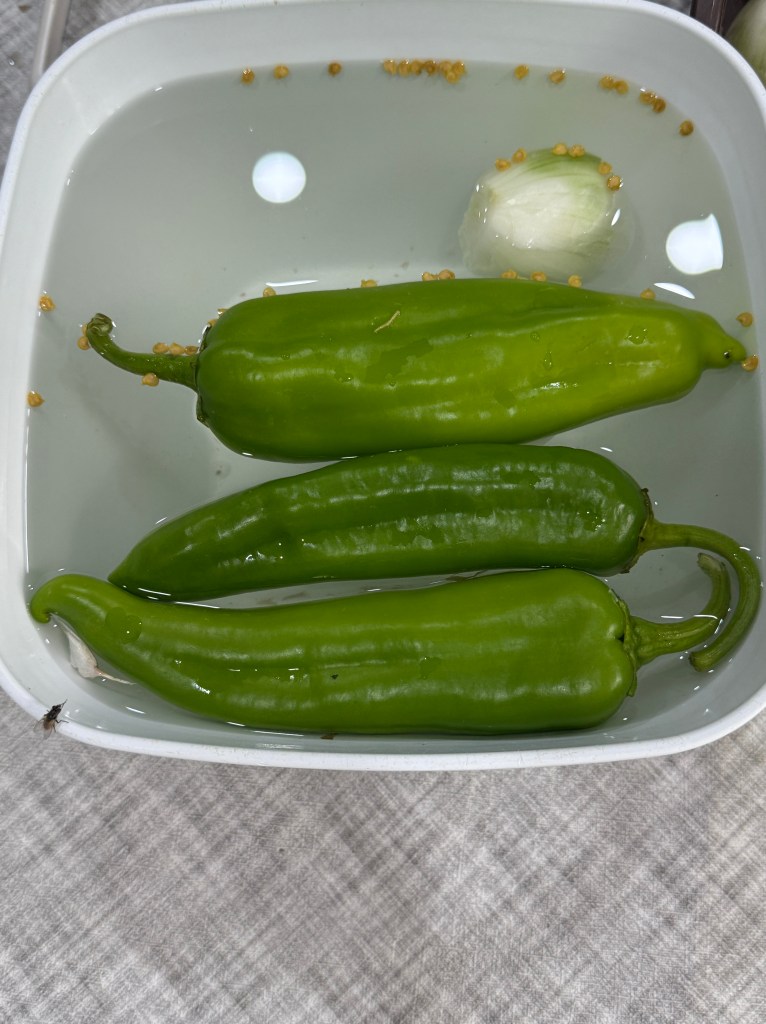
In the same pan, onions and garlic gently sauté in olive oil, joined by chopped green peppers that brighten and sweeten as they cook. Tomatoes and harissa follow, mingling with cumin and coriander until a rich, fiery sauce develops. The browned merguez rounds, glistening with their own juices, are folded back in, and finally eggs are cracked into the bubbling sauce, their whites barely set, yolks golden and just runny. Scooped up with fresh bread, ojja embodies the heart of a Tunisian gathering.
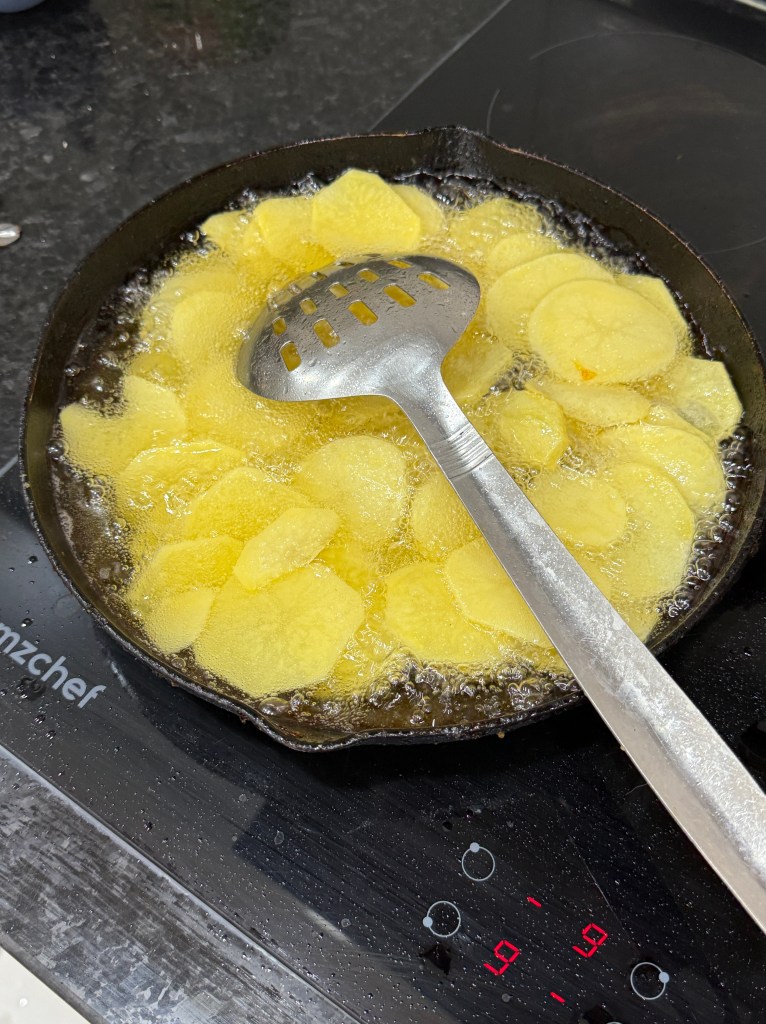
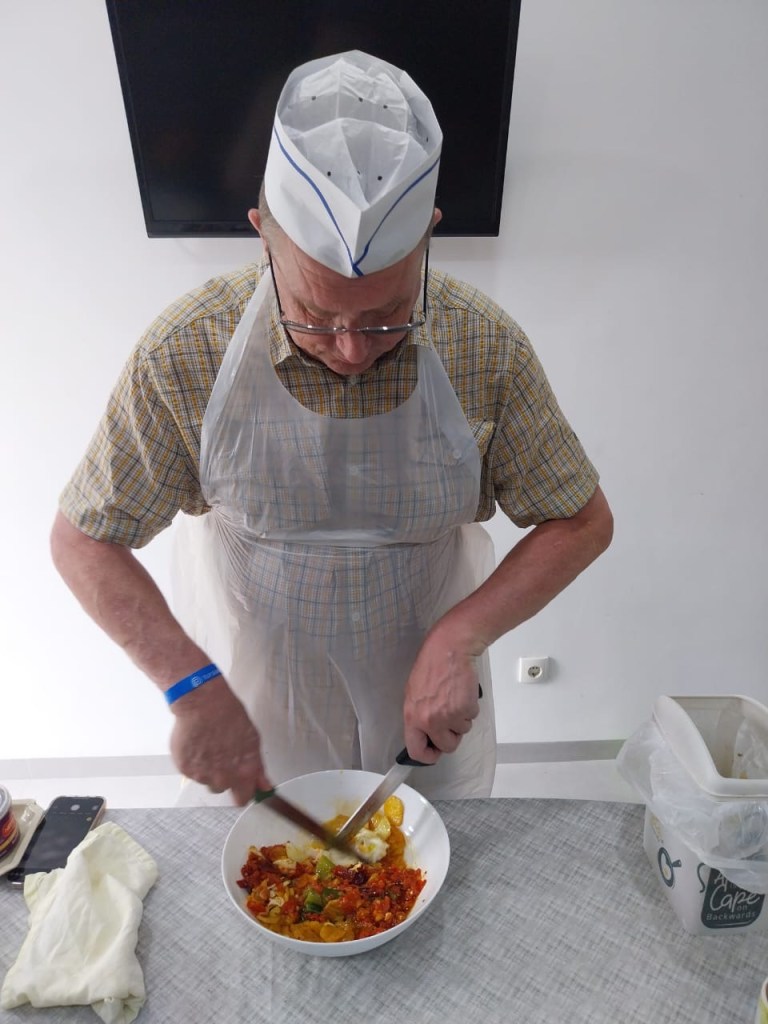
Moving across the kitchen, the creation of kafteji is a celebration of color and texture. Potatoes and squash are sliced thin and fried separately, each piece taking on a golden, crisped edge. Peppers and chilies are fried in turn, then all the vegetables come together in a medley on a broad platter. Fried eggs are then laid across the surface and everything is cut into enticing strips, mingling vegetable and egg in a fragrant jumble. This dish, which is always served for sharing – is wholesome, rustic, full of sunshine and very tasty.
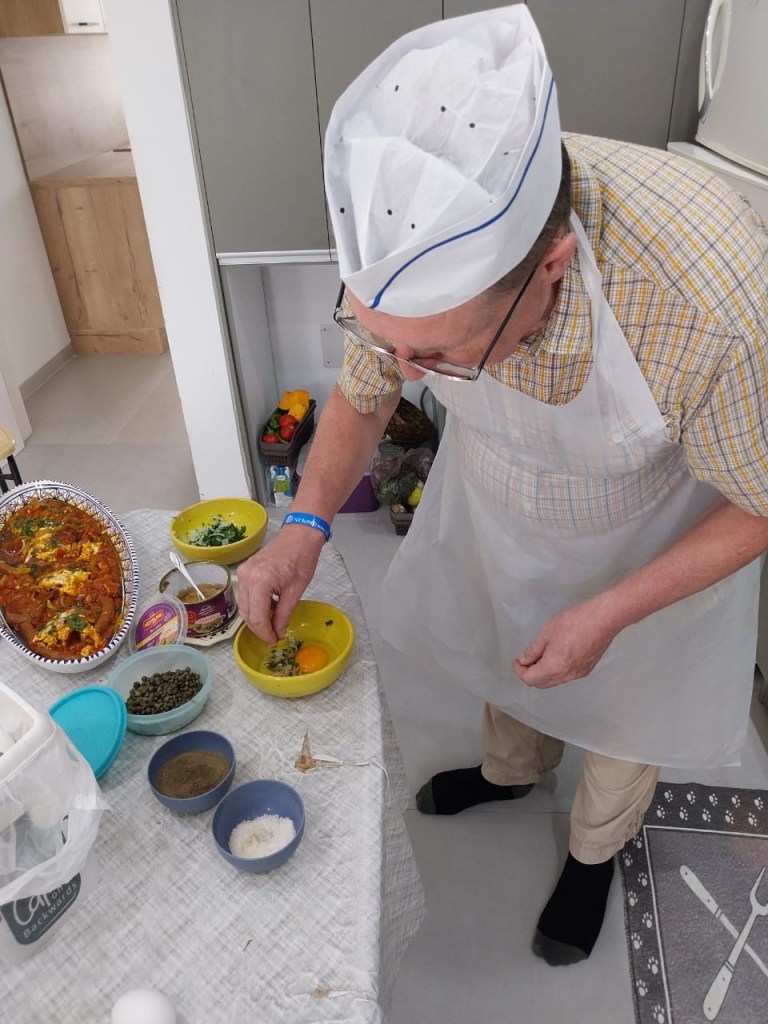
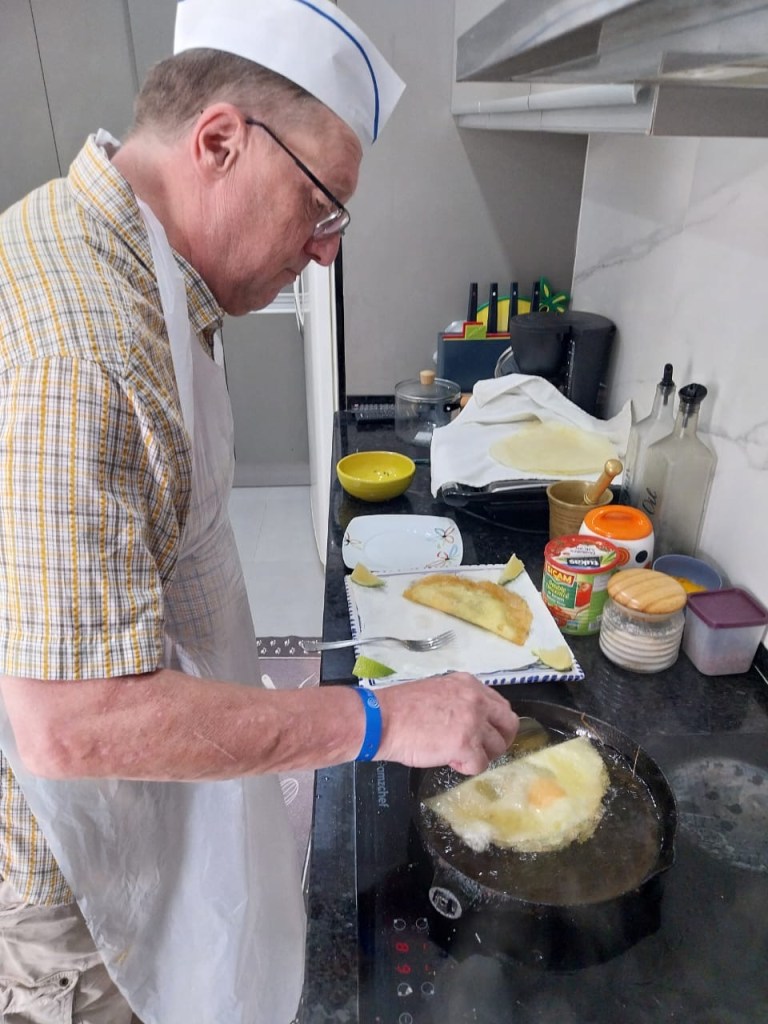
Brik provides the theatrical finale. Each delicate sheet of pastry (malsouka, which we purchased freshly made at the Medina) is filled with a little seasoned tuna placed at its centre, some Tuna. chopped Parsley and a little chopped Onion along with the freshest egg available. The pastry is folded to envelop its filling, with quick, sure hands, and lowered carefully into shimmering hot oil. In just moments, the brik crisps and blisters to a golden finish, the egg inside barely set with a runny yolk. Served immediately, with a wedge of lemon ( and for me Harissa, I love the stuff), brik is crisp yet delicate, a Tunisian delight both sumptuous and fleeting – capturing the very soul of the country’s spirited home cooking.
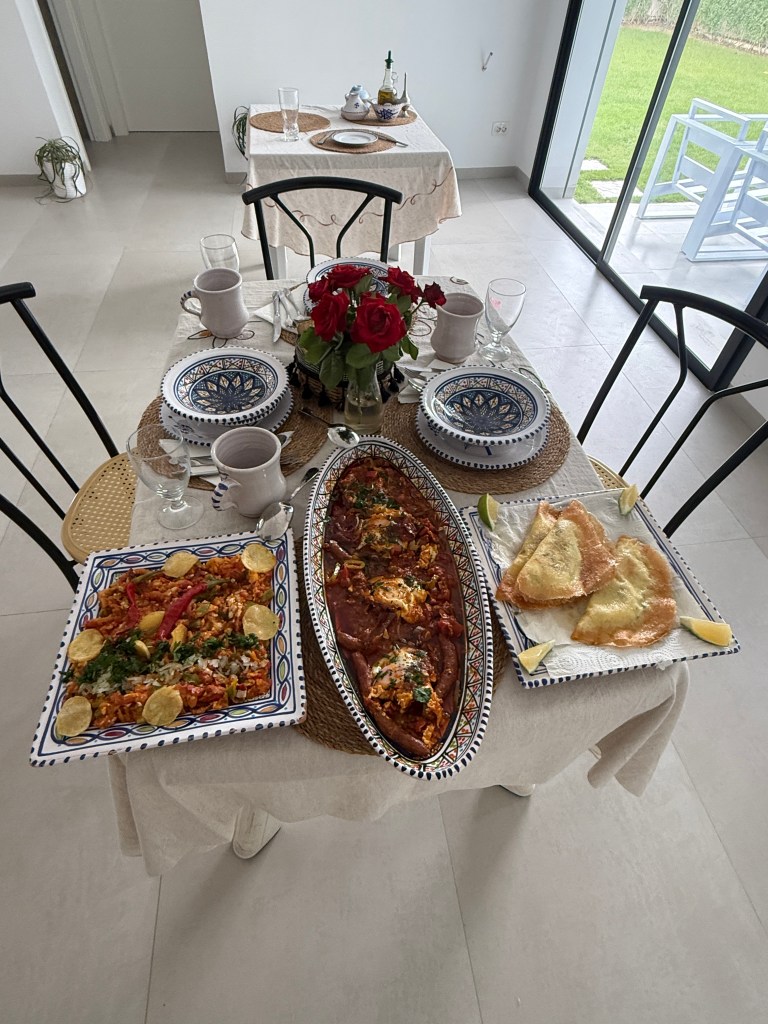
We drank from traditional white and blue Tunisian terracotta mugs – slightly porous and beautifully handcrafted. The clay kept our drinks deliciously cool, even in the midday warmth, each sip a simple pleasure that echoed centuries of Tunisian craftsmanship and refreshment.

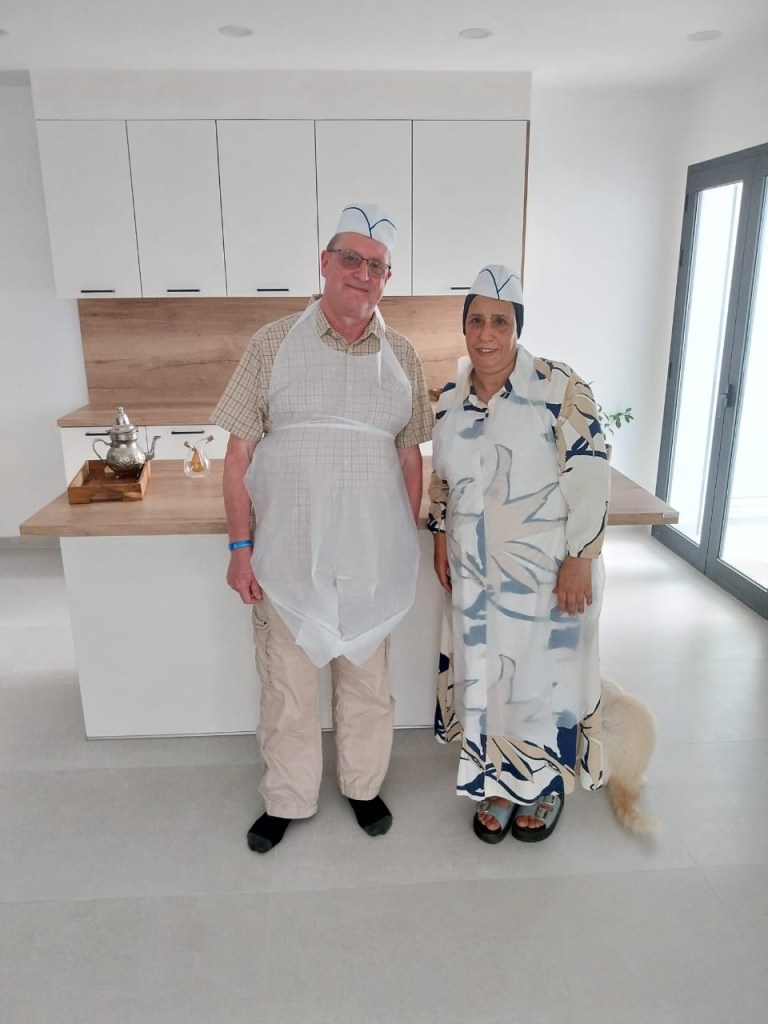
Nisaf was nothing short of magical – a chef imbued with talent and generosity, guiding each step with a graceful confidence that made every new technique feel within reach. With Nabil’s able hands and his effortless translation between languages, learning was transformed into pure delight; culinary secrets became stories, and the kitchen itself pulsed with laughter and the easy rhythm of shared discovery. As we finally sat down to savour the feast we’d created, each bite shimmered with the flavours of Tunisia, rich with memory and promise. I left the table not only filled with the most delicious food, but also with a new treasury of knowledge and inspiration – thirty genuine recipes tucked eagerly into my bag, ready to carry the vibrance of Tunisian cuisine into my own kitchen, time and time again.
After I arrived back to the U.K. I was invited to join a Sicilian Cookery Session at Richard Bertinets Cookery School in Bath which I will be writing about soon.

………………………………. Until Next Time…………………….. L8ers
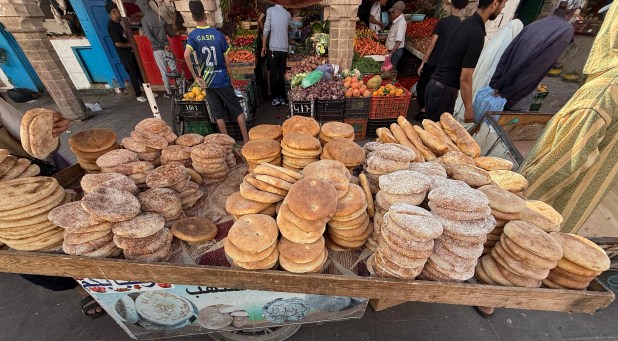
From Farm to Table and Gallery to Gift—A Moroccan Day of Indulgence and Inspiration (Day 5)

I awoke and blinked into the golden Moroccan light, hardly believing it was already Wednesday, the last full day in Essaouira. Since stepping off the plane the previous Saturday, the world I’d left behind had melted away: work, customers, endless problem-solving, even the distant rumblings of the world economy, all had faded into irrelevance. This journey had done its magic, untangling the knots of daily life and filling the space with colour, flavour, and discovery.

Each sunrise brought new marvels, and I found myself immersed in the rhythms of Morocco, its vibrant markets, ancient traditions, and the intoxicating pulse of its cuisine. Guiding me through it all was Amanda: not just my personal guide and masterful chef, but a kindred spirit whose passion for Morocco’s culture and food opened doors I never knew existed. With every shared meal and story, I felt a sense of wonder grow, a reminder that travel, at its best, is a gentle awakening to beauty, friendship, and the joy of being fully present in the world.

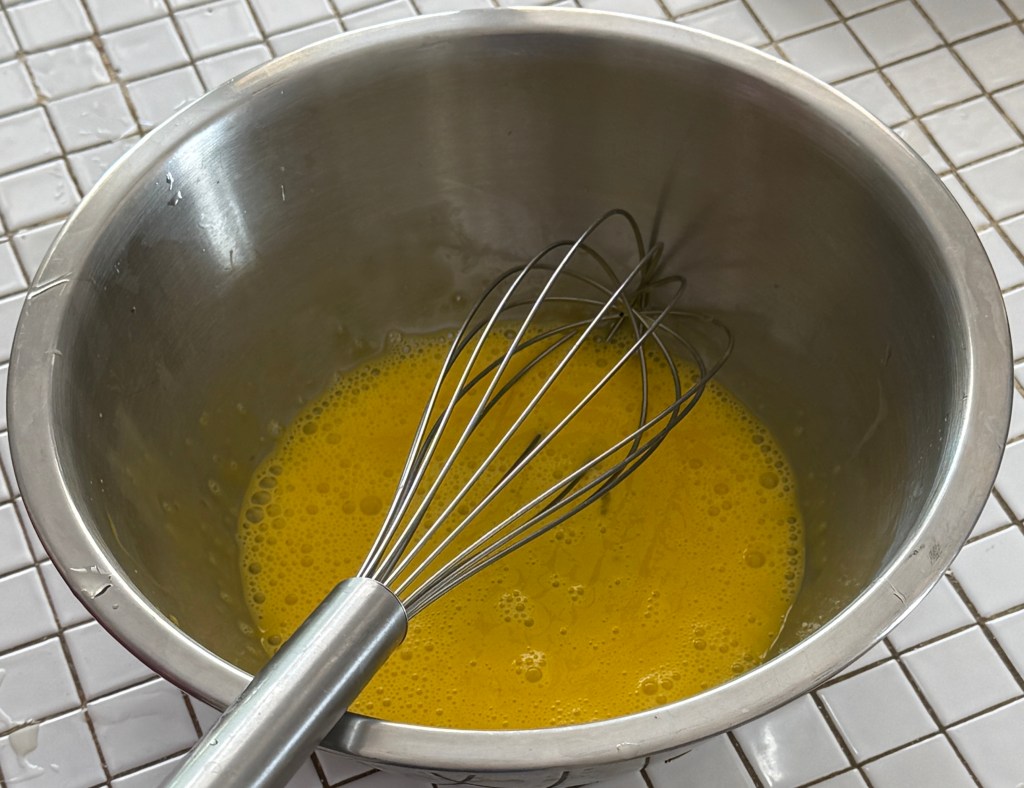
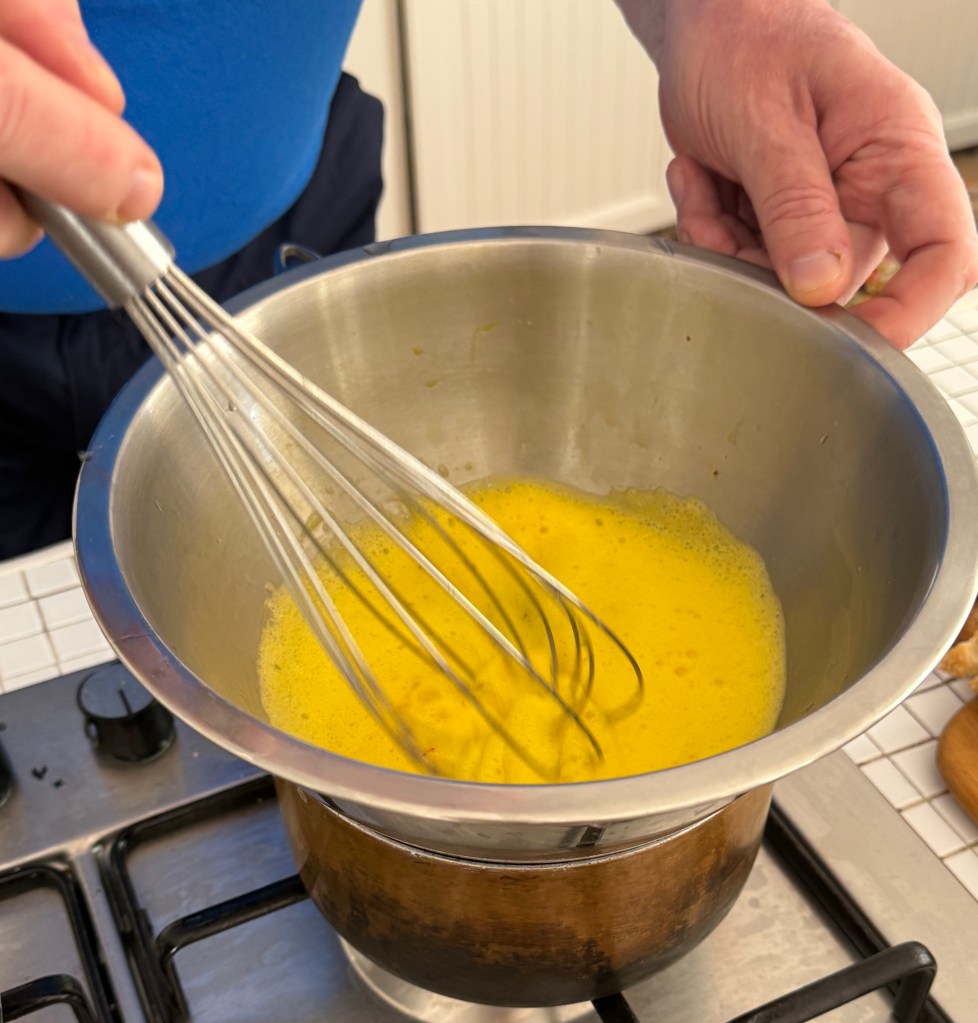
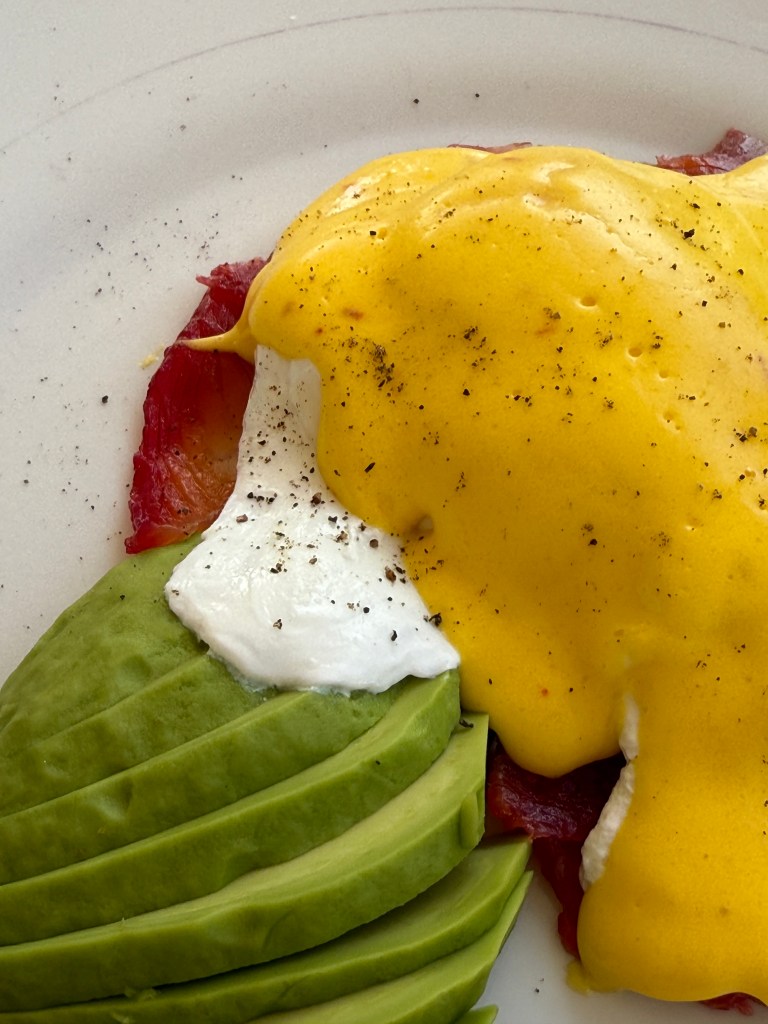
Making a rich saffron hollandaise is one of life’s true pleasures, luxurious, golden, and deeply satisfying. I’ve had the delight of whisking it to silkiness a few times before, most memorably at Rick Stein’s Cookery School in Padstow, where it crowned a beautiful ‘tronçon’ of turbot. This morning in Essaouira, the sauce would take centre stage once again. Earlier in the week, we had cured some trout in a vivid blend of beetroot, salt, and sugar, and now it was ready for its moment: breakfast as an event. Slices of the jewel-toned trout were paired with creamy avocado and a perfectly poached egg, all generously draped in that opulent saffron hollandaise and finished with a satisfying crack of fresh black pepper. Each bite was a celebration—of technique, of flavour, and of the sheer joy of starting the day with something extraordinary.

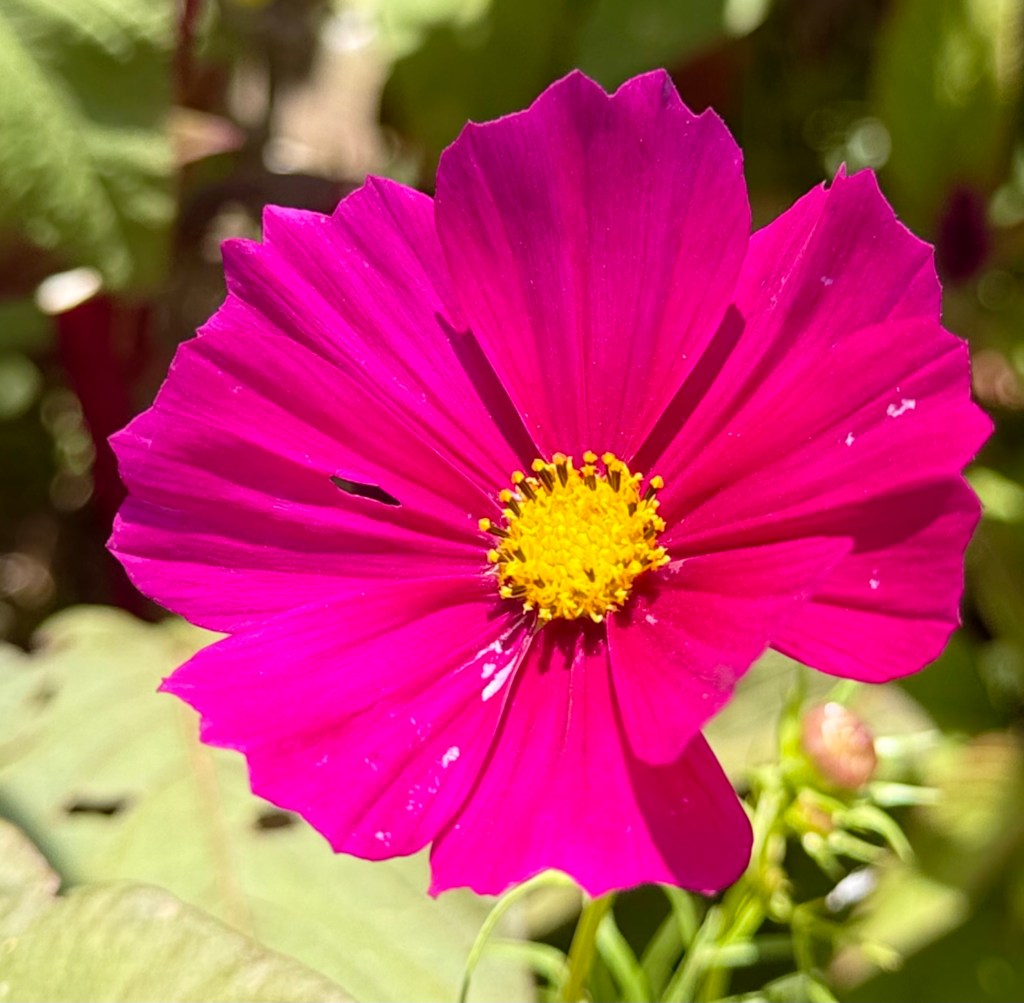
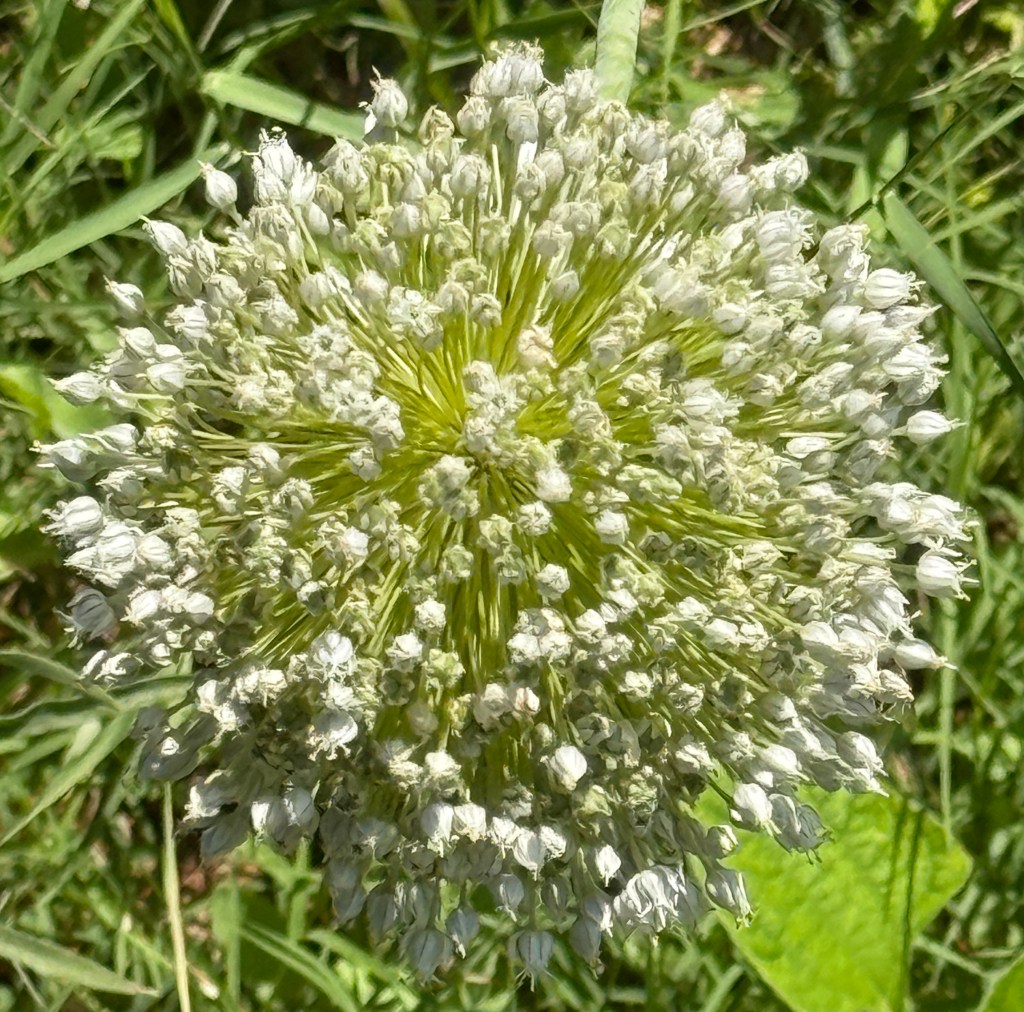
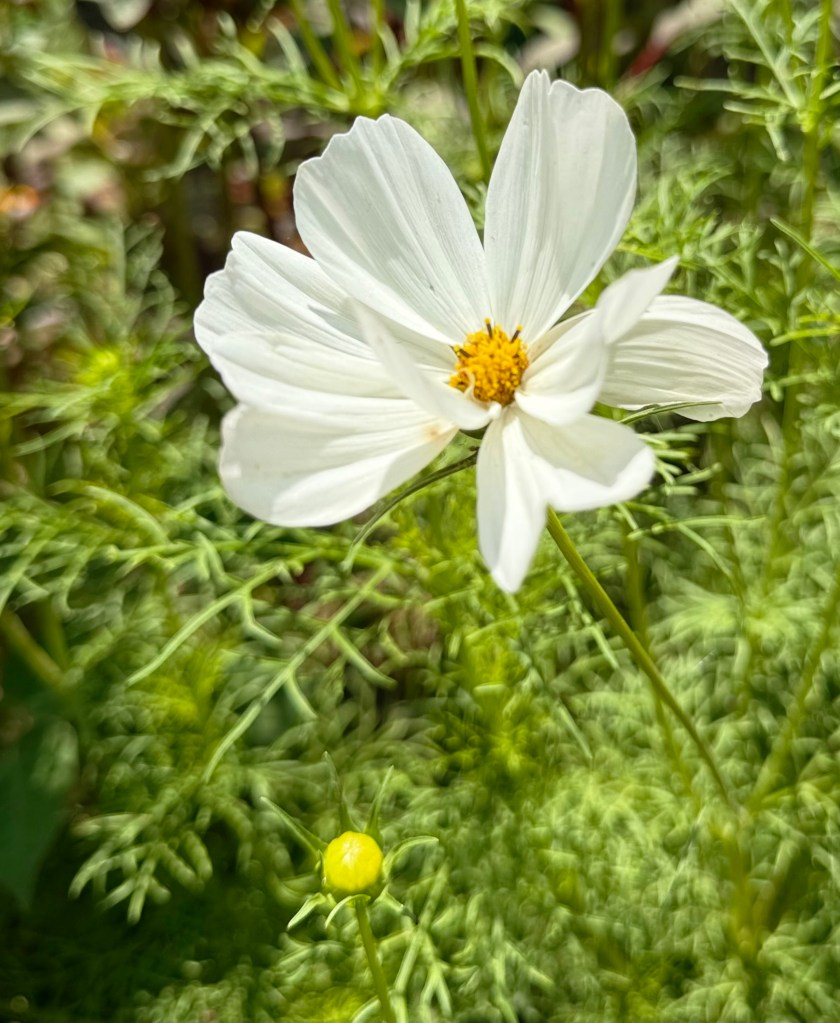
Way back in 2013, I found myself in Puglia, at Masseria Montenapoleone, an organic farm nestled in the sun-drenched heart of southern Italy. It was my very first cooking vacation and the spark that ignited countless culinary adventures to come. There, I learned the subtle art of using flowers not just for beauty, but to create a vibrant, bio-diverse environment: drawing the so-called “unwanted” plant eaters away from crops, while inviting in the pollinators and beneficial insects that keep nature in balance. Akal, here in Morocco, is very much a kindred spirit—an eco-farm that weaves flowers into every aspect of its philosophy. At Akal, the blooms aren’t just guardians of the fields; they’re also an integral part of the tasting experience, gracing the table and infusing the most imaginative, flavourful menus with colour and fragrance. Dining here is more than a meal—it’s a celebration of nature’s harmony, and a reminder of how the smallest details can transform the way we taste the world.

Our lunchtime destination was no more than 15 minutes drive, Domaine Du Val D’Argan. Domaine du Val d’Argan is a remarkable testament to vision, perseverance, and the unique character of Moroccan terroir. Founded by Charles Melia, a seasoned winemaker with deep roots in both France and Morocco, the vineyard sits just outside Essaouira, where the Atlantic winds sweep over limestone and clay soils, echoing the Rhône valley’s own mistral. What began as a retirement dream became a pioneering adventure: Melia cleared stony ground by hand, planted the first Rhône varietals, and patiently learned to coax vines to thrive on the edge of the desert, sheltering them from fierce sun and wind with natural methods and organic care.

Today, Val d’Argan is a landscape of lush vine rows bordered by sorghum and eucalyptus, where dromedaries still help tend the land and the cellar holds the promise of Morocco’s finest vintages. The wines—ranging from bright, aromatic whites to robust reds and elegant rosés—capture the sun, wind, and wild spirit of their setting. Visiting the domaine is more than a tasting; it’s an immersion in a story of resilience and passion, where every glass reflects not only the land’s bounty but also the quiet determination of its founder. This is a vineyard where French tradition and Moroccan landscape meet, yielding wines—and memories—that are truly one of a kind.

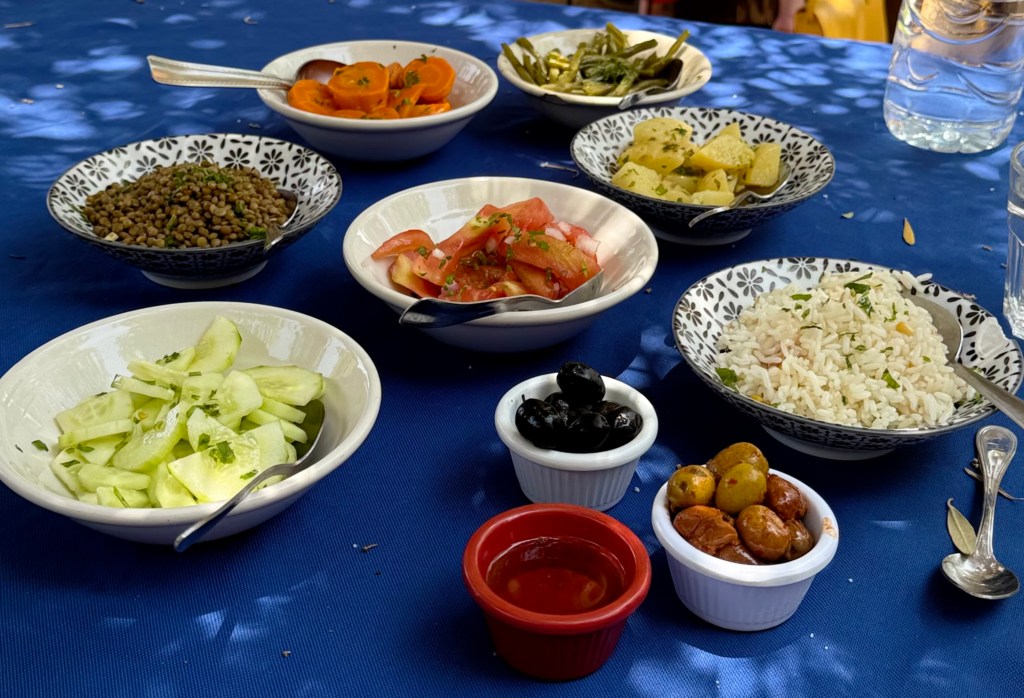
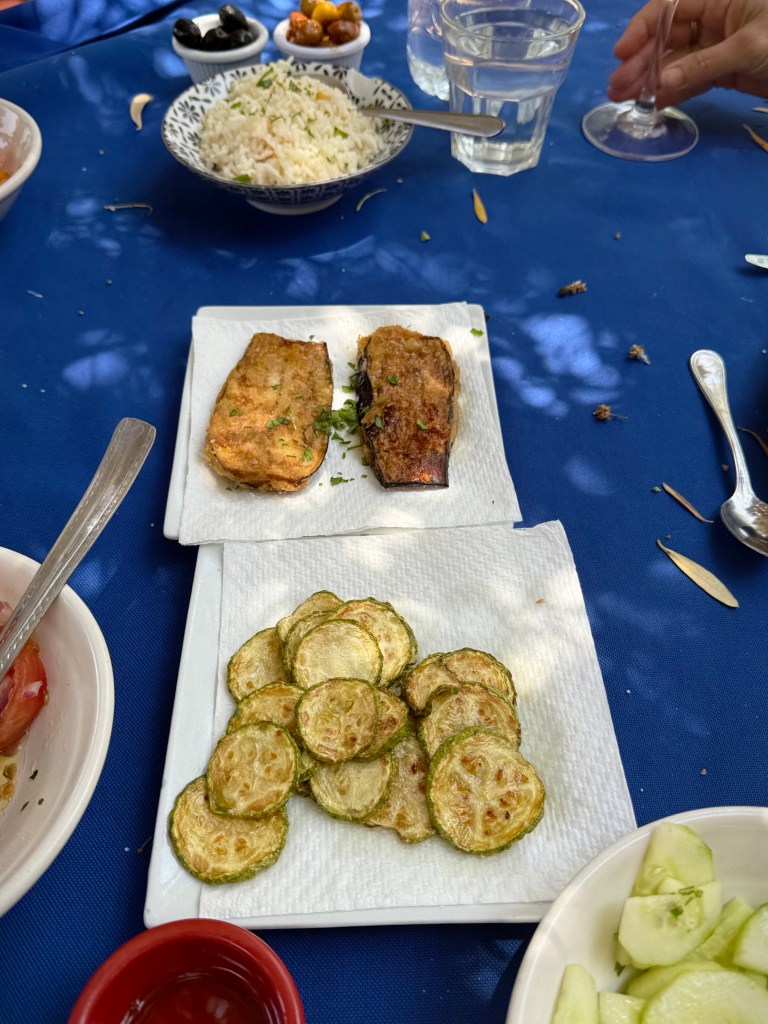
I found myself ‘in the moment’ once again, shaded beneath the branches of an ancient olive tree at Domaine du Val d’Argan. Plates of freshly prepared food appeared in a steady, generous procession, vivid salads bursting with local flavour, a fragrant tagine, and turkey roasted on kebab skewers, each dish a celebration of Moroccan abundance. Glasses of the estate’s wines flowed freely, each one a new discovery.

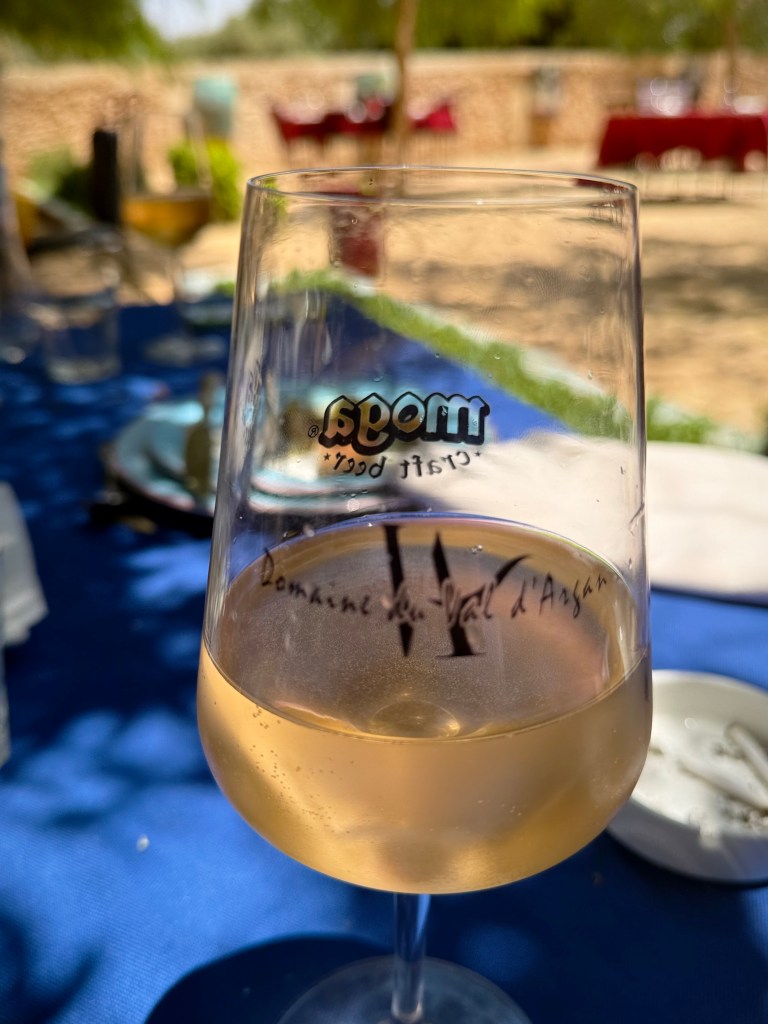
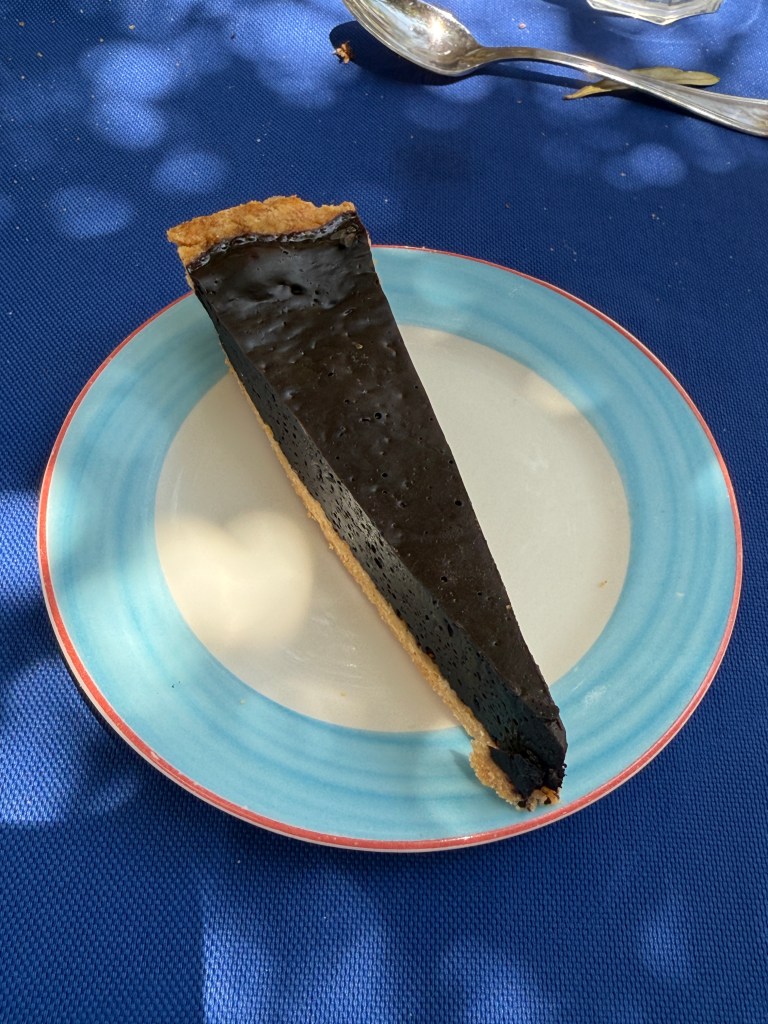
The “Gazelle de Mogador” in white, red, and rosé offered a taste of the Atlantic’s easy elegance, while the Val d’Argan range echoed the vineyard’s Rhône heritage, capturing the region’s sun and wind in every sip. Yet it was the Perle Grise that truly captured the spirit of the place for me, a wine as pale as morning light, delicately aromatic, with hints of citrus blossom and wild herbs, perfectly refreshing beneath the olive canopy. As the afternoon stretched on, a rich chocolate dessert arrived, rounding out a meal that was both relaxed and luxurious. At Domaine du Val d’Argan, the artistry of winemaking and the generosity of Moroccan hospitality come together in a setting as memorable as the wines themselves, a place where every glass tells a story, and every moment lingers long after the last sip. It was time to head back to Essaouira for some last minute exploration.

As we entered the medina, the air shimmered with the ethereal tones of a young man playing a handpan, his fingers coaxing otherworldly melodies from the spaceship-like drum that echoed off the ancient stone walls.

As the sun dips toward the Atlantic, the ancient medina of Essaouira began to pulse with an energy that is both timeless and electric, the unmistakable prelude to the Gnaoua World Music Festival. For a few magical days each year, the city’s labyrinthine alleys and windswept squares become a living stage, as hypnotic rhythms and haunting melodies spill from every doorway and rooftop. The air grows thick with the deep, trance-inducing thrum of the guembri, the metallic clatter of krakebs, and the soaring call-and-response of Gnaoua singers, their music weaving a spell that draws locals and travellers alike into its embrace.

Founded in 1998, the festival is a vibrant celebration of Gnaoua culture, descendants of West African slaves who brought with them a mystical musical tradition rooted in healing, spiritual trance, and communal memory. Over the years, the festival has blossomed into a global gathering, where Gnaoua masters share the stage with jazz virtuosos, blues legends, and musicians from every corner of the world. This fusion of sounds creates a heady, intoxicating atmosphere, where ancient African rhythms meet flamenco, reggae, rock, and Sufi chants, all under the open Moroccan sky.

The festival is more than a concert—it’s a living tapestry of history, spirituality, and artistic exchange. The music, once used in sacred rituals to heal and connect with the divine, now fills Essaouira’s medina with a sense of unity and celebration. For a few unforgettable nights, the city becomes a crossroads of cultures, a place where the boundaries between audience and performer, past and present, seem to dissolve in the intoxicating swirl of sound and spirit.

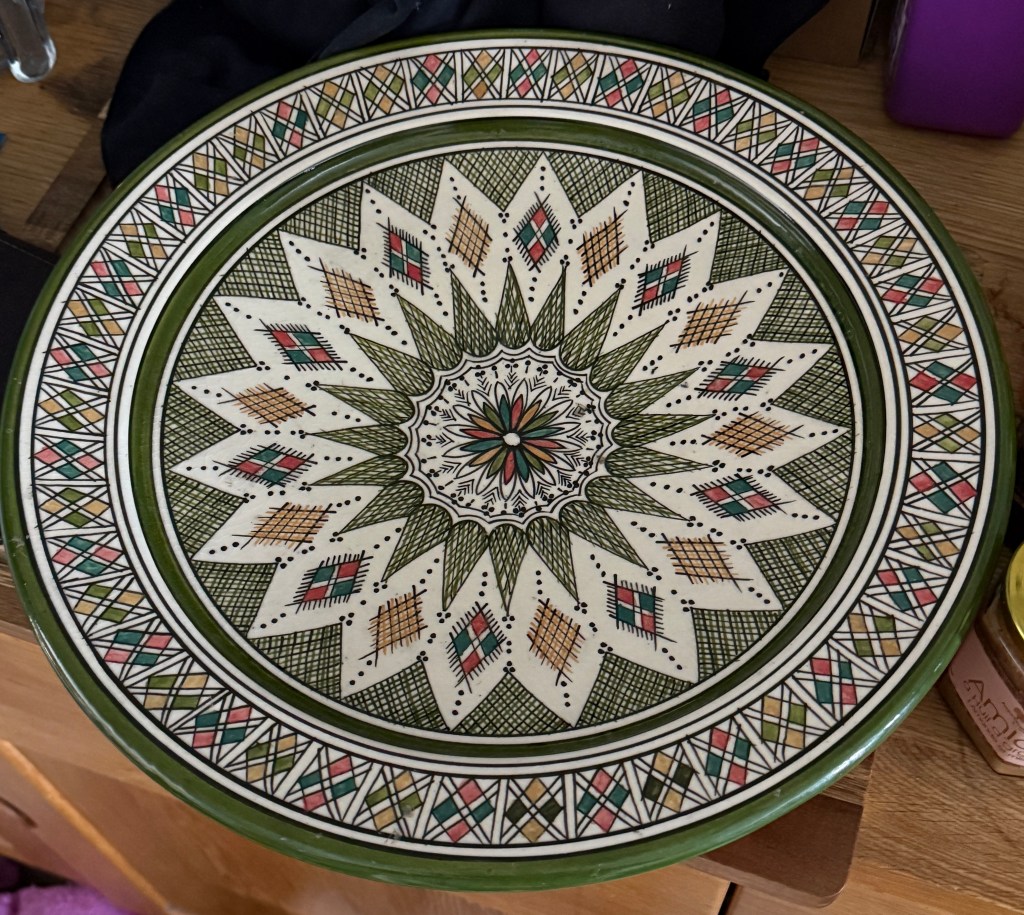
This stunning plate ( a present for my best friend and wife forever ), is a true testament to Moroccan artistry, its surface alive with intricate geometry and vibrant colour. Crafted in the traditional style of Fez, the design radiates from a central starburst, each petal meticulously hand-painted in shades of emerald green, saffron yellow, and soft rose. Delicate crosshatching and fine black lines create a mesmerizing lattice, while the outer border is woven with interlocking patterns that speak of centuries-old craftsmanship. The plate’s symmetry and precision are captivating, drawing the eye inward and inviting contemplation of the skill and patience required to create such a piece. More than just a vessel, it is a celebration of heritage, a beautiful reminder of Morocco’s rich ceramic traditions and the enduring allure of handmade work.

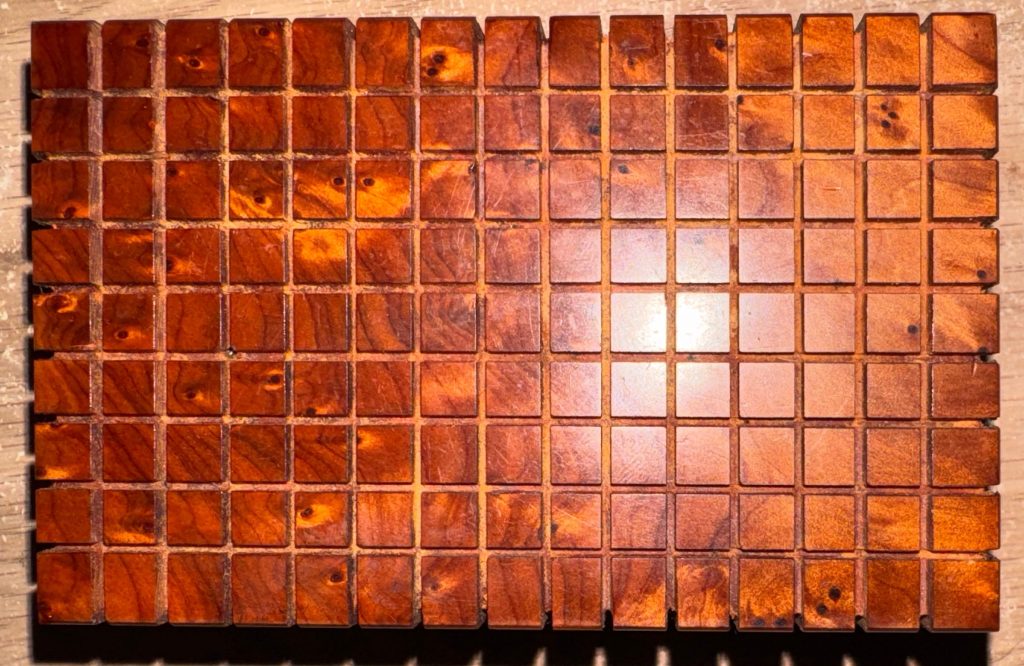
In the heart of Essaouira’s medina, you’ll often come across what locals call the “magic box”, a beautifully crafted container made from the region’s prized thuya wood. Native to Morocco’s coastal forests and especially abundant around Essaouira, ‘thuya’ wood is renowned for its rich, swirling grain, warm hue, and natural, cedar-like fragrance

Artisans here have honed their craft for generations, turning thuya burl into intricate puzzle boxes, lidded spheres, and inlaid treasures, each one polished to a satiny sheen and finished with lemon oil to enhance its natural luster. These boxes are more than just souvenirs; they’re a testament to Essaouira’s heritage of marquetry and woodworking, a tradition dating back to the 19th century when sultans commissioned decorative objects and furniture from the city’s master craftsmen.

Whether used to store spices, trinkets, or secrets, a thuya wood “magic box” from Essaouira is a piece of living history, fragrant, tactile, and always a little mysterious, as if it holds a story all its own. Our son loves his…

………………………………..Until Next Time………………………….L8ers

Earthquakes, Amazigh and Souks – An Adventure in Morocco (Day 1)

It was the dawn of January 2025, and a restless energy stirred within me. Work had been exhilarating -truly rewarding – but the relentless pace of the past few months left my mind yearning for a change of scenery. I count myself incredibly fortunate to have a family who not only understands my passions but celebrates them. As a gesture of gratitude, they gift me an annual passport to adventure: a chance to slip away on my own and immerse myself in new cultures and flavours. This cherished tradition began in 2013 with a soul-stirring journey to Puglia, and each year since, it has become my way to recharge, reflect, and rediscover the world – and myself.

In the early hours of September 8, 2023, the tranquil mountain communities near Dar Tassa were shaken to their core by Morocco’s most powerful earthquake in over a century. Centered in Al-Haouz province, this magnitude 6.9 quake unleashed violent tremors that tore through the High Atlas, toppling centuries-old homes and flattening entire villages nestled along rugged slopes.

The devastation was profound: roads became impassable, isolating survivors and delaying the arrival of aid, while families – many of whom depended on livestock and small-scale tourism, were left to sift through rubble in search of loved ones and remnants of their lives. In these remote valleys, where poverty and resilience intertwine, the earthquake’s scars run deep, marking a tragedy that will shape the region’s future for generations. There were at least 30 deaths in the village of Tassaouirgane, my 1st stop on my next food and culture trip.

I usually take great pride in crafting my own journey – my last adventure to Venice was a labour of love that unfolded over more than a year of meticulous planning. This time, however, I didn’t have the luxury of endless months; I was determined to set out in May or June. After hours of scouring the internet, a handful of enticing options emerged. Morocco had already captured my imagination based on a previous trip, but finding someone I could trust to meet my exacting standards was another matter entirely. I pour not just money, but precious vacation time and anticipation into these escapes, so choosing the right partner was essential. In the end, my decision hinged on responsiveness and intuition – who replied swiftly, and who truly understood what I was seeking?

So Morocco are a small, independent UK registered ‘Moroccan’ Holiday company providing high-quality, private tours of Morocco. Looking through the itineraries I found the kind of ‘vibe’ I was looking for so I quickly fired off an email to see what could be done within my budget, the response was impressive both in speed and content.

By mid January the contract was sealed, a few emails, a couple of adjustments and the itinerary was set. I booked my flights to make sure that I could get to Morocco and back, and now had a 5 day two centre trip, with my own driver (actually two), and the continued services of one Amanda (Chef/Guide), and wow, was she something extra extra special as all will become clear. The trip aligned with the end of Eid al-Adha.

Eid al-Adha, the Festival of Sacrifice, is a radiant celebration of faith, compassion, and unity observed by Muslims worldwide. Marking the culmination of the Hajj pilgrimage, it honours Prophet Ibrahim’s devotion and willingness to sacrifice, reminding us of the virtues of selflessness and gratitude. Families gather in joy, sharing festive meals and acts of charity, weaving together tradition and togetherness in a spirit of peace and generosity.

Linda, the owner of So Morocco also has a couple of other Morocco focussed businesses, Walking with Nomads and My Nomadic Kitchen each of their experiences promises a truly unique “off-grid” adventure, either venturing into the Sahara, or new food learning opportunities, from comprehensive showcase meal lessons to quick spice mix demos and snack preparations for your next picnic lunch. Experience the authenticity of Moroccan cooking by preparing meals over hot coals, savouring the flavours in their most natural state. .

The range of options is wonderfully diverse—spanning different locations, budgets, durations, and activities – yet every journey is designed to be sustainable in nature and gentle in its impact. Whether you find yourself living alongside nomadic tribes, learning from rural craftspeople, connecting with remote cooperatives, or engaging with pioneering professionals, environmental conservation remains at the heart of every trip. The impact is multi-layered, nurturing Morocco’s delicate natural heritage with genuine respect and care.

I’d be honoured to introduce you to Haj Brahim our host for the 1st evening, owner of Dar Tassa. The title “Haj” (also spelled “Hajj” or “El-Haj”) in the name Haj Brahim is a mark of deep respect in many Muslim cultures, including Morocco, signifying that Brahim has completed the sacred pilgrimage to Mecca – one of the Five Pillars of Islam and a profound spiritual achievement. Adding “Haj” before a name honours both religious devotion and community esteem.

After the pilgrimage, men are called “Haj” and women “Hajja,” followed by their given name. The name “Brahim” is the Arabic form of Abraham, a revered prophet in Islam, Judaism, and Christianity, symbolizing faith and devotion. Thus, “Haj Brahim” means “Abraham, who has performed the Hajj,” reflecting both spiritual accomplishment and a name rich in tradition. He was a beautiful kind soul that had spent 30 years in the UK, and had a brilliant sense of humour.

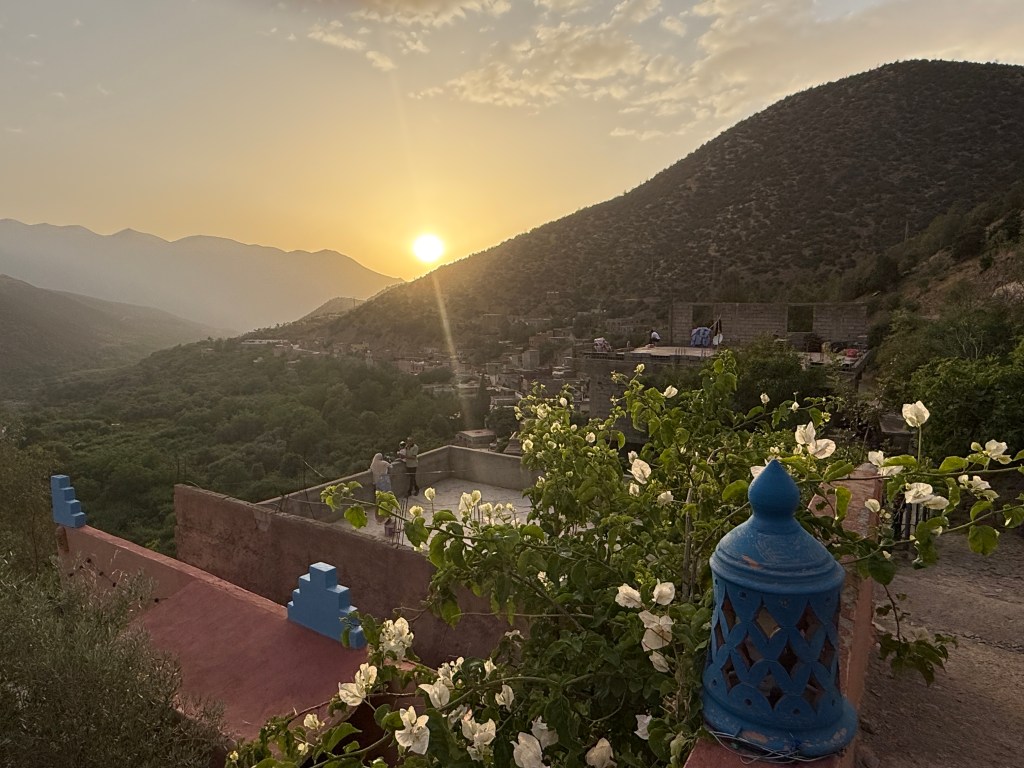
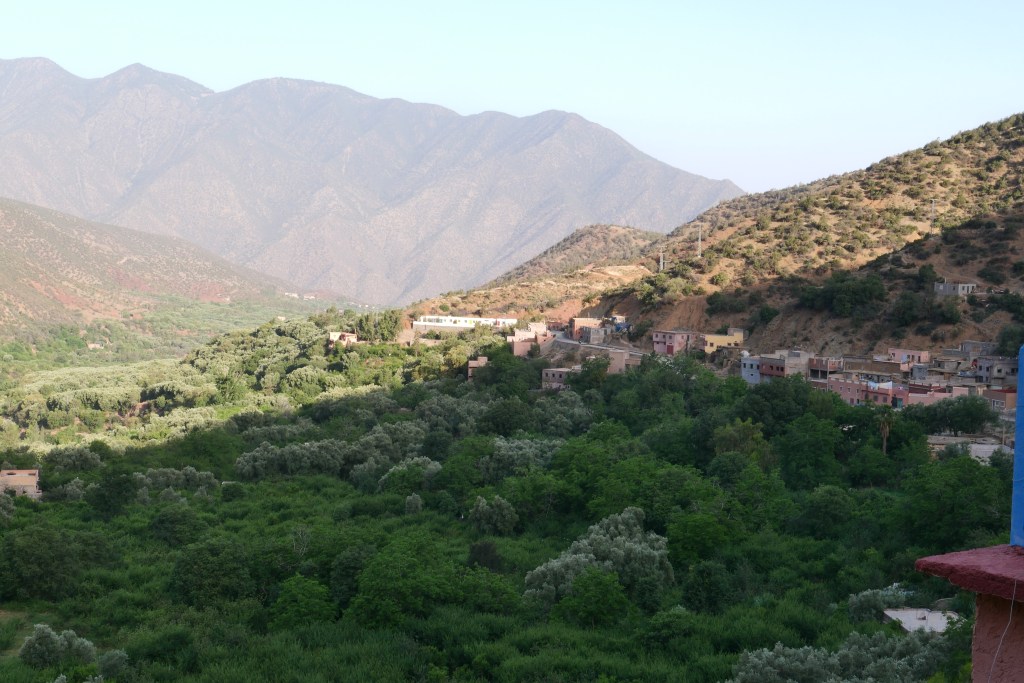
Nestled in a tranquil corner of Toubkal National Park, just over an hour from Marrakech, Dar Tassa is an eco-friendly mountain retreat whose name – “The Home of Motherly Love” – captures the warmth and welcome that awaits every guest.

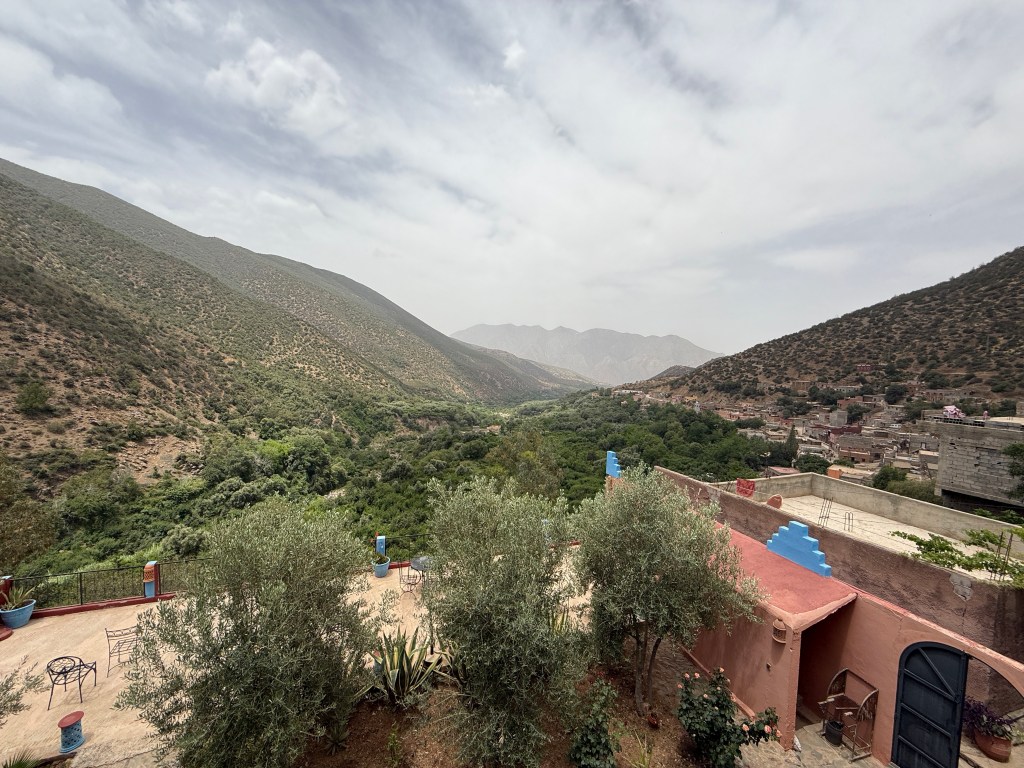
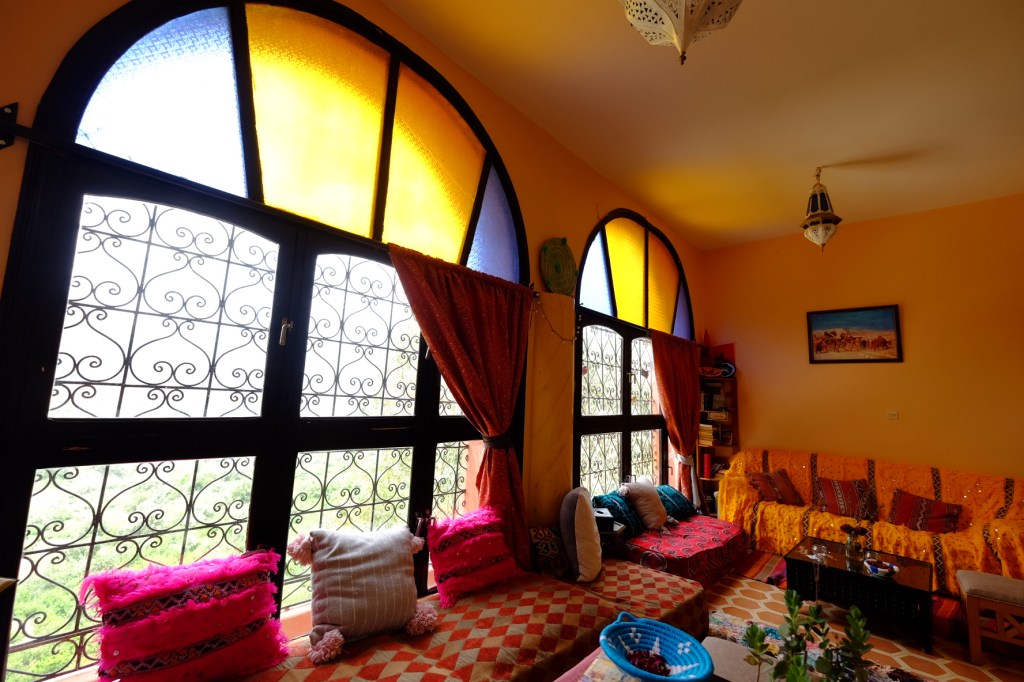
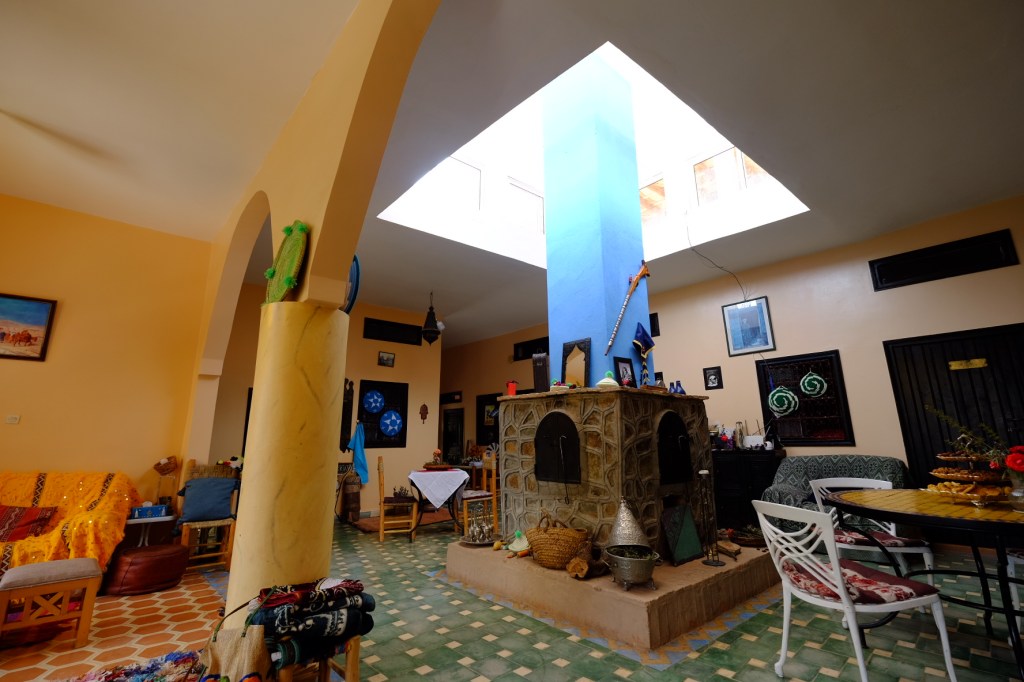
Framed by soaring Atlas peaks and wild, unspoiled nature, this charming guesthouse offers a haven from city life, blending modern comforts with the timeless hospitality of the Berber people. Floor-to-ceiling windows flood the interiors with light and breath-taking mountain views, while the soothing fountain at its heart invites quiet reflection. Whether you seek gentle strolls through the valley, exhilarating alpine adventures, or simply a peaceful terrace to savour traditional Moroccan cuisine, Dar Tassa is a doorway to both relaxation and discover – a place where “marhaba” is not just a greeting, but a way of life.

As we arrived, Haj Brahim greeted us with a warm smile and a gesture steeped in tradition “hleb b tmar” (حليب بالتمر) or “halib bil tmar”- a glass of cool, creamy milk accompanied by plump, sweet dates. This simple offering, cherished by the Amazigh as a symbol of welcome and blessing, was his way of sharing both hospitality and heritage. In that gentle moment, the spirit of the mountains and the generosity of their people were beautifully, deliciously revealed.

I was shown to my room – Studio Toukbal – the finest suite available, boasting a breath-taking view that swept down the valley, a panorama so stunning it felt almost otherworldly. After a delicious lunch – one so memorable I forgot to photograph it in my eagerness for the adventures ahead – I began my afternoon with a captivating demonstration: the art of crafting a unique, traditional bread.

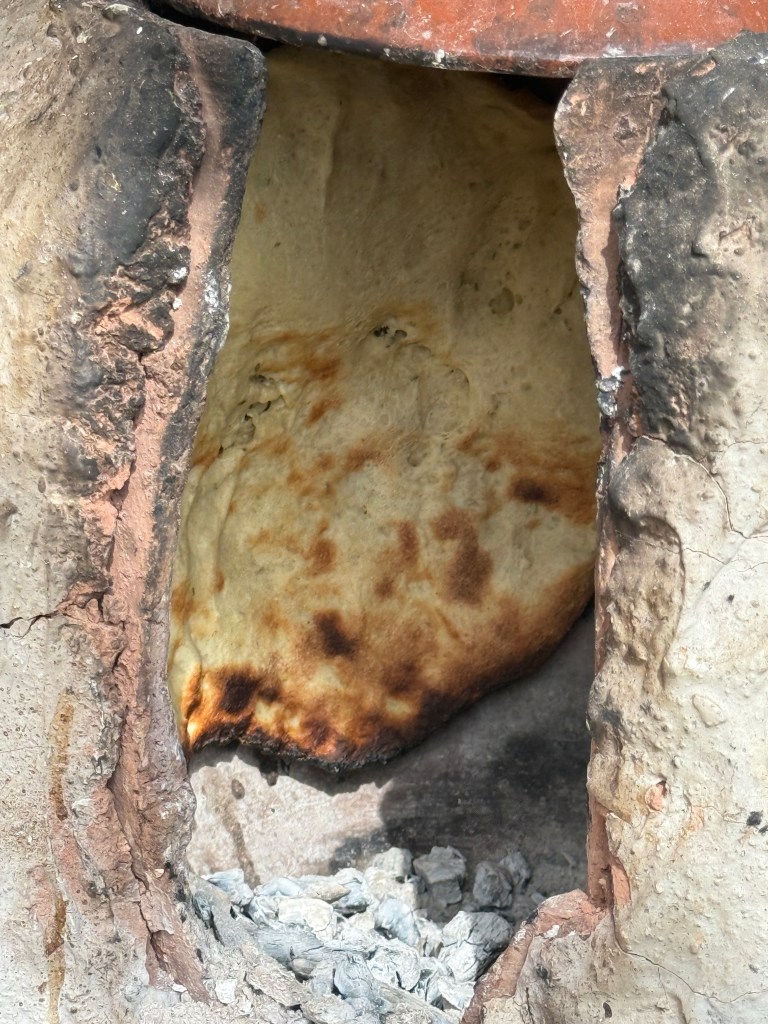
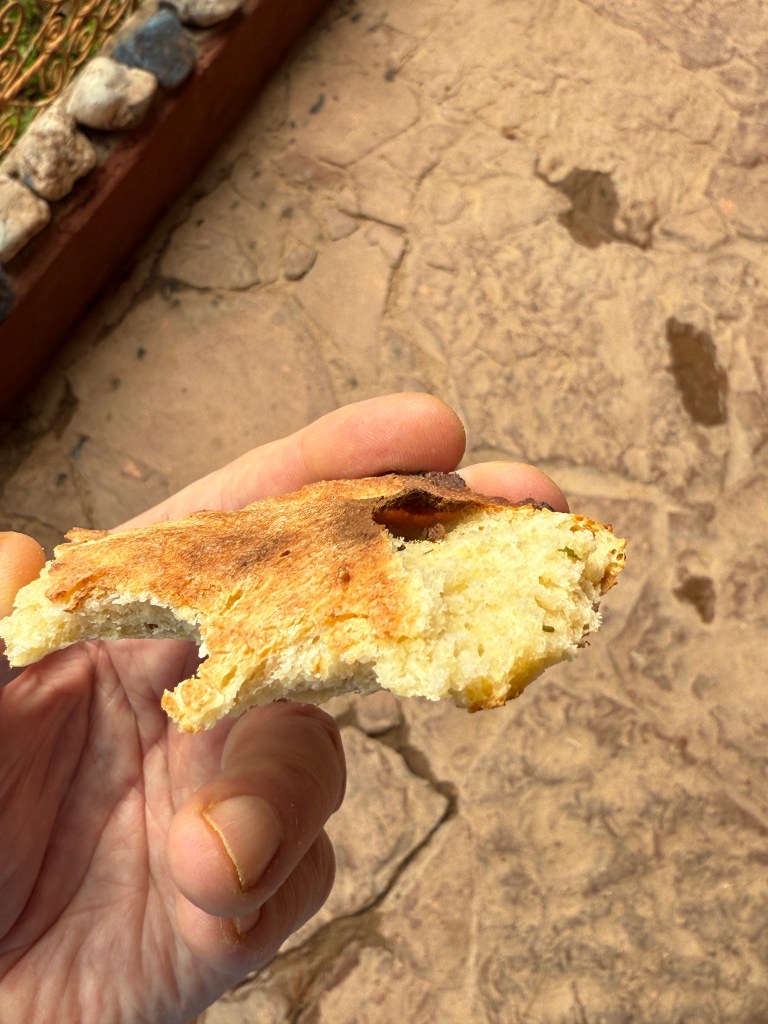
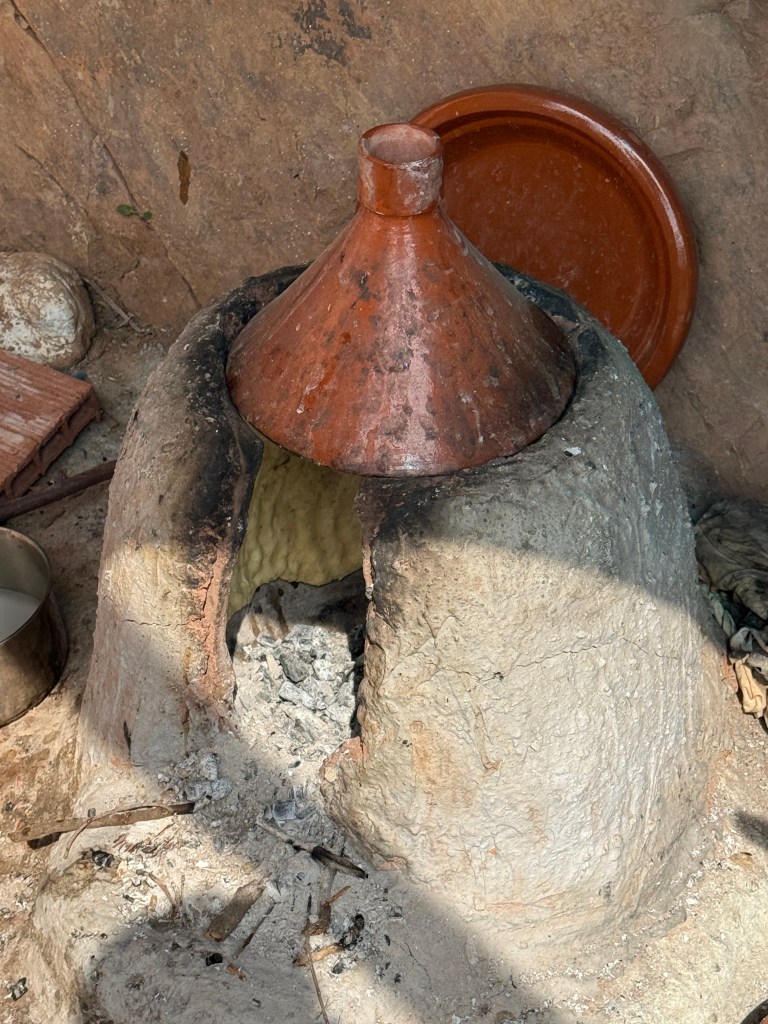
In the High Atlas Mountains, the Amazigh – Morocco’s indigenous Berber people – bake their beloved ‘tanort’ bread in a clay wood-fired oven called a ‘takat’. This rustic flat round loaf, enriched with aromatic fennel seeds, is a hallmark of Amazigh hospitality. The name “Amazigh” means “free people,” and their bread, with its golden crust and fragrant, smoky flavour, beautifully embodies the warmth and enduring spirit of their mountain culture. It was delicious.

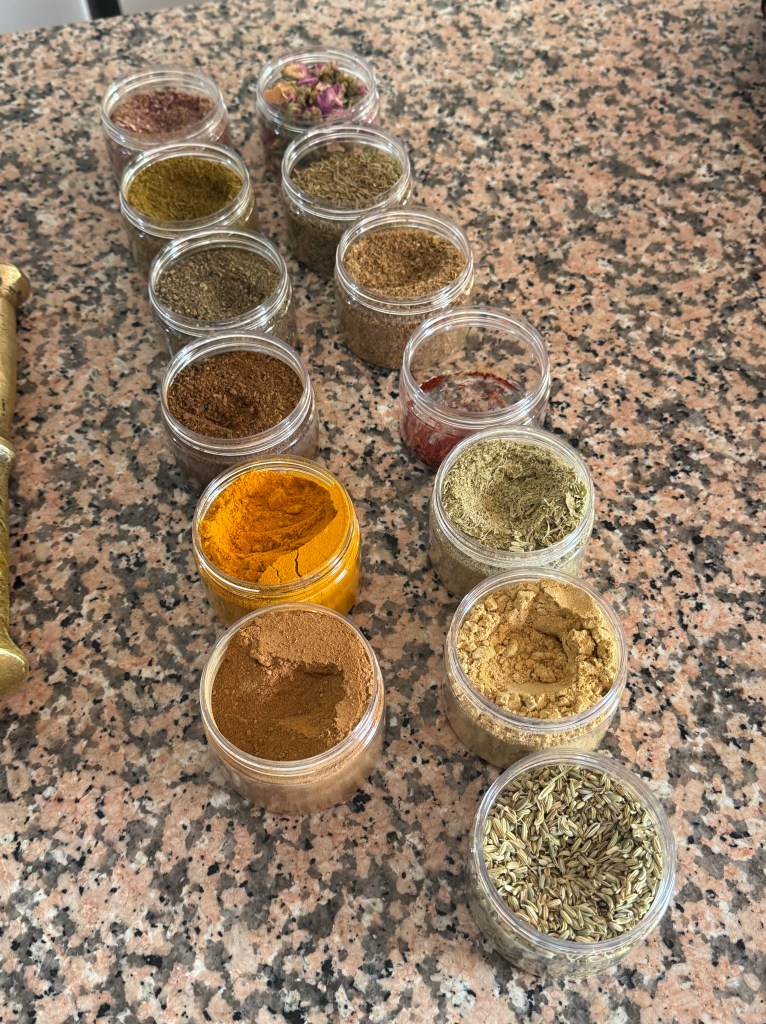
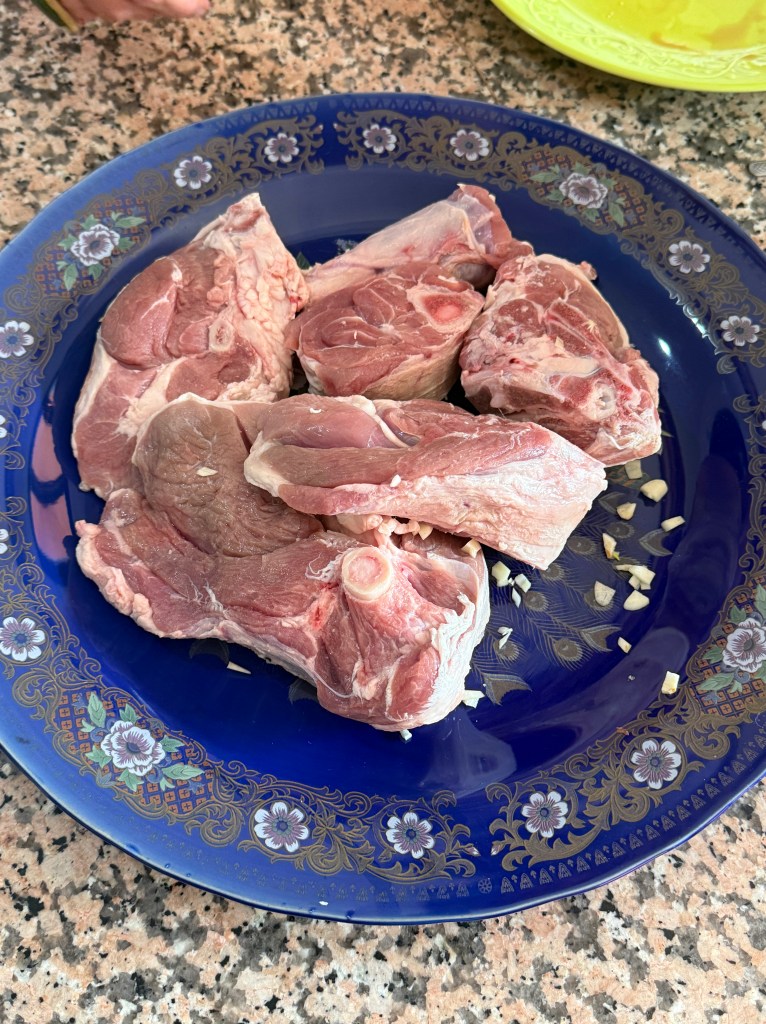
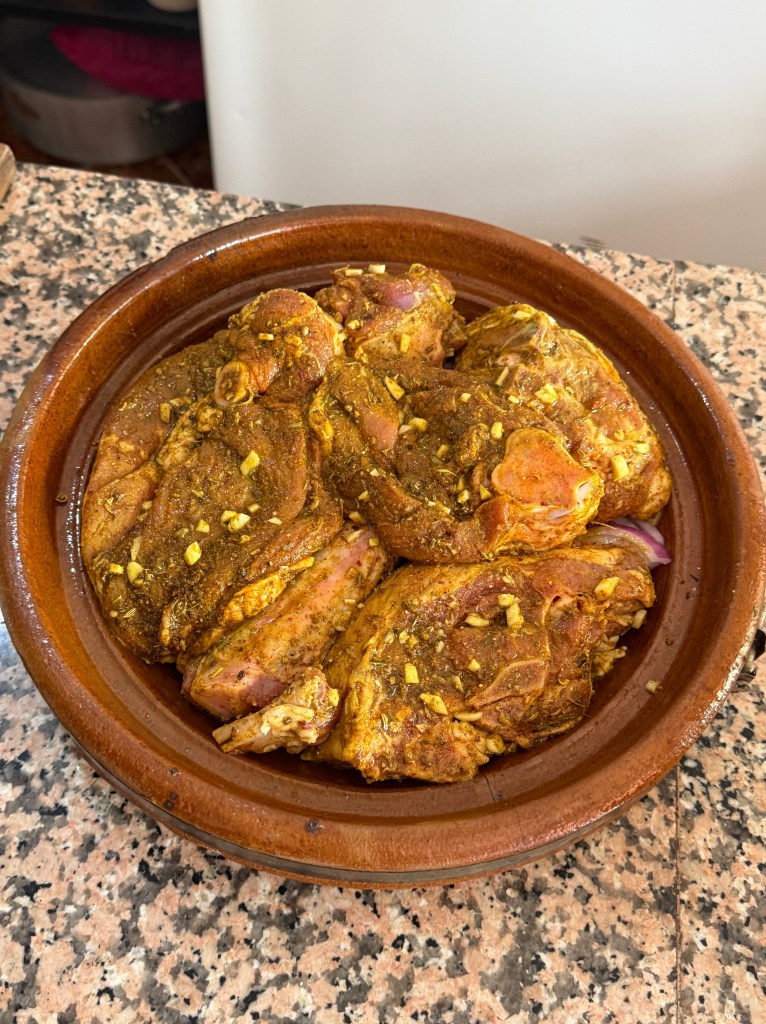
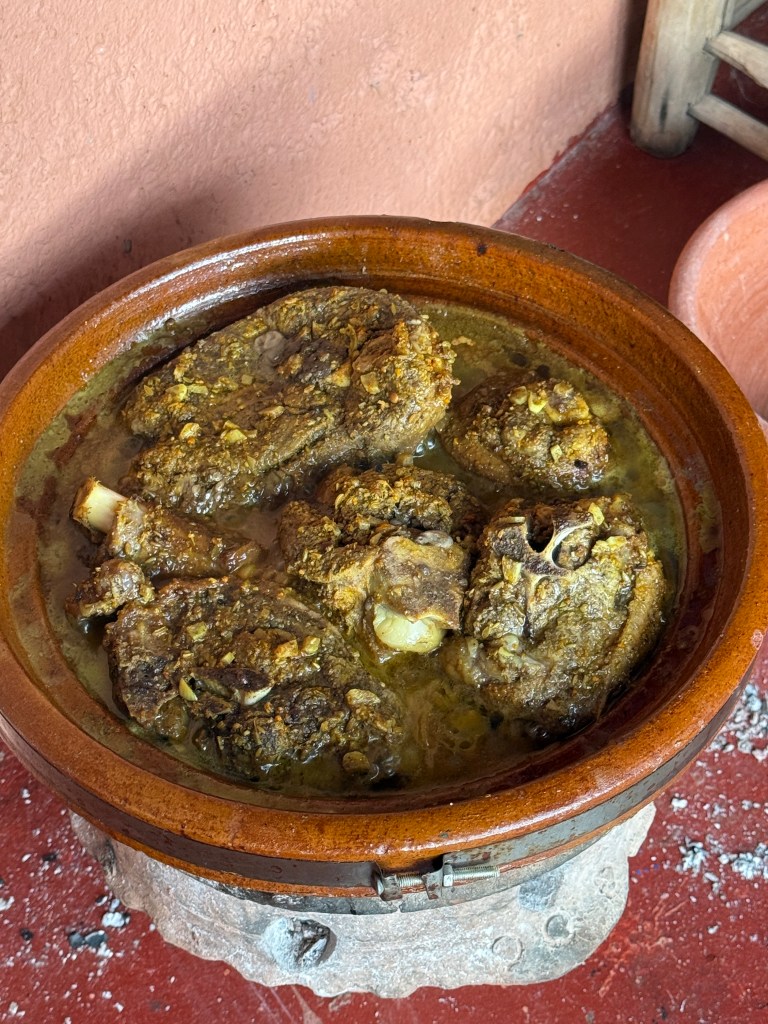
Amanda, the extremely gifted New Zealand chef who has called Morocco home for over twenty-three years, welcomed me into the Dar Tassa kitchen in Tassaouirgane with genuine warmth and expertise. Against the backdrop of the Atlas foothills, she showed me how to craft a goat tagine, using her own homemade, organic ras el hanout – a fragrant blend of rose petals and mountain spices.

As the tagine started to simmer, Amanda’s stories of embracing Amazigh traditions and sustainable living mingled with the rich aromas, making the experience a true celebration of Moroccan heritage and her remarkable culinary journey. It was 16:23 when we started the cooking process, placing the Tagine on its stand, known as a majmar (مِجْمَر) which in Moroccan Arabic literally means a brazier or charcoal burner.

As the Tagine simmered gently, filling the air with the promise of rich, layered flavours, Haj Brahim invited us to stroll through the village -a place marked by both the scars of the 2023 earthquake and the resilience of its people. Wandering the quiet paths, we witnessed not only the visible traces of destruction but also the heartfelt efforts to rebuild and restore the community’s spirit. On this poignant afternoon, at the close of the Muslim festival, I hesitated to take lots of photographs, sensing that no image could truly convey the emotional weight of what we experienced. Some moments, I realized, are best preserved in memory, where their true significance quietly endures. The image above vividly reveals the volcanic past, with the distinctive shapes of ancient molten rock visible near the centre at the top.

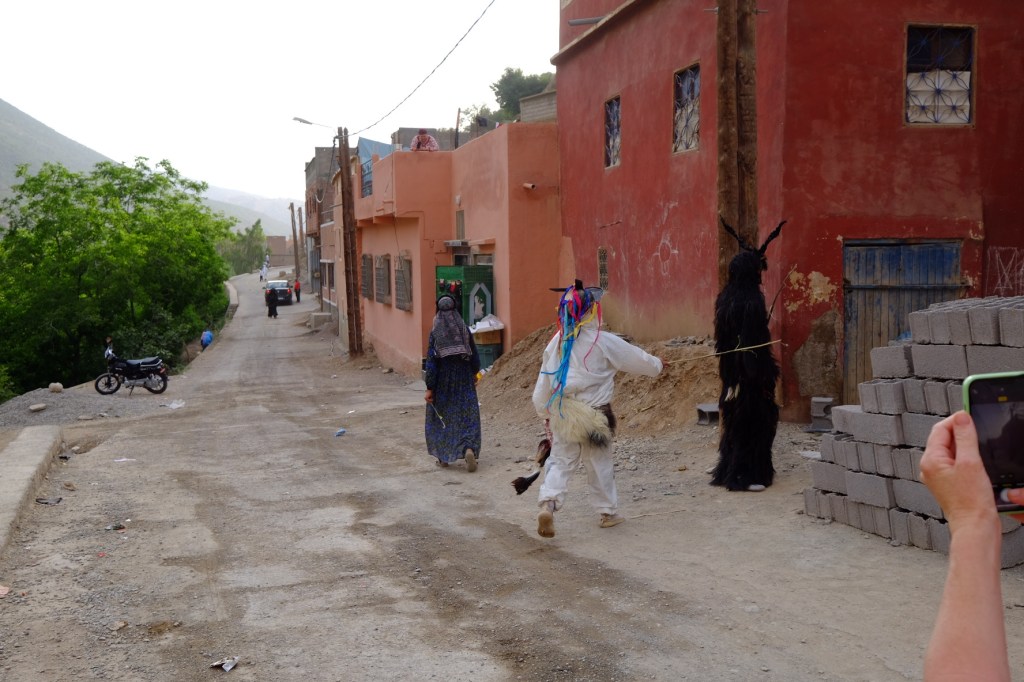
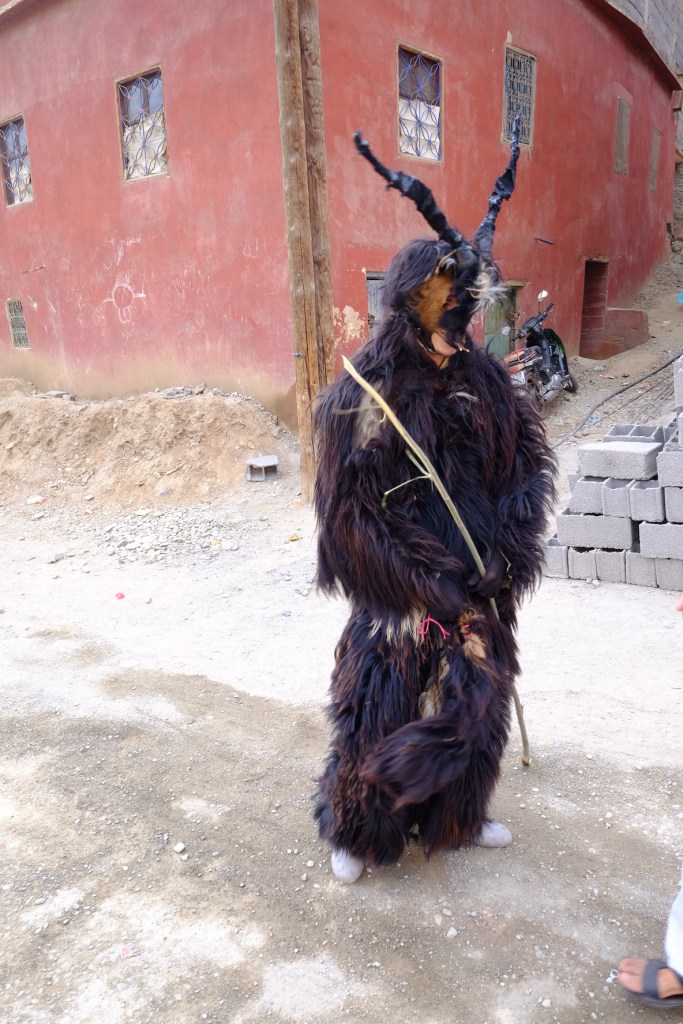
Bejloud, also known as Boujloud or Bilmawen, is a vibrant Amazigh (Berber) festival celebrated in Morocco after Eid al-Adha. Participants, often young men, dress in the pelts of sheep or goats sacrificed for Eid, don masks or paint their faces, and parade through the streets with music, dance, and playful antics. Sometimes called “Morocco’s Halloween,” Bejloud has roots in pre-Islamic rituals celebrating nature’s cycles and the balance of good and evil. The festival blends theatrical performance, social commentary, and communal blessing, as those in costume interact with the crowd, believed to ward off evil spirits and bring good fortune. Today, Bejloud remains a cherished tradition, uniting communities in joy and connecting them to Morocco’s rich cultural heritage.

As we wandered through Tassaourigane, we were greeted with warmth at every turn – villagers celebrating, children laughing and fleeing the playful ‘men with horns’, and joy filling the streets. Out of respect, I took just one photograph, with our host’s permission, capturing a home that had in some way, only just weathered the 2023 earthquake.

Soon, a local youth leader and his brothers, known to our host, beckoned us in for coffee. We followed them into a simple home with visible cracks, fixed with mortar, where we sat together on a large open terrace soaking in the setting sun behind us, and taking in the genuine hospitality of these humble, kind-hearted people, a memorable experience never to forget.

It was time to carry on the walk, our Tagine was cooking and we still had some places to see. I am going to leave the afternoon in the air, the village of Ouirgane is beautiful, and at the start of the Jebel Toukbal trail, I subsequently discovered a close friend, an artist had stayed there, in the same Dar Tassa in 2009.

Just as we were about to gather around the table and savour our Tagine, a sense of anticipation filled the air. The security cameras flickered to life, revealing lights weaving their way along the path. From the terrace, we glimpsed flashlights bobbing in the darkness, heard voices approaching, and caught the distant, hypnotic beat of a drum. Haj Brahim turned to us with a smile and asked if we would welcome visitors. With eager hearts, we agreed—and in that moment, we were graced with the magic of Bejloud. Before our eyes, the ancient celebration unfolded: vibrant costumes, rhythmic drumming, and spirited dancing transformed the night into a living tapestry of tradition. The hand-beaten drums echoed through the air, drawing us into the heart of Moroccan culture. It was a truly unforgettable experience, a rare and wonderful gift that connected us to the soul of the community.

As our newfound friends melted into the night, their laughter and the distant pulse of Bejloud drums lingering on the breeze, a gentle calm settled over us. It was time to gather and savour the Goat Tagine, which had been quietly simmering since 16:23, its rich aroma weaving through the air like a promise. After five and a half hours, the meat was impossibly tender, yielding at the slightest touch. By the soft glow of evening, the three of us shared the meal in the timeless tradition – no knives or forks, only the crisp, smoky tafernout bread to cradle each fragrant morsel. The food was exquisite, but it was the moment itself – bathed in warmth, tradition, and quiet wonder – that made it truly magical.

……………………………………Until next time…………………………..L8ers

Eating Venice, And Generally Avoiding Crowds 3.

I woke up at 04:30 on Monday morning, the excitement of the day was probably flying around my head, beckoning me to get up and start exploring, I took a brief look out the window and went back to bed!

The daily routine repeated itself until departure, Venice is just a wonderful place to explore so I was determined to get as much out of my few days as possible, after putting so much time into planning things. A knock at the door just after 08:00, ‘buongiorno’, breakfast had arrived, perfecto. Fresh Croissant, various bread and conserves, ham and cheese and a Latte, it did the job, I was not in Venice for a ‘fry-up’!

The 1st day was going to be a real test, had my planning process worked, the timings, route etc. Test one was getting a weeks Vaporetto ticket at the local water bus stop, again, there were so many recommendations and comments on social media, I ignored them all, went up to the ticket machine, selected English, 7 Days, inserted the credit card, PIN code, and boom, le ticket arrivé, simples, next stop The Penny Guggenheim Collection for some arty education.

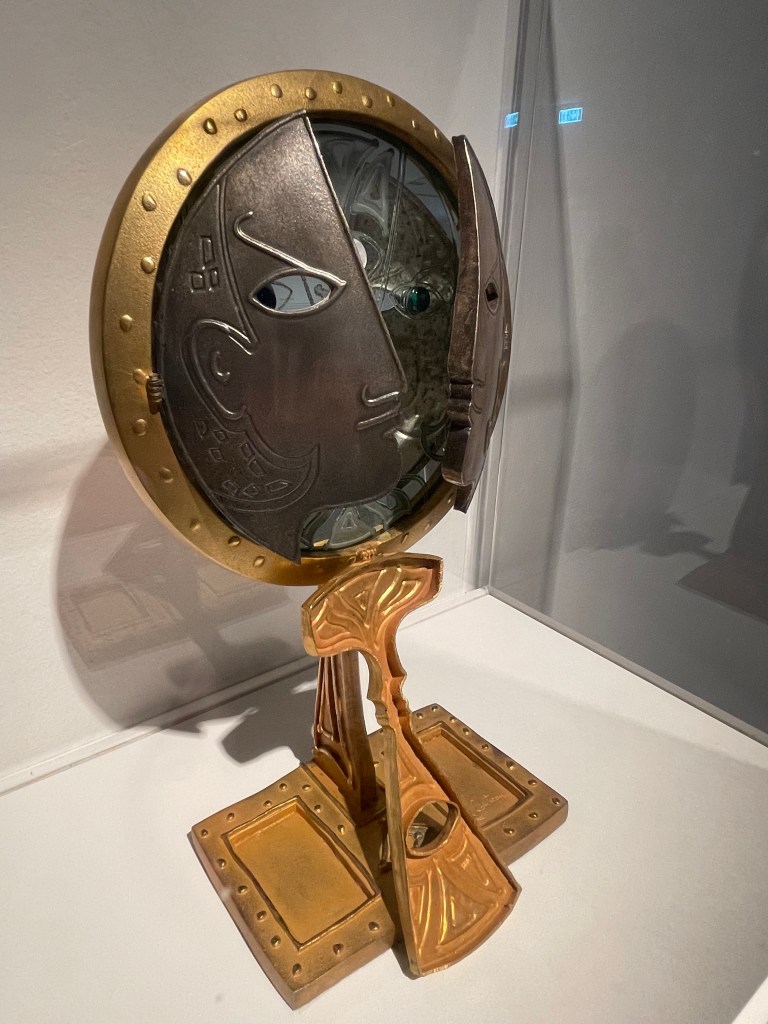
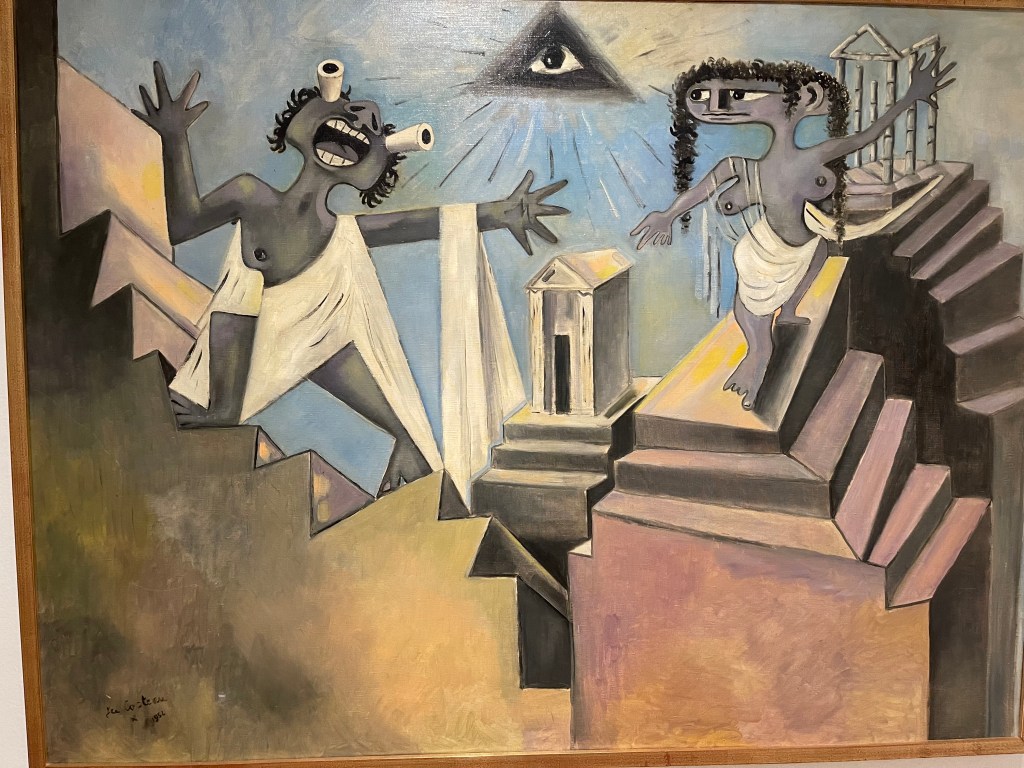
As well as a host of well known names such as Salvador Dali, Henri Laurens, Max Ernst and Pablo Picasso, a special exhibition was being presented, dedicated to Jean Maurice Eugène Clément Cocteau a french poet, playwright, novelist, designer, film director, visual artist and critic. He was one of the foremost artists of the surrealistavant-garde, and Dadaist movements and an influential figure in early 20th century art, and a drug addict! The largest picture in the above gallery is one of his, as is the ‘interesting’ one below, Violinist, Study for a Poster for the Menton Music Festival circa 1920.

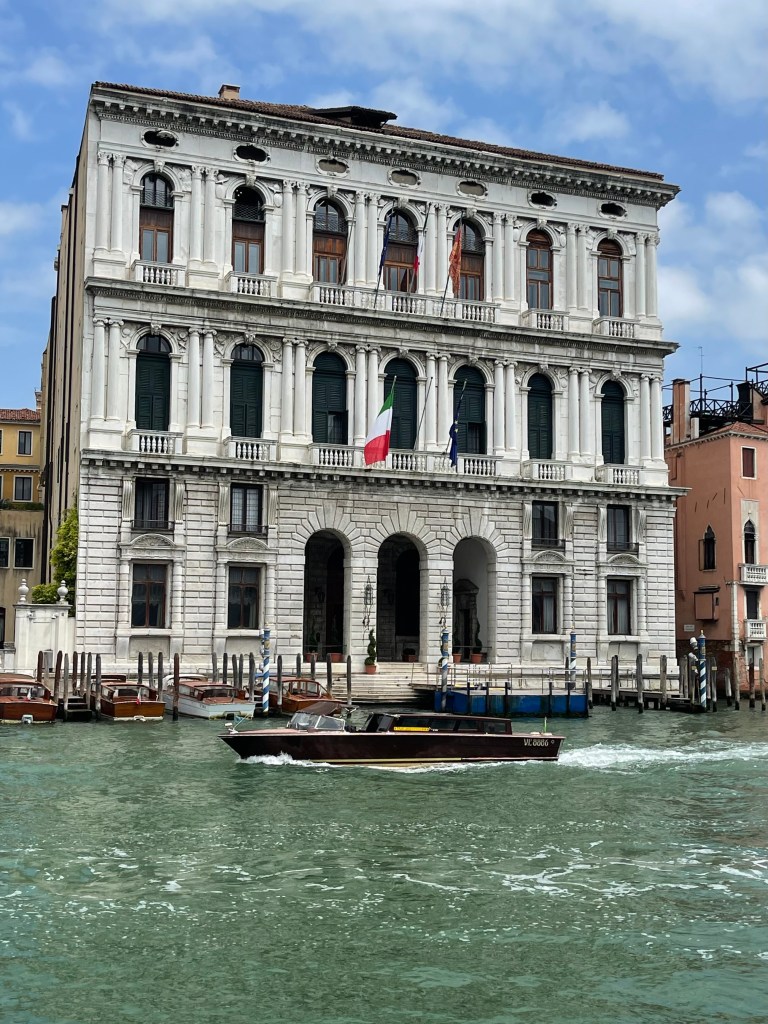
There is a lovely view of the Venice Prefect building ‘canal side’, and a delightful cafe selling homemade delights and serving coffee and tea, oh well, when in Venice.

Much of his work ‘didn’t do it for me’, but there were a few that seemed to be a route into his mind, probably during a drug ‘high’ in some cases, nonetheless I thoroughly enjoyed Penny’s collection and Jean Cocteau was definitely interesting, it’s really worth a visit if you are in Venice, I got a copy of the 257 page guide with the complete collection with pictures, as many are not on display.

During my research I had read a little about the famous Venetian ‘rowing boat’, the Gondoler. These magnificent craft are built by hand, without plans, from memory in a A Squero, a factory dedicated to their production and I was trying to arrange a visit, unfortunately they were so busy, they did not have time to allow a tour but I still made for Squero Di San Trovaso, an iconic location, and cicchetti stop, I was peckish! There is another Squero to the north of the city where you can also arrange a visit, but I found out too late, it’s more of a museum and restoration project though.

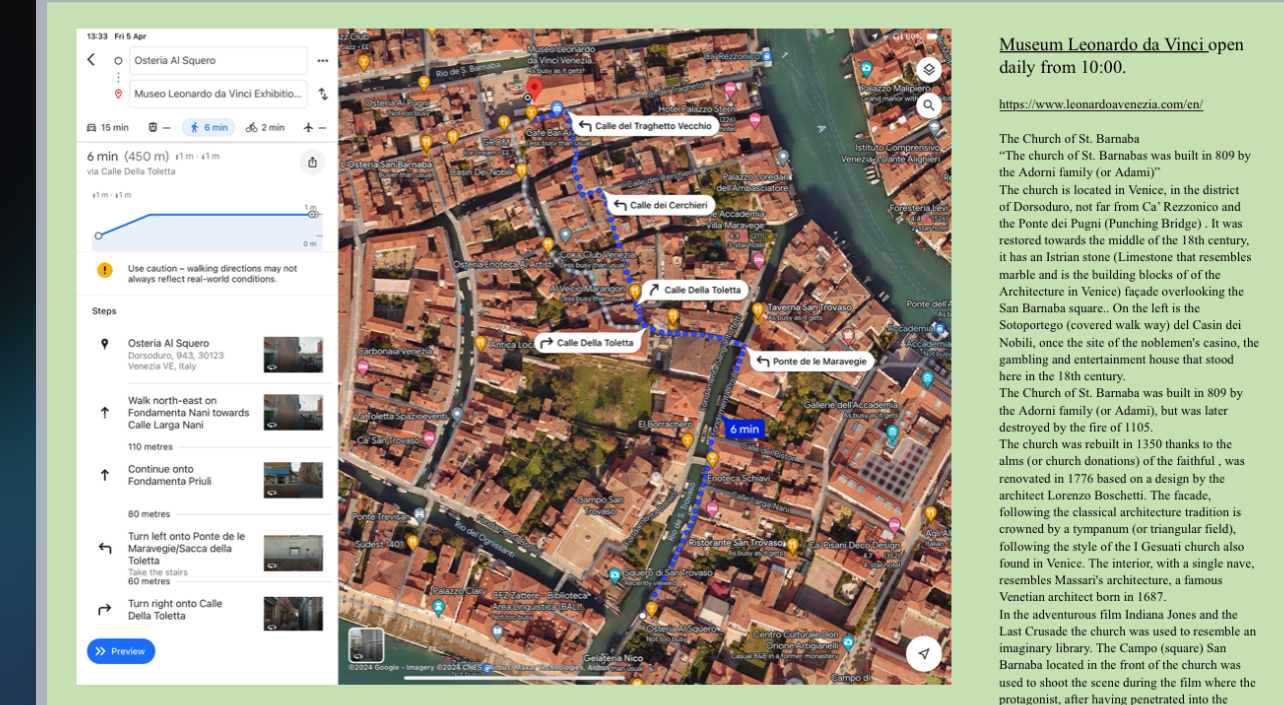
Continuing to plan, a trip to one of two Leonardo de Vinci exhibitions, via the Ponte dei Pugni, the ‘Bridge of Fists’ where disputes were settled by a ‘punch up’, I noticed at least three towers in Venice that had varying degrees of lean, fingers crossed they will be sorted before they lean to far and collapse!

Banksy has been to Venice, and managed to paint ‘The Migrant Child’ dated 2019, it’s going to be restored thanks to Italy’s culture ministry, its certainly a tourist stop for those in the know, located at ‘shhhh”, explore and find it yourself, it’s really very poignant.

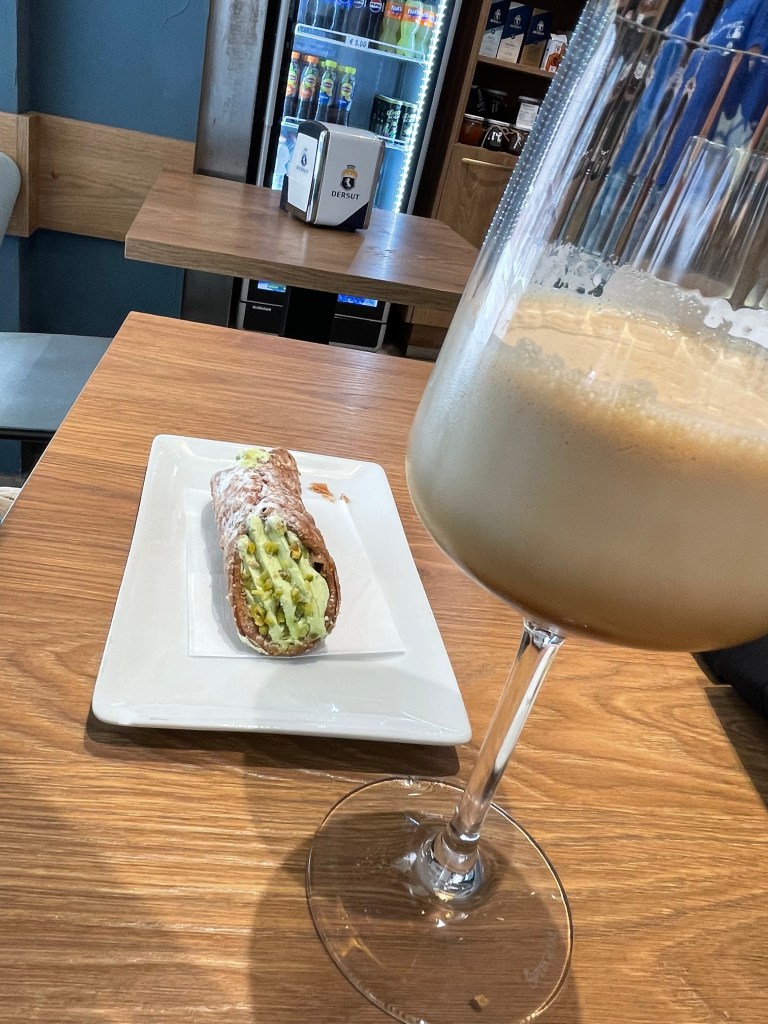
It was time for a quick pit stop before the next visit, Botegga del Caffé Dersut was right next to the Basilica Di Santa Maria Gloriosadei Frari and serves delicious cannoli and the most refreshing iced ‘shakerto’, chilled coffee in my case infused with cardamom, delicious.

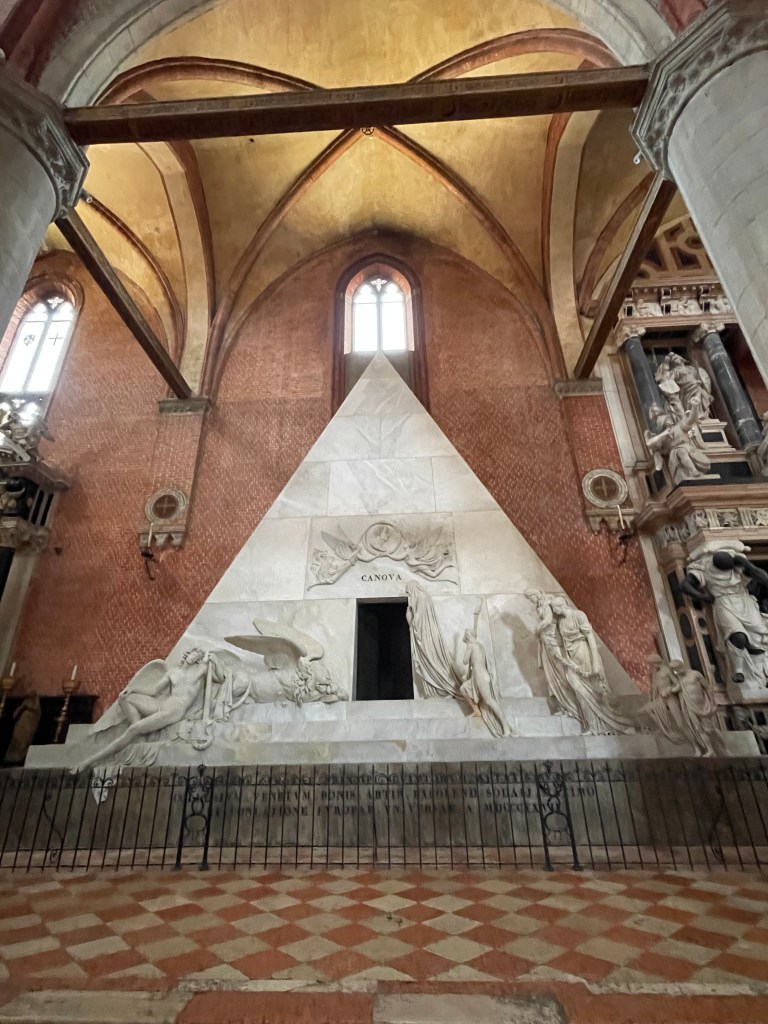
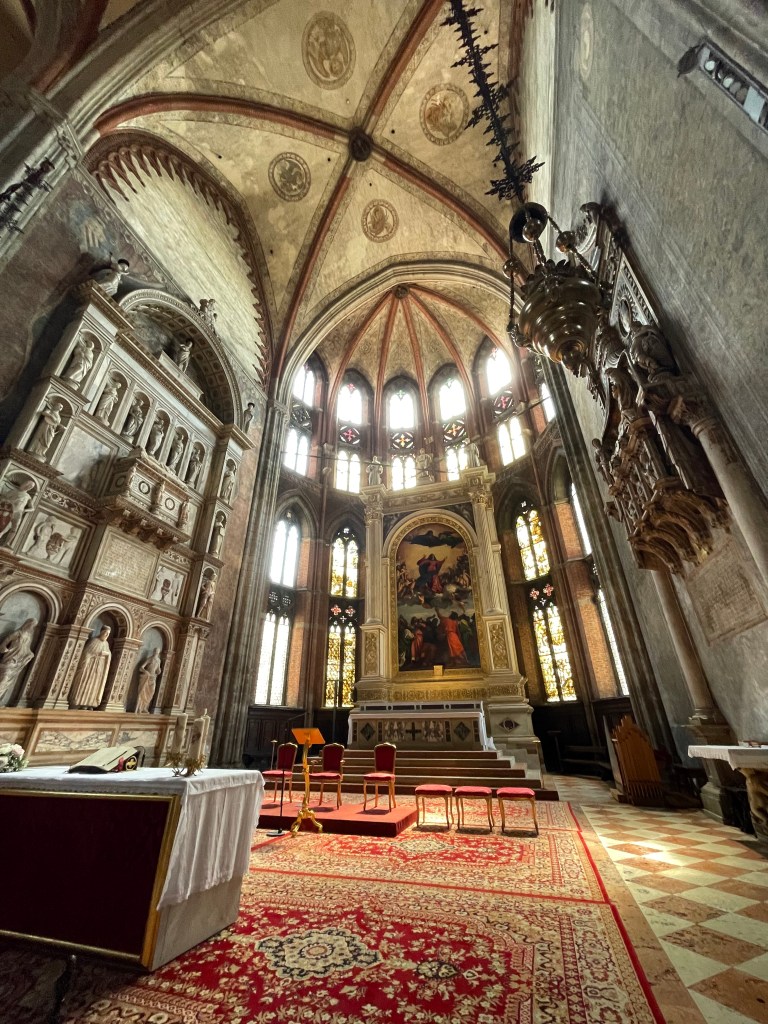
The Basilica was amazing, and almost completely empty which had been the theme throughout the day, I don’t do crowds, my better half has suspected I might be slightly ADHD and possibly OCD for many years, in more recent times I just prefer space and try to avoid confined areas and places that are crowded, luckily, so far, the day had been almost dreamy. Another guide to add to the collection and descriptions of the magnificent paintings, carvings and architecture, a stunning place to visit.

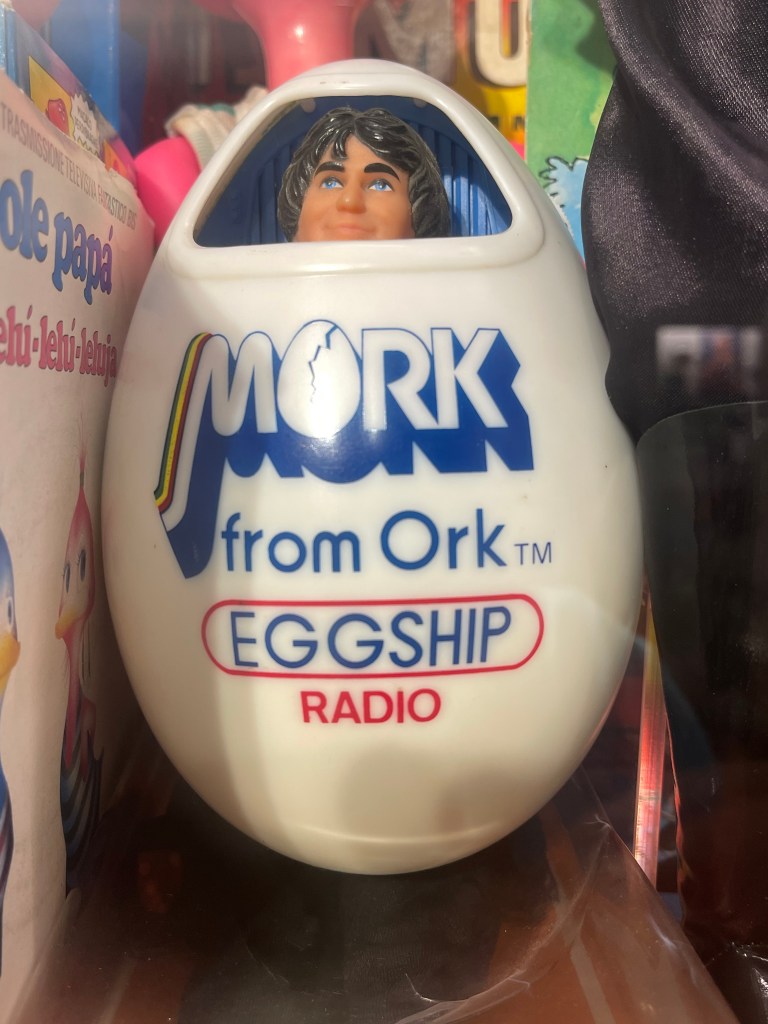
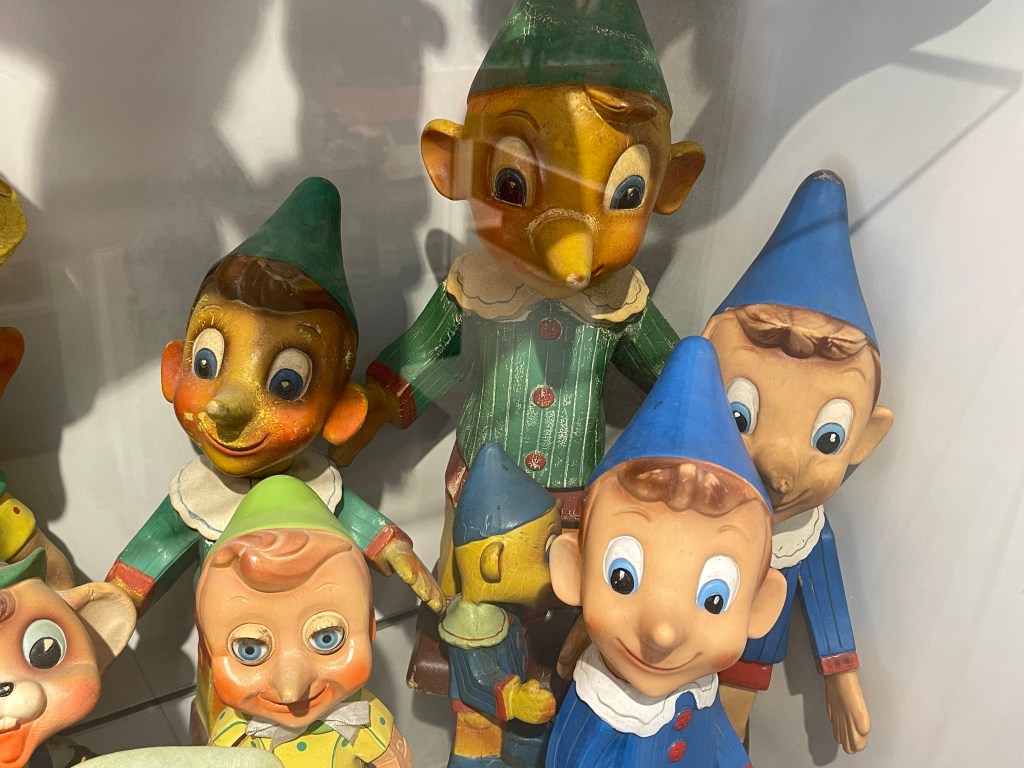
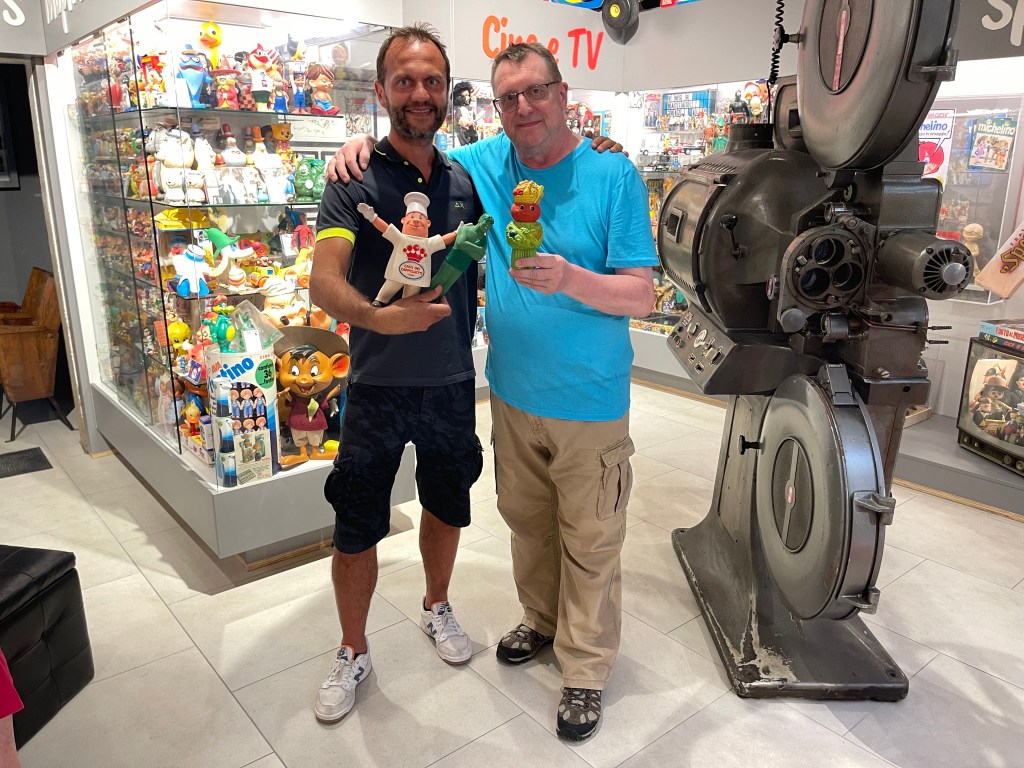
The last stop of the day was just brilliant, and certainly a ‘must do’ if you have even the slightest interest in the history of cartoons, cinema and the wonderment of the huge numbers of characters that have been created over the years, from Popeye to Pinocchio, Laurel and Hardy to Mork and Mindy the Venice Vintage Toys Museum contains over 5000 pieces, so many extremely rare, curated by the passionate Fabrizio Fontanella, what a place to finish the days touring.

I spent ages looking through the various cabinets and displays, being taken back to my childhood, black and white memories morphing into colour as technology developed, a few particularly caught my eye but one grabbed my attention.

My first ever international blog post was way back in June 2013, I had just come back from Masseria Montenapoleone in Puglia, southern Italy on my first week long cookery school. I was taught to cook real Italian food by the most amazing ‘nona’, she was just brilliant. In the picture I am making the original Tiramisu with the ‘proper’ biscuits. Now try and find them in the pictures above, the Tiramisu was perfect!

The day had been brilliant, the planning worked, timings were good and the Toy Museum had been an unexpected surprise taking me back to my first trip to Italy, to an amazing cookery school. Thank-you Fabrizio for taking the time to talk me through the exhibits, and removing some foodie ones for a photograph or two.

As I made my way back to the hotel, I notice another 80 degree tower!, I was convinced it had a slight lean. After a relax, refresh and change of clothes I was off to dinner at an iconic restaurant, featured in the film starring Jonnie Depp and Angelina Jolie, ‘The Tourist’, The Hotel Danieli. Unfortunately, it was too windy to eat on the terrace, but the dining room was opulent and views very pleasant looking out to the lagoon.

Impeccable service was obvious from the moment I arrived to the time I left, it would have been rude not to try a Bellini before starting the tasting menu and wine flight, which proved to be a delicious experience from start to finish.

Freshly made bread was really good, the Baccalà Mantecato delicate but flavourful, the Rissoto I felt could have done with another minute in the pan, it had a slight chalkiness to the texture, but it still tasted damn good, the Saffron Cod was a delight, the Panna Cotta perfectly wobbly and not rubbery or firm.

Day one had been a complete success, yes I was a tad tired (being polite here), I felt overwhelmed by the days adventure and walking back towards the hotel I noticed ‘that’ leaning tower in the night sky, tell me it’s not leaning slightly, maybe even more than slightly.

……………………. Until Next Time ………………. L8ers …………………..
Eating Venice, And Generally Avoiding Crowds 2.

There are a number of resources available which give you some clues as to where to take pictures that are less ‘busy’, people wise. You can see the hordes of people in the distance above trying to snap the ‘Bridge of Sighs’, I was on the Ponte de San Provolo further along the canal, nicely quiet and with the added interest of a Servizio Gondole, where you can loose many euros for the privilege of a trip in Venices traditional ‘rowing’ boat.

My arrival was midday Sunday, the afternoon was chilled and relaxed, the evening was to be the 1st culinary adventure, so back to the hotel to get ready. The rooms at A Tribute To Music Residenza are subtly themed, mine being the Mozart Room, No.103. It was comfortable and functional, I did not want, or need 24hr room service, staff wearing suits etc. It was perfect for my intention, a spectacular view, and a base to explore.

I was off to ‘LOCAL’ a 1 Michelin star restaurant for my 1st evenings treat, and what a night it was to be.

I arrived a few minutes early and watched the staff briefing through the glass fronted building. The location, in Salizzada dei Greci was a 5 minute walk from the hotel, nice. I was ushered in and lead to a table overlooking the cooking, brilliant, I could see some of the action.

During my afternoon wander I had visited the restaurant and seen the mise en place in action, the kitchen team prepping for evening service, I was really looking forward to my first tasting menu.

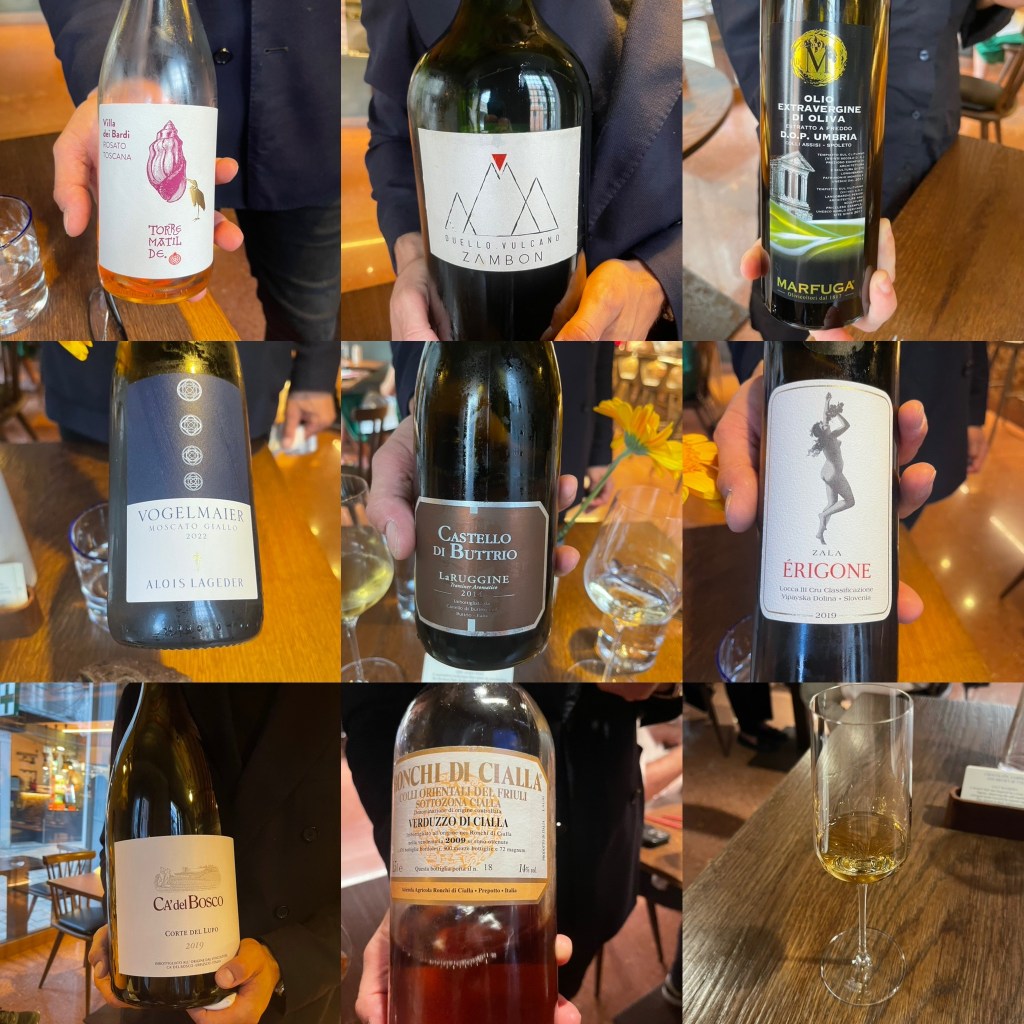
Local is the masterpiece of siblings Benedetta and Luca Fullin, with Salvatore Sodano running back of house, creating culinary treasures, and Maitre Sommelier Manual Trevisan doing an awesome job front of house, assisting with service and pairing wines with considered expertise. The food was pushing the limits and the wine matching would need to do the same.

Having seen the reviews and comments on numerous social media sites, the food could be described as controversial, personally, I would say more like unbelievably inventive, something to really test your palate and definitely to embrace with open arms (well mouth), it was an experience I will positively remember, truly magical.

Prior to the trip, I hade been checking each month, making reservations in 11 restaurants took some considerable effort, what, 11, yep, this was a foodie extravaganza and I wanted to pack in as much as an experience as possible during my week in Venice.

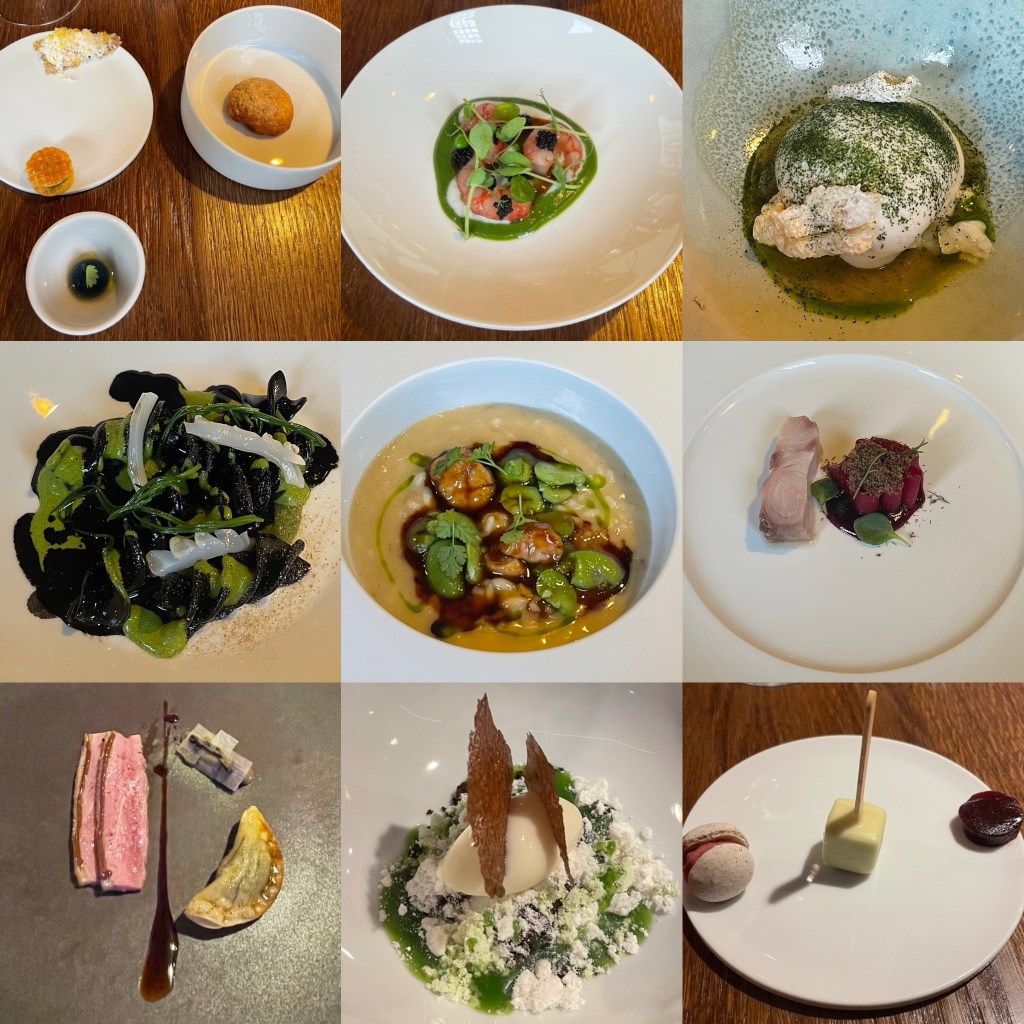
So, I chose the 9 course tasting menu, pictured above with wine flight, why not, a chance to see the expertise of both the kitchen and the sommelier, I was not disappointed in the slightest it was all just brilliant!

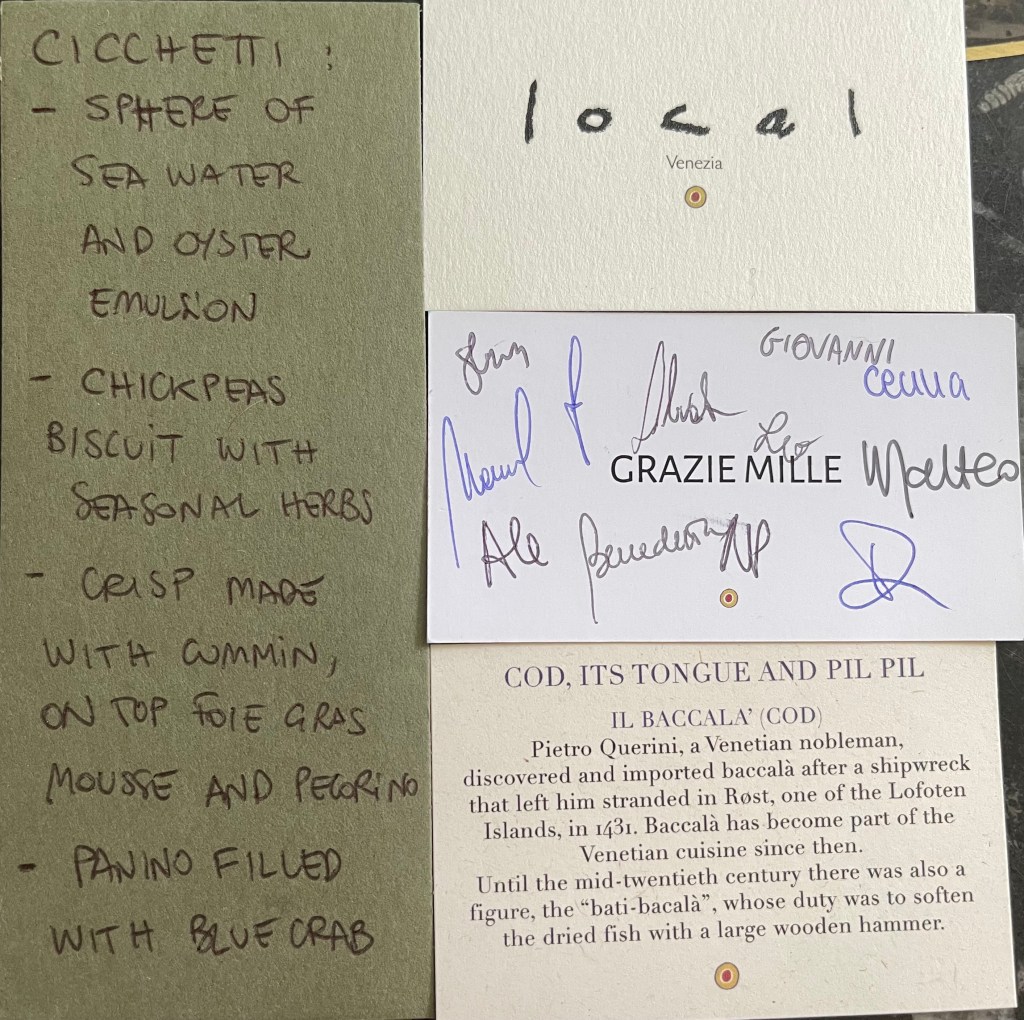
The first course of cicchetti was a stunning ‘mystery’, each item had been eloquently explained but in my excitement, I had forgotten what I had eaten, I could certainly remember each element being sublime, brilliant, sometime unusual but definitely delicious. I beckoned Benedetta, and within minutes, she had kindly written the description of each cicchetti as can be seen above left.

Manual did an awesome job with the wine pairings, each perfectly matched Salvatores stunning food, especially surprising was my 1st taste of ‘raw’ prawns, they are so so fresh in Venice and perfectly safe to eat, I had them several times during the week. Also stunning was the Squid Ink dish, another surprise. The sweetbreads were standout, to be honest the meal was just brilliant, all of it.

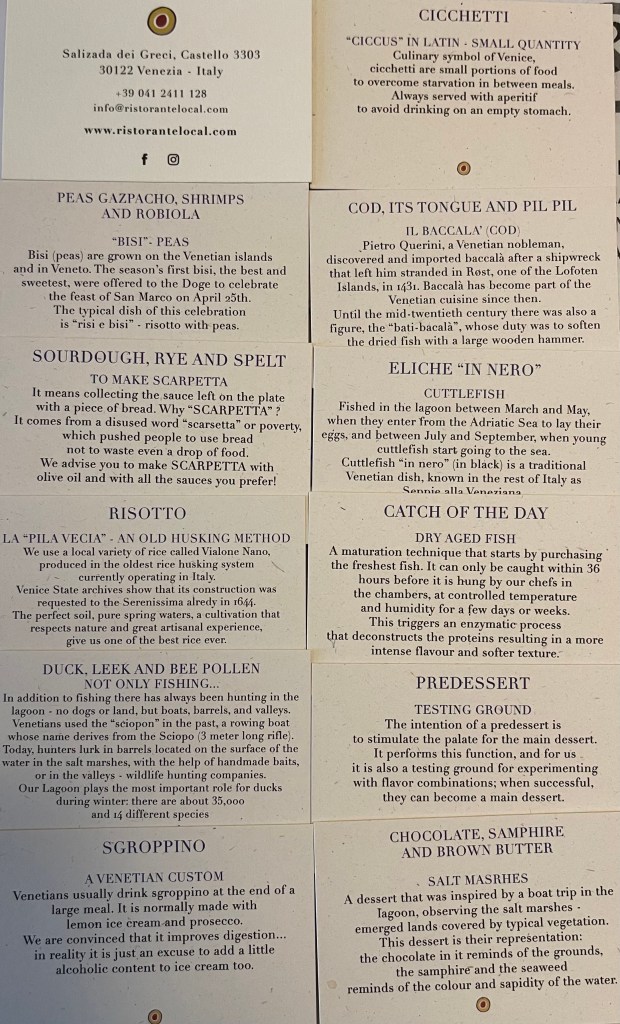
Each course is described on a small card which was a lovely touch, a souvenir to take away, a card personally signed by the whole team was also something different, another personal touch.

One surprise was the cod, its tongue and pil pil, particularly the origin and connection to The Lofoten Islands in Norway, my foodie destination in 2023, a perfect link and totally unexpected. The descriptions on the cards provided a culinary story, some context and reasoning behind each of the dishes, a really great idea as this is often lost in a traditional ‘menu’. Some dishes had their process described, the curing of fish, why and the result, nice.

Would I recommend LOCAL, hell yes, it was an unexpected culinary journey through a valley of tastes, textures and flavours which was really testing, but in a positive way. The extremely clever use of salt and sweet in some of the dishes was perfectly balanced and a real joy.

Service was unfussy but attentive enough to feel special. At the end of the meal I was invited to meet chef Salvatore and Manual for a quick chat, we discussed the menu, the critiques and his passion for pushing the boundaries, it was a truly delightful evening, another I will never forget, thank-you to everyone at LOCAL for a perfect 1st evening in Venice, Graci Mille indeed.

……………………. Until next time ……………. L8ers ………………
Eating Venice, And Generally Avoiding Crowds 1.

August 2023 was an interesting month, I was extremely happy having found myself working for a company I had fallen in love with, a small team of outstanding people, with character, charm, humour in gallons and generally totally bonkers! My manager was just brilliant, I had been given enough empowerment to make my own impression on the local team in Europe, Middle East and Africa, and I had just returned from Berlin after an extremely successful customer trip, I felt great; but I needed my annual foodie break and nothing was in the diary!

I am a massive fan of the sadly departed Russell Norman; an author, restaurateur, writer, chef and generally nice bloke who had inspired me in the kitchen with a number of cookery books, the most influential being Polpo, and Venice: Four Seasons of Home Cooking, which sit proudly on my bookshelf alongside his other books Brutto: A Simple Florentine Cookbook and Spuntino: Comfort Food.

Fast forward to June 2024 and my dream had come true, over 9 months of quite, no very intensive planning and I was in my hotel room at A Tribute To Music Residenza, on Riva deli Shiavoni and overlooking the Lagoon In Venice!

I had been looking at a number of social media feeds since August the previous year, sounding out what and how people got to Venice, what they did, and the variation was immense. I am the sort of person that prefers an agenda, typically a jam packed itinerary, travelling to another country for me is an invitation to explore, excite the taste buds and cram as much in as possible, the financial investment needs to be justified, leaving family at home for a period of respite on both sides is not something I take lightly.

After some thought I adopted what I considered a methodical approach to planning a week in Venice, focussed on food and preferably avoiding crowds of people which I don’t enjoy in the slightest. The process ended up with 34 pages of colour coded routes, visits, restaurants all carefully calculated around food and exploring the least ‘apparently’ busy areas of Venice, the one exception being The Doges Palace, but more of that in a future post.

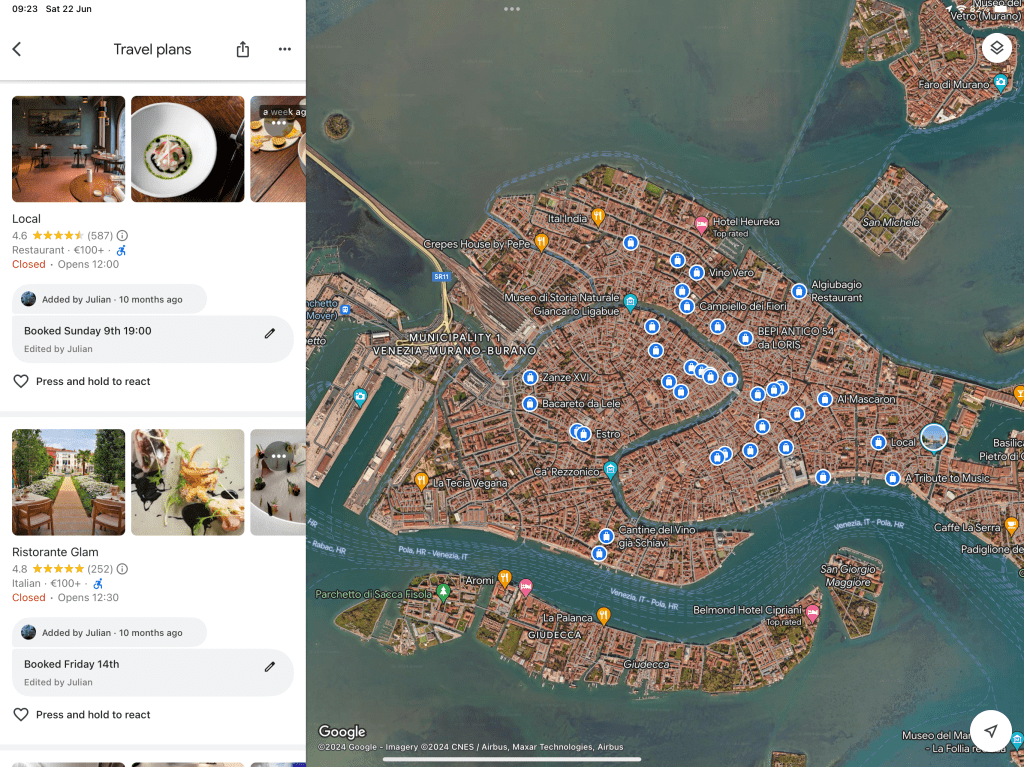
I spent hours studying restaurant reviews on a multitude of sites, and plotted each one on Google Maps which created the ‘framework’ for my visit. I then started to look at ‘what to see’, checked opening times and started to create a plan which was really fun to do, even though it did take up a lot of time. There are approximately 472 bridges linking areas of the city which added another interest, locating the unique ones and adding those.

Further material i studied intensely included YouTube videos which to be honest, were mostly disappointing as the same places kept on being shown, again and again. I purchased some more reference material, signposted by the likes of Rick Stein who had featured Venice on one of his TV series ‘Venice to Instanbul’ where he had lunch with a local gentry Francesco da Mosta, I had to get his books too; they were insigntful and a great read.

The day before I was due to leave I headed to the local library, they had a quality colour printer. My months of planning appeared on 34 colour coded sheets, each maliciously prepared and timed. The walking distance each day had been calculated to allow for itinerary changes on the fly, and the ability to swap days should the unexpected happen. I also included some notes of the sites, historical detail and architectural notes, creating a bespoke tour guide to enable time to be focussed on the do, not the how too.

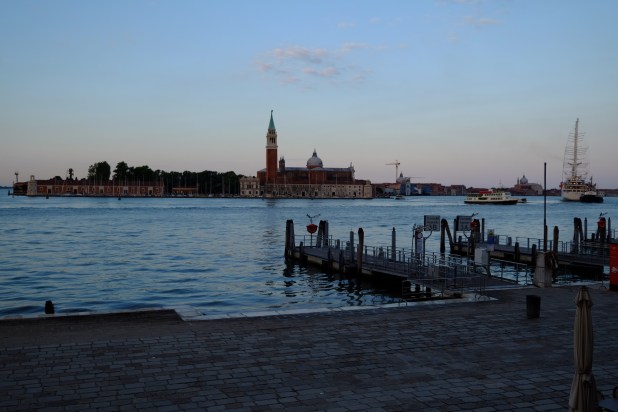
I had a lovely flight, the pre-booked shared water-taxi was brilliant (get your guide) the title picture is the journey into Venice from Marco Polo Airport which dropped me 5 minutes from the hotel. After settling in, a quick orientation walk was taken to find the evenings restaurant, more of that in post no.2 and on the way a quick ‘pit stop’ at Osteria alla Bandiera to start the week of, a plate of delicious, simple seafood, a theme that would continue throughout the week, delicious.

…………………….. Until Next Time …………… L8ers ……………………
Culinary Excellence – Not Me, but getting there! (Padstow Day 4)

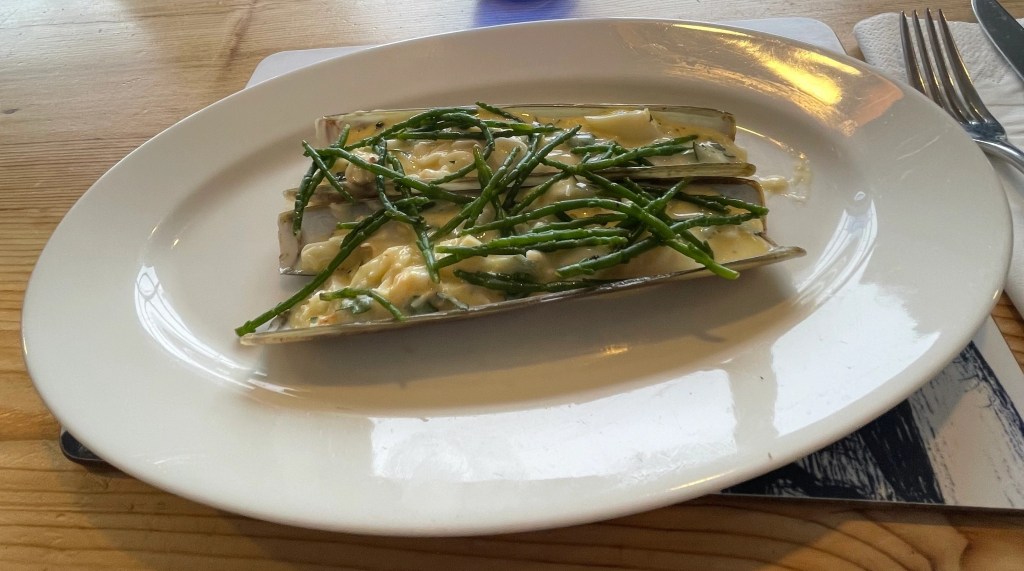
Spoots’, commonly known as Razor Clams are delicious when prepared and cooked properly, I had my 1st taste of them many years ago At Tom Kitchins Michelin star restaurant in Edinburgh, they were delightful.

Our first dish, on the last day in the kitchen was a Jack Stein creation, from his book ‘Jack Steins World on a Plate’, Razor Clams served with Crab and Samphire. Cooking these gems of the sea is an art, too long and they are like rubber, too short, yuck, get the timing correct and you get tender delicious morsels that delight the palate.

Breakfast was served, the clams were cooked after steaming for 2-3 minutes and then finishing in a sauce of fish stock, cream and of course, butter. The Samphire added some texture and ‘saltiness’, like seasoning without adding salt from a shaker, very tasty indeed and quick to make.

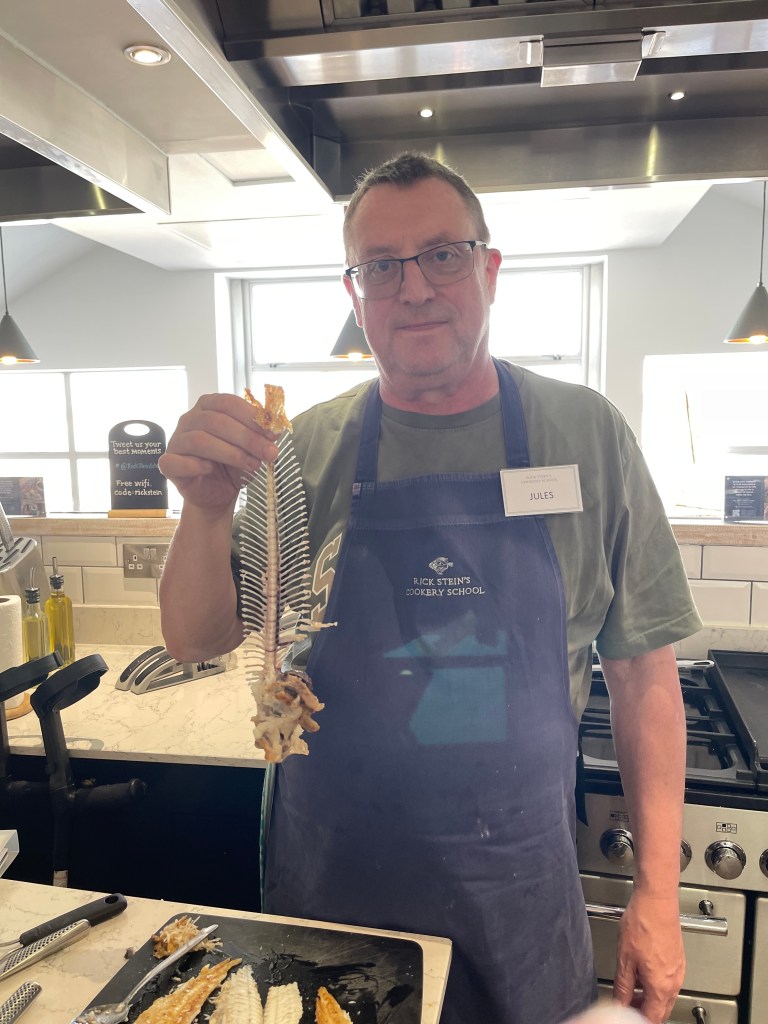
As part of the last days menu we needed to prepare some more fish for stocks and reductions, we were given a Hake to deal with, it’s a soft fleshed fish so if you can cope with its delicate nature, everything else is easy, my attempt including removing the skin is above, well proud I was when I ‘got it done good’.

’Industrial’ kitchen equipment was used to prepare our next treat, a rich classic fish soup with rouille and croûtons, and a grating of parmesan. The rouille used a homemade harissa which was simply prepared in a blender before our very eyes, it was another tasty dish, packed full of flavour, with the crisp fiery croûton adding to the party, and extras available for those who wanted them, yes please!

The last day was not as busy as the previous three which was a relief, everyone was feeling the impact of hours on our feet, all the prep, cutting and checking our recipes in order to produce a decent plate of food, over and over.

It had been great fun at the cookery school but there was still work to be done, like preparing a top notch dish of Roast Tronçon of Turbot with Hollandaise Sauce! The various dishes we had been preparing during the week had given us the chance to learn new techniques, revise and practise those we had tried before which was a really good way to progress skills, and confidence.

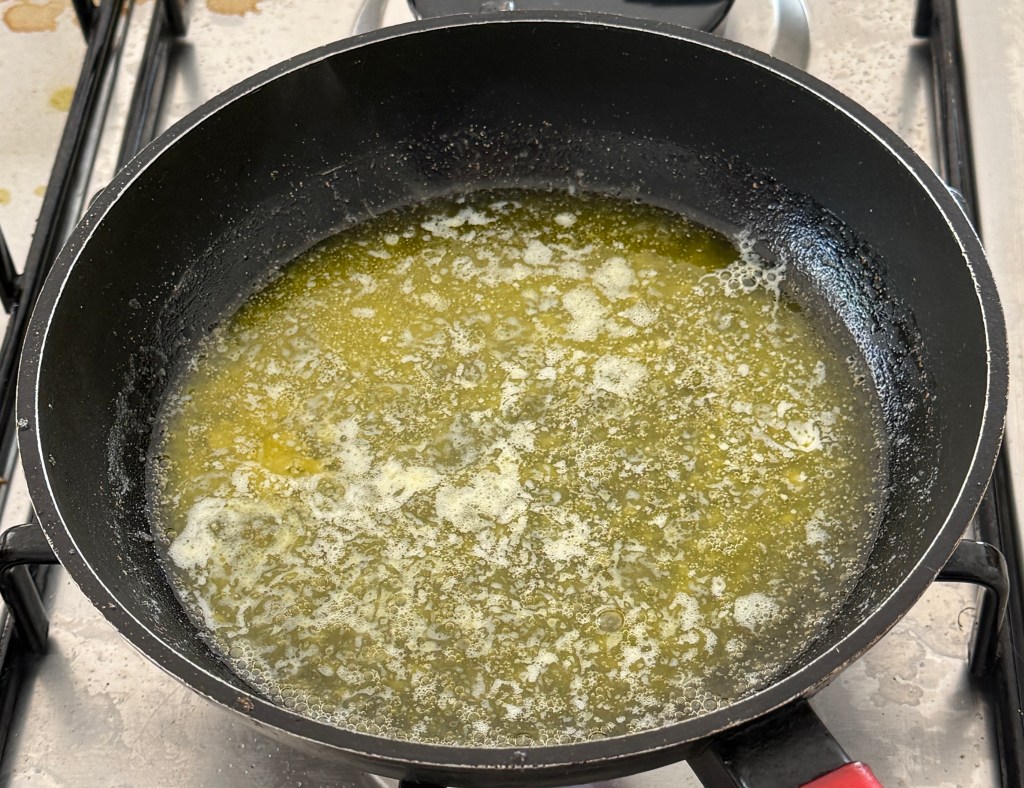
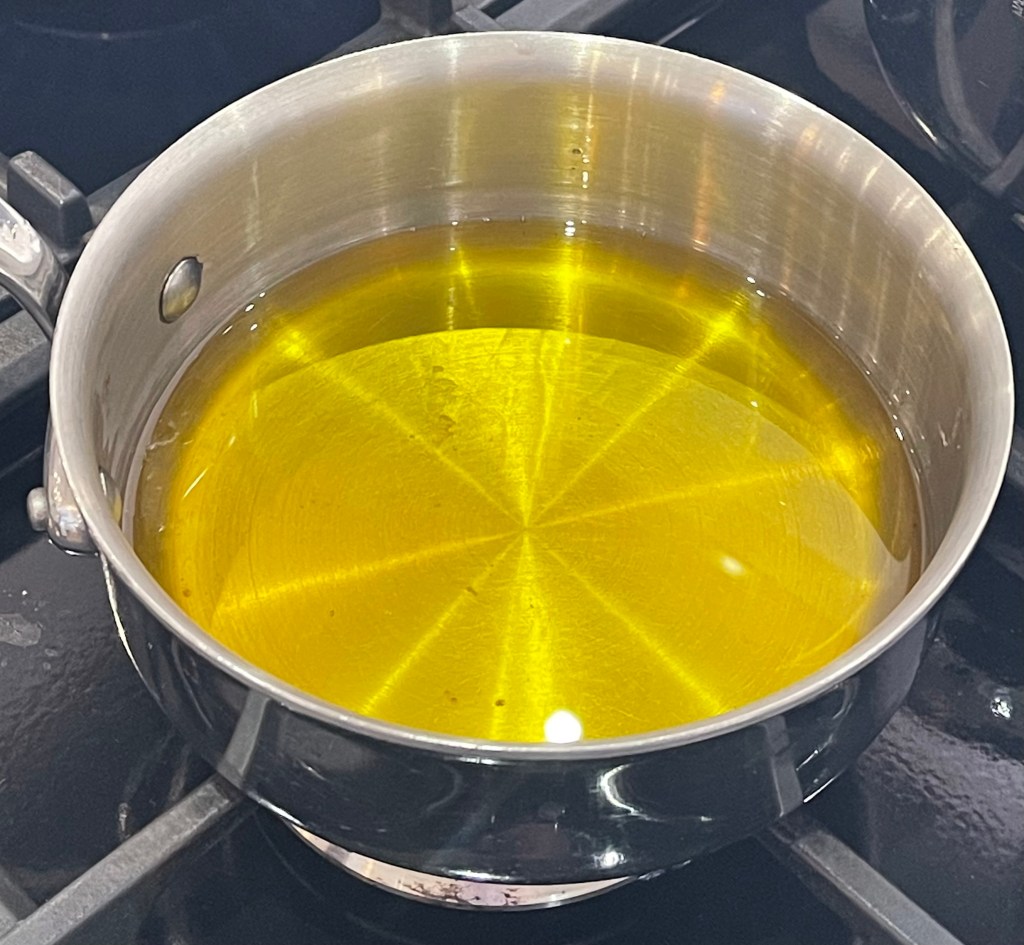
The previous day, a large pot had been put on the hob with several blocks of butter to cook slowly, to make clarified butter, the smell was intoxicating.

Preparing Hollandaise takes some practise, this time was my best effort ever, and I think I may have finally cracked it. I mentioned consistency in my last post, being able to reproduce something the same, every time, that’s where my head was at, and continues to be, it makes cooking so much nicer, feeling confident in what you are preparing, knowing the end result will be excellent.

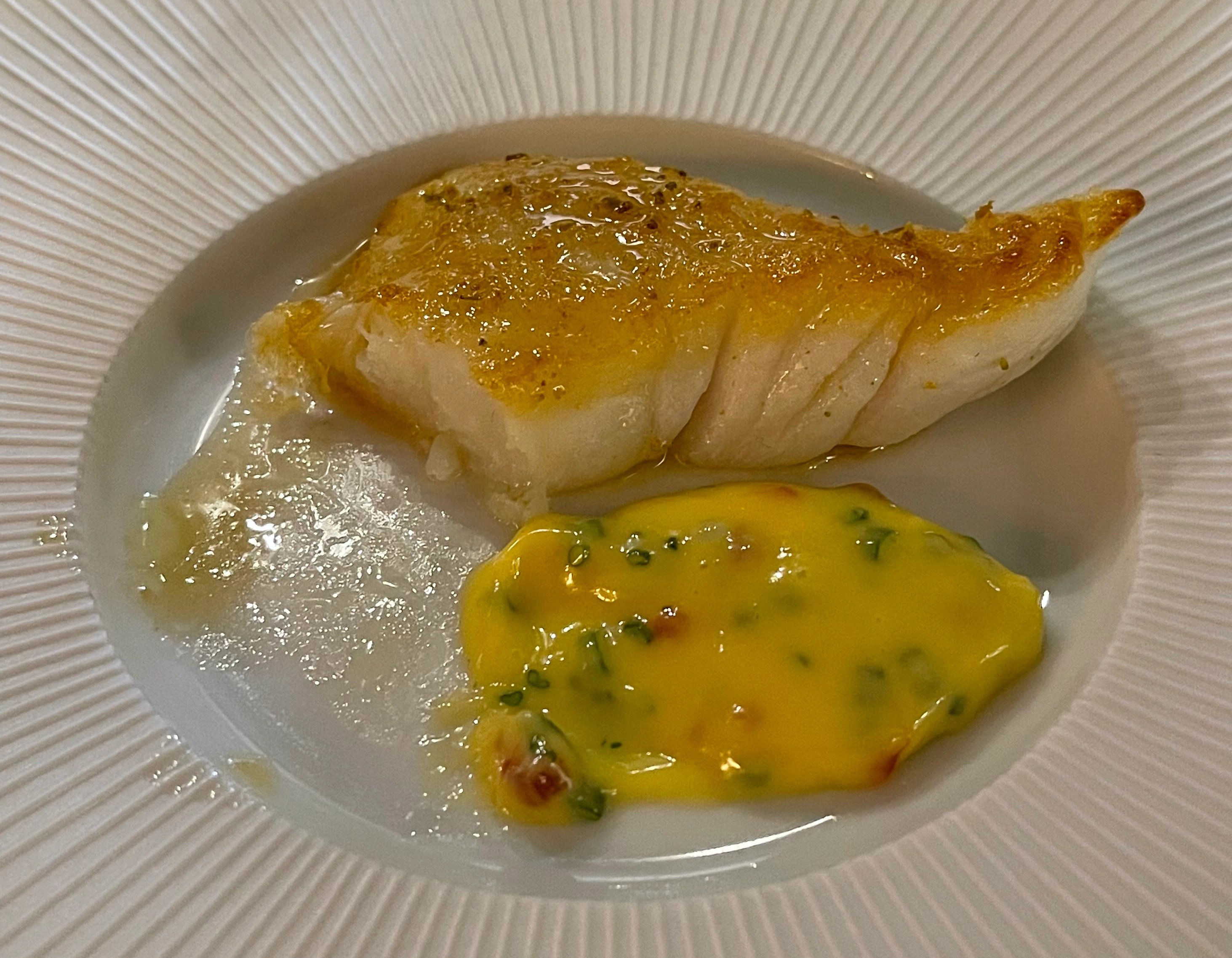
I was delighted, bright, glossy, a lovely consistency my Hollandaise was done. The Turbot, a fillet from a fish costing about £75, with only 5 – 6 fillets per fish was to be roasted, after some browning treatment on the hot plate. There are some techniques to understand when doing this, you can find out how by signing up for the course.

Once the fish was cooked we plated up, slathering the rich Hollandaise to our hearts content. We had also prepared a herb fines sauce, using Parsley, Tarragon, Chives and Chervil, this was placed around the plate and added an extra dimension to what was a delicious and extremely tasty plate of food.

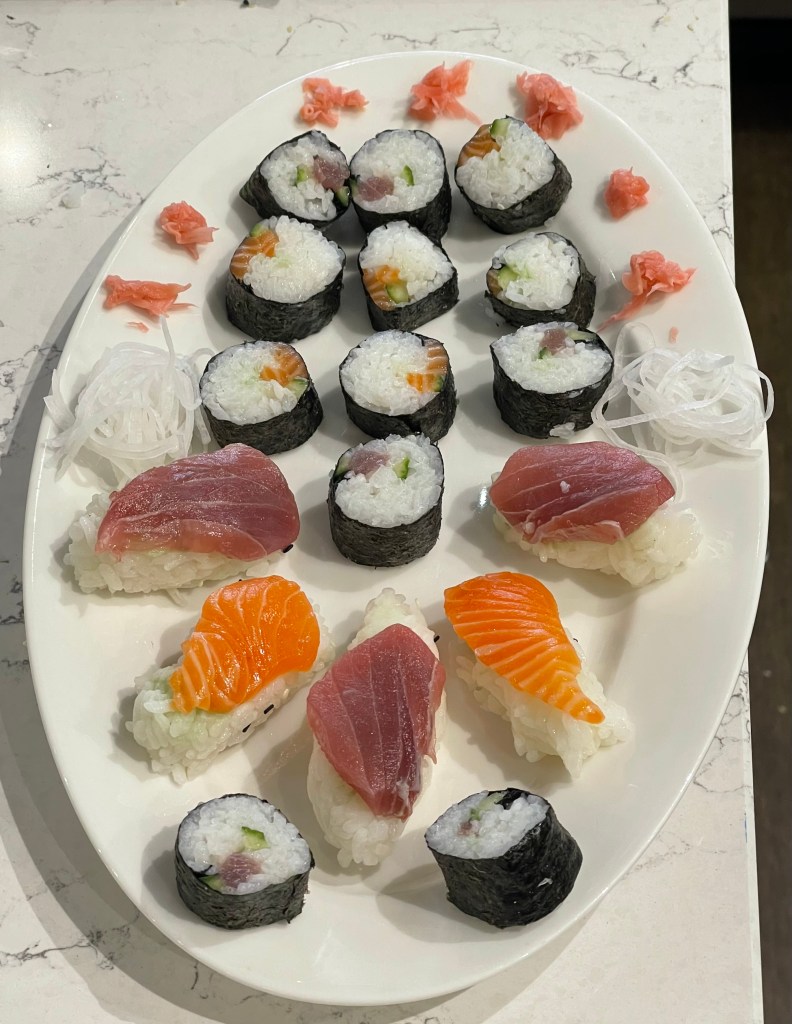
Lets make sushi! Nick gave us a masterclass in making several types of Sushi. Before starting, the rice had been cooked, chilled and seasoned with a mixture of vinegar and sugar. Various styles were created, like Nigiri, a hand moulded ‘oblong’ of sticky rice, with typically, a layer of raw fish. Makisushi, a roll of rice and assorted fillings such as Cucumber and Salmon, or Tuna.

Next it was our turn, again in our pairs we produced plates of delectable tasty delights, using bamboo rolling mats to shape the MakiSushi, some even attempted the California Roll where the rice is on the outside rather than the inside. We were provided with Ginger, and some GENUINE wasabi, not the horseradish based product you typically get in the UK, this was the proper stuff from Japan, in root form, boy it was completely different to what you are normally served on the high street.

The course was complete, 4 days of intensive cooking, and eating, with Nick and his brilliant team making sure everything ran smoothly it had been fantastic. My knowledge and more important, confidence has been raised (again), and dealing with fish will become a more frequent activity, we are lucky to have some local suppliers where we can get fresh line caught fish whole, perfect.
I wandered back to he hotel after receiving my attendance certificate and saying goodbye, there was still one more thing I had booked but I had some time to relax and ended up watching some cookery programs in my hotel room!

I arranged this trip 6 months ago, a lot of planning was involved and now my last night was to be at probably, no yes, my favourite restaurant in the U.K.*, Paul Ainsworth at No.6, my second visit I had high hopes indeed. It was raining again (a lot), and I arrived at the front door at least 40 minutes too early.

*I am challenged as to favourite restaurant overall, No.6 is up there at the very top, but, there is one other restaurant where I have had an amazing meal that physically made me cry with delight, and the fish was the dish that did it for me. Read about it HERE

Right, back to the brilliant No.6.

Sitting above the restaurant is a cosy bar called Ci Ci’s, selling Cocktails and Pintxos it usually has to be booked in advance due to its cosy nature, there was room for me so I was welcomed up the stairs and invited to sit at a bar stool.

There is an interesting and extensive cocktail list, something for everyone, I decided on a ‘Three Of A Kind’, based on a quality Calvados it was delicious. Tom who was sorting my drink out was friendly and a perfect host, we chatted in-between his cocktail preparation, I was gearing up for a fab night downstairs in the restaurant. After I was served there appeared to be a ‘run’ of ‘Three Of A Kind’s’, either people were listening or they knew a thing or two.
Despite the amount of food that I had consumed already during the week, and on the last day of the cookery course, I was hungry and had some time to spare before my booking, so I decided to grab some Pinxtos, in my case Cave Aged Manchego, Rosemary Crackers and Chestnut Honey, delightful.
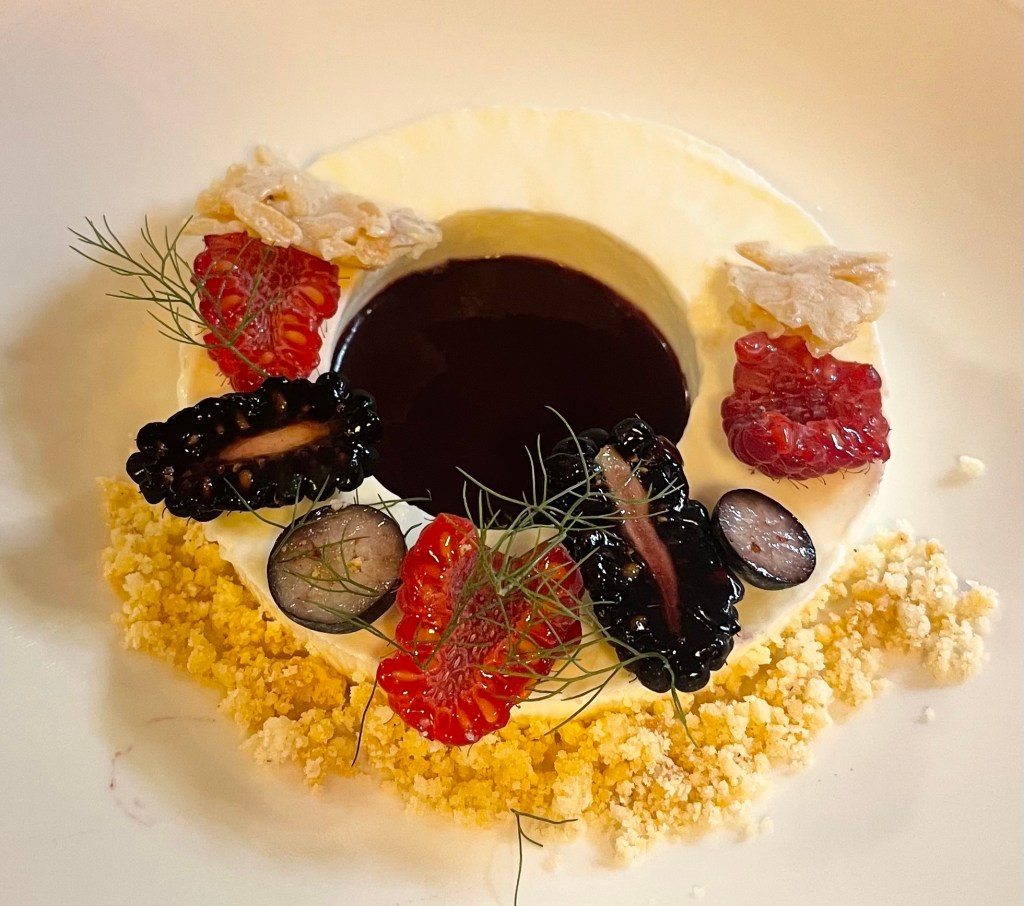
I ‘get’ savoury and sweet, this was a perfect marriage and got my taste buds tingling.

It was soon time for dinner and as we were going downstairs I was told of the refurb upstairs, and the creation of a pastry kitchen and was invited to take a quick look. Yes Please!
As I looked around I recognised the distinctive shape of Barkham Blue Cheese from Two Hoots Artisan Cheese makers, based near where I live! Middle Picture left shelf, the UFO shaped objects, it’s a cracker if you can get it!

I then recognised Alice who walked in behind me, an extremely competent Pastry Chef, now Restaurant Director, ‘welcome back’ she said, that’s the first sign of great service considering it was two years since my last visit.

I was prepared for a good night, but epic is a more appropriate description of the evenings events, truly memorable.

A tasting menu with matching wine flight was ordered, a special occasion, being my last night in Padstow after another culinary adventure it was the only choice I could make. The menu has land and sea options, and follows a story, a different style from other restaurants and great fun.

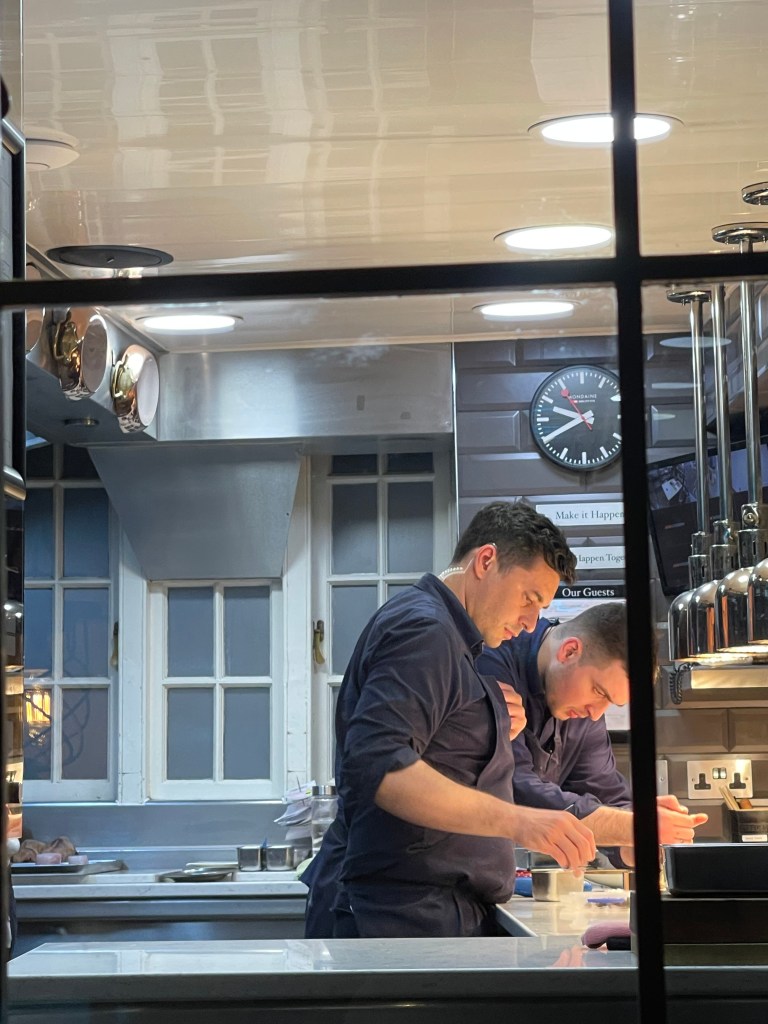
I was seated at the same table as last time, a perfect view into the kitchen, my favourite spot to watch all the going’s on.

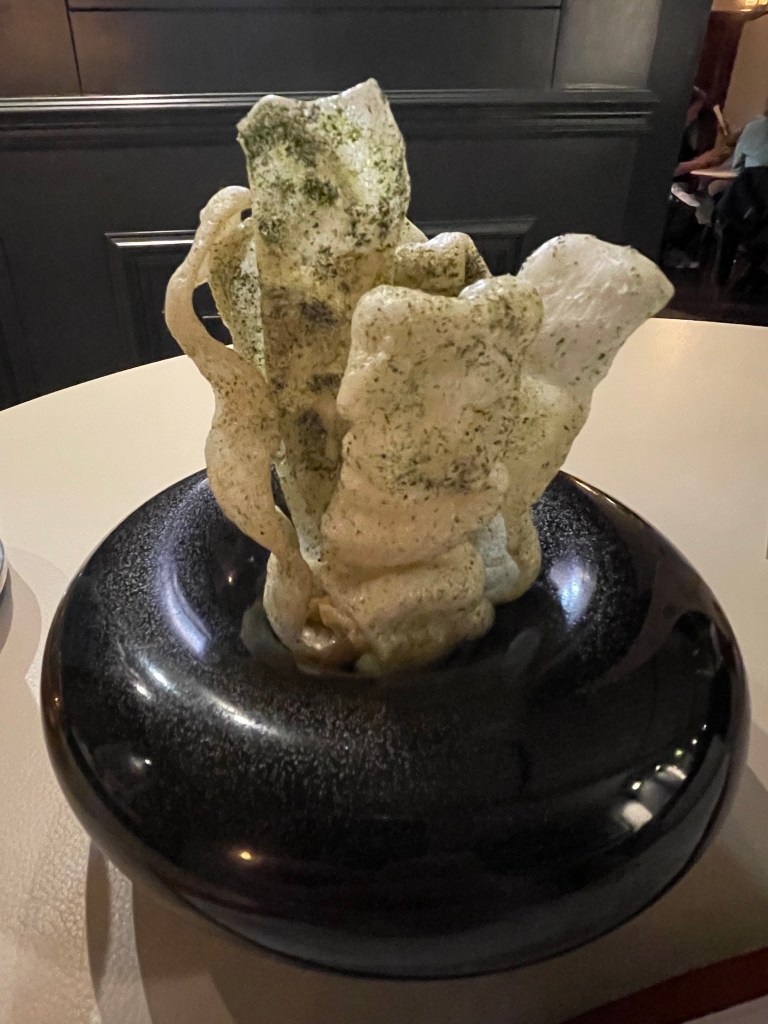
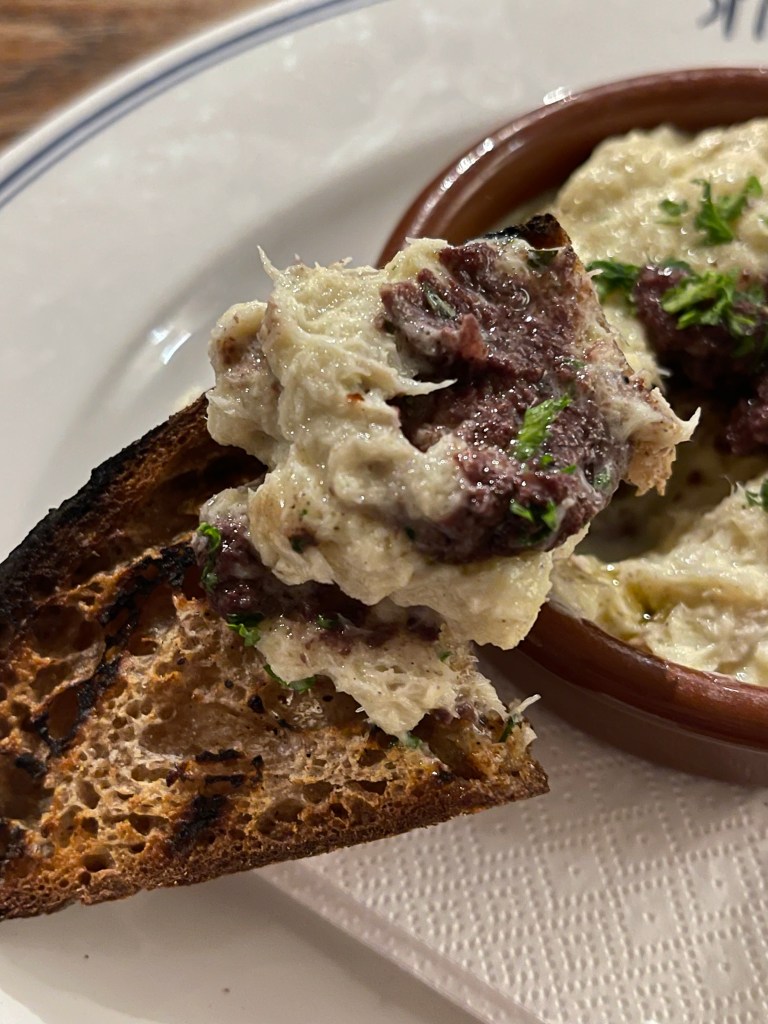
Some nibbles to start things off, ‘Quavers”, with Vinegar and Seaweed seasoning, in a moreish Aubergine Dip was really surprising, so so tasty, and this was just a ‘snack’!

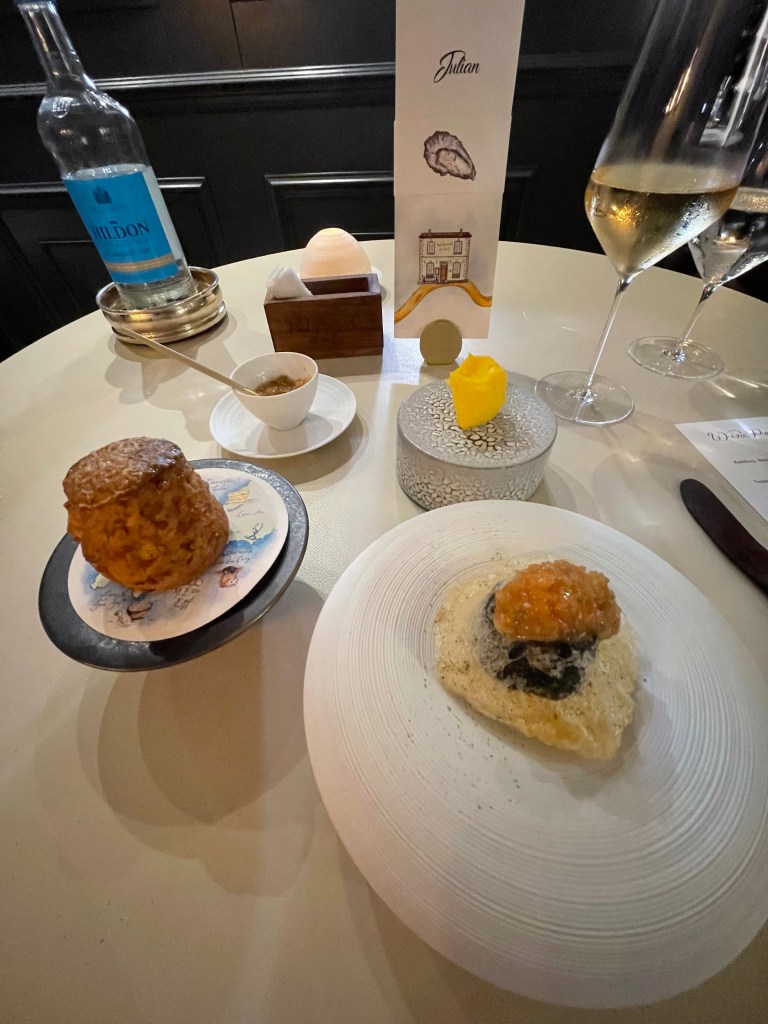
I won’t describe all the dishes this time, suffice to say the 1st course was a belter, I recognised the Cheese Scone, a delicious speciality of No.6 and featuring on the menu twice in different guises, the accompanying Blanc de Noirs from Alfriston in East Sussex, a pleasant treat being a UK sparkling wine, it was perfect.

Rathfinny Estate is a relatively young vineyard, established in 2010 it utilises a south facing slop, chalk soil and low intervention techniques to produce some amazing bubbles.

Chris McClurg, Chef Patron popped out of the kitchen and said hello, also welcoming me back and we chatted briefly before he was back in the ‘engine room’, preparing food ready for serving, a true gent.

Soon, Chris was back, personally serving my next course, the Smoked Eel with Crapaudine Beetroot another belter of a dish, the previous version I had two years ago was with a Pomme Anna. This was very tasty, I do love Eel, but don’t eat it often. The balance of all the textures and flavours was spot on, especially the earthiness of the Beetroot.

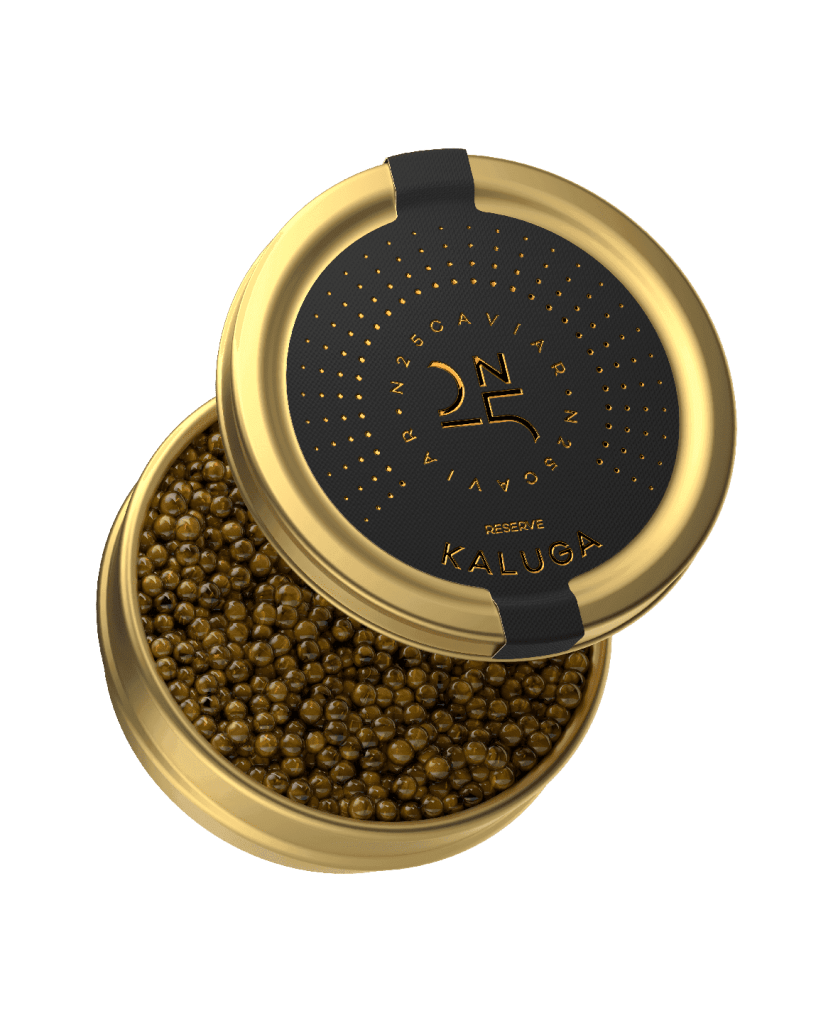
There was a very healthy serving of Kaluga Reserve N25 caviar which worked well.

An exquisite species, second largest of the sturgeon family reaching up to 1000kg. It is also known as the “river beluga” as it is the only other sturgeon from the Huso family; the other being the Huso Huso (Beluga). This extraordinary variety of sturgeon also produces the most amazing and large grains of caviar. Due to the old age of the fish and over a decade of waiting needed to produce caviar, the roe is one of the most prestigious and sought-after. It was very tasty indeed.

The wine match, a Trebbiano 2022, from an estate in Tuscany that dates back to the 20’s is heaped in history, and has been cared for by the Contini Bonacossi family, it was delicious, another belter of a paring.

Next course, hello Chris, I was getting star service tonight, Wild Turbot, booooooom, delicious. I loved the Scarpetta which appeared as I was about to finnish, Perché non fai la scarpetta? Scarpetta is the practise of mopping up your plate with bread. This bread, freshly made, warm and doused in a delicious olive oil. Yummmm! Apologies for the picture, I had dived in before taking a snap, it looked so good!

Another brilliant wine paring, this time from the Languedoc region of France, Boulevard Napoleon ‘Le Pal’ comes from the village of Livinière, 70 year old + vines produce a very special wine, only a few hundred cases are made each year the grapes are hand harvested, fermented and aged using French Oak Barriques.

In making wine there are many different sizes of barrels used. Barrique barrels are relatively small barrels, but not just any small barrels. Barriques are also known as Bordeaux barrels, because it was in Bordeaux that their shape and size was designed and developed. Barriques are relatively tall and have a capacity of  225 liters (59 gallons).

This winery is a partnership, part of the well known St. John chain based in London, Fergus Henderson is renowned for his hardcore nose to tail food, his restaurants are on my ‘must do’ list.

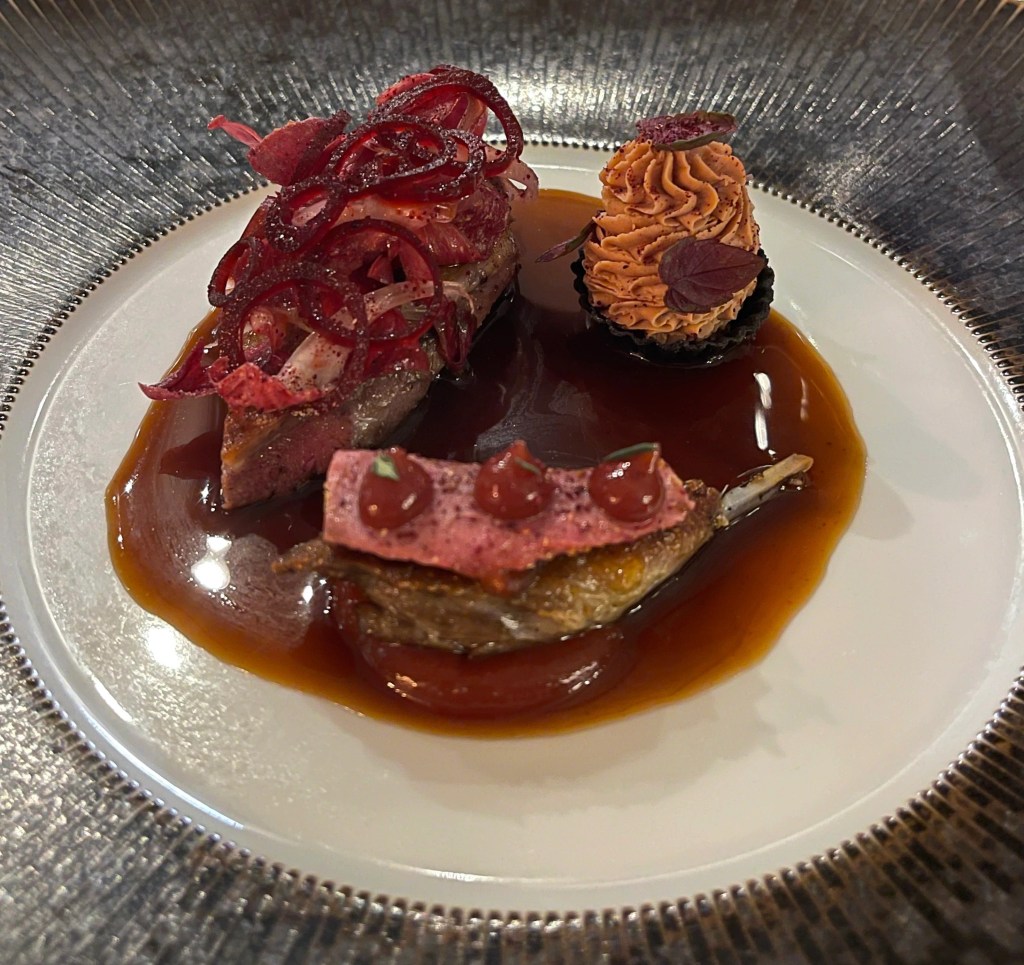
I adore this dish, ‘All Of The Pigeon’, it’s outstanding, moreish and makes me want to weep it’s that good. Using as much of the Pigeon as physically possible it hits all the taste buds, bouncing around the palate, teasing every flavour receptacle. I especially like the whipped Pigeon liver parfait piped into a crisp serrated shell, perfect.

The sumptuous red wine from the Veneto region of Italy was another perfect choice. La Grola, 90% Corvina Veronese and 10% Oseleta is manually harvested (hand picked) in the second half of September, fermented in steel tanks, then aged in ‘2nd use’ French Oak Barrels for 16 months and in large Slavonian barrels for another 2 months followed by bottle ageing for 10 months, its worth the wait! Delicious.

Throughout the evening, Loren, the assistant sommelier had been explaining why each wine was paired with a particular dish, not just a quick ‘it’s dry’ or it’s ‘rich’ or it’s ‘red’, the explanations were beautiful, eloquent and accurate for my palate, very impressive indeed I suggested creating some extra ‘tasting notes’ as part of the dining experience, maybe on the back of the wine card that you get presented with to remind you of the wine flight contents.

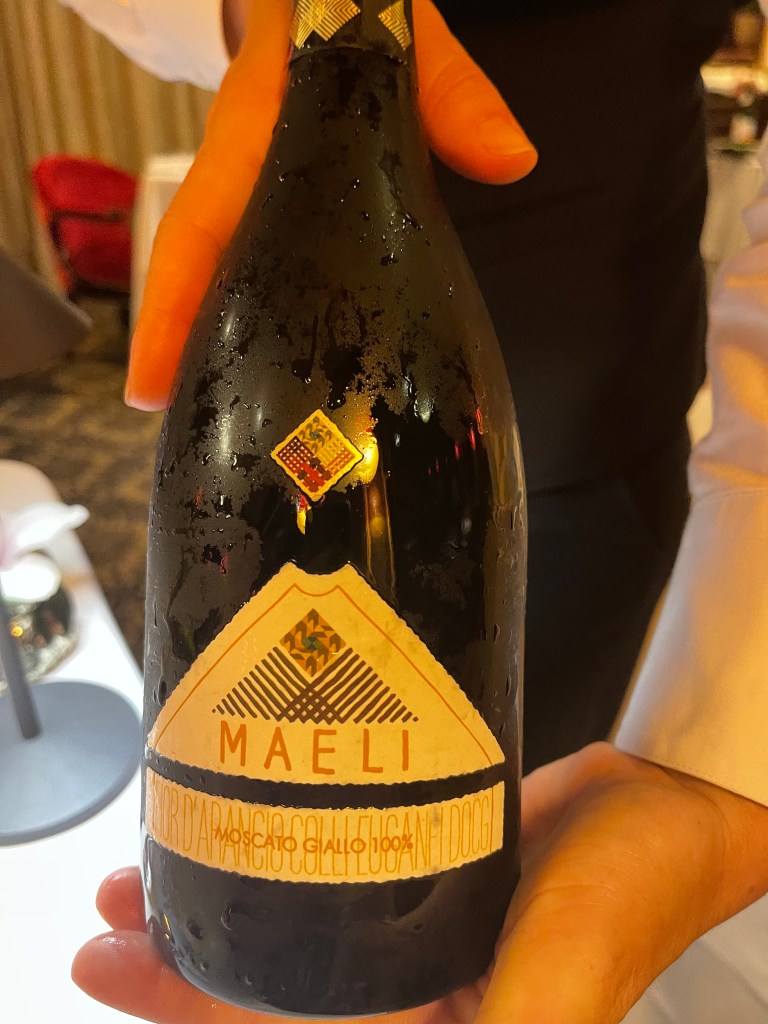
The next dish was a pre-dessert, an extremely clever play on a previous course, I am not spilling the beans suffice to say it was brilliant! The winery, from Tokaj in Hungary called Dobogó means clippity clop and produces ‘Mylitta’ desert wine, your can find out more about this small family run company by clicking the link above.

Almost done! I had arrived at just after 19:15 and it was now after 10:30, the evening had slowly drifted as each plate arrived at the table, described in detail followed by the accompanying wine, brilliant service, un-rushed and delightful.

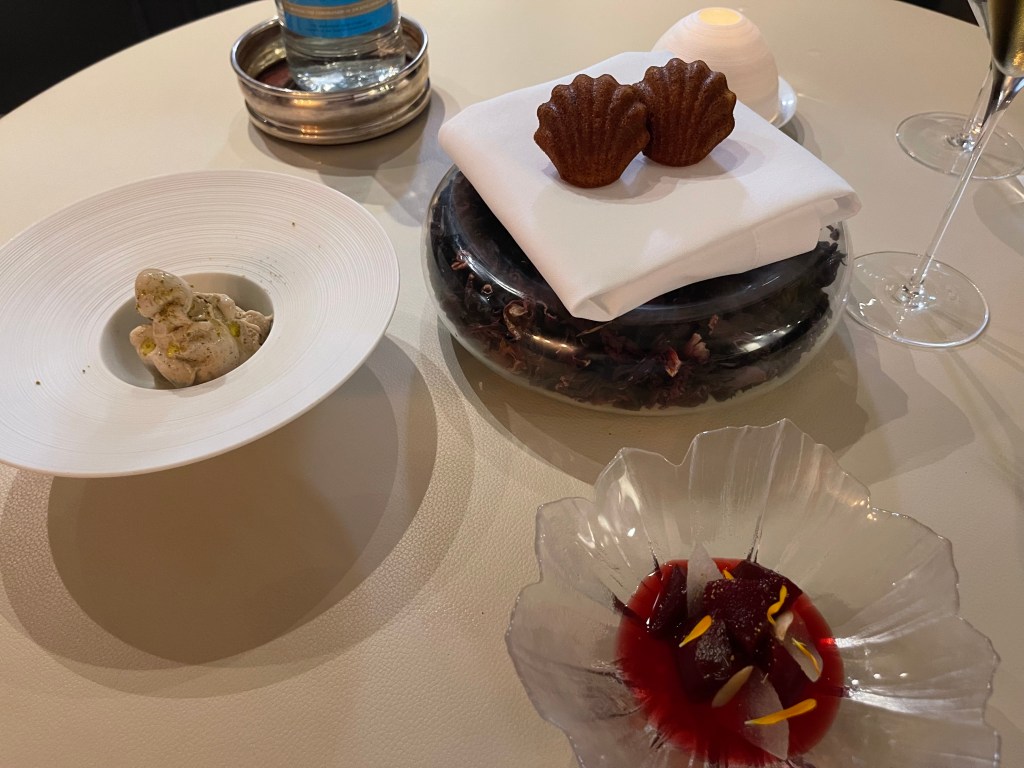
The ‘main’ dessert was a combination of hot, cold, texture, balanced flavours and comprised of 3 main elements, each with ‘sub’ elements, complex, but seriously tasty. I am not really a desert person but this was packed with flavour, but at the same time light and a good finish to the main event.

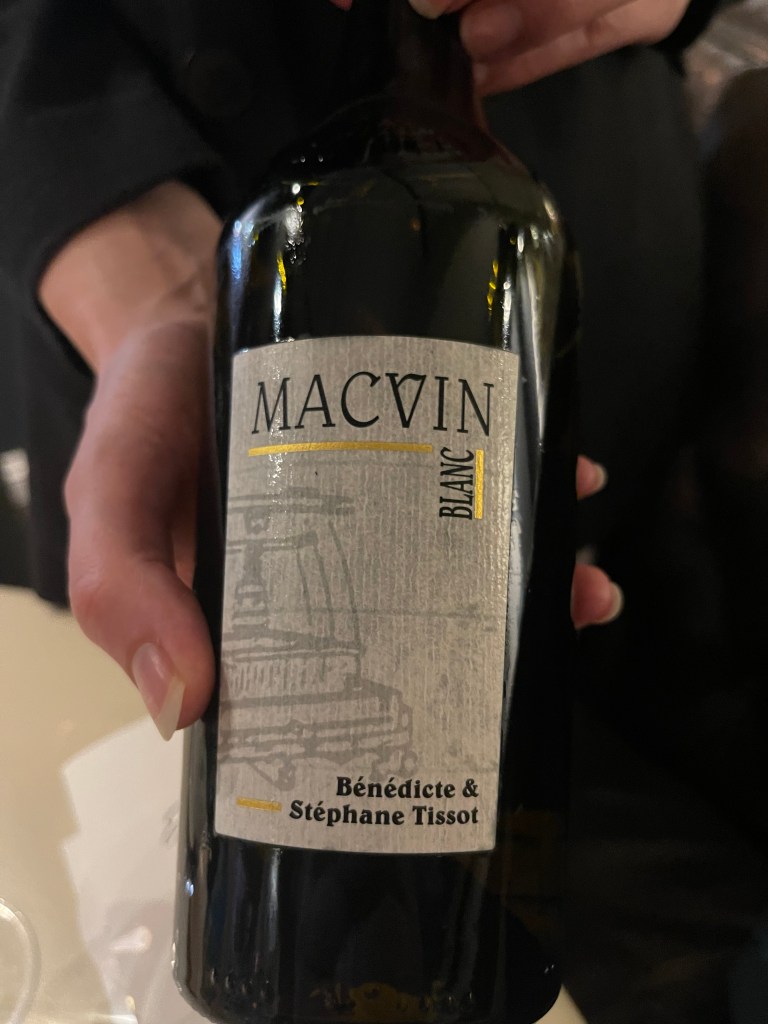
The wine again was perfect, A Macvin du Jura Blanc, a blend dating back to the 14th century. It was sweet, complex and a mixture of Jura grape varieties and Marc du Jura, a strong distillate of grape skins, pulp and seeds. It’s strong!

My guilty pleasure is cheese, I am a serious cheese addict and will often have cheese as an evening meal, with an assortment of biscuits, grapes, apple and all sorts. I am amazed at how milk can be capable of producing so many different flavours and textures, and when you apply heat to the right cheese, its miraculous transformation into something extra special.

On my last visit to No.6 I don’t recall a cheese course, this time there was. The Barkham Blue I mentioned earlier is a favourite, especially a Christmas. I recall a year or two ago not being able to get any as the farm where the cheese is made had had a fire, luckily they are back to normal now and I can get it locally at a couple of specialist outlets. The cheeses were served with warm Apple Pie, I love the mix of sweet and savoury, and salty with the blue cheese, it works for me, a delicious end to a stunning meal.

We were done, the end of an evening of taste, imagination and wonderment, an adventure to test the palate and taste buds in the best possible way. The staff were the best, polite, generous and warm, the whole experience from entering the front door 40 minutes early, to the final dish had been just brilliant.

A big thanks to Paul Ainsworth and all the team front and back of house for the most enjoyable evening, and to Tom the Cocktail Shaker, Alice, Chris and Loren for their friendship and kindness during my evening at No.6.

That was it, my 2nd ‘Eating Padstow’ trip was complete, off to bed, sleep and rest before setting off for the 4 hour drive back home!

…………………………….Until Next Time………………..L8ers……………………….

Thai, Italian and Exotic, Padstow (Day 3)

I was chilled, calm and relaxed, the week so far had delivered, even overdelivered in so many ways, like before my planning had worked and everything ran as I had hoped, the weather had been great but rain was forecast, but who cares when your in a kitchen with like minded classmates learning new cookery skills.

As before I was up and out early, sitting in the school by 08:30, Phil preparing my coffee it set the day off nicely. The others drifted in, questions about the previous nights entertainment, who had eaten where, and what, all we seemed to discuss was food!

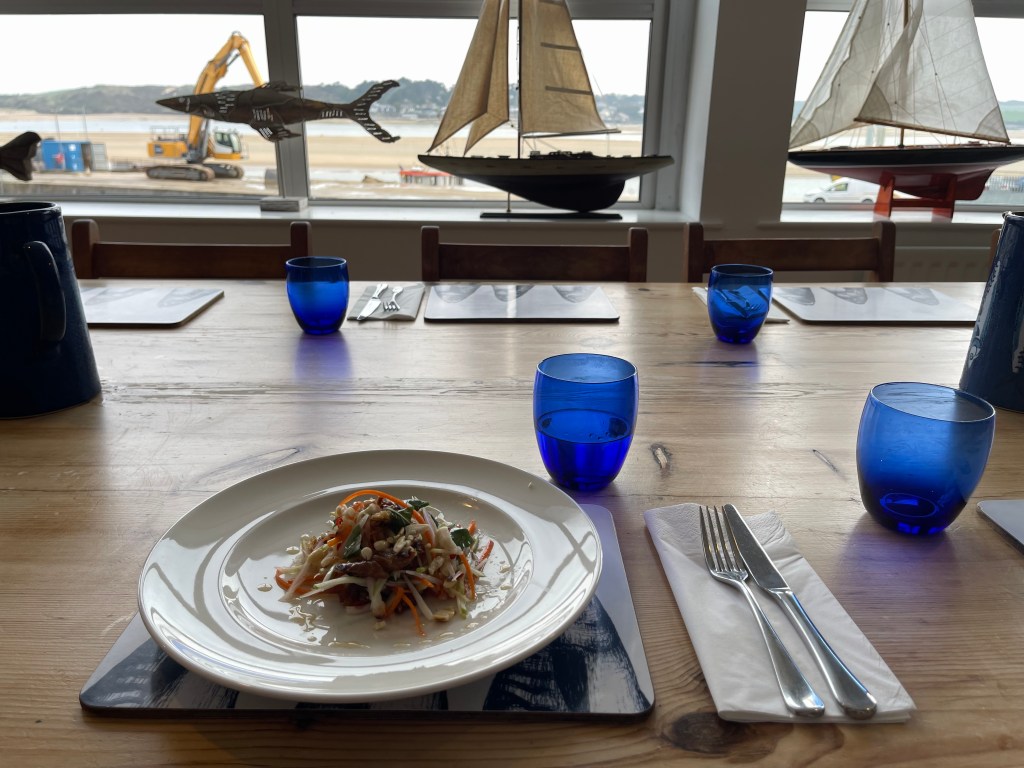
The first dish of the day, our mid morning snack was an unusual, simple but really delicious affair, a Smoked Mackerel Salad with Apple and Thai Basil. The unusual was that the smoked Mackerel was fried until crisp, it added an amazing texture to an exotic salad, dressed with Nước chấm a blend of fish sauce, lime, chillis and sugar, delish.

I can count the number of times I have cooked a risotto on one hand, its not that I don’t like a good one, I have eaten a few over the years in the UK and Italy (I made that one at my first international cookery school trip many years ago in 2013), they are just really hard work for a savoury rice pudding!

As expected, prepare a really really good stock, this is the basis for the flavour, and make sure it’s hot when you add it to the rice, that’s been fried in oil to start to break it down, followed by a decent glut of wine, nice.

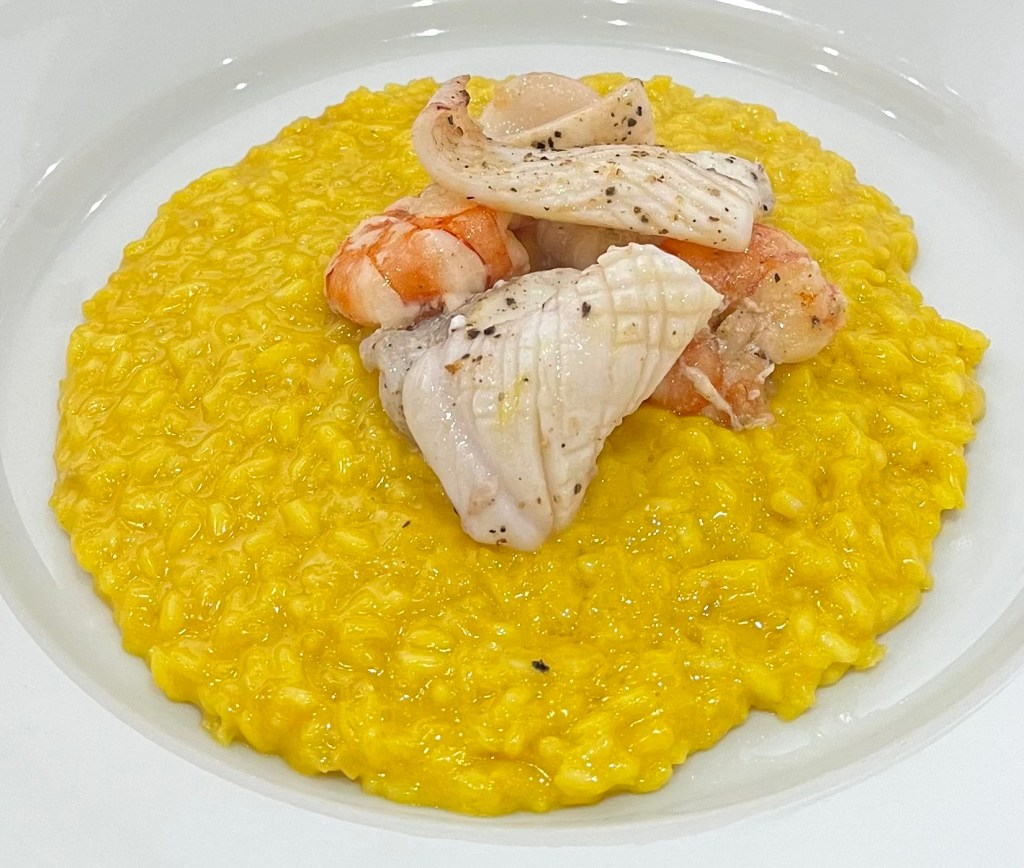
After 25 or so minutes of continuous stirring the Risotto was ready, glistening with the added butter and umami from some Parmesan cheese it was ready for some seafood, squid and shrimp which we had prepared earlier and just needed some heat on a Plancha to finish things off. I was eating out (again) that evening, my cooking partner had missed the morning session but arrived in time for a Risotto lunch, I decided he could have mine, it was very good apparently.

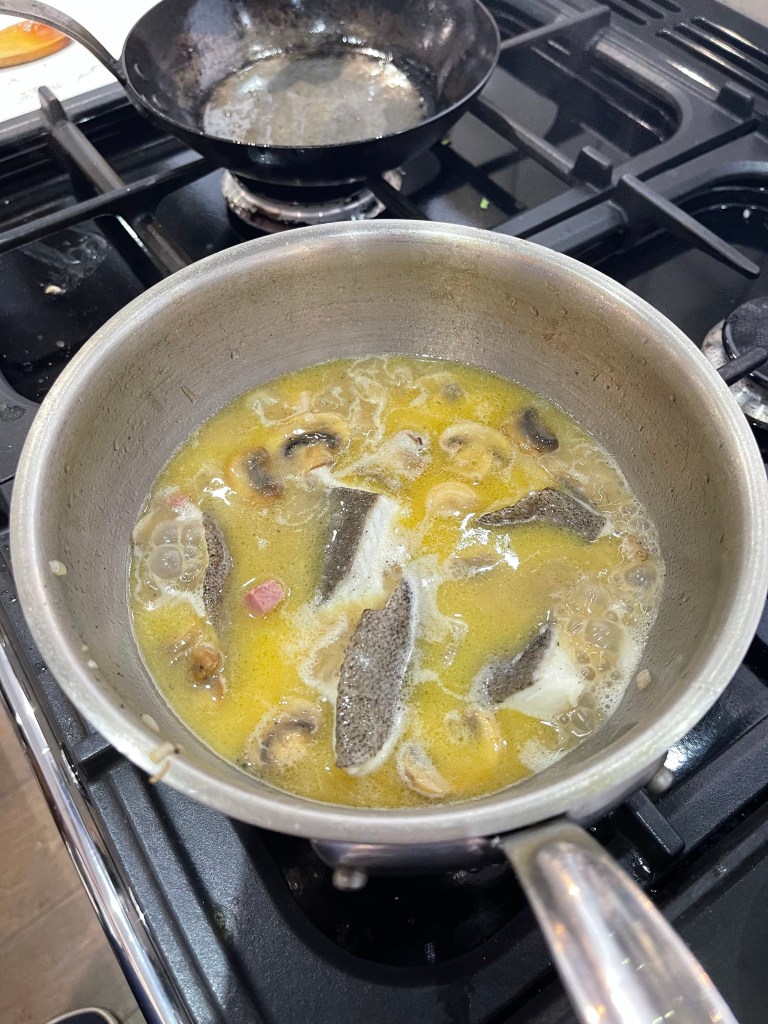
Back to the front for the next demonstration we were shown how to deal with Turbot, a beautiful if quite expensive fish it’s ‘meaty’, and prized by many a fish lover as their favourite species, I love it. Going back over 25 years to when we were blessed with a TV Series and book called ‘Rick Steins Fruits of the Sea’ this was a ‘classic’ dish, with mushrooms, potato, truffle and a rich sauce it was great fun to prepare, and even better to eat.

Cooking in stages, reducing stock, adding vermouth, reducing, adding, ham, shallots and potato the flavour layers were building nicely, I love this style of cooking, tasting as you go you can elevate simple dishes to something extra special, and ruin them by going too far, it’s food creativity in practise.

In order for things to work, preparation is critical so ‘mise en place’, gathering all the ingredients and making sure you don’t suddenly realise you have forgotten something and overcooking happens. Luckily, our ingredients had been laid out for us on trays so we only had to do the final prep, saving a lot of time and ensuring we all had a chance of making something absolutely delicious. This was a cracking lunch.

The final dish of the day was, as previous days our chance to relax a bit, ask lots of questions of Nick, our chef tutor and wind down, this was not a holiday, it was actually hard work but very rewarding and enjoyable.

Seafood in a Crab and Ginger Broth introduced some new techniques, like clarifying stock to remove any sign of a solid, and produce a clean, clear and vibrant bath for the seafood to be added when cooked.

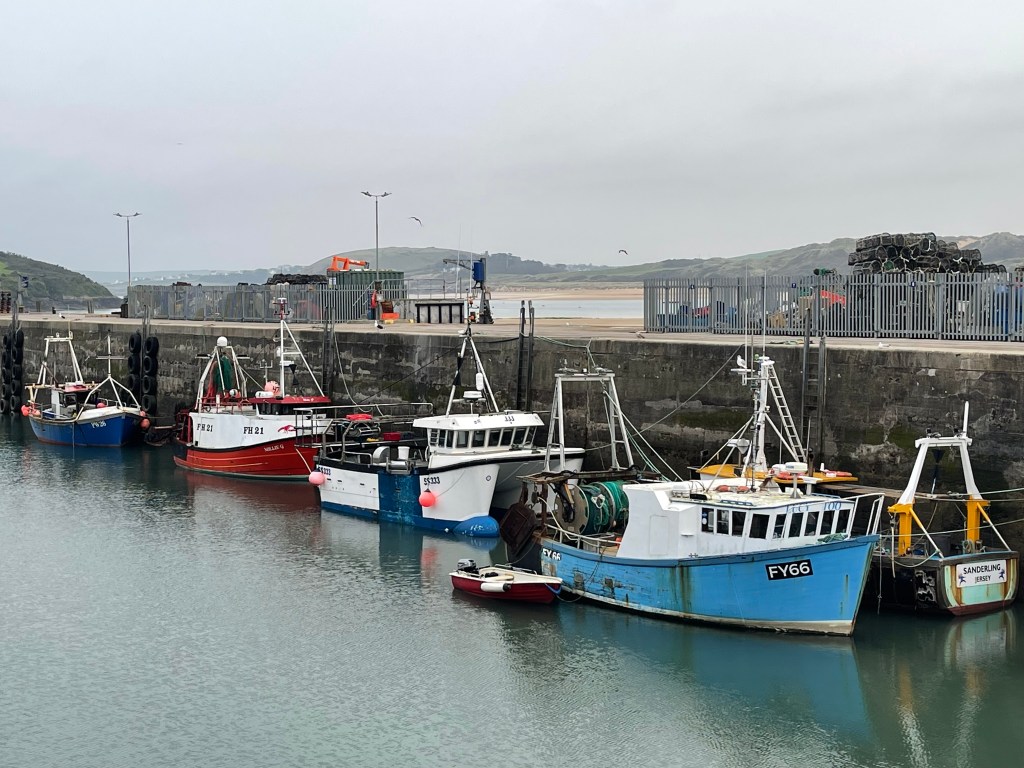
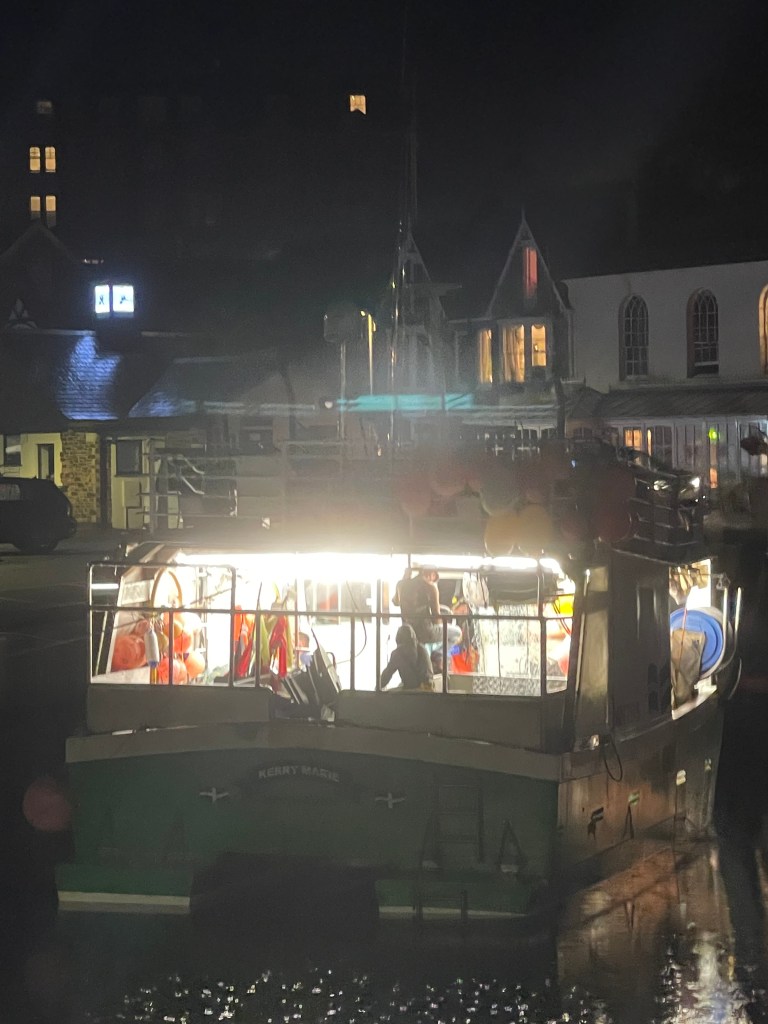
As I was walking back to my hotel I caught a glimpse of those extremely brave fisherman heading out to sea, risking their lives to bring amazing ingredients for us to cook and eat!

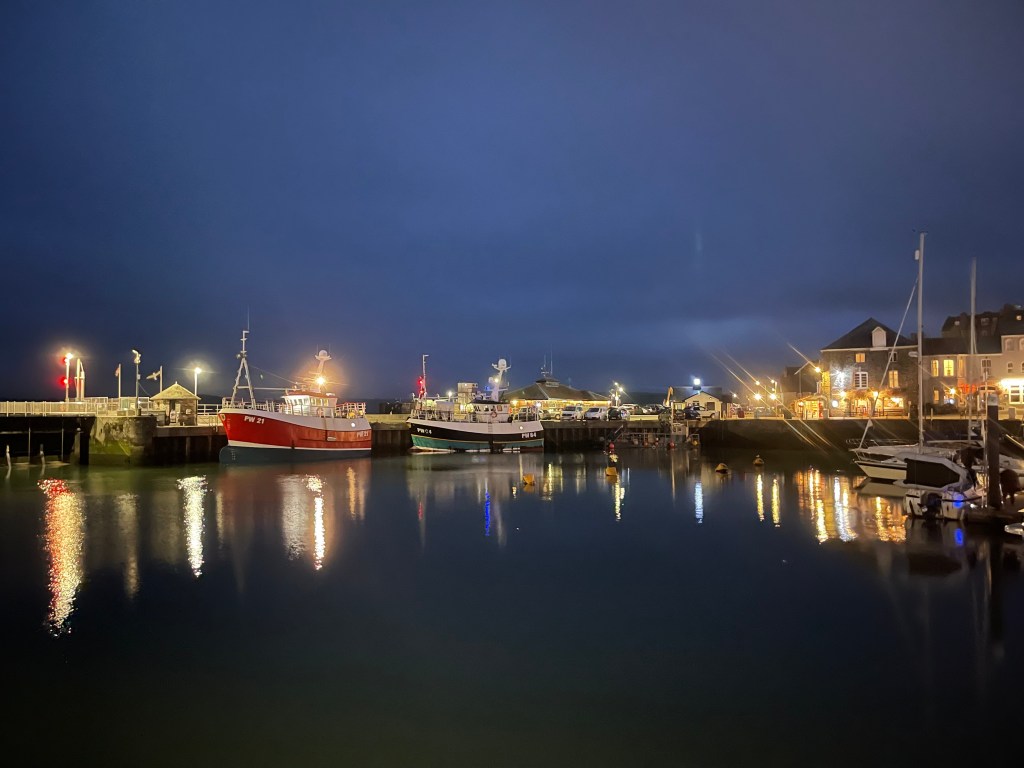
It was wet, I am being polite it was pi&&ing down with rain as I started my evening walk before dinner, taking in the sights of Padstow, specifically the lovely harbour area where a boat was dealing with nets, I stumbled across the R.N.L.B Anne Allen, launched in 1932 it’s crew had saved 43 lives, truly amazing for such a simple, exposed craft.

Hello Sam, I was back at Caffe Rojano and my waiter (actually the Operations Director), was previously the head chef and had cooked my meal 2 years ago, when I was in Padstow attending a 2 day cookery school and ‘eating Padstow’ for the 1st time.

My plan for the evening was the same as before, albeit with different menu options I was going to create a tasting menu, with wine flight, with a 15 minute break in-between each dish. To help things going a Blood Orange Gin and tonic helped in my decision making process, and soon the evening was well underway.

Off the starting gate was a delicious Tuna Tartare, served on a toasted Sourdough bread with corn, and some lightly pickled onion, paired with a Pinot Grigio, Ponte del Diavolo, Pavia, Italy 2022. I’ve just checked the current menu and it looks like its been replaced with a Mackerel dish, Caffe Rojano does change its menu frequently according to season and produce availability.

Sam was really accommodating with my ‘tasting menu’ idea and made sure that food and wine were delivered as requested. When time allowed we also had a chance to have the odd conversation which I really enjoyed being a solo diner, I had pictures of my previous visit on my phone which was fun to discuss as he had been the chef and cooked my food, also very tasty, he is a great cook.

I am a sucker for Croquetas, especially aged Manchego and Jason Iberico, these were awesome. Crispy outside and soft and giving centre they packed a real punch, I could have had a couple of servings to be honest. The matching wine was a ‘belter’, seriously moreish De Loach, Russian River 2020 Chardonnay from California, it really hit the spot, delicious.

Lastly, I didn’t do dessert, a bowl of Paprika Fried Squid with Cayenne Mayonnaise, Parsley, Lemon and Lime, matched with a 2022 Gavi di Gavi, Terre Antiche, Piemonte. This was also a flavour punch, crispy outside, tender on the inside just booooom delicious.

This was my fourth night in Padstow, I was really impressed, the point was consistency, I had tried all the restaurants before and they had delivered then, and then, two years later equally delivered if not more so. I get so disappointed eating out, paying decent money and not feeling it, that sense of calm and satisfaction after awesome food and service, thanks Sam and the team behind Caffe Rojano for another awesome night out. I will be back!

……………………………….Until Next Time……………………L8ers…………………..

Mussels, Crab, Gurnard and Lemon Sole (Padstow Day 2)

It was a beautiful morning, I was up and excited for the days tuition and cooking, sleep had been restful, the Harbour Hotels bed and pillows agreed with me, after a cup of tea and shower I walked down to the harbour to look at the day boats before heading to the school, a daily habit.

The communal table at the far end of the ‘kitchen’ was my starting position, welcomed by Phil, ‘what would you like to drink Jules’, I would alternate between Latte and Cappuccino, soon the others would drift in and discuss the previous evenings activities, we were all staying local but in different hotels and guest houses. I still had the previous evenings meal on my mind, it was really good, what were we going to cook today was my next thought.

Nick came over and asked us to the front of the kitchen, ready for the next demonstration, we were going to cook Mussels, hmmmmm, what did I have last night, these were different, no XO, but Garlic, Tomato, Chilli and Parsley, delicious. We were taken through the process, and at the same time questions were asked and stories told about Nicks chef life, interesting and amusing at the same time, he had some great stories to tell which got everyone engaged.

Interesting was the source and reasoning for picking a particular supplier of mussels, West Country Mussels, they are amazing. Grown offshore near Fowey they are very plump, have a thinner shell and much less gritty than the mussels you get rope grown in estuaries and close to the shoreline, they were the same ones I had the previous evening.

After Nick prepared each dish we all got to take a picture of the finished meal, we also got a taster so we could understand what our dish should be like flavour wise, obviously everyone has their own palate so there was always an amount of ‘interpretation’ here and there! Above left is Nicks taster, right is my lunch at the communal table, it was very tasty.

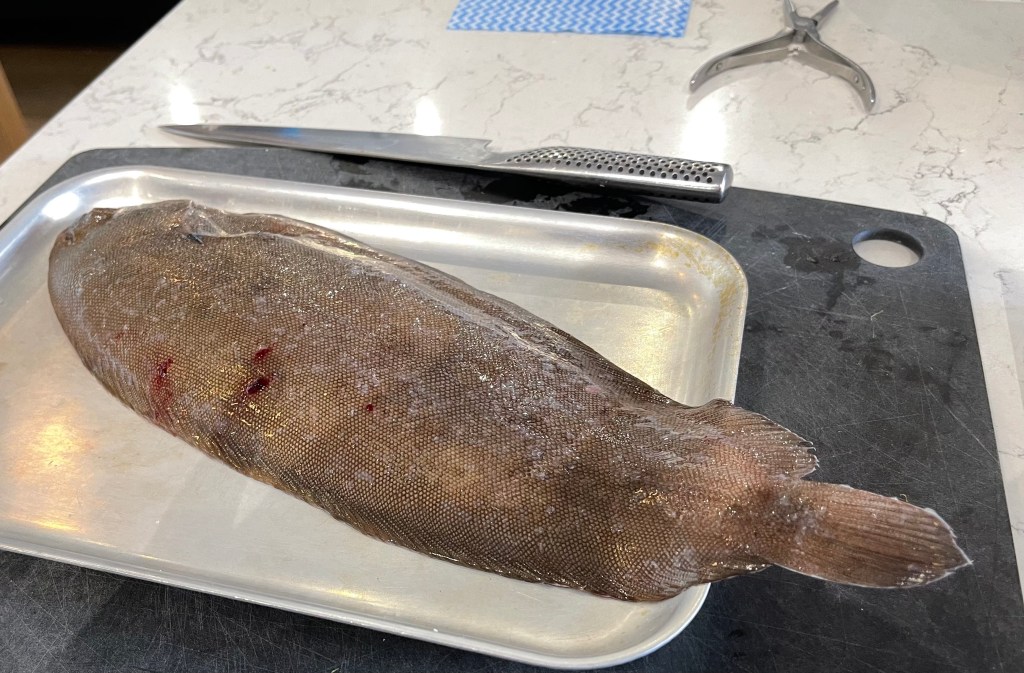
It’s Sunday and earlier today there was an episode of Ricky Stein’s Seaford Odyssey on TV, he was in his original small kitchen at ‘The Seafood”, cooking Lemon Sole with a delicious spiced butter, I know it’s delicious as we all cooked the very same dish last week, on day 2. Learning the 2 common methods of preparing the fish before cooking was fascinating, can you spot the difference in the picture above. There were a couple of amusing stories relating to this, if you want to find out you will need to book the course and learn some fab skills at the same time.

Off we went in our pairs, chatting, chopping, slicing and preparing, deciding which method to go with, it made a difference but ultimately, a delicious grilled flatfish with flavoured butter ended up on the dinner plate, along with crisp glass of Muscadet this time, served by the ever present Phil, who also advised, guided and ‘got stuff ready’, so we could focus on the cooking and make the most of our time.

Excuse my french but Gurnard is a bugger of a fish to prepare, it has an awkward shape and bones in unusual places, Nick sorted one like it was child’s play, the rest of us took a little longer! This was a brilliant dish from ‘Rick Steins India’ book, a Madras Curry base packed with tomatoes, mustard seeds, onion and Tamarind it was a belter. This could easily be prepared using Cod or any other firm white fish, it wasn’t too challenging except the fish preparation, one of the reasons we were all attending the school.

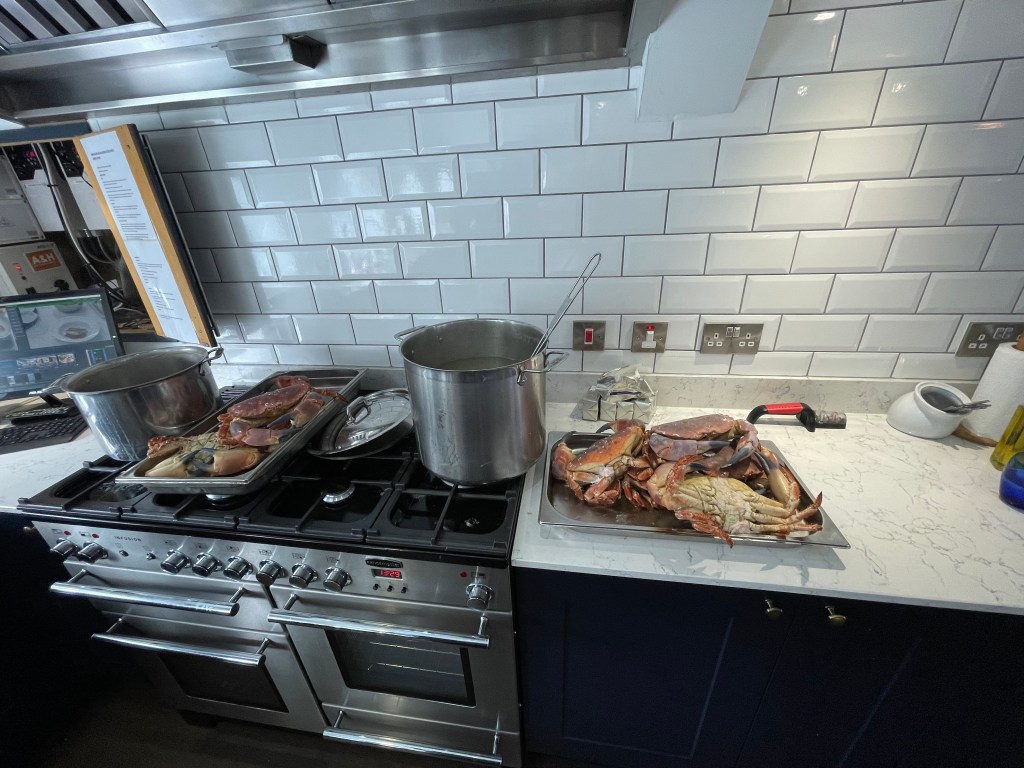
Singapore Chilli Crab was our next adventure, after Nick explained how to tell the difference between male and female we all got a crab to prepare, its not too difficult once you have been shown the good and not so good bits. No part of the crab is poisonous, some parts are just unpleasant so don’t believe all the stories you may have heard about dead mans fingers!

We had all been snacking on demo dishes and eating our own efforts, I was conscious that I was out again that evening so put the breaks on and let my colleague have my efforts, so that I had some space for the special event later on.

The ‘Tuesday demo’ was a delicious looking Indonesian Seaford Curry (£39.95 in the restaurant), served with a Green Bean and Grated Coconut Salad, Crispy Shallots and Garlic. We were shown the various stages and when completed everyone was given a serving, it was very popular.

In the summer, Padstow is heaving with people, this time of year it’s a peaceful idyl, there are a few tourists around but come evening it’s almost empty. I went for my routine stroll, the evening was warm, the forecast rain had not arrived and I sat by the harbour looking at the fishing boats and imagining the horror of being on one, during really rough seas, not something I would want to experience.

St Petroc’s Bistro was my evenings destination, the executive chef Mark O’Hagen and I had a conversation on 10th November 2021, I had suggested adding some black pudding to the pigeon salad dish I had that evening, we had remained in contact ever since.

Starting with service Yaz was going to make sure I had a great evening the menu arriving promptly, along with a ‘Tarquins Rick Stein’ gin and Fevertree Tonic to set the evening going. As the previous evening I had been looking at the menu for weeks before, trying to reduce my options to a point of decision, it was still difficult.

There were appetiser options before starters and something caught my eye, Salt Cod Brandade with Olive Tapenade and Sour Dough toast, that sounded interesting and something I had not eaten before so it went straight to the top of the ‘must have’ list.

What a decision, absolutely delicious…. Notable (I’m fussy), the Sour Dough was perfectly grilled, no soft lazy edges it was brilliantly done, I know its just a bit of bread but when you have a soft Brandade you need the contrast, it was perfect. As for the Brandade it was delicious, meltingly soft, seasoned with a spread of Olive Tapenade it was a perfect way to get the taste buds going, boooom.

For starters I chose the Smoked Salmon with Horseradish Cream and Walnut Bread, another delicious banging dish. Yaz had been the perfect host so far, checking on me occasionally, not imposing, a beautiful balance of service and attention, a credit to St. Petroc’s.

Back to the starter, the Salmon had a delicate smoke, not heavy and intrusive but subtle and sitting in the background, the Horseradish Cream had the right amount of heat, the chives providing a hint of onion, the Walnut Bread was a perfect match, enough Walnut to be noticeable and offer some texture, simple done brilliantly.

It was the main event and Yaz walked up with my Bass, Beure Blanc and Spinach, it looked fab. Bright Yellow butter sauce, obviously using quality eggs again, St.Ewe as I was to find out later in the week and perfectly cooked Bass fillet, crispy skin and soft giving flesh, it was delightful. My chosen wine for the evening was a bottle of Domain Horgelus which was a perfect match, cutting through the rich sauce like hot knife through butter, what a meal.

A busy day in the kitchen prepping, cooking eating and just the best evening, beautiful service from Yaz and Mark, you knocked it out the park (again), thank-you for making my lonesome evening so enjoyable and memorable.

(Just a quick note, I paid full price for this week in Padstow and have received no incentives or persuasion that would affect my comments and reviews, they are all my personal and unbiased experiences)

……………………………………………Until Next Time……………………L8ers………………

Scallops, Prawns, Sole & Lobster (Padstow Day 1)

Each day started at 08:45 (or usually 08:30 for me, I am keen!), with a nice coffee freshly made by Phil, one of the professional chef support team who supported Nick the chef tutor. Nick has either run, or worked in nearly all of the ‘Stein’ establishments and has over 25 years hands-on experience of the chef trade, not just focussed on fish, he is extremely good.

Each day had a list of practical techniques that we would learn, by preparing specific dishes carefully planned to complement each other. On the first day, we would sort out some Scallops, Prawns, Fillet and de-skin Dover Sole and make Lobster Thermidor, YUMM.

There was a rhythm and routine that was followed, it worked really well like 2 years previous. I tend to learn by a combination of seeing, doing and pictures, I try and capture the before and after of each stage with my camera, taking notes occasionally where clarification is required. I was teamed up with Roger who had flown in from Australia to do the course, and see his son in the UK, he was really nice and we worked well together. There was a lot to do, so individual working wouldn’t allow dishes to be completed, we shared the workload and swapped over when required so that we got a chance to do everything if that makes sense.

A simple dish of Steamed Scallops, in the half shell, with Ginger, Soy, Sesame Oil and Spring Onion involves a number of processes to take an ordinary dish, to an extraordinary dish. Understanding how and where to clean the delicate crustacean is an art, requires knowledge, dexterity and patience so that you don’t damage the expensive ingredient. Following Nicks instruction during the demonstration we carefully went through the process and within 30 or so minutes, sat down to the most delicious breakfast!

The deep fried Coconut and Chilli prawns with Papaya Dipping Sauce were next, more technique but these I have cooked before, the dipping sauce is especially delicious and this was to be our early light lunch, the wine glasses were on the table and we had the option of a French Muscadet, or my favourite, the Xanadu 2020 Chardonnay from Margaret River Australia, it was delish, as were the prawns.

Sole a la Meunière is very special (In my humble opinion). The fish is currently costing approximately £26 online from reputable suppliers, expensive due to its ‘meaty’ texture and use by all the top chefs which drives up the price. To be honest, it is delicious if treated respectively and not over done. Eating Dover Sole in a decent restaurant you will probably pay £45 – £50 depending on location and chef, and we were going to learn how to give the respect this mighty fish deserves. There is considerably skill required to get the fish on a plate and if you want to learn, sign up for the course like I did, it’s great fun and you get to eat dishes you might not even think of trying, like we all did.

Anyone for Lobster Thermidor? Yes please! Half a large Thermidor will cost you about £55 at a decent restaurant, if you learn the techniques involved, then you can eat at home for much less, it won’t be quite the same as decent restaurants use fresh lobster, whereas most people won’t like dealing with live, they can be problematic if you don’t know how to safely put them to sleep and cook them. Frozen Lobster is available for £11 from some supermarkets in the shell so you can have a go if you are in the know. As before, Nick showed us the techniques involved and we were soon with our ‘partners’ preparing and cooking away until we were done, sat at the communal table, comparing notes and tucking in.

At the end of each day we were treated to a demonstration, something we didn’t have to cook, but could enjoy without the sweat and tears! Day 1 was Splash Café Clam Chowder in Sour Dough Bowl, I remember seeing Rick Stein eat this in the Road To Mexico series. The recipe is a closely guarded secret as it’s the cafés speciality so this version is an interpretation, I was eating out that night so did not have any, but it smelt delicious, I will have a go back at home.

So on day one, we had learned to prepare and cook menus with the equivalent worth of approximately £145, and had the joy of eating them, the course had easily lived up to my expectations, day 2 was ahead but before that, a treat was in store.

I had a routine, after each day I went back to the hotel, had a cup of Earl great tea in my room, looked at restaurant menus, then went for a walk, Padstow is so calm this time of year now the mass of tourists have left. I booked this ‘event’ months ago, it wasn’t a holiday or a vacation, I have an overactive brain, often overthink things and therefore need something ‘intensive’ to help me relax and calm down. Food is my thing and the cooking week, along with eating was like medicine or treatment to help me to stay sane!

When I booked the cookery school, it wasn’t without considerable planning. Like before, those 2 years ago I was going to ‘Eat Padstow’, starting at Ricks Seafood Restaurant, then St. Petroc’s Bistro, then Caffe Rojano and finally Paul Ainsworth at No.6, The food focus would help stop my brain wander and give it some relax time.

Seafood is my thing, if ever we eat out, if I can be confident of the quality I will lean towards fish over meat every time. The Seafood restaurant has grown considerable in the last 30 or so years, now having some rooms above you can stay in, a couple of the guests at the cookery school were doing just that.

On arrival I was shown to my table and the lovely Kelly was to be my waitress for the evening. ‘The Seafood’, as Nick our chef tutor used to call has an extensive menu, enough to tempt most palates and I had probably gone through it at least 10 times in the week before my arrival, it takes me ages to choose, I have to remove options before I arrive to speed things up, it was still challenging!

The wine menu also offers a great choice, by the glass or bottle so caters for most budgets. Eventually I had made my choice, after noting at least two dishes I had cooked and eaten earlier, which made the decision making process more challenging, rather than easier, and I was also trying to remember what else we were cooking so I didn’t pick those dishes, which I managed to do last time!

Mussels and Clams in XO Sauce started things off, Kelly provided a lemon/water finger bowl to enable me to clean my fingers, this was a hands-on eating experience and extremely good it was too. Rich Umami, succulent Mussels and Clams it was delicious. I had picked a favourite wine of mine, Gruner Veldtliner, Wagram Heiderer_Mayer 2021 from Austria, it worked a treat. Earlier, Nick had been talking about where they source their mussels from, these were stunning.

let’s move onto the main, after such a blinding starter my expectations were over the roof to be honest, and I wasn’t disappointed at all, far from it. I am familiar with the term ‘mi cuit’, it means partially cooked and is a technique I learnt in France a few years back, preparing the controversial Foie Gras.

In this case though, we are talking a Trout fillet poached in Olive Oil, served with a Potato Salad and Cucumber, with a side order of thin cut Chips. The fillet is cured in salt first, so doesn’t require seasoning, then lightly poached in Olive Oil, jeez it was so good, you can see the moist flaky texture in the picture above, the flavour so delicate and perfectly matched with the cucumber and potato salad. The chips were also spot on, crispy , fluffy, delightful, I was there, in my happy place feeling chilled and relaxed………..

’The Seafood’ delivered, front of house, in service, Kelly was perfect, not too invasive like some places, just delivering the best dining experience. The chefs, spot on, awesome cooking, thank-you.

…………………………………………….Until Next Time………………………………..L8ers…………………….