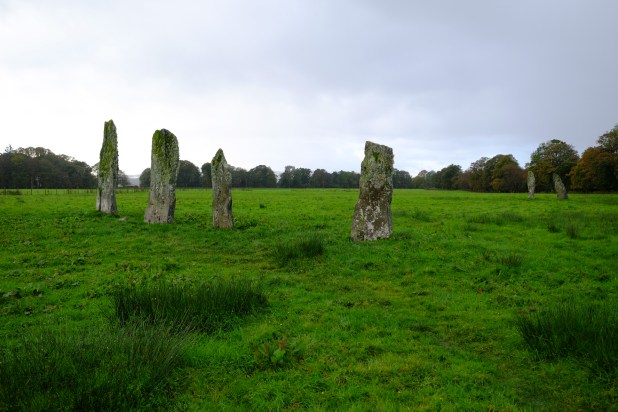
Day Two – Bombay Breakfast, Vikings and the Road to Ancient Scotland
After a thoroughly enjoyable first evening in Glasgow, Tuesday morning arrived, and with it the prospect of finally putting my meticulously researched Scottish itinerary into action. First, however, there was the rather important matter of breakfast.
I’d already earmarked Dishoom, conveniently located around a 10-minute walk from the AC Hotel by Marriott. Their Bombay-inspired breakfast offering had caught my attention during my pre-trip research, and I thought it would make a splendid start to the day. I had purchased the book by the same title some time back and was thoroughly inspired by the stories within.
A little Indian influence in Scotland before heading off in search of prehistoric burial chambers, ancient standing stones and centuries of clan warfare. Why not?
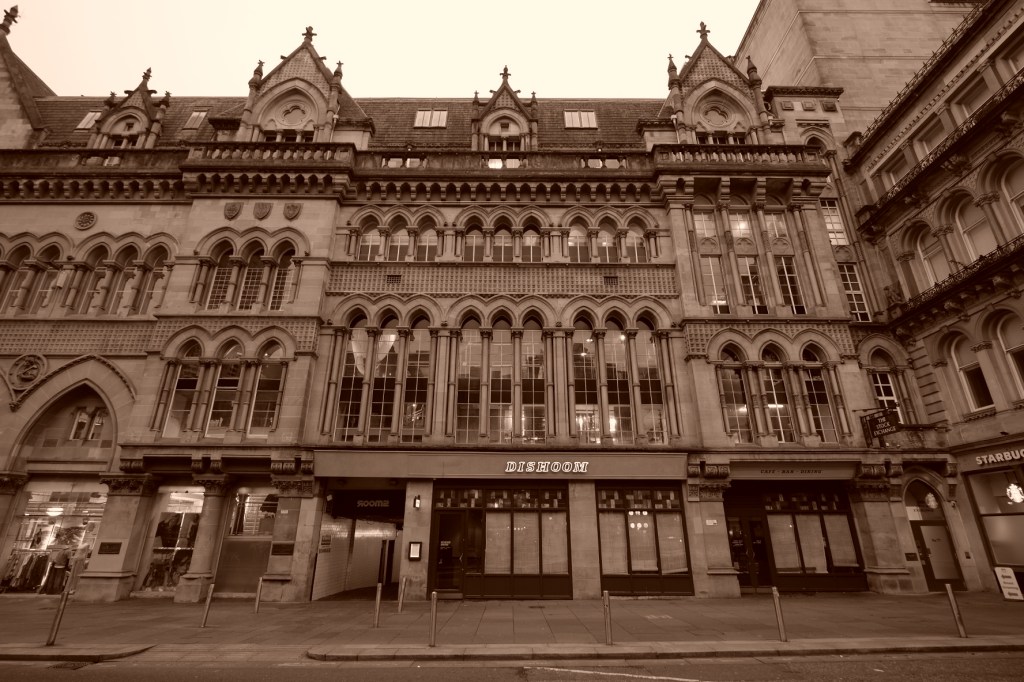
Dishoom occupies part of Glasgow’s magnificent former Stock Exchange building, an extraordinary piece of Victorian architecture that makes quite an impression before you’ve even stepped through the door.
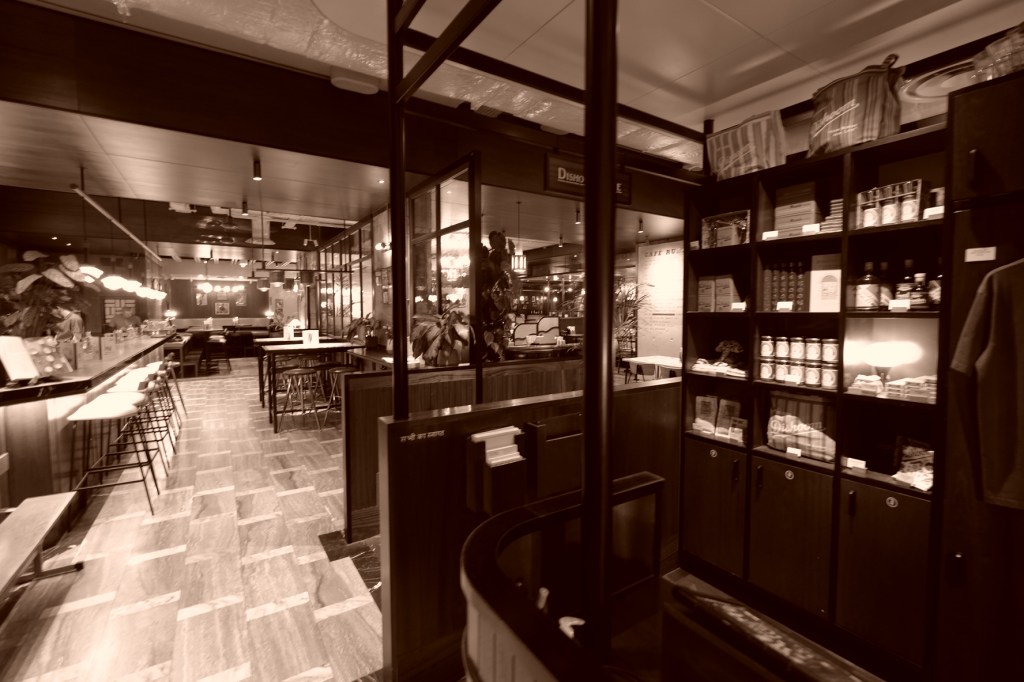
Inside, the atmosphere was warm and inviting, with its wonderfully eclectic mixture of old-fashioned furniture, patterned tables, framed photographs and the unmistakable character of a Bombay café.
Dishoom draws its inspiration from the Irani cafés that became such an important part of Bombay’s social and culinary history. Established largely by Persian immigrants, these were places where people from different communities and backgrounds could gather over tea, food and conversation. Once numerous, the original cafés have steadily declined in number, making Dishoom’s affectionate interpretation of them rather appealing. It certainly made a change from the usual hotel breakfast buffet.
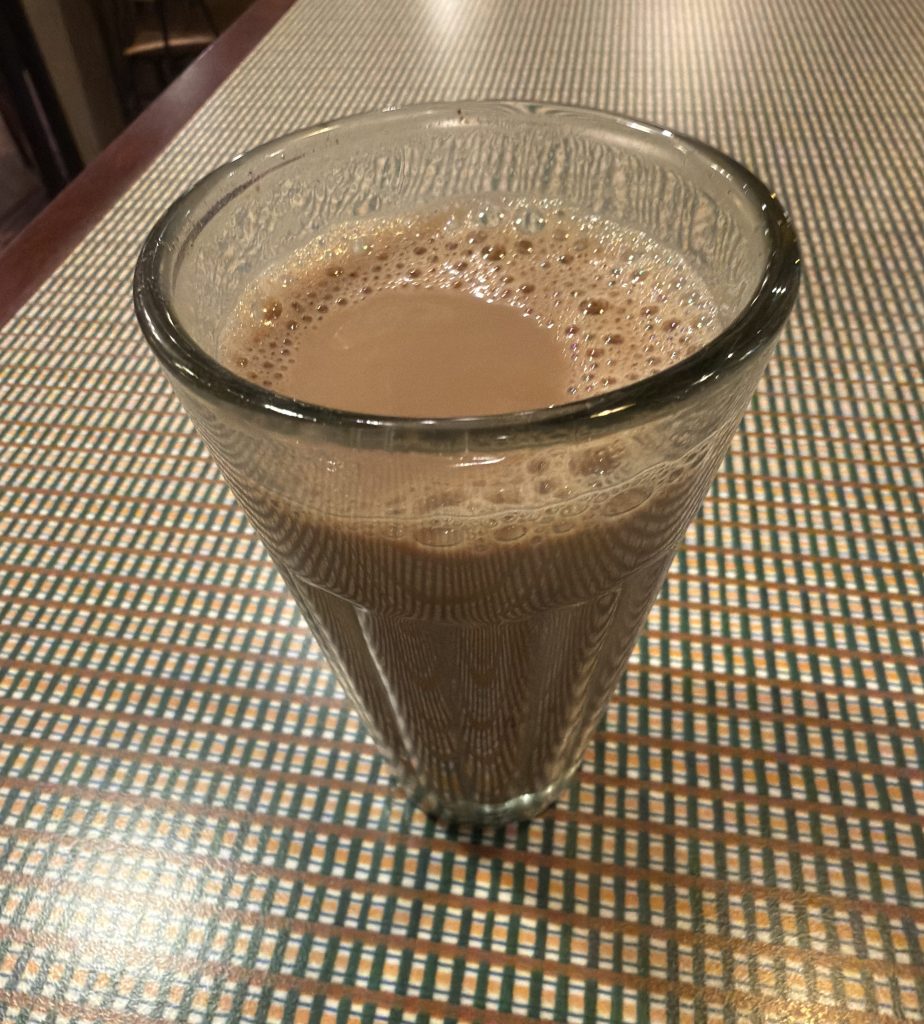
Naturally, there had to be chai.
Served in a simple glass, rich, warming and beautifully aromatic, it was just the thing to get the morning underway. There’s something wonderfully comforting about Indian chai, the combination of strong tea, milk, sweetness and warming spices producing a drink that feels considerably more indulgent than an ordinary cup of tea.
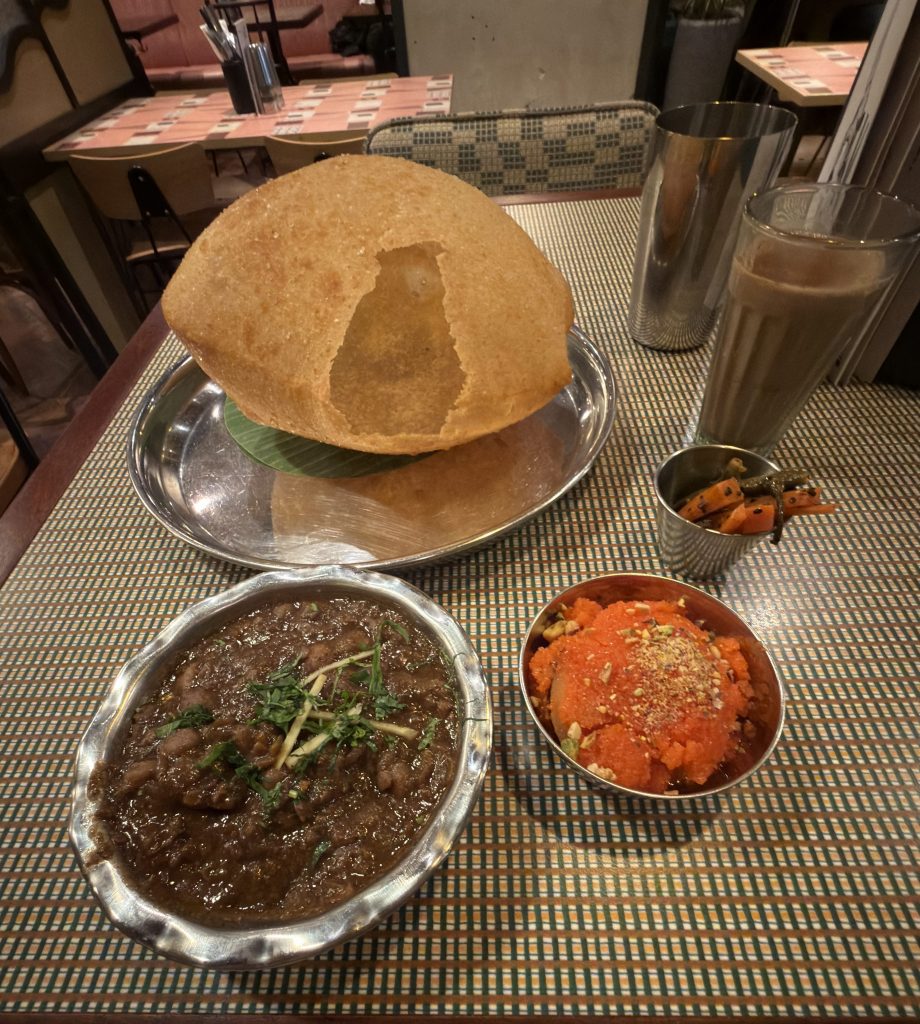
Breakfast itself was a wonderfully colourful affair. A richly spiced chickpea preparation, accompanied by a magnificent puffed puri, pickles and a portion of sweet halwa, Chole Puri Halwa, the chef’s favourite according to the menu.
The puri was quite a spectacle, arriving inflated like an edible balloon, its delicate golden shell practically demanding to be broken into.
The combination of savoury, spicy and sweet made for a rather interesting start to the day. A little of the chickpea curry scooped up with the bread, followed by something sweeter, another sip of chai, and suddenly the prospect of an ordinary bowl of cornflakes seemed deeply uninspiring.
Suitably fortified, it was time to turn my attention from Bombay to something rather older, as I was leaving a pristine paper cup was thrust in my hand, Chai to take-away, now that was service.
Glasgow Cathedral – Where the City’s Story Began
Suitably fortified by my rather splendid breakfast at Dishoom, it was time to check out of the hotel and get the adventure properly underway. A swift checkout was followed by the slightly less swift process of extracting the hire car from the multi-storey car park, whose narrow ramps and unforgiving concrete walls seemed designed to test both my driving skills and the limits of the rental insurance.
Car and driver eventually emerging unscathed, I set off for my next destination: Glasgow Cathedral.
This was somewhere I’d particularly wanted to explore. My pre-trip research into Scotland’s religious history, folklore and considerably darker past had revealed that Glasgow’s magnificent medieval cathedral had rather more stories to tell than its imposing architecture alone might suggest.
The cathedral is dedicated to St Kentigern, better known as St Mungo, Glasgow’s patron saint and a man whose story is an intriguing mixture of early Christianity, royal scandal and some fairly improbable miracles.
According to tradition, Mungo was born around the sixth century, the son of Princess Teneu (also known as Thenew), daughter of a British king, and a nobleman named Owain. His arrival into the world was apparently not universally celebrated. His mother, having become pregnant outside marriage, was condemned by her father and, according to later accounts, cast adrift in a boat without oars. Against considerable odds, she survived, eventually reaching the Firth of Forth, where Mungo was born.

Not perhaps the most conventional start to a distinguished ecclesiastical career.
The young Kentigern was subsequently raised under the protection of St Serf, traditionally associated with Culross, who is said to have given him the affectionate name Mungo, commonly interpreted as ‘dear one’.
He eventually travelled west, establishing a Christian community beside the Molendinar Burn, on the site associated with today’s cathedral. Around this early religious settlement, a community developed that would, over the centuries, become the great city of Glasgow.
But it’s the legends surrounding Mungo that make him particularly interesting.
His exploits are immortalised in Glasgow’s coat of arms, which features four rather unusual symbols: a bird, a tree, a bell and a fish carrying a ring in its mouth.
The bird represents a robin supposedly restored to life by the young Mungo after it had been killed by jealous fellow pupils. The tree recalls an occasion when he miraculously rekindled a sacred fire using a branch after the original flames had been extinguished. The bell is associated with his religious authority and a traditional story connecting it to Rome.
Then there’s the fish.
According to the legend, a queen of Strathclyde had lost a precious ring, which her suspicious husband subsequently demanded she produce. With her position becoming increasingly uncomfortable, she appealed to Mungo for assistance. He instructed a fish to be caught from the River Clyde, and there, rather conveniently, in the mouth of a salmon, was the missing ring.
A remarkable piece of divine intervention, although one suspects the salmon might have had a slightly different interpretation of events.
These stories survive largely through medieval religious biographies, most notably one written by Jocelin of Furness in the twelfth century, some 500 years after Mungo’s lifetime. They’re wonderful examples of Scotland’s early Christian folklore rather than events we can confidently establish as historical fact.
What is far more tangible is the magnificent cathedral itself.
Mungo is traditionally believed to have been buried here around AD 612, and his shrine became an important destination for medieval pilgrims. The great Gothic building we see today was developed largely during the twelfth and thirteenth centuries, with Bishop Jocelin initiating major expansion work in 1181.
Remarkably, Glasgow Cathedral is the only medieval cathedral on the Scottish mainland to have survived the Reformation with its principal structure intact, although its Catholic furnishings were subsequently removed.
So here I was, standing in a building whose origins stretched back to a sixth-century saint, whose supposed miracles still decorate the city’s official coat of arms, and whose final resting place helped give birth to Glasgow itself.
Not bad for a man whose career apparently began with resurrecting a robin.
And what a building it is.
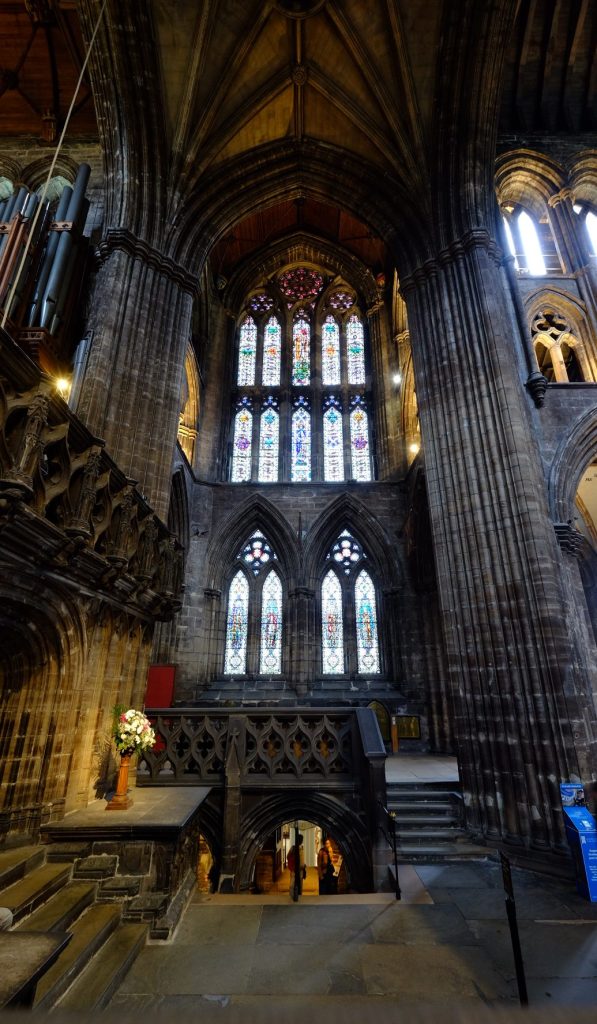
Stepping inside, your eyes are immediately drawn upwards. Great stone columns rise into pointed arches, intricate details emerge from the shadows and the sheer scale of the place makes you wonder quite how medieval craftsmen achieved such extraordinary results without the benefit of modern machinery.
What makes Glasgow Cathedral particularly remarkable is its survival. The Scottish Reformation of 1560 transformed the country’s religious landscape, bringing an end to papal authority and fundamentally changing the way people worshipped. Many medieval churches and cathedrals subsequently lost their furnishings, religious imagery and, in some cases, their very existence.
Glasgow, however, was fortunate. The cathedral survived substantially intact, although its Catholic furnishings and decoration did not escape the changes. Its continued use as a place of Protestant worship helped preserve one of Scotland’s finest examples of medieval Gothic architecture.
A rather impressive survivor, considering Scotland’s occasional enthusiasm for dismantling anything associated with the previous administration.
A Little Colour Amongst the Ancient Stones
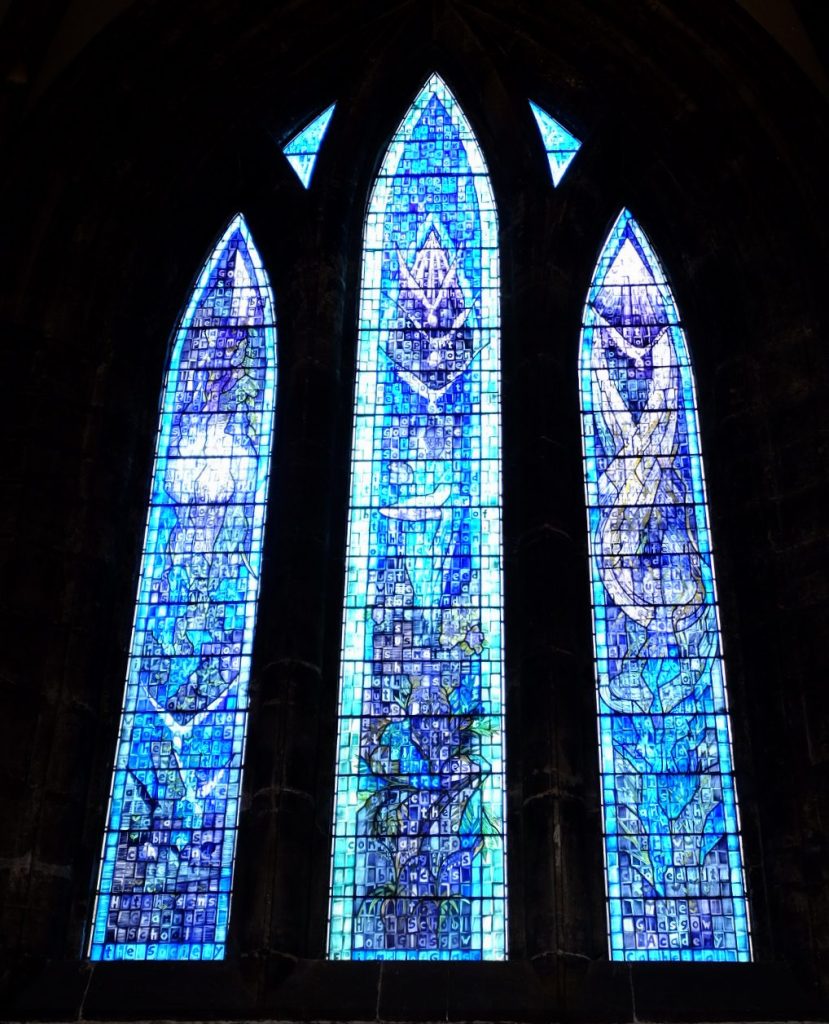
One of the things that particularly caught my attention was the stained glass. Set against centuries-old dark stonework, the extraordinary intensity of the colours creates an almost theatrical effect, especially when the light catches them.
Perhaps the most striking was a magnificent arrangement of brilliant blue windows, their modern design contrasting beautifully with the medieval architecture surrounding them.
Interestingly, much of the stained glass we see in Glasgow Cathedral today is relatively modern. The Reformation had swept away the medieval glazing, and although Victorian stained glass was introduced during the nineteenth century, much of this was subsequently replaced during the twentieth century.
The result is a fascinating combination of medieval craftsmanship and contemporary artistic expression, centuries apart but somehow entirely at home together.
I particularly liked the contrast. The building itself speaks of an age when faith was central to almost every aspect of daily life, while the windows demonstrate that even a cathedral approaching 900 years of age can accommodate something new.
Faith, Folklore and a Rather Dangerous Time to Be Different
My interest in Glasgow Cathedral wasn’t entirely architectural, however.
During the months leading up to this trip, I’d spent considerable time exploring Scotland’s darker religious history, particularly the relationship between Christianity, traditional folk beliefs and the persecution of those accused of witchcraft.
For centuries, Scotland’s communities had lived with a fascinating mixture of Christian teachings and much older beliefs. Fairies, healing charms, sacred wells, supernatural encounters and folk remedies were woven into everyday life, especially in rural communities. These weren’t necessarily regarded as contradictory beliefs by the people practising them. A person might attend church on Sunday and still seek assistance from a local healer, carry a protective charm or avoid a particular hillside after dark for fear of disturbing its otherworldly inhabitants.
Following the Reformation, however, religious authorities increasingly sought to regulate such practices, and the passing of Scotland’s Witchcraft Act in 1563 made witchcraft a capital offence.
The consequences could be devastating.
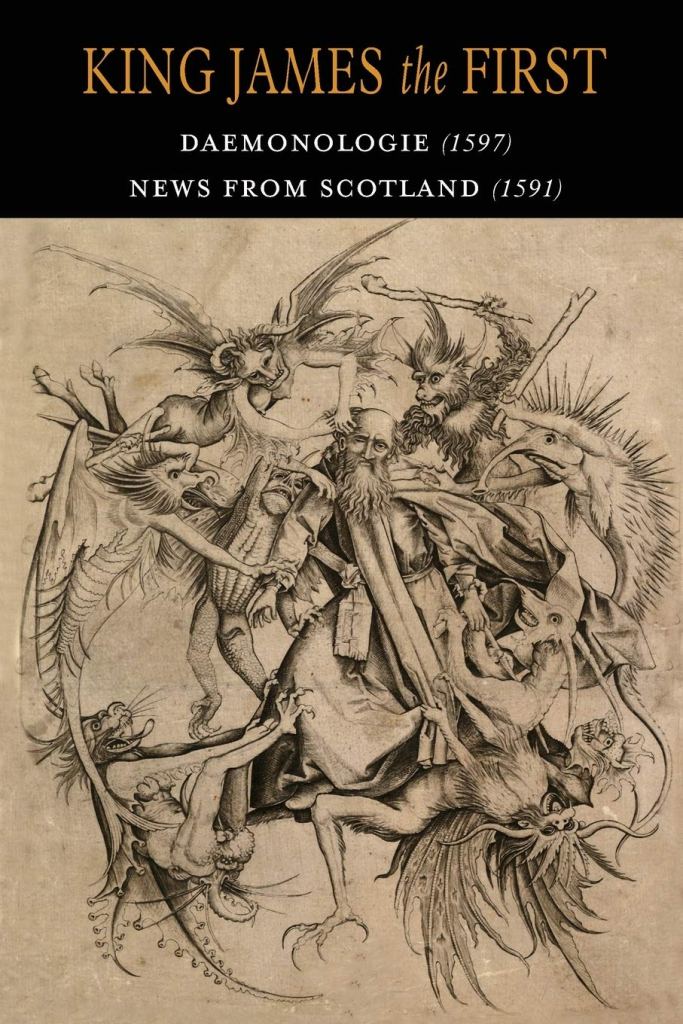
Scotland experienced several major periods of witch-hunting during the late sixteenth and seventeenth centuries. Accusations were frequently driven by local disputes, illness, misfortune, suspicion and fear, with women disproportionately represented among those prosecuted. Even King James VI developed something of an obsession with the subject, publishing his treatise Daemonologie in 1597, in which he argued for the reality of witchcraft and the need to suppress it.
An unfortunate time to fall out with the neighbours, particularly if your herbal remedies were more successful than the local physician’s.
Standing inside the cathedral, I found myself thinking about the extraordinary changes in belief that had taken place within these walls. The same building had witnessed medieval Catholic worship, the upheavals of the Reformation and the emergence of a very different religious Scotland.
And just outside, amongst the weathered gravestones, was a reminder that not everyone in sixteenth-century Glasgow was preoccupied with witches and the supernatural.
Some were attempting to drag medicine into the modern world.
Doctor Peter Low – A Man Ahead of His Time
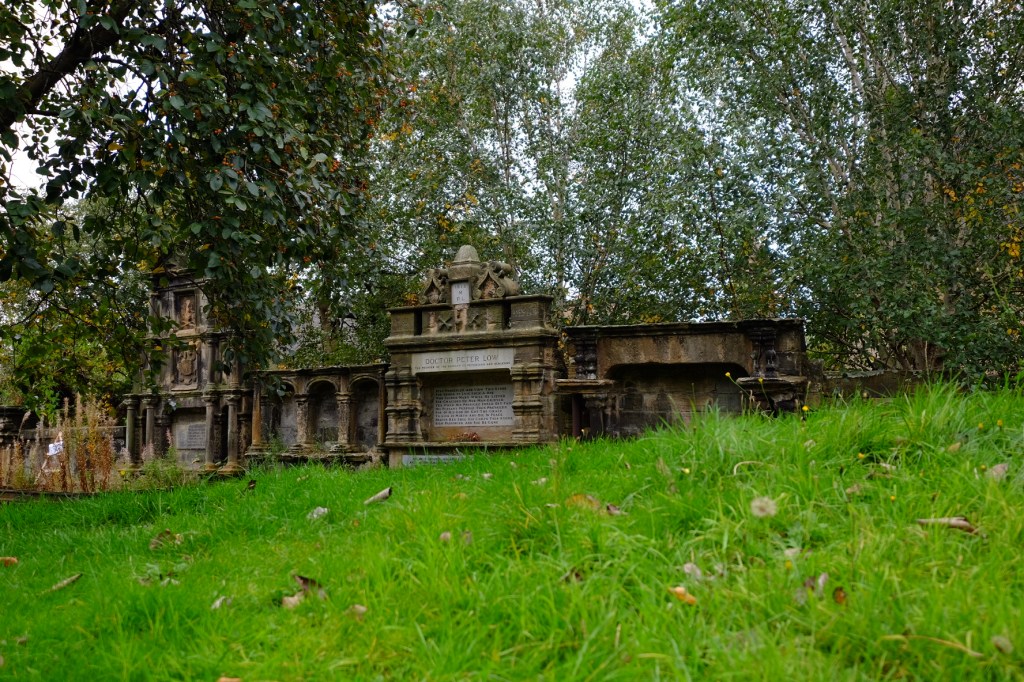
Among the monuments near the cathedral is an impressive memorial to Doctor Peter Low, a rather remarkable Scottish surgeon whose contribution to medicine deserves considerably wider recognition.
Born around the middle of the sixteenth century, Low spent time studying and practising surgery in France before eventually settling in Glasgow. In 1597 he published The Whole Course of Chirurgerie, an important surgical textbook that helped bring together contemporary medical and surgical knowledge in the English language.
Two years later, in 1599, he secured a royal charter from James VI establishing what would eventually become the Royal College of Physicians and Surgeons of Glasgow.
His ambition was to improve medical standards and ensure that those practising surgery and medicine were properly examined and qualified.
This was no small undertaking in an age when medical treatment could be something of a lottery, and the distinction between a trained practitioner, an enthusiastic barber and someone armed with a collection of questionable remedies wasn’t always reassuringly clear.
Low’s original organisation also had responsibility for examining and regulating practitioners, including surgeons and apothecaries, and its foundation represented an important step towards the professional medical institutions we recognise today.
His memorial is an intriguing survivor, tucked away amongst the older stones, and a reminder that Glasgow was developing a serious intellectual and scientific identity long before the Industrial Revolution transformed it into one of Britain’s great commercial cities.
What I particularly enjoyed was the historical contrast.
Here was a city in which religious authorities were grappling with witchcraft and supernatural beliefs while pioneering individuals such as Peter Low were simultaneously attempting to establish more rigorous standards in medicine.
Faith, fear, folklore and emerging science, all occupying much the same period of history.
Scotland in the sixteenth century was certainly never dull.
But fascinating as Glasgow had been, the clock was ticking. I still had an ambitious itinerary ahead of me, and after yesterday’s aviation-related disruption, I was determined to recover at least a little of my carefully prepared schedule.
It was time to leave the city behind.
Next stop, Dumbarton Rock, where the history was considerably older, the defences rather more imposing and the Vikings had once made themselves spectacularly unwelcome.
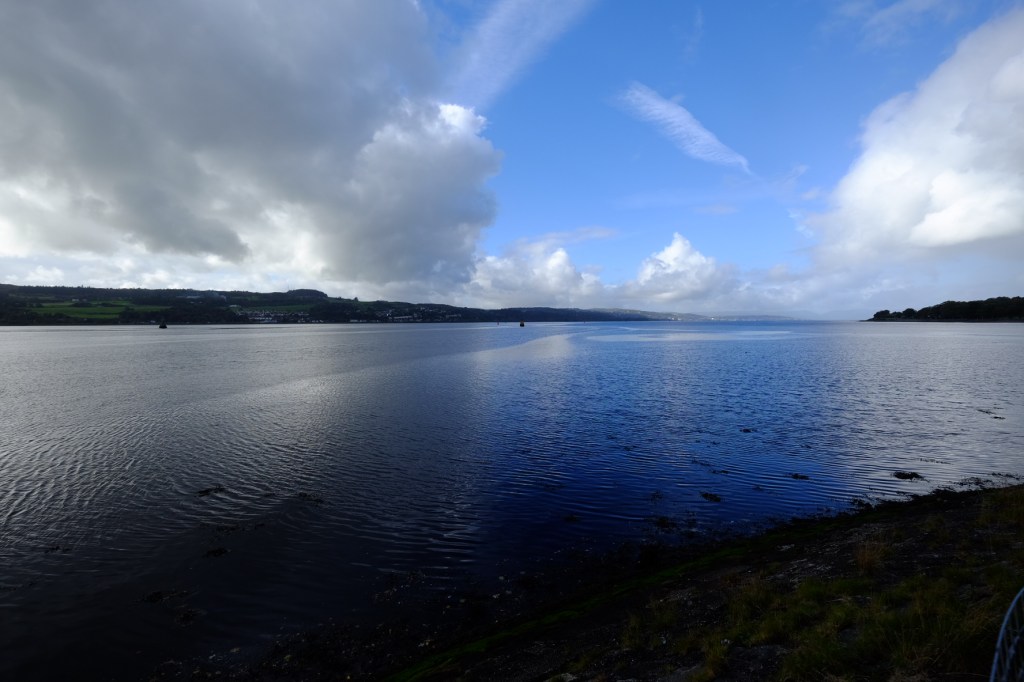
Leaving Glasgow – The Road to Dumbarton
With my exploration of Glasgow Cathedral complete, it was time to leave the city behind and begin the journey west.
The drive towards Dumbarton provided a fascinating transition. Glasgow’s imposing Victorian buildings, busy streets and industrial heritage gradually gave way to a more open landscape, with the River Clyde becoming an increasingly prominent feature.
For centuries, the Clyde was the lifeblood of Glasgow’s prosperity. Its banks were once lined with shipyards, engineering works and heavy industry, producing some of the finest ships in the world. At its peak, the river was synonymous with Scottish industrial ambition, its shipbuilders helping Glasgow earn its reputation as the Second City of the Empire.
But heading west, the industrial landscape begins to soften. The river broadens, the surrounding hills become increasingly prominent and the sense of approaching a rather different Scotland begins to take hold.
And then, rising dramatically from the landscape, comes Dumbarton Rock.
It’s difficult to miss.
An enormous volcanic outcrop towering above the surrounding countryside, with the remains of one of Scotland’s most historically significant fortifications perched upon it.
Dumbarton Castle – Before Scotland Was Scotland
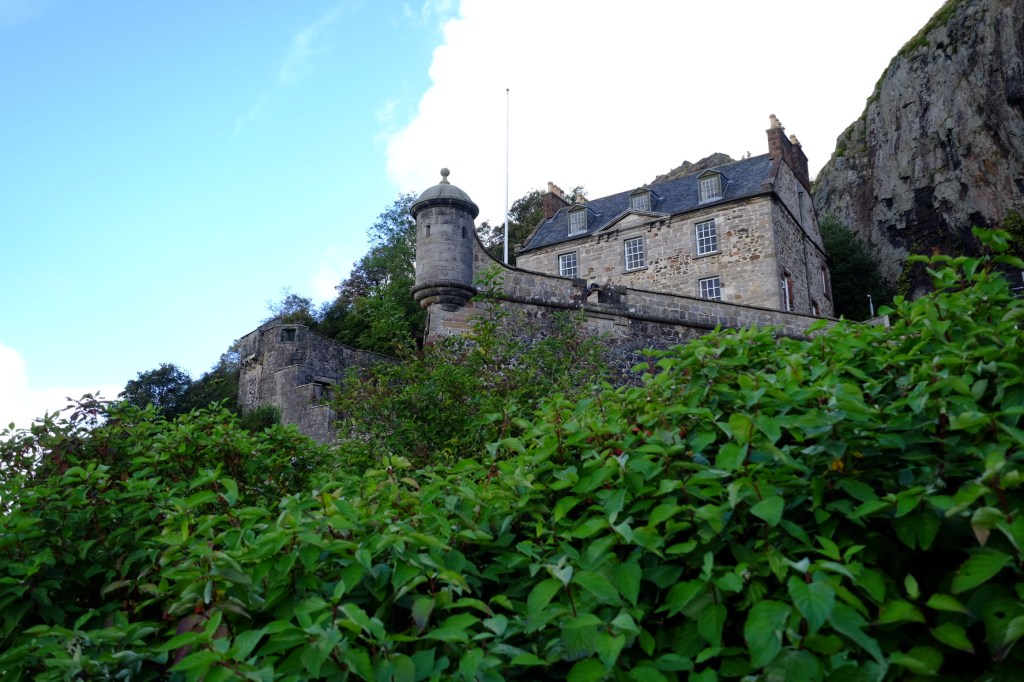
Dumbarton Rock is a remarkable place, and one I’d been particularly looking forward to photographing.
Long before the medieval castle was established, this great volcanic stronghold was known as Alt Clut, meaning ‘Rock of the Clyde’, and served as the principal fortified centre of the ancient Brittonic kingdom of Strathclyde.
Its position is extraordinary. Rising steeply above the confluence of the Rivers Clyde and Leven, the rock provided an almost naturally impregnable defensive position, commanding the surrounding landscape and an important route into Scotland’s interior.
In AD 870, however, even these formidable natural defences proved insufficient.
Viking forces led by Olaf and Ivar laid siege to Dumbarton Rock in an assault that reportedly lasted four months. Eventually the fortress fell, and according to contemporary Irish annals, the invaders returned to Dublin with an enormous quantity of treasure and captives, carried aboard a fleet said to number some 200 ships.
One can only imagine the reception committee.
The site subsequently became an important royal stronghold, with Alexander II developing the medieval castle during the thirteenth century as Scottish and Norwegian interests competed for influence along the western seaboard.
Its later history reads like a condensed account of Scotland’s political turbulence.
William Wallace was brought here following his capture in 1305 before being handed over to the English. In 1548, the five-year-old Mary, Queen of Scots, was sheltered within its defences before sailing to France. Then, in 1571, during the civil wars surrounding Mary’s reign, the castle was captured in an extraordinary night assault by Thomas Crawford of Jordanhill, whose men scaled the supposedly impregnable rock.
A Viking siege, medieval kings, William Wallace, Mary, Queen of Scots and an audacious military assault.
Not bad for one rather substantial lump of volcanic rock.
A Photographer’s Patience – Somewhat Tested
I was particularly keen to get a decent photograph of the castle, ideally capturing the great rock and its fortifications without too much modern-day interference.
Unfortunately, I wasn’t alone.
A group of people appeared to be conducting a dog-training session in precisely the area I had earmarked for my photographs.
Now, I have absolutely nothing against dogs. Or, for that matter, people training them. But I do have a particular dislike of people appearing in photographs of historic buildings, especially when I’m attempting to capture something that has stood for hundreds of years.
There’s something faintly irritating about composing a photograph of a magnificent medieval fortress, imagining Viking longships approaching along the Clyde, only to have someone in a fluorescent jacket wander into the foreground clutching a bag of dog treats.
Not quite the historical atmosphere I had in mind.
I spent a little time moving around, adjusting the composition and waiting patiently for suitable gaps in the canine activities.
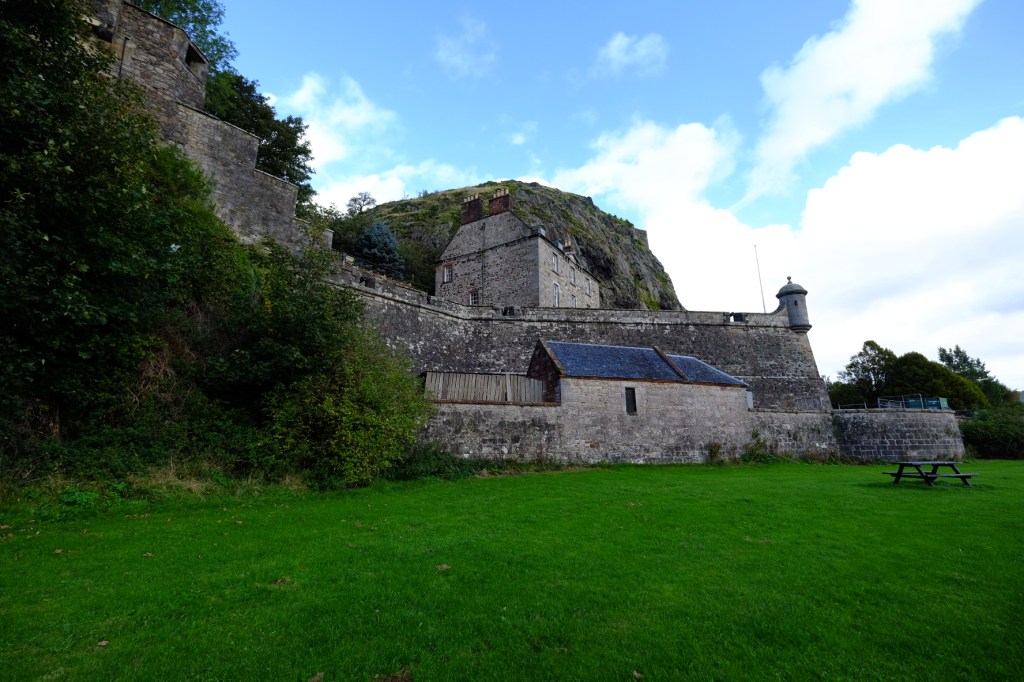
Eventually, I managed to capture the views I wanted, although it did require rather more patience than I’d anticipated.
I suspect the Vikings had an easier time organising their invasion.
With Dumbarton duly photographed, it was time to continue the journey, there was, however, a small problem, I was getting hungry.
The Great Lunchtime Expedition – Or How Not to Find Lunch
I’d already identified a couple of potentially interesting places to stop for something to eat, so finding lunch shouldn’t have presented much of a challenge, famous last words!
The first was a Vietnamese establishment that had caught my attention during my research. I had visions of wonderfully fragrant broths, fresh herbs, perhaps a bánh mì with crisp pickled vegetables and a little chilli. Something light, interesting and full of flavour. Unfortunately, what I discovered bore rather little resemblance to the Vietnamese experience I’d been anticipating.
Burgers and baps appeared to be the order of the day.
Now, there’s absolutely nothing wrong with a decent burger, but when you’ve mentally prepared yourself for the flavours of Vietnam, a bap comes as something of an anticlimax, never mind, time for plan B.
The second establishment looked promising, and I approached with renewed optimism, only to discover that it was closed on Tuesdays, naturally, today was Tuesday.
Two attempts, no lunch!
For someone who’d spent months researching medieval castles, prehistoric monuments, Scottish folklore and the finer points of Highland clan warfare, my inability to locate a decent sandwich was becoming mildly embarrassing, clearly, the 55-page guide had overlooked something important.
Out came the phone for a little emergency culinary research, and before long I’d found something that looked considerably more promising. There was just one slight complication, it meant heading back towards Glasgow. Not exactly the most efficient use of a carefully constructed itinerary, but there are times when culinary considerations must take precedence over geographical common sense. Besides, I’d already lost Stirling Castle to yesterday’s fog. I wasn’t about to lose Tuesday’s lunch to a burger and a locked door.
And that was how I discovered “Mootz”.
Mootz – Now That’s a Sandwich!
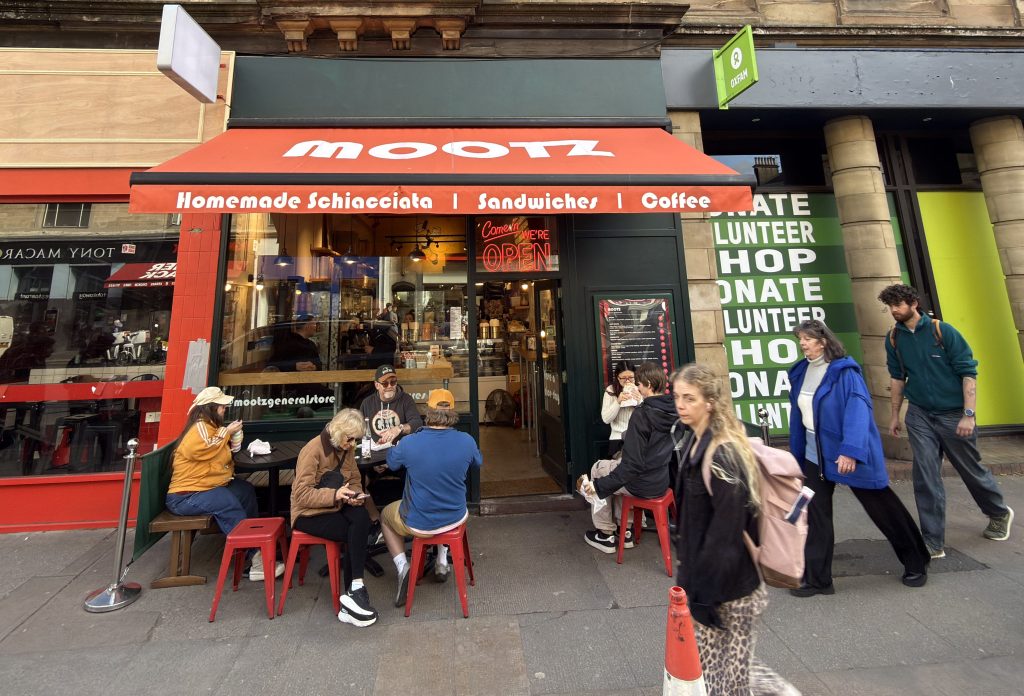
Mootz specialises in freshly prepared Italian “schiacciata” sandwiches, and one look at the menu suggested my little detour might prove rather worthwhile.
Schiacciata, originating in Tuscany, is a wonderful olive-oil-enriched flatbread, with a beautifully golden exterior and a light, airy interior. When made properly, it provides the perfect foundation for a generously filled Italian sandwich, and generous appeared to be something of a speciality here.
The menu was full of tempting combinations featuring mortadella, prosciutto, stracciatella, mozzarella, pistachio pesto and assorted other delicious ingredients.
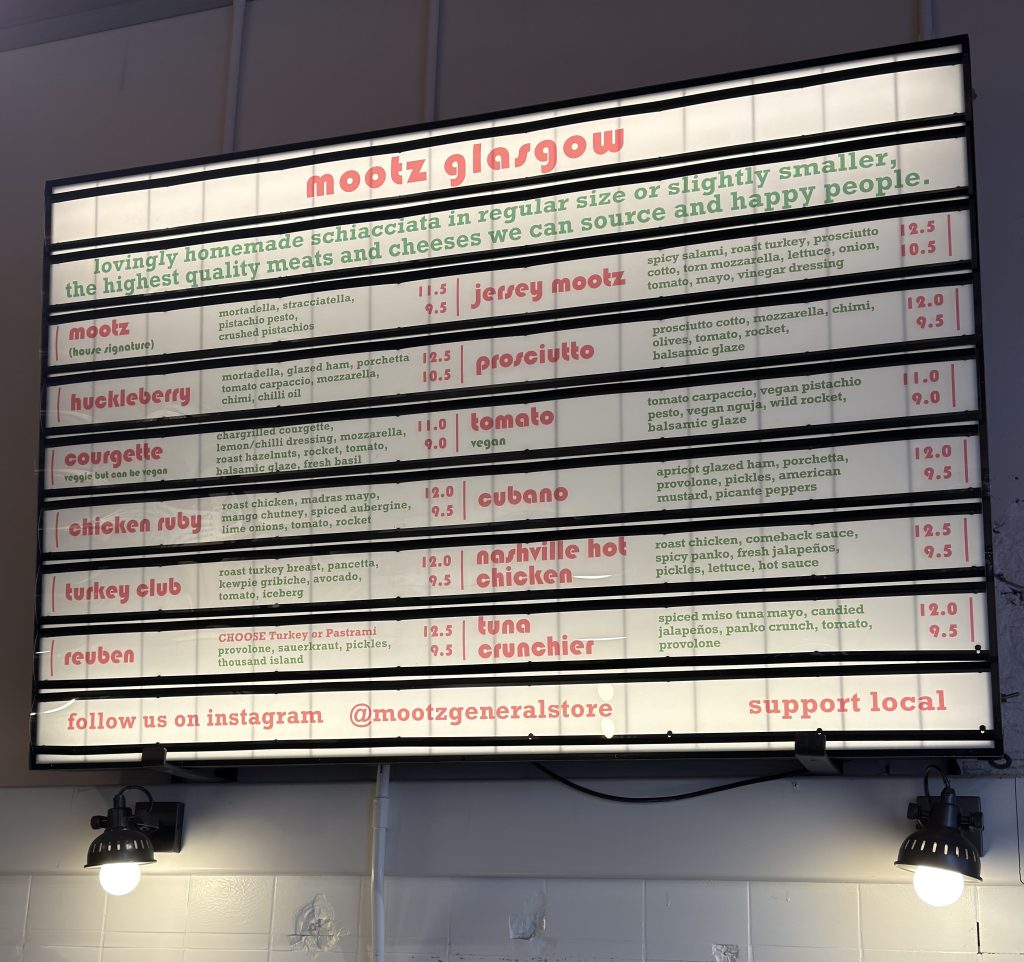
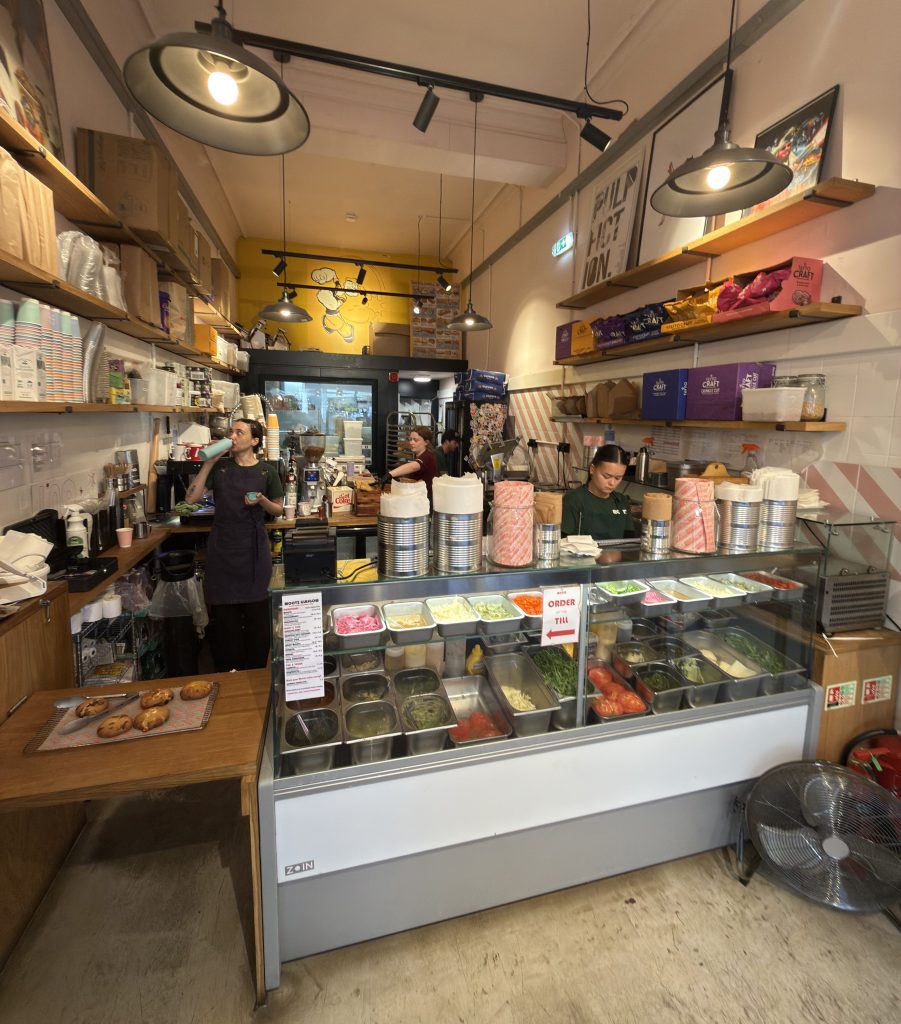
The signature Mootz caught my attention: mortadella, stracciatella, pistachio pesto and crushed pistachios.
A beautifully simple combination, allowing the individual ingredients to shine. The richness of mortadella, the wonderfully creamy stracciatella and the distinctive nutty flavour of pistachio all wrapped in that magnificent bread.
It looked substantial, to say the least.
But, after considerable deliberation, I settled on the Huckleberry, a rather magnificent creation consisting of pistachio mortadella, apricot-glazed ham, porchetta, tomato carpaccio, mozzarella, chimichurri and chilli oil, all generously packed between two substantial slices of freshly baked schiacciata.
This wasn’t so much a sandwich as a carefully engineered construction project.
With my precious cargo safely aboard, it was time to leave Glasgow behind for the second time that day.
I had a particular destination in mind for lunch. Somewhere considerably more scenic than a city-centre pavement, and somewhere I could finally test another of my recent acquisitions.
My little portable espresso machine was about to earn its place in the luggage.
Loch Lomond – An Island with a History of Its Own
Heading north along the A82, the urban landscape gradually disappeared, replaced by wooded hillsides, distant mountains and increasingly impressive views across Loch Lomond.
The loch is the largest freshwater lake in Great Britain by surface area, extending for approximately 36 kilometres from its southern reaches towards the Highland mountains. Its character changes dramatically along its length. To the south, the water is broad and comparatively gentle, scattered with numerous islands, while farther north the mountains close in and the landscape takes on a much wilder appearance.
One island in particular had caught my attention during the pre-trip research.
Inchmurrin.
At approximately 120 hectares, Inchmurrin is the largest freshwater island in the British Isles, and, naturally, it has a rather interesting history.
Named after St Mirin, the early Christian saint associated with Paisley, the island was once an important possession of the Earls of Lennox. During the fourteenth century, a castle was established near its southern end, providing the powerful Lennox family with a secluded island stronghold. Its history became entangled with the political turbulence surrounding Scotland’s medieval aristocracy and the Stewart dynasty. The castle eventually fell into ruin, but its remains survive as another reminder that Scotland’s beautiful landscapes frequently conceal a more complicated past.
I rather liked the idea of an island within a loch, with its own castle, history and centuries of intrigue. And, of course, there was something particularly appropriate about encountering it while travelling towards another island altogether, Eilean Shona, where the culinary part of this adventure was still waiting for me.
But that was a few days away.
For now, I had lunch to consider, and the landscape was becoming increasingly spectacular.
Rest and Be Thankful – A Rather Appropriate Place for Lunch
Continuing along Loch Lomond towards Tarbet, I turned left onto the A83, heading west into the magnificent landscape of the Arrochar Alps. Here the road begins to climb through Glen Croe, winding between imposing mountain slopes towards one of Scotland’s most wonderfully named locations: the Rest and Be Thankful.
The name originates from the eighteenth-century military road constructed through the glen as part of a wider network intended to improve military access through the Highlands.
The old route involved a considerable climb, and travellers reaching the summit were encouraged to stop and appreciate their achievement. An inscription commemorating repairs undertaken by the 93rd Regiment in 1768 helped preserve the wonderfully simple sentiment.
Rest and Be Thankful
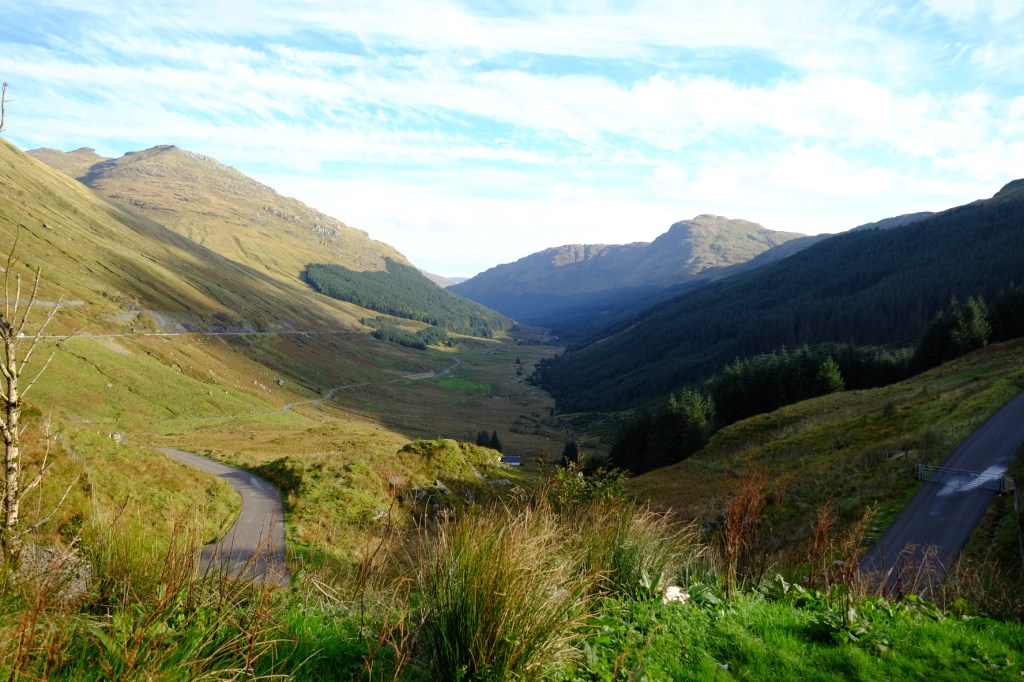
Considering the view, it seemed only polite to comply. This was where I finally stopped for my rather delayed lunch.
Surrounded by towering mountains, with the dramatic sweep of Glen Croe stretching away below, I unwrapped my magnificent Mootz sandwich.
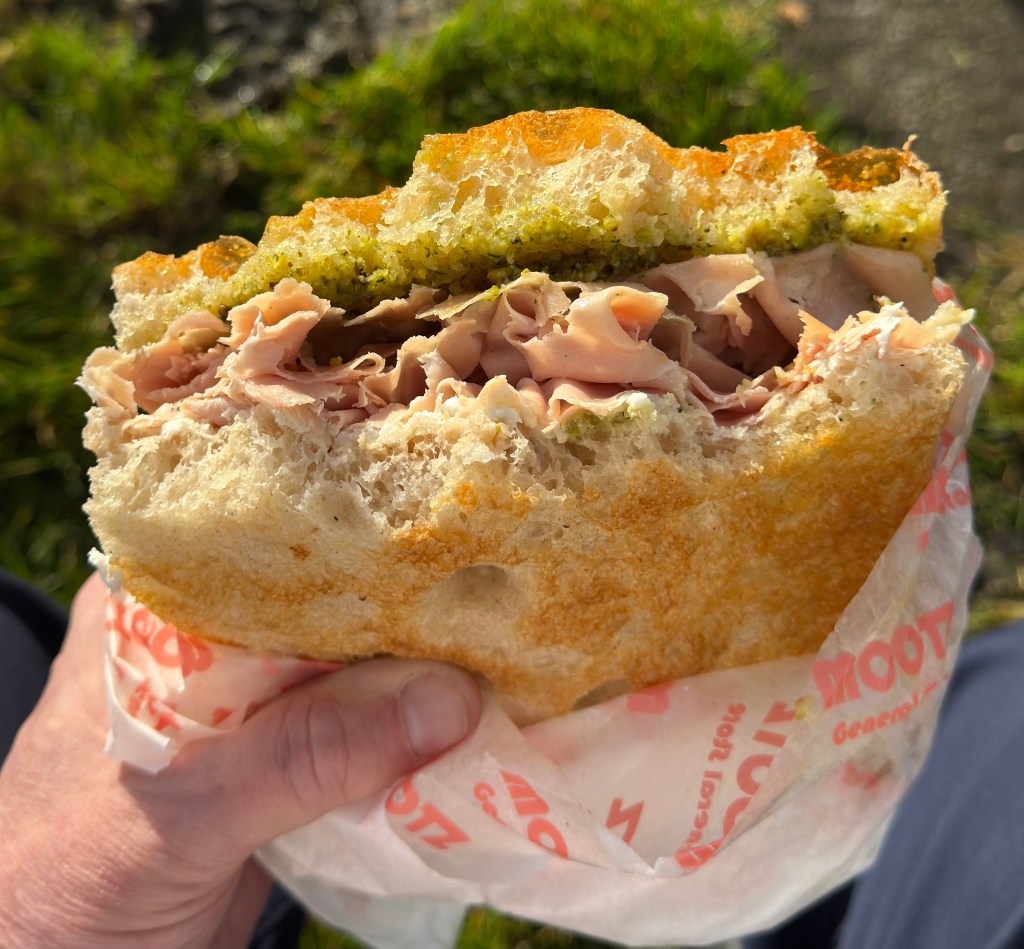
And what a setting I’d chosen.
The landscape was spectacular, with great banks of cloud drifting across the mountains, occasional bursts of sunlight illuminating the slopes and the ever-present possibility of the weather deciding to provide a little additional entertainment.
After two failed attempts to find lunch, an unscheduled return towards Glasgow and rather more driving than anticipated, the sandwich tasted all the better for the effort.
The combination of ingredients was inspired. Delicate, silky mortadella provided a lovely richness, complemented by the sweetness of the apricot-glazed ham and the deeper, savoury character of the porchetta. Fresh mozzarella brought a welcome creaminess, while the finely sliced tomato added moisture and a little acidity to balance the cured and roasted meats.
Then came the chimichurri, that wonderfully vibrant herb-based sauce, cutting through the richness with its fresh, garlicky sharpness, while the chilli oil delivered a gentle background warmth.
And holding this magnificent collection together was the schiacciata itself. Golden and lightly crisp on the outside, wonderfully soft and airy within, with that distinctive olive oil character that makes good Italian flatbread such a pleasure to eat.
It was an absolute triumph of contrasting flavours and textures: rich, sweet, savoury, creamy, fresh and just a little spicy, with each ingredient contributing something rather than simply competing for attention.
Sometimes the simplest things are the most enjoyable.
Although I wasn’t quite finished.
Espresso in the Wild – The Inaugural Field Test
Now came another important moment in the adventure.
The first proper outdoor test of my new Outin portable espresso machine.
I’d bought this clever little rechargeable device specifically for the trip, imagining freshly made espresso in some wonderfully remote Scottish setting. Now here I was, surrounded by Highland mountains, armed with my GRIND coffee capsules and absolutely no need to locate a coffee shop.
For those unfamiliar with it, the Outin is a compact battery-operated espresso maker capable of heating water and extracting coffee without requiring mains electricity. It accepts compatible capsules or ground coffee, making it particularly appealing for travelling, camping or finding yourself miles from the nearest decent café.
A little water, a capsule, a press of the button and the machine set about producing a proper espresso.
There’s something immensely satisfying about enjoying good coffee somewhere like this.
No queue, no barista asking for your name and, perhaps most importantly, no paper cup informing you that you’re having an inspirational day.
Just an Italian sandwich, freshly extracted espresso and one of the finest views Scotland could offer.
Civilisation, I decided, is more a state of mind than a geographical location, the name of the viewpoint seemed particularly appropriate.
After my slightly ridiculous lunchtime expedition, I was indeed resting, and extremely thankful.
The Road to Kilmartin – Lochs, Puffers and Five Thousand Years of History
With lunch finally enjoyed and the coffee experiment declared a success, it was time to pack away my little mobile coffee shop and continue west.
The road carried me deeper into Argyll, where the landscape seemed determined to become more spectacular around every corner. The towering mountains gradually softened into wooded hillsides, great stretches of water appeared between the trees, and the late afternoon sunshine was beginning to cast that wonderful golden light across the countryside.
I was also becoming increasingly aware that my camera was rather interfering with my carefully planned timetable. Every bend seemed to reveal another scene demanding attention.
Not that I was complaining.
A Brief Encounter with Loch Fyne
One particularly lovely stop was beside Loch Fyne, where I pulled in near the famous Loch Fyne Oyster Bar.
With the sun beginning to sink behind the surrounding hills, the view was magnificent. The loch stretched away into the distance, its waters reflecting the warm evening light, while great sweeps of cloud filled the sky overhead.
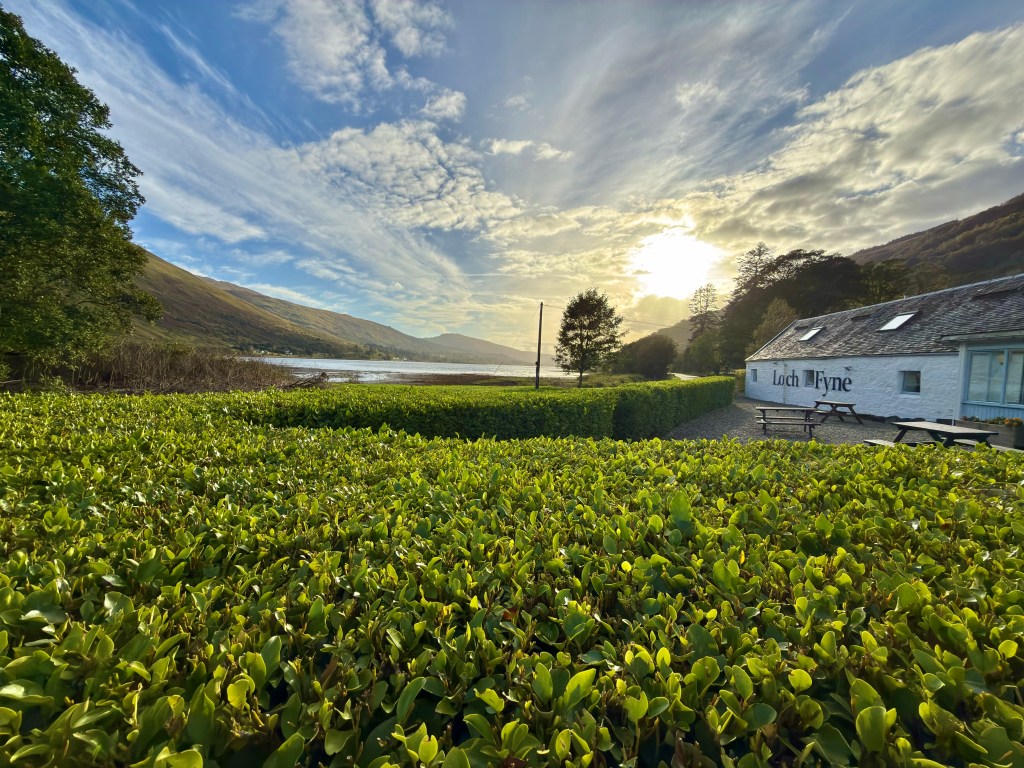
Loch Fyne is Scotland’s longest sea loch, extending for around 40 miles inland from the Sound of Bute. Its sheltered waters have long supported fishing and shellfish production, and its oysters are particularly celebrated.
The Loch Fyne Oyster Bar itself grew out of a small roadside business established in the late 1970s, helping bring the region’s exceptional seafood to a much wider audience.
Under different circumstances, this would have warranted a considerably longer investigation. Possibly involving oysters. Almost certainly involving something else from the menu.
Unfortunately, time was marching on, and having already travelled rather further than originally intended in pursuit of a sandwich, I thought it prudent not to embark on another culinary expedition.
A few photographs, a moment to enjoy the view, and I was on my way.
The Vital Spark – A Little Maritime Nostalgia
Continuing towards Inveraray, another unexpected photographic opportunity presented itself in the form of a wonderful old vessel named Vital Spark, her distinctive red-and-black hull standing out beautifully against the waters of Loch Fyne.
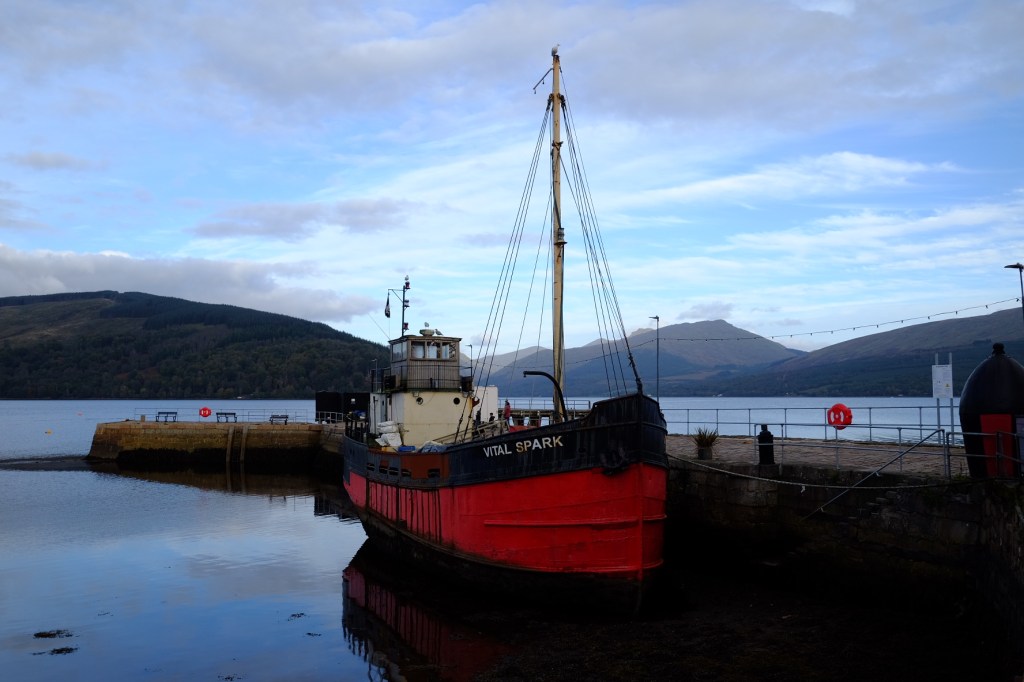
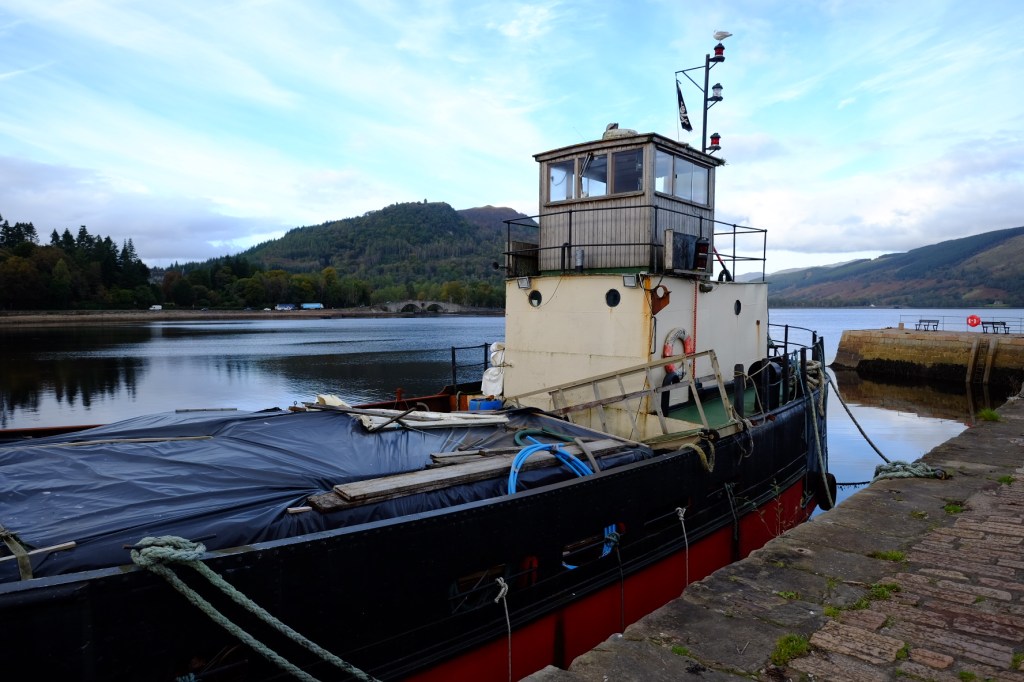
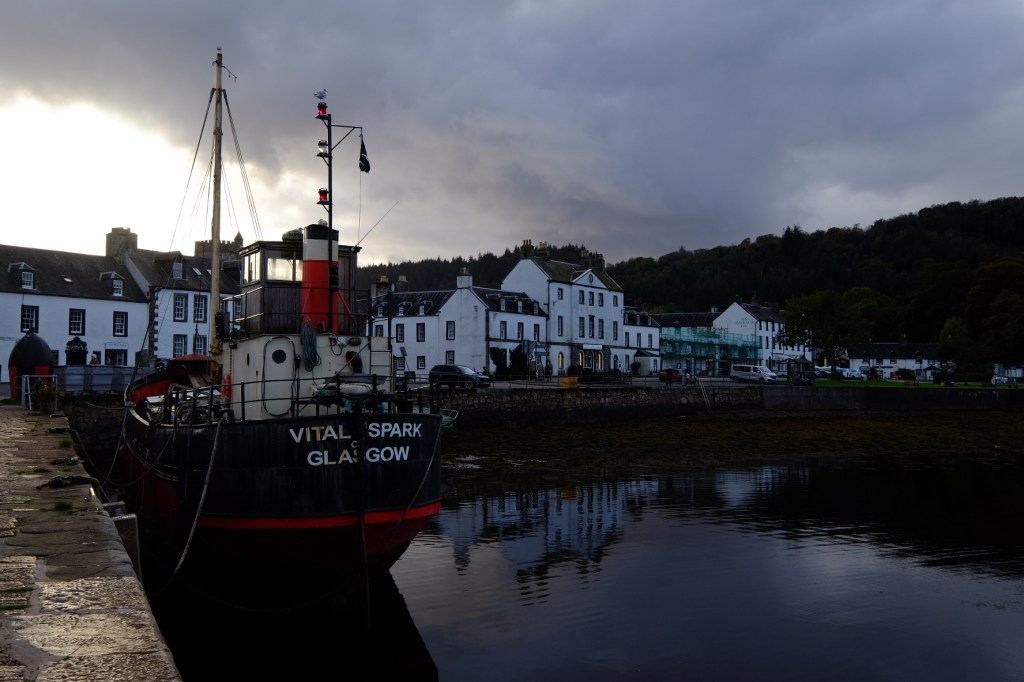
The name immediately evokes Scotland’s famous Clyde puffers, those sturdy little steam-powered cargo vessels that once carried essential supplies from the Clyde to the remote communities of the western Highlands and islands.
Coal, food, building materials, whisky barrels and almost anything else required by isolated settlements travelled aboard these remarkably versatile boats. Their shallow draught and flat bottoms allowed them to reach small harbours and even beach themselves where proper docking facilities were unavailable.
The puffers also became immortalised through Neil Munro’s fictional character Para Handy, the gloriously self-important skipper of the Vital Spark, whose adventures and frequent misunderstandings became a much-loved part of Scottish literature and television.
A captain whose confidence in his own abilities was, shall we say, not always entirely justified.
And this particular Vital Spark has quite a history of her own.
Built in 1944 as VIC 72, a wartime naval victualling vessel, she subsequently spent decades working as a cargo boat around Scotland’s western islands under several different names. Eventually brought to Inveraray in 2001, she was renamed Vital Spark in 2006 in honour of Neil Munro’s much-loved fictional puffer.
Although originally steam-powered, she was later converted to diesel, so she’s not quite the traditional steam puffer her appearance might suggest. Nevertheless, her working-boat character and distinctive profile make her a wonderful surviving reminder of the vessels that once provided a lifeline to Scotland’s remote coastal communities.
Not bad for a lady approaching her 82nd birthday.
There was something wonderfully atmospheric about her sitting quietly against the pier, with the wooded hills and calm waters of Loch Fyne providing a magnificent backdrop.
Quite how Para Handy would have coped with my increasingly revised itinerary is anyone’s guess, although I suspect he’d have found a perfectly reasonable explanation for every delay, preferably one that involved blaming somebody else.
And speaking of waterways, my next photographic diversion was waiting a little farther along the road.
Crinan – A Shortcut Through Scotland
As the afternoon slipped towards evening, I made my way to Crinan, a beautiful little settlement overlooking the Sound of Jura and the western entrance to the Crinan Canal.
By now, the light was changing rapidly. The sky had taken on soft shades of gold and blue, the rocky shoreline was beautifully silhouetted against the water, and distant islands appeared almost suspended beneath the clouds.
It was the sort of scene that makes you forget you’ve been driving for most of the day.
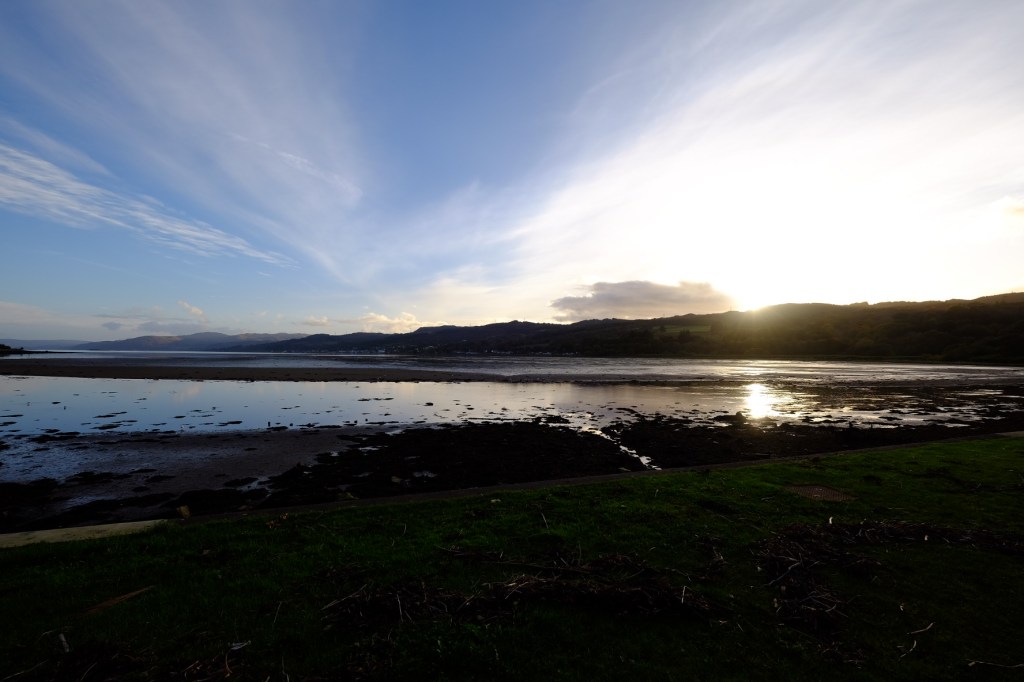
The canal itself has a fascinating history. Designed by the great civil engineer John Rennie and opened in 1801, it provides a nine-mile navigable shortcut between Ardrishaig on Loch Fyne and Crinan on the Sound of Jura.
Before its construction, vessels travelling between the Clyde and the western islands faced the considerably longer and potentially hazardous journey around the Mull of Kintyre.
The canal, with its 15 locks, transformed that journey, becoming an important commercial route for fishing vessels, cargo boats and, later, the Clyde puffers.
Not surprisingly, it acquired the rather splendid description of Britain’s most beautiful shortcut.
Standing beside the quiet harbour, looking at the boats, old stonework and canal locks, it wasn’t particularly difficult to understand why.
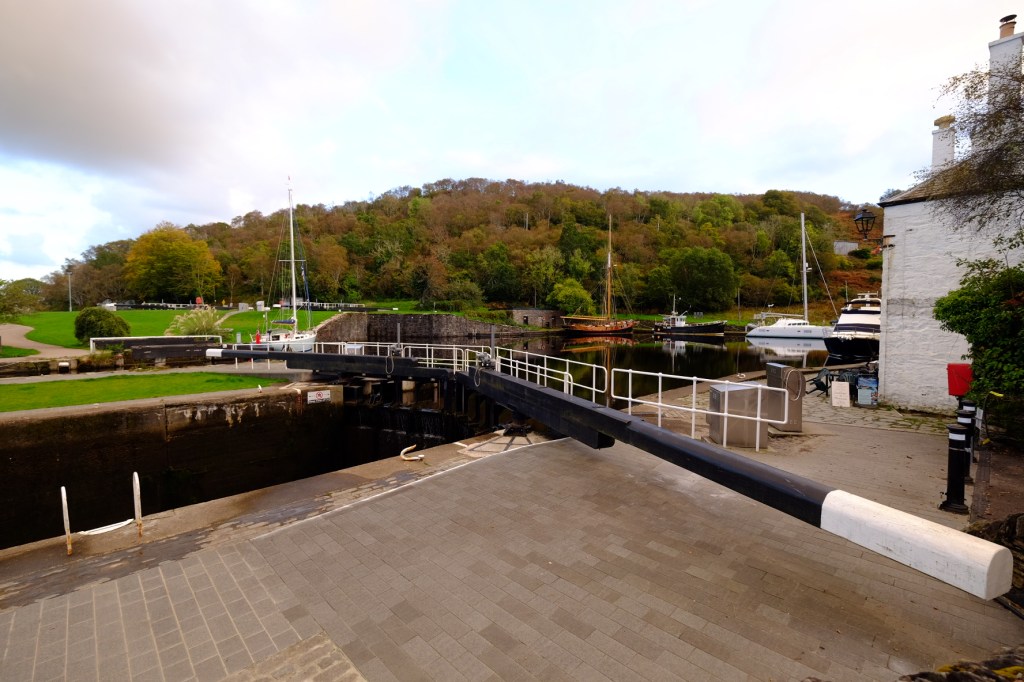
There was a lovely stillness about the place. Boats rested in the sheltered basin, their masts rising against the wooded hills, while the old lock gates and surrounding buildings provided a glimpse of the canal’s working past.
After the bustle of Glasgow, the dog-training activities at Dumbarton and the unexpected lunchtime expedition, Crinan felt wonderfully peaceful.
I could easily have spent considerably longer here, exploring the shoreline and photographing the changing light, but there was one small problem.
I still hadn’t reached my hotel.
Kilmartin – At Last!
A short drive later, I finally arrived in Kilmartin.
And, almost on cue, the weather decided that I’d enjoyed quite enough sunshine for one day.
The sky had turned decidedly grey, the roads were wet, and there stood the wonderfully traditional white frontage of the Kilmartin Hotel, looking rather inviting after a long day’s travelling.
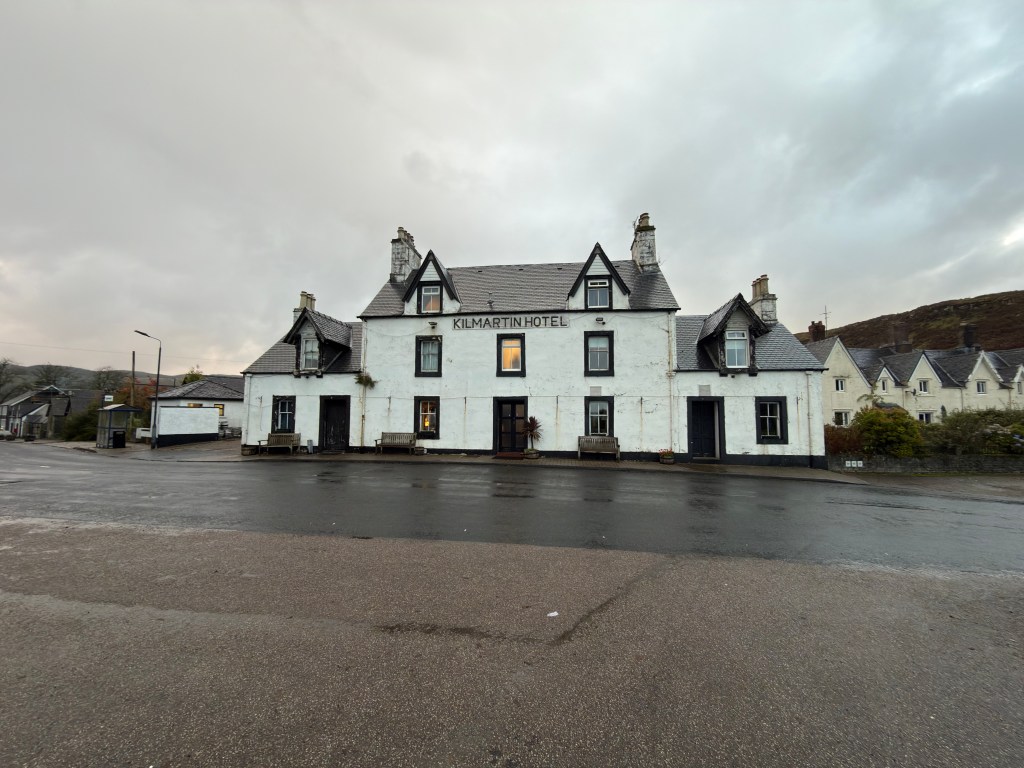
I’d made it.
The hotel sits in the heart of a landscape I’d spent months researching, surrounded by one of Britain’s most remarkable collections of prehistoric monuments. Within just a few miles are ancient burial cairns, standing stones, stone circles and mysterious cup-and-ring carvings, many dating back thousands of years.
There is also Dunadd, once an important royal centre of the Gaelic kingdom of Dál Riata, where a footprint carved into the rock is traditionally associated with the inauguration of early Scottish kings. From prehistoric ceremonial landscapes to the emergence of early Scottish kingship, an astonishing amount of history is concentrated in this relatively small corner of Argyll.
And here I was, finally in the middle of it.
After months of research, countless maps, historical investigations and enough printed material to suggest I was preparing a doctoral thesis rather than a holiday, the real exploration was about to begin.
There was, however, something rather satisfying about simply arriving.
Looking back over the day, I’d managed to squeeze in a Bombay-inspired breakfast, an extraordinary medieval cathedral, a pioneering surgeon, Viking invasions, a rather unsuccessful search for lunch, one magnificent Italian sandwich, an espresso overlooking the Highlands, Loch Fyne, a characterful old puffer and a beautiful evening beside the Crinan Canal.
Not bad for a Tuesday.
But the ancient stones, mysterious burial chambers and several thousand years of Scottish history would have to wait until morning. For now, I had a hotel to check into, a camera to put away and, quite possibly, a well-earned glass of something Scottish to contemplate.
Five thousand years of history weren’t going anywhere overnight.
At least, I sincerely hoped not.
………………… Until Next Time ………………. L8ers ………………………

