Six O’Clock – Rather Too Excited to Sleep
Six o’clock. Wide awake.
Not because of an alarm, a passing vehicle or the familiar noises of everyday life, but simply because I was far too excited to stay in bed. After nineteen months of anticipation, and an excellent opening dinner courtesy of Val Warner the previous evening, I had finally spent my first night on Eilean Shona.
My home for the next few days was Tioram Cottage, a wonderfully comfortable stone-built house overlooking Loch Moidart, shared with Ruth and Tim, each of us occupying a separate bedroom. The cottage was generously appointed, with a large open-plan kitchen, dining and sitting area, comfortable sofas and an open fireplace. Its windows looked across the water towards the magnificent ruins of Castle Tioram.
There were also some thoughtful little touches, including fresh milk, drinking water and three miniature bottles of Nc’nean Organic Single Malt Scotch Whisky, produced on the nearby Morvern peninsula. I was particularly impressed by the provision of both whisky and fresh milk. Clearly, somebody understood that the needs of a gentleman can vary considerably according to the time of day.
Outside, the island was slowly emerging from the darkness. Beyond the cottage lay woodland, sheltered bays, rocky coastline and the waters of Loch Moidart and for once, I had absolutely nowhere I needed to drive, a rather unfamiliar situation after four days of chasing castles, archaeological monuments and interesting places to eat across western Scotland.
My carefully annotated OS maps could finally enjoy a well-earned rest, I couldn’t.
With another hour and a half before breakfast, I consulted the itinerary, an altogether more agreeable document than anything produced by the DVLA. Val and Clare had thoughtfully explained that we should enjoy the island at our own pace. There were activities, demonstrations, excursions and plenty of opportunities simply to relax. We were under no obligation to participate in everything.
An extremely civilised philosophy.
The first choice of the day rather neatly illustrated the point. From 7:30am, there was an optional swim and sauna down at Sail Loft beach, coinciding with the start of breakfast in the main house.
I considered both possibilities.
One offered invigorating immersion in the bracing waters of the Scottish Highlands, followed by the restorative warmth of a sauna, whilst the other offered a roaring log fire, freshly brewed Earl Grey and a breakfast menu that I’d already heard very promising things about.
As a man who had travelled all this way primarily because of his enthusiasm for excellent food, I felt it important to remain true to my principles, by the time breakfast began, I was already at Eilean Shona House.
First to arrive, naturally.
I appreciate that some people embrace the wild through physical endurance and exposure to the elements, but personally, I was perfectly happy to begin with a cup of tea.
A Roaring Fire and a Proper Scottish Breakfast
And what a lovely welcome awaited me.
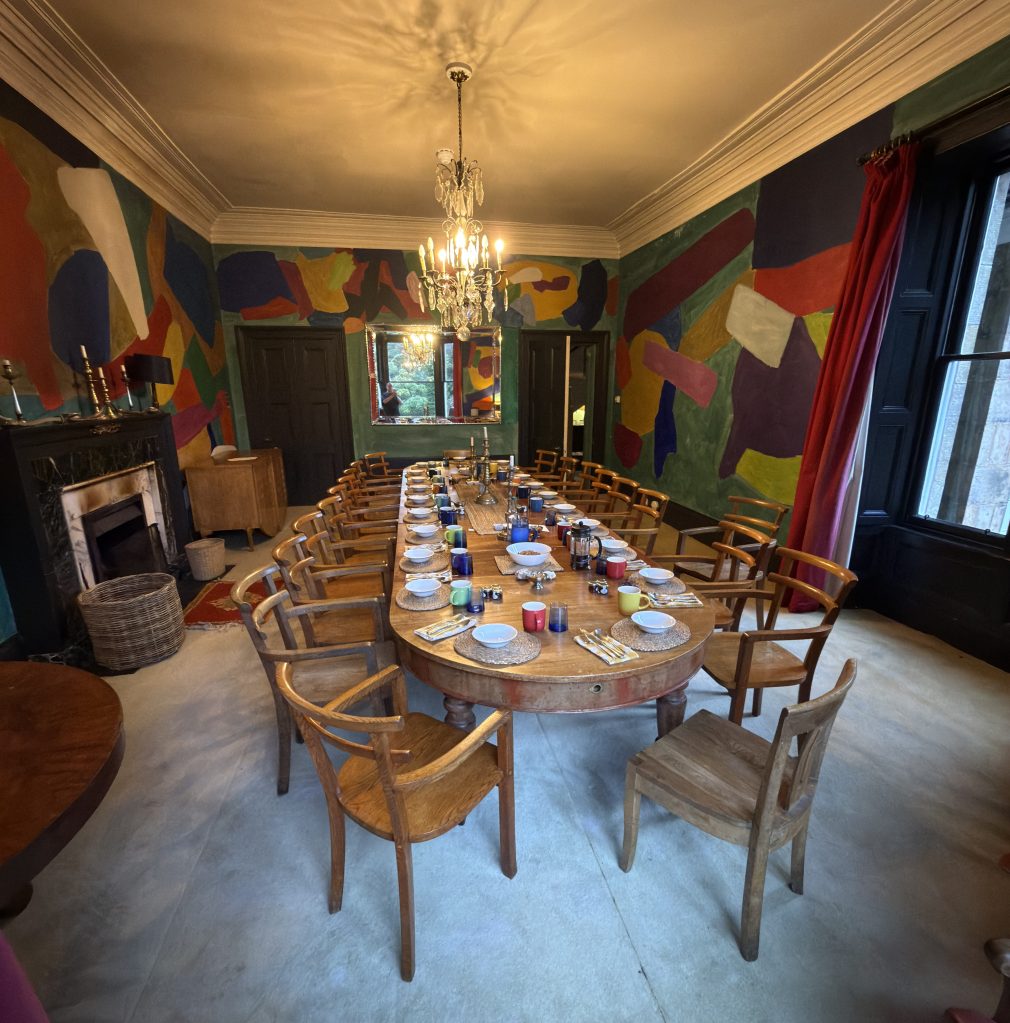
The house was wonderfully atmospheric in the early morning. A roaring log fire filled the room with warmth, the comfortable surroundings invited you to linger, and the dining room, with its magnificent abstract mural and long communal table, had been transformed overnight from the scene of our splendid first dinner into an equally inviting breakfast setting.
There was something particularly enjoyable about being first downstairs. The quiet before everyone gathered, the smell of toast, the fire crackling away and that wonderful anticipation of a day with no emails to answer, no traffic to negotiate and no pressing decisions beyond what to eat.
Admittedly, given the breakfast menu, that final responsibility was not entirely insignificant, and once again, there was the reassuring sense that everything had simply appeared as if by magic.
Of course, it hadn’t.
Behind the relaxed atmosphere was an extremely hardworking team of skilled chefs, house staff and organisers, quietly ensuring that everything ran beautifully. Meals were prepared, rooms looked after, activities coordinated and drinks produced, often before anyone had thought to ask.
And somebody had already grasped the importance of a properly timed cup of Earl Grey.
An excellent start to the day, and considerably less traumatic than a swim in Loch Moidart.
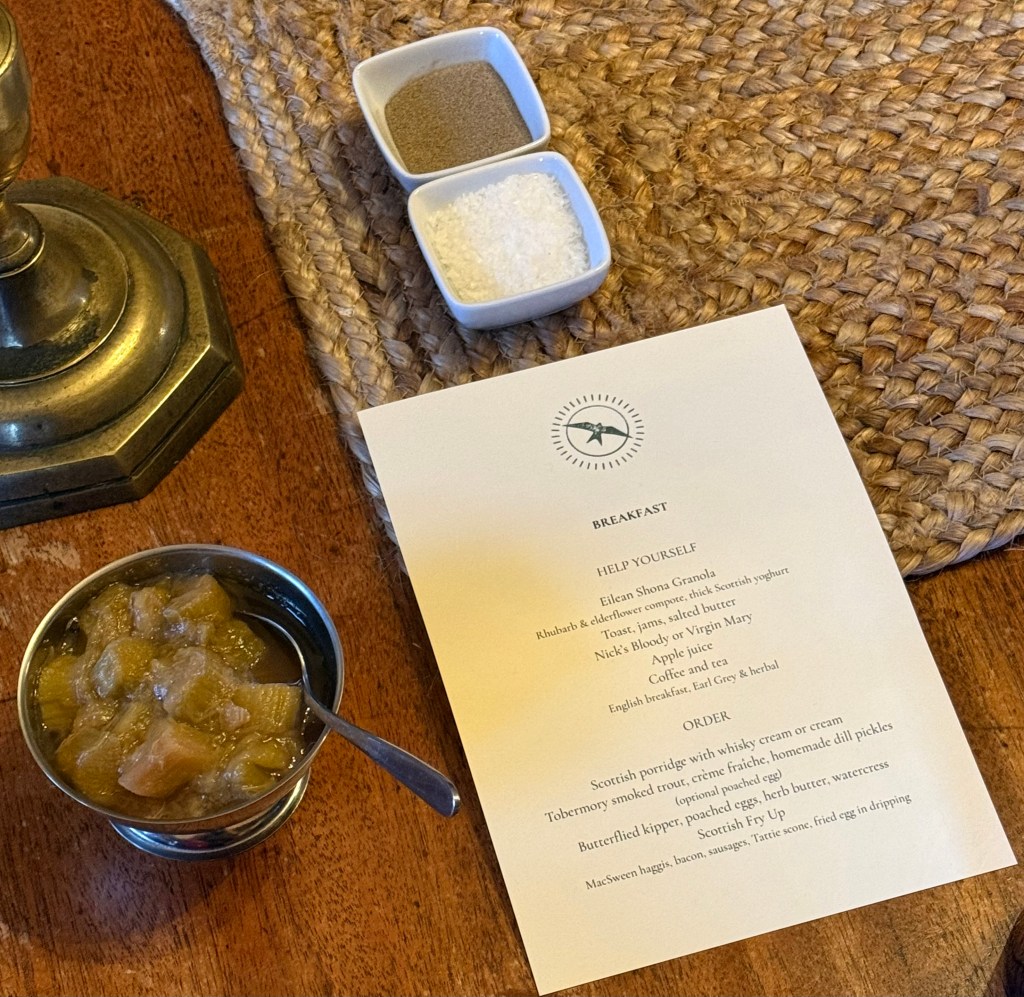
The breakfast menu was a thing of beauty.
On the help-yourself side were Eilean Shona granola, rhubarb and elderflower compote, thick Scottish yoghurt, toast, jams and salted butter. There was apple juice, tea and coffee, along with Nick’s Bloody or Virgin Mary. Given Nick Strangeway’s considerable credentials in the drinks department, even the prospect of a Bloody Mary at breakfast came with rather more pedigree than usual.
Then there were the cooked choices.
Scottish porridge with whisky cream or ordinary cream, Tobermory smoked trout with crème fraîche and homemade dill pickles, butterflied kipper with poached eggs, herb butter and watercress, or a full Scottish fry-up incorporating MacSween haggis, bacon, sausages, tattie scone and an egg fried in dripping.
Honestly, I could have spent the next four mornings investigating the menu and still felt I’d neglected something important.
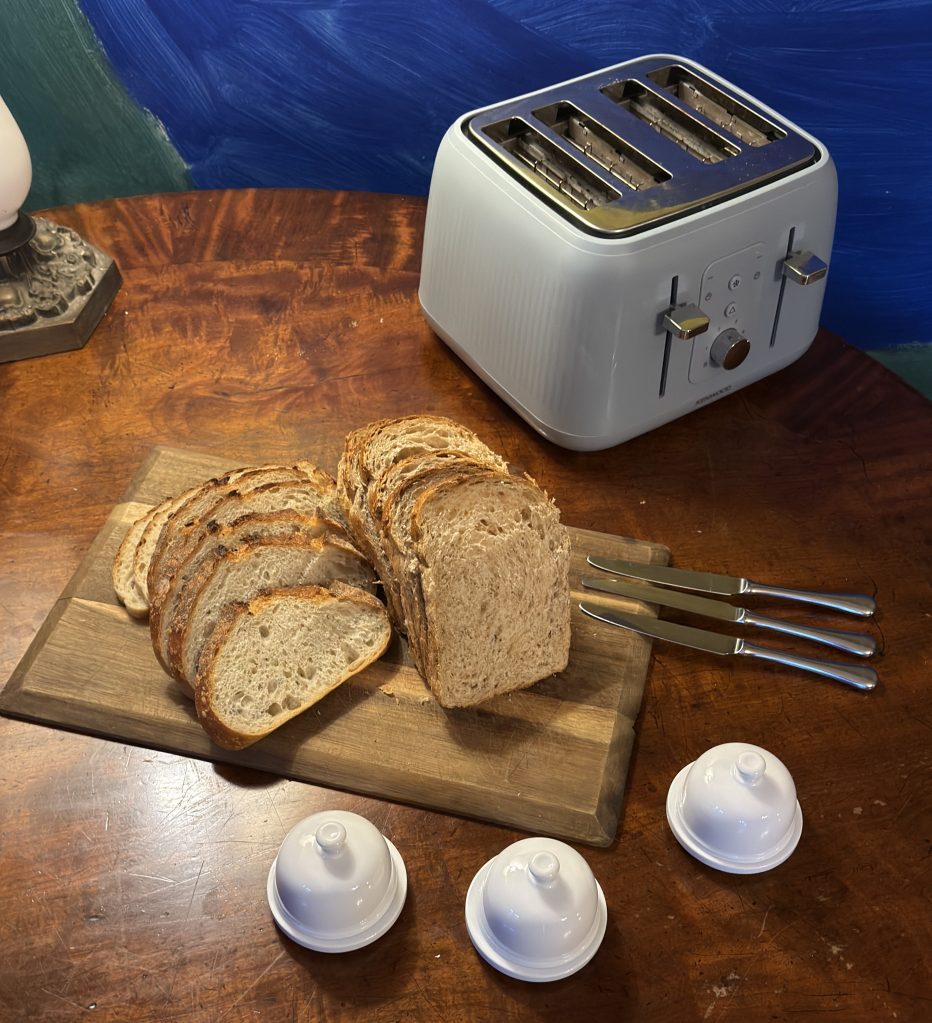
[INSERT PHOTO: 08:00 – Freshly sliced bread, toaster and breakfast preparations.]
The bread alone looked excellent, with generously sliced rustic loaves waiting alongside the toaster. There was something satisfyingly domestic about this arrangement. Extraordinary cooking in a remarkable house, but without losing the simple pleasures of making yourself a decent piece of toast.
The rhubarb and elderflower compote was particularly tempting, its soft fruit offering a combination of sweetness and gentle acidity. Alongside thick Scottish yoghurt and the house granola, it made a rather civilised beginning and was also exceedingly good, slathered on buttered toast.
But I had already made my decision about the main event.
Tobermory Smoked Trout – A Very Good Decision
I chose the Tobermory smoked trout, crème fraîche and homemade dill pickles, with the optional poached egg.
Optional?
Under what circumstances would a perfectly good poached egg be regarded as unnecessary?
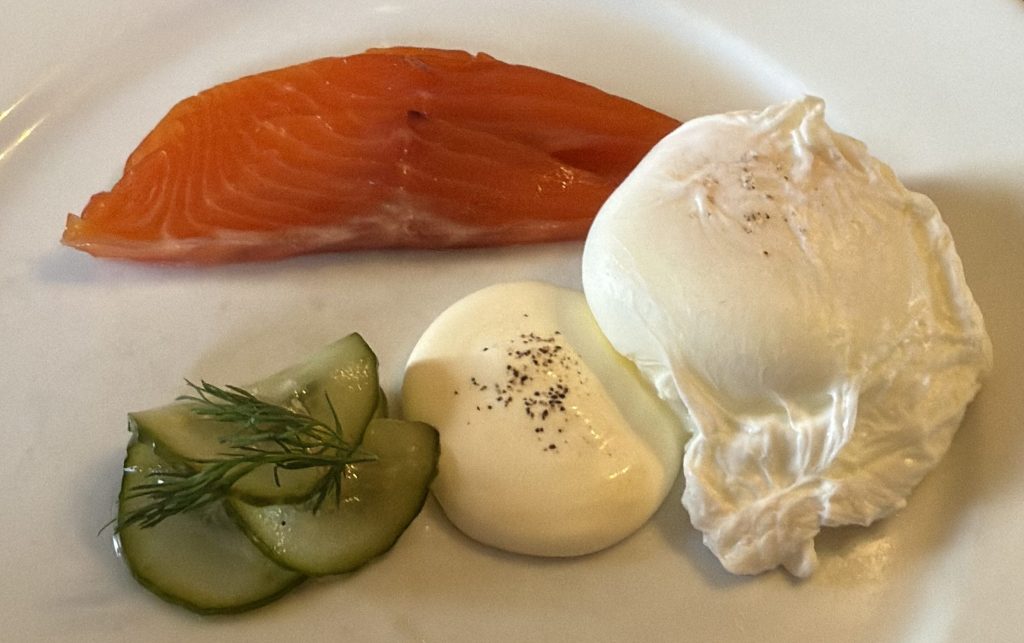
The plate arrived looking wonderfully restrained.
A generous piece of beautifully coloured smoked trout, its vivid orange flesh contrasting with the pale crème fraîche, delicate slices of homemade pickle and a perfectly formed poached egg.
The trout possessed the rich, gently smoky character that makes this style of fish so appealing. The crème fraîche added a welcome freshness and richness, while the crisp, lightly acidic pickles, scented with dill, provided the contrast needed to bring everything together.
And then there was the poached egg, a beautifully formed little parcel, its delicate white concealing the promise of a magnificent golden yolk. Some things simply belong together, and smoked fish, good bread and a properly poached egg are very high on my list.
It was an excellent breakfast, enjoyed beside a roaring fire, and I was beginning to appreciate just how pleasant it was to have an entire day ahead without the slightest responsibility for organising any of it.
An unusual sensation.
But one I felt I could learn to enjoy.
Egg Tempera – Three Hours in the Company of Anna Koska
At 9:30am, it was time to head to the Studio for an activity I’d been particularly looking forward to: a morning exploring the ancient art of egg-tempera painting with Anna Koska. Unlike most of the people I’d only recently met on the island, Anna was already something of a familiar presence, having discovered her extraordinary natural-history illustrations some months earlier, I’d become completely captivated by her work, and we’d been briefly exchanging comments on Instagram in the lead-up to the trip.
Her paintings have a quality that photographs, however accomplished, rarely achieve. She notices the tiny variations in colour, structure and texture that most of us simply overlook: the subtle translucency of a petal, the curve of a leaf, the extraordinary detail in the scales of a fish, or the delicate architecture of something as seemingly insignificant as a snail’s shell.
There is something wonderfully absorbing about her approach to the natural world, and now I was about to discover rather more about how she achieved it.
I should probably explain that my enthusiasm for beautiful botanical artwork does not necessarily indicate any corresponding ability to produce it.
Appreciation and execution are two entirely different disciplines.
An Ancient Technique, a Rather Unusual Ingredient
Egg tempera is one of the oldest established painting methods, used since antiquity and particularly associated with medieval and early Renaissance art. Before oil painting became dominant in Europe, it was the medium responsible for many of the extraordinarily detailed religious panels and altarpieces that survive today. Its essential ingredients are remarkably simple: powdered pigment, water and egg yolk.
The yolk acts as the binder, holding the coloured particles together and fixing them to the painting surface as the paint dries. It is a beautiful meeting of natural materials and artistic endeavour.
Although it does mean that, having already enjoyed a magnificent poached egg for breakfast, I was now about to spend the remainder of the morning investigating an entirely different application for its close relative.
Clearly, Kitchen in the Wild had decided to explore the versatility of eggs in some depth.
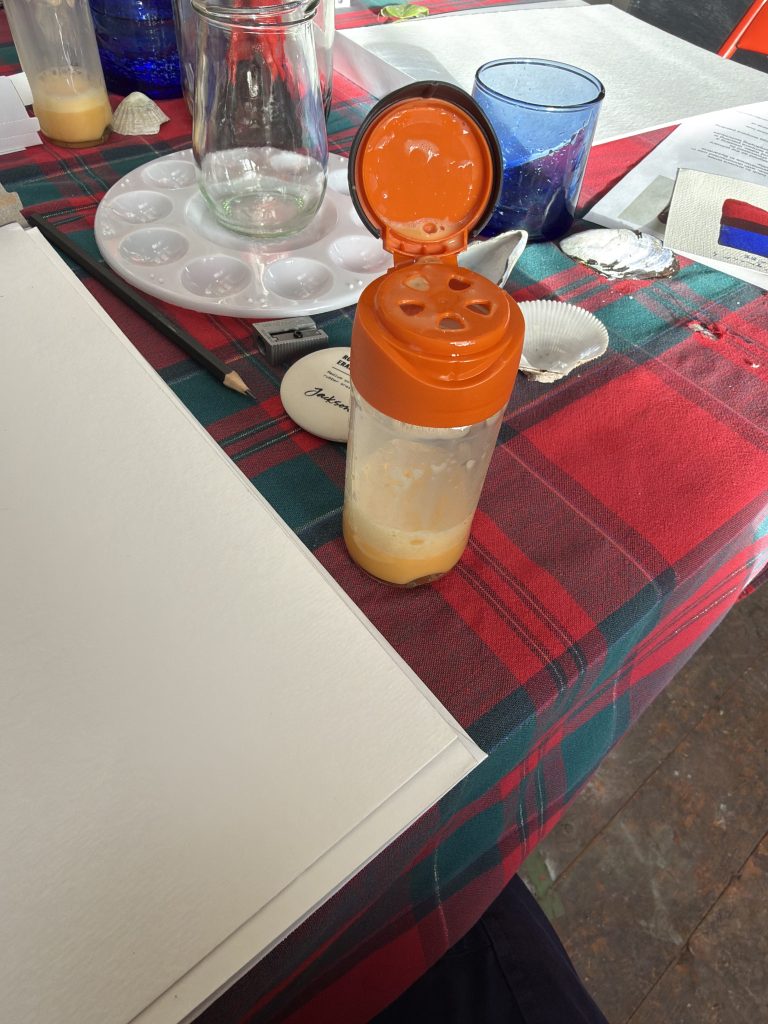
Our workspace had been prepared with paper, brushes, pigments, small containers and the various materials required to make our own paint, and what initially appeared quite straightforward rapidly developed into a fascinating lesson in the nature of colour itself.
The Extraordinary World of Pigments
One aspect I found particularly absorbing was Anna’s explanation of pigments. Long before artists could purchase conveniently packaged tubes of colour, their materials came from the natural world: coloured earths, minerals and other substances that could be processed and ground into fine powders.
Some colours were relatively inexpensive and readily available, earth pigments such as ochres and umbers could be obtained from iron-rich clays and mineral deposits.
Others were historically extraordinarily valuable.
Natural ultramarine, for example, was produced from lapis lazuli, much of it transported from mines in what is now Afghanistan. Its remarkable blue made it so prized that, in certain periods, it could cost more than gold. An artist’s palette could therefore represent not merely a collection of colours, but an astonishing network of geology, trade, craftsmanship and expense.
Even with modern pigments, differences in their composition, fineness and behaviour affect how the paint mixes, covers and responds to the brush.
I found this fascinating.
Something that appears so uncomplicated when looking at a finished painting turns out to involve a remarkable degree of material knowledge.
And then there was the egg.
The pigment is first mixed into a workable paste, while the yolk provides the binding medium. Combined in suitable proportions, they produce a paint that can be applied in beautifully fine, controlled layers. It dries relatively quickly, meaning that the artist cannot simply push wet paint around indefinitely, as might be possible with oils.
Instead, depth and subtlety are achieved gradually, through repeated applications, carefully judged colour and patient brushwork.
It was beginning to dawn on me that Anna’s extraordinary illustrations were not the result of somebody casually waving a paintbrush about for half an hour. There was rather more to it than that.
Learning to Look
What I enjoyed most about the session was the change of pace it encouraged.
The previous few days had involved covering considerable distances, searching out ancient monuments, photographing landscapes and attempting to absorb five thousand years of Scottish history. Now, for almost three hours, the objective was simply to stop, look carefully and concentrate.
To consider colour rather than merely recognise it.
To notice subtle changes in tone, how one shade sits beside another, how light alters what we think we’re seeing, and how even a seemingly simple natural form can contain an astonishing amount of visual information. There is a particular kind of calm that develops when you’re concentrating completely on a small piece of work, like a simple leaf!
The conversations around the table gradually gave way to quieter discussion, the occasional question, the gentle movement of brushes and the business of mixing and testing colours. Coffee appeared at appropriate intervals, which I regarded as an essential contribution to the creative process.
Anna guided us through the materials and technique with patience and enthusiasm, encouraging us to experiment while developing a better understanding of what we were actually trying to achieve. Choosing a brush was itself an education. Different sizes and shapes offered varying degrees of control, but egg tempera rewards a particularly considered approach, building colour through fine, deliberate marks rather than great sweeping applications.
At least, that was the theory.
My own approach occasionally suggested somebody attempting to decorate a very small fence.
Nevertheless, I became thoroughly absorbed. For somebody whose usual relationship with a paintbrush involves making sure there aren’t any visible drips on a skirting board, this was rather a revelation.
My Contribution to the World of Fine Art
By the end of the session, I had produced my own little egg-tempera creation.
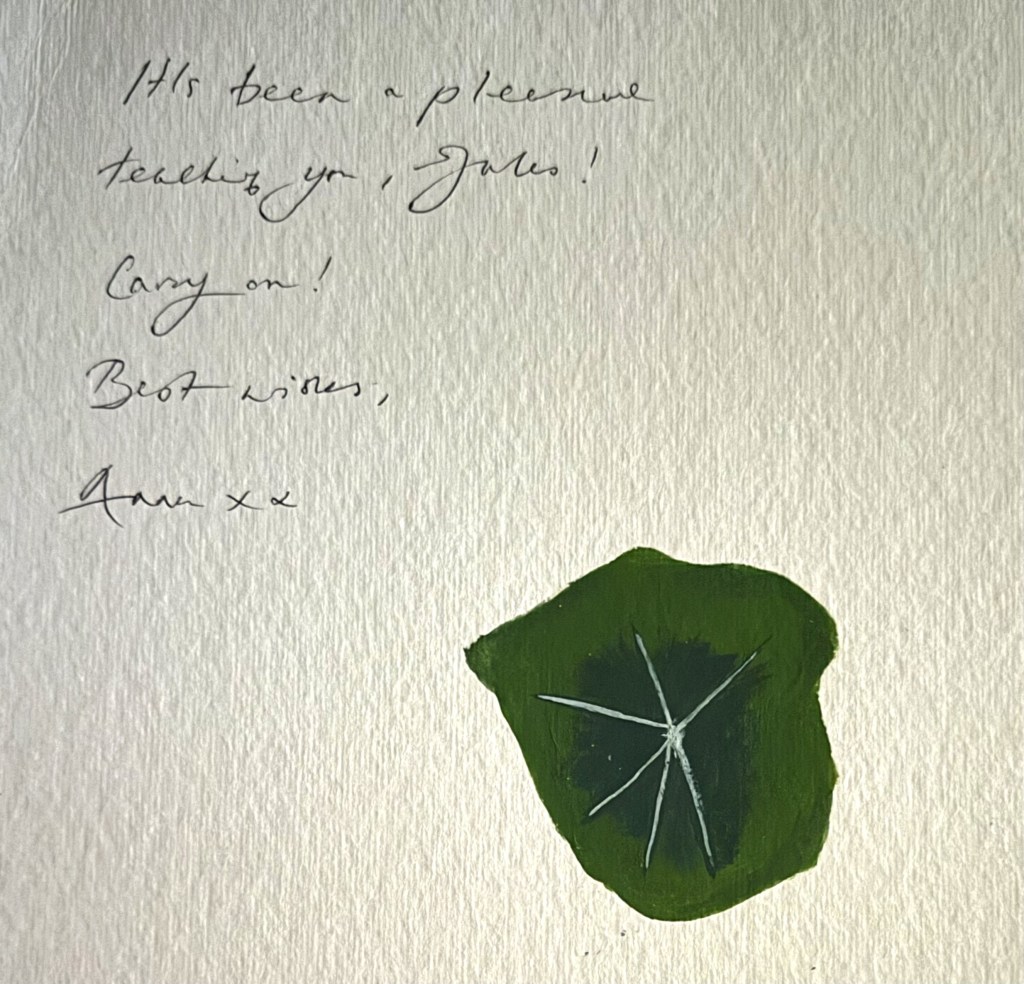
A small study involving variations of deep green, with fine pale lines radiating across its surface.
Was it likely to trouble the National Gallery’s acquisitions committee? Perhaps not immediately.
But I was rather pleased with it.
More importantly, it represented three thoroughly enjoyable hours spent discovering a new medium, developing a little patience and learning to appreciate the care behind an artist’s work.
Anna very kindly added a handwritten message to my painting:
“It’s been a pleasure teaching you, Jules! Carry on! Best wishes, Anna xx”
Which I thought was rather lovely.
And, being a reasonably perceptive chap, I decided to interpret “Carry on!” as encouragement rather than an urgent plea to keep practising.
A Very Special Gift
Anna also gave us all beautiful little paintings, created in egg tempera.
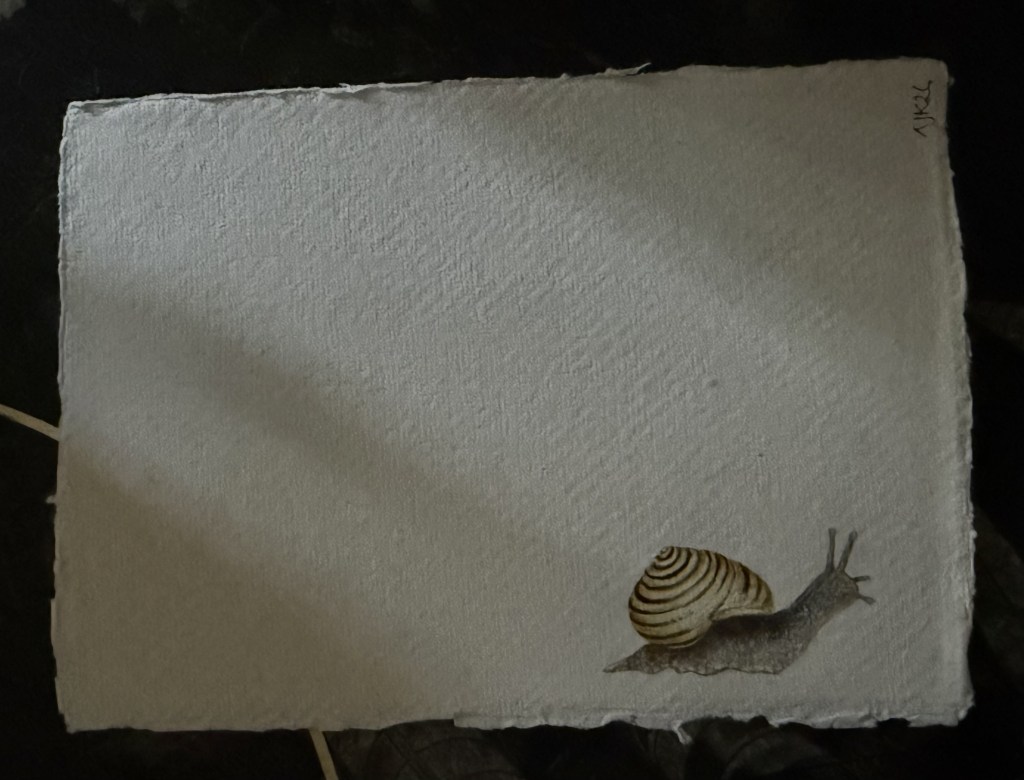
Now this was something quite different.
The painting was an incredibly thoughtful gift, and one I’ll treasure.
There was another lesson from the morning, too. Egg tempera is not a technique to be mastered in a few hours. Developing the sensitivity, precision and understanding of colour that Anna brings to her work takes years of observation, practice and patience.
Our three hours had been no more than the first tentative steps on what promised to be a very slow journey.
A journey undertaken, appropriately enough, at a snail’s pace, although judging by Anna’s beautiful little painting, even the snail was considerably further along than I was.
After months admiring Anna’s work from afar, it had been a real pleasure to spend the morning learning from her in person, and I came away with something rather more valuable than a rudimentary understanding of egg-tempera technique, a renewed appreciation for the importance of observation, patience and simply taking the time to look.
Three hours had disappeared almost without my noticing, which, considering my normal ability to become distracted by the prospect of lunch, was quite an achievement.
Fortunately, lunch was next.
And Kitchen in the Wild had something rather splendid waiting for us in the Village Hall.
Lunch in the Village Hall – Not Quite Cullen Skink
By lunchtime, we had gathered in the island’s village hall. There is something rather appealing about eating in a simple communal setting after a morning of activities. It suits the spirit of Kitchen in the Wild perfectly: wonderful food without the need for elaborate surroundings or unnecessary ceremony.
And what arrived was exactly the sort of lunch you want in the Highlands in October.
A generous bowl of rich seafood chowder, served with Saltine crackers.
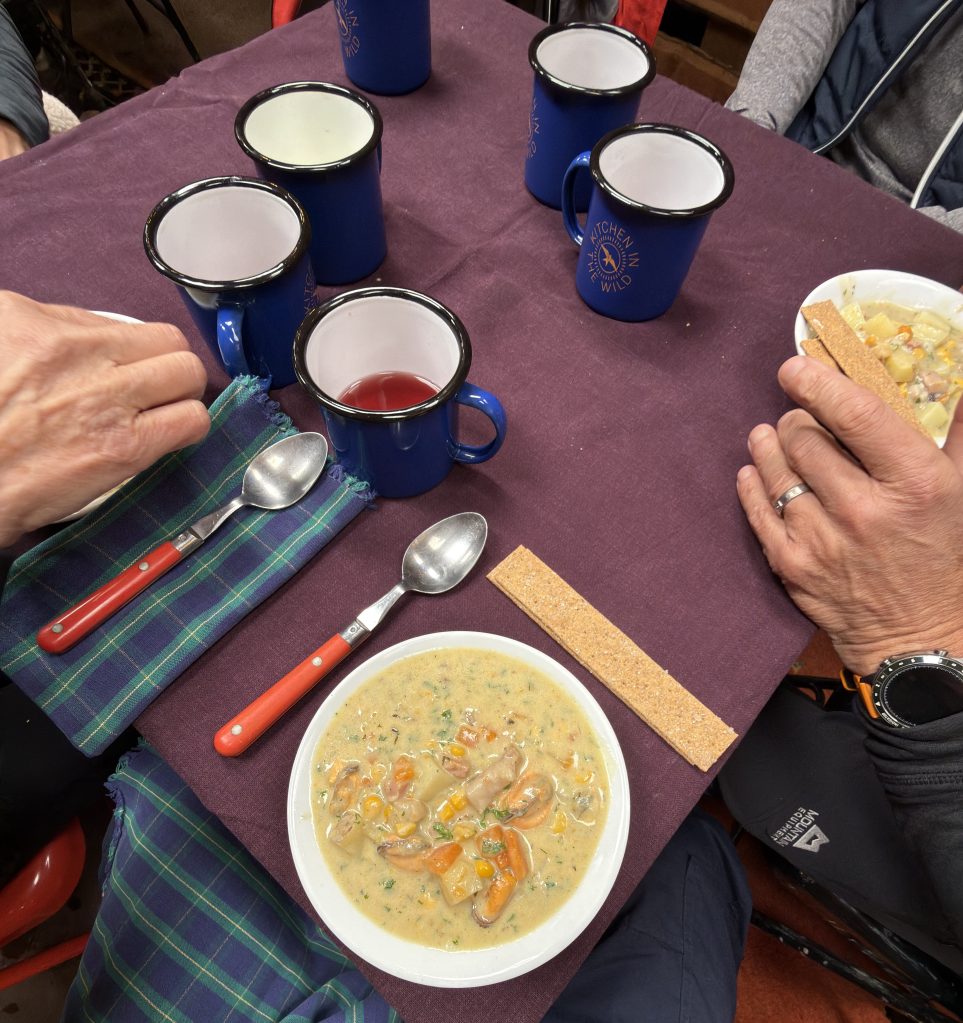
Now, I initially found myself thinking of Cullen skink, that celebrated Scottish soup traditionally made with smoked haddock, potatoes and onions.
But this wasn’t Cullen skink.
It was a considerably more varied seafood affair, with visible shellfish, chunks of vegetables, sweetcorn and finely chopped herbs in a creamy, deeply comforting broth. The bowl looked magnificent, its pale golden liquid dotted with orange, yellow and green, with pieces of seafood generously distributed throughout.
Alongside came long, crisp saltine crackers, providing something suitably crisp and salty with which to accompany the chowder.
Simple food, generously prepared, and precisely what the moment called for.
Our drinks were served in the blue enamel Kitchen in the Wild mugs, which were rapidly becoming part of the character of the whole experience. Practical, robust and delightfully informal.
There was also a pleasing contrast between the morning’s artistic pursuits and the straightforward pleasure of sitting around a table enjoying an excellent bowl of soup.
I may not have been able to produce a painting worthy of Anna’s approval, but I felt considerably more confident in my ability to appreciate a good chowder.
We all have our strengths.
A Stag, Some Sunshine and the Sound of Scotland
One of the pleasures of spending time on Eilean Shona is that its wildlife doesn’t appear to have received the memorandum about keeping a respectful distance from the guests, among the afternoon’s sights was a magnificent red deer stag, standing in the grassy woodland amongst the trees and autumn bracken.
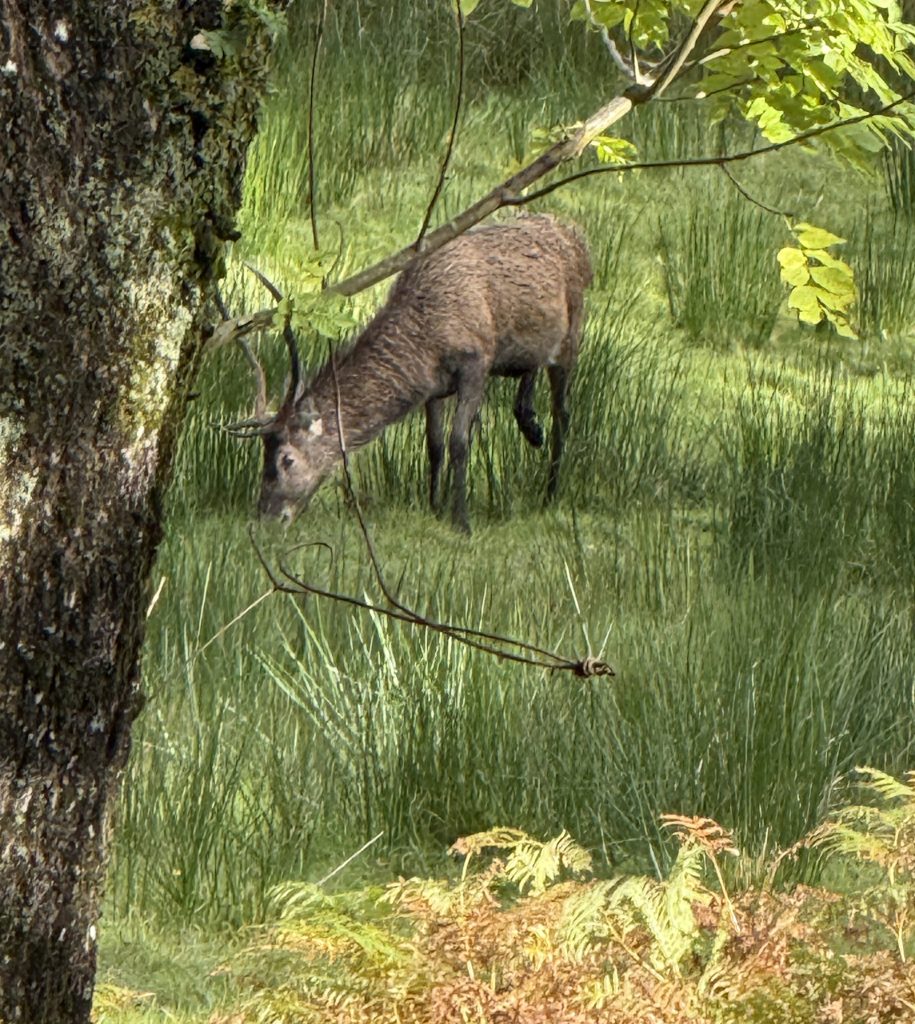
There is something particularly impressive about seeing a red deer in its natural surroundings. The stag’s antlers, dark neck and thickening autumn coat gave it an unmistakably commanding appearance, even while engaged in the comparatively undignified business of eating grass.
For a while, it seemed perfectly content to continue grazing.
Then it lifted its head.
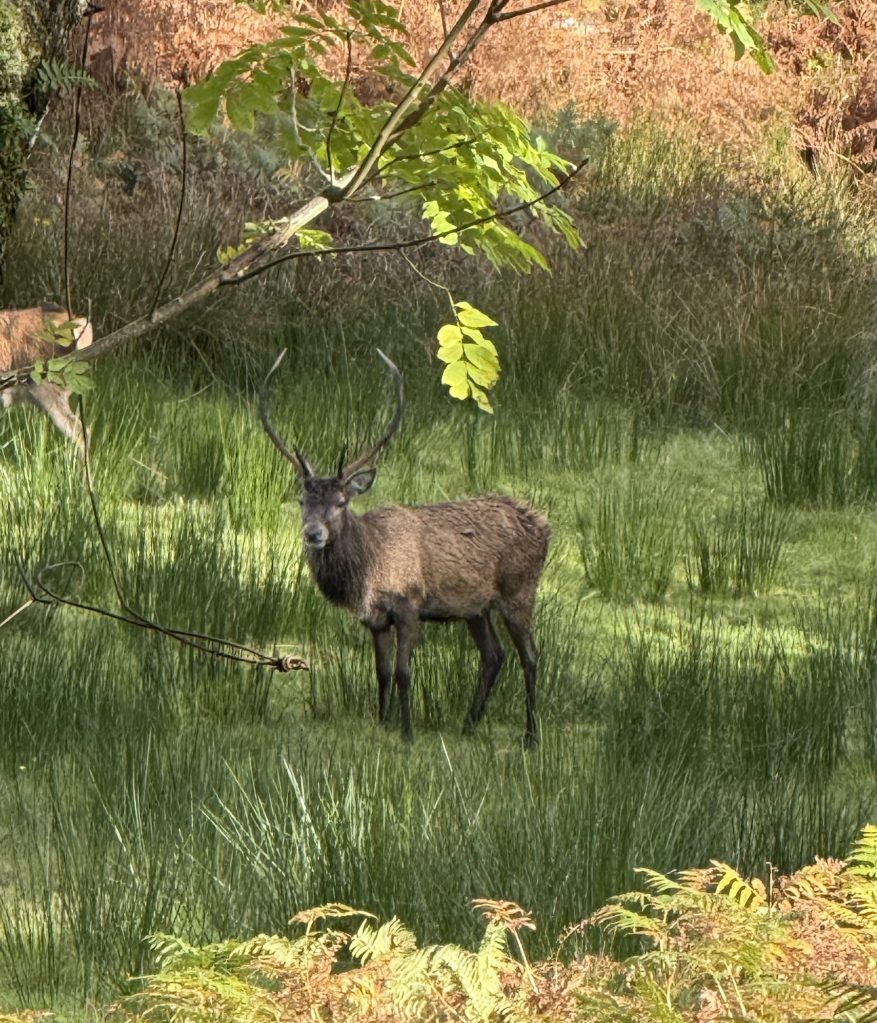
Quite magnificent.
The contrast between the dappled sunlight, lush green grass and copper-coloured bracken made the scene especially beautiful.
October is also the season of the red deer rut, when mature stags compete for access to females, their deep roaring calls carrying considerable distances across Highland glens. I had spent part of the previous day contemplating animal carvings made thousands of years ago in Kilmartin. Now here was the living subject, looking directly at me.
I felt the prehistoric artists had been onto something.
We were also treated to the unmistakable sound of the bagpipes, played by Matt, our naturalist and guide later that day, he was very good.
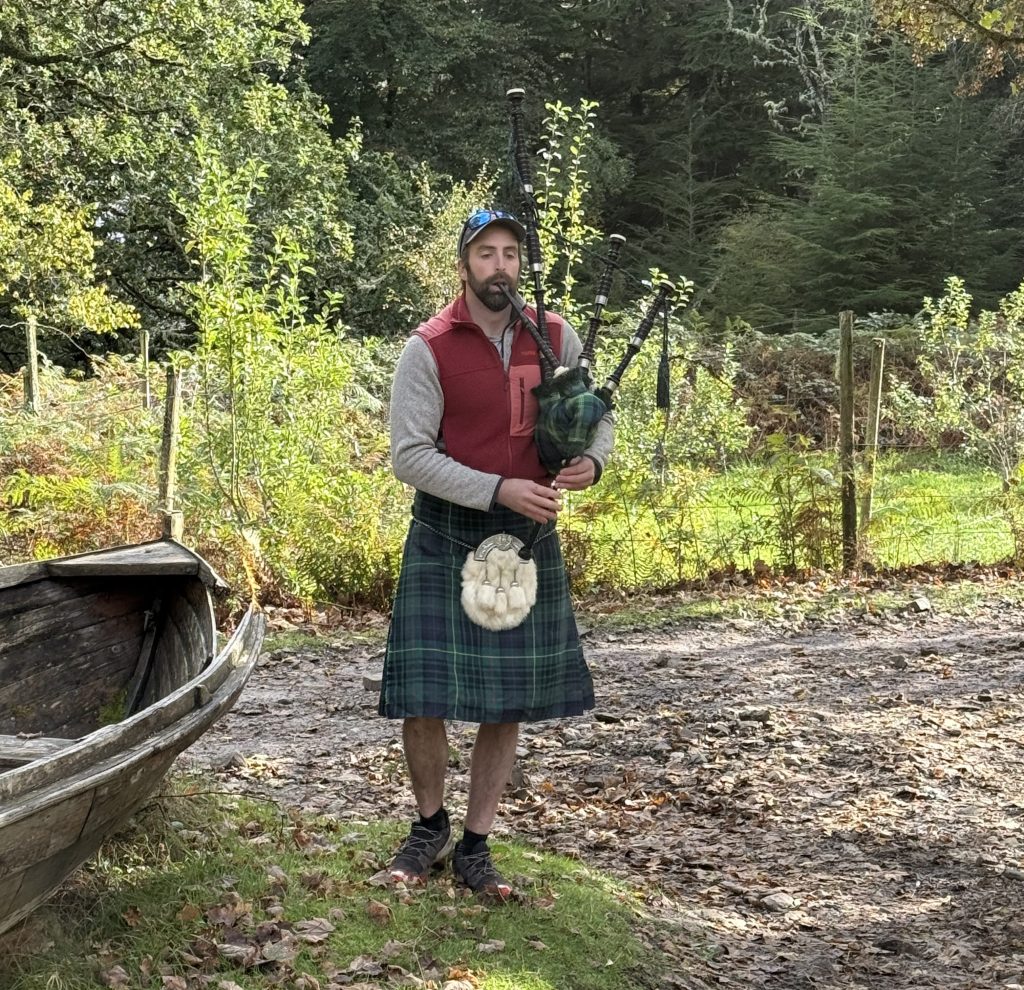
There are few sounds more closely associated with Scotland, although hearing pipes in the open air, surrounded by woodland and Highland scenery, is rather different from encountering them outside a busy tourist attraction.
Their music has a remarkable capacity to fill the landscape, and I have to say that the combination of tartan, a piper, a nearby stag and some unexpectedly beautiful sunshine suggested Scotland was making a determined effort to deliver the full promotional package.
All we needed now was a rainbow.
Although the weather had rather different plans for the afternoon.
The Afternoon – Life Jackets On
After lunch came our first proper expedition onto the water.
Matt Waterston’s expertise would now come into its own as we prepared to explore Loch Moidart and the surrounding coastline aboard the RIB, there is something undeniably exciting about travelling in a rigid inflatable boat. Particularly when you have spent the morning in the civilised surroundings of a beautiful house, enjoying poached eggs and experimenting with egg tempera.
Now it was time for waterproofs, life jackets and the altogether less predictable business of Scottish maritime weather.
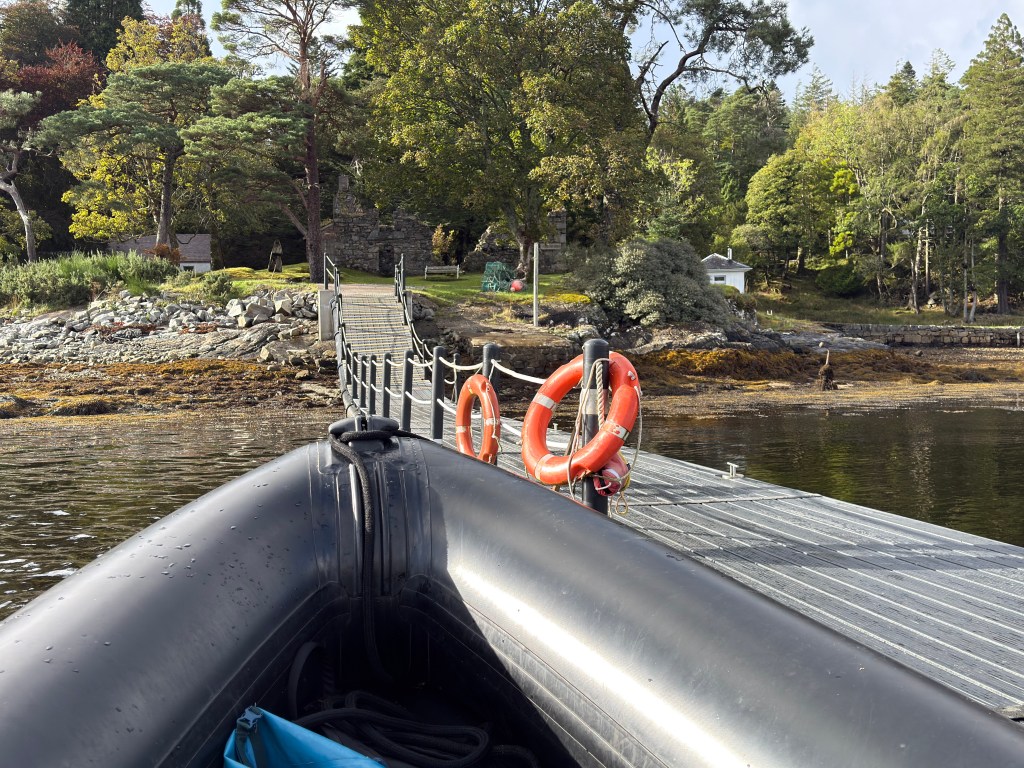
The island’s landing stage was framed by woodland, old stone buildings and shoreline exposed by the tide, in the sunshine it looked wonderfully peaceful. The sort of setting that encourages the entirely reasonable assumption that the weather might remain pleasant for the rest of the afternoon.
An assumption Scotland was about to correct.
Four Seasons in Twenty Minutes
Setting off across Loch Moidart, we were treated to a remarkable demonstration of Highland meteorology.
One moment there was blue sky and sunshine illuminating the surrounding hills. The next, dark clouds were gathering, the wind was picking up and the water was developing an altogether more energetic character.
Then came intense rain.
Then sunshine again.
And, for good measure, another threatening bank of cloud.
It was as though somebody had decided to demonstrate all four seasons in approximately twenty minutes, without bothering to consult those of us sitting in the boat.
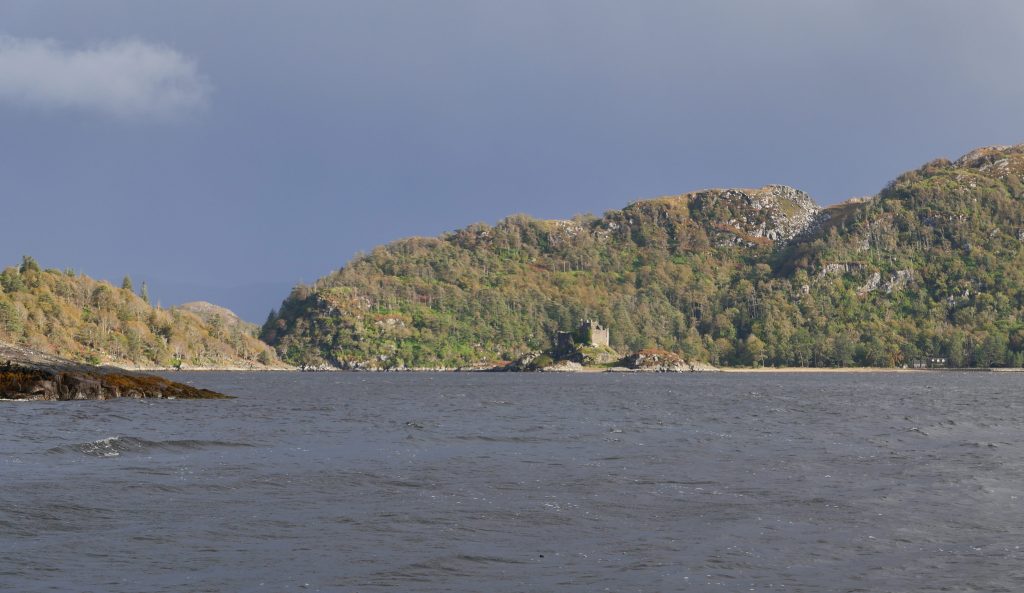
The changing conditions made the landscape look quite extraordinary. As sunlight moved across the hills, individual stands of trees glowed against the darker slopes, while the water shifted from a bright reflective blue to a much moodier slate grey.
The scenery was constantly transforming.
And, as we rounded one of the headlands, Castle Tioram appeared once again.
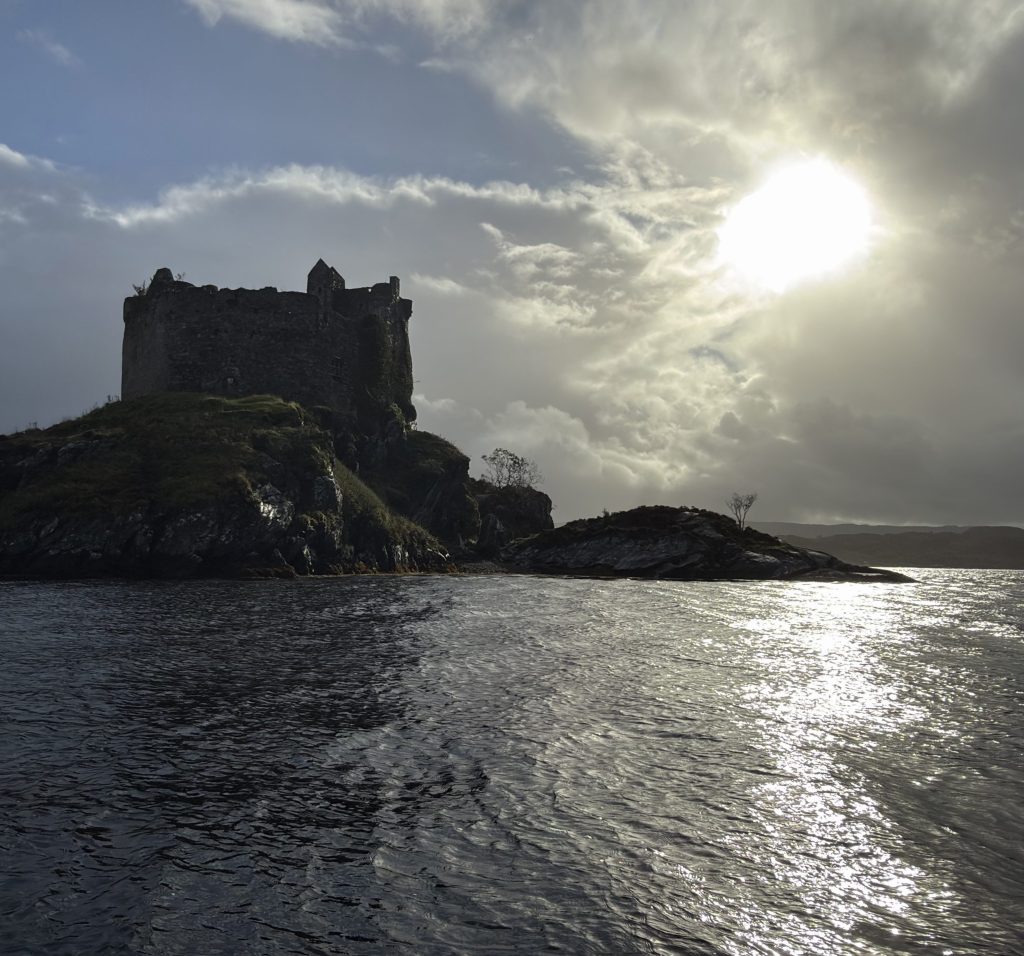
What an extraordinary sight.
The castle stood in silhouette upon its rocky island, the low autumn sunshine breaking through the clouds behind it and scattering silver light across the water. Having photographed it during the previous day’s journey, I was delighted to see it again from a different perspective, the weather had provided its own theatrical lighting.
Admittedly, it had also made certain that everyone aboard appreciated the practical value of waterproof clothing.
But one shouldn’t complain when Scotland offers this much atmosphere free of charge.
The Wildlife of Loch Moidart
Our expedition was about rather more than enjoying the scenery. The sheltered waters, rocky shores and islands of Loch Moidart support an extraordinary variety of wildlife, and exploring by boat gives you an entirely different perspective from anything available on land, and among the highlights was a seal resting on the exposed shoreline.
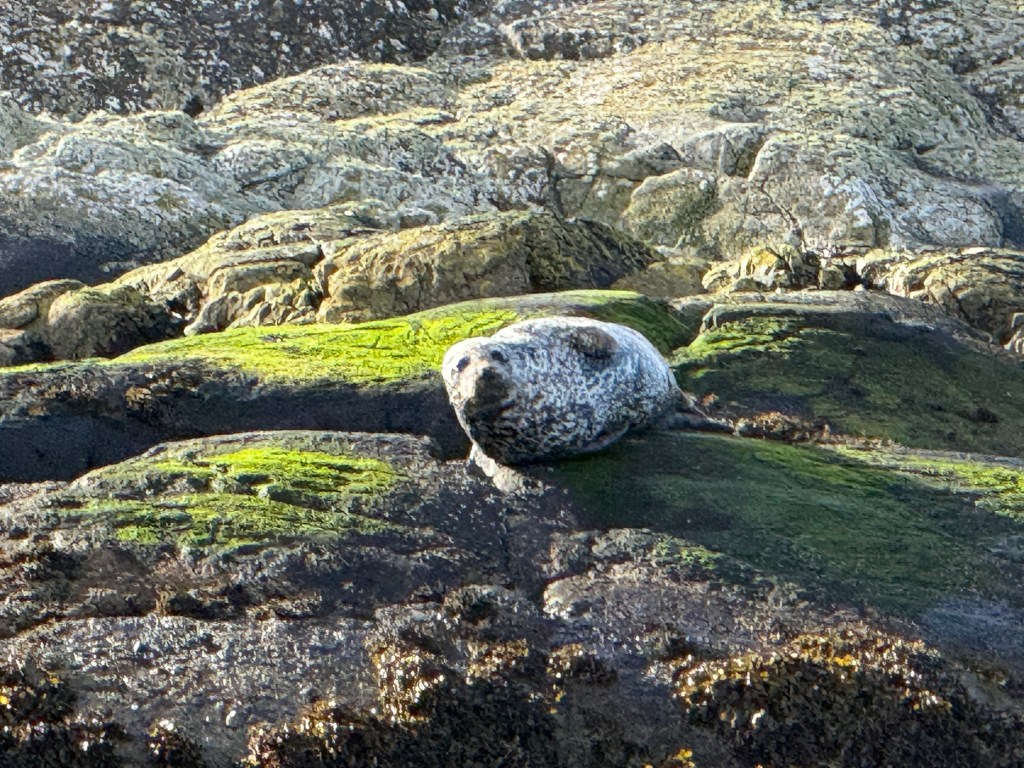
It appeared entirely untroubled by the conditions, occupying a comfortable-looking patch of rock with the air of an animal perfectly satisfied with its afternoon arrangements.
Seals are wonderfully expressive creatures, and there is something particularly appealing about observing one stretched out on the shoreline, apparently contemplating the world with considerably less urgency than most of us. The dark, wet rocks, bright green seaweed and beautifully mottled coat made a striking photograph.
Meanwhile, Matt helped bring the surrounding landscape and its wildlife into focus, drawing upon his considerable experience of exploring Scotland’s western coastline.
It was exactly the sort of expertise that made Kitchen in the Wild so appealing.
One moment we could be discussing the delicate details of botanical illustration with Anna Koska; a few hours later, we were out on the water discovering a completely different aspect of the same extraordinary environment.
And then, of course, there was the lobster.
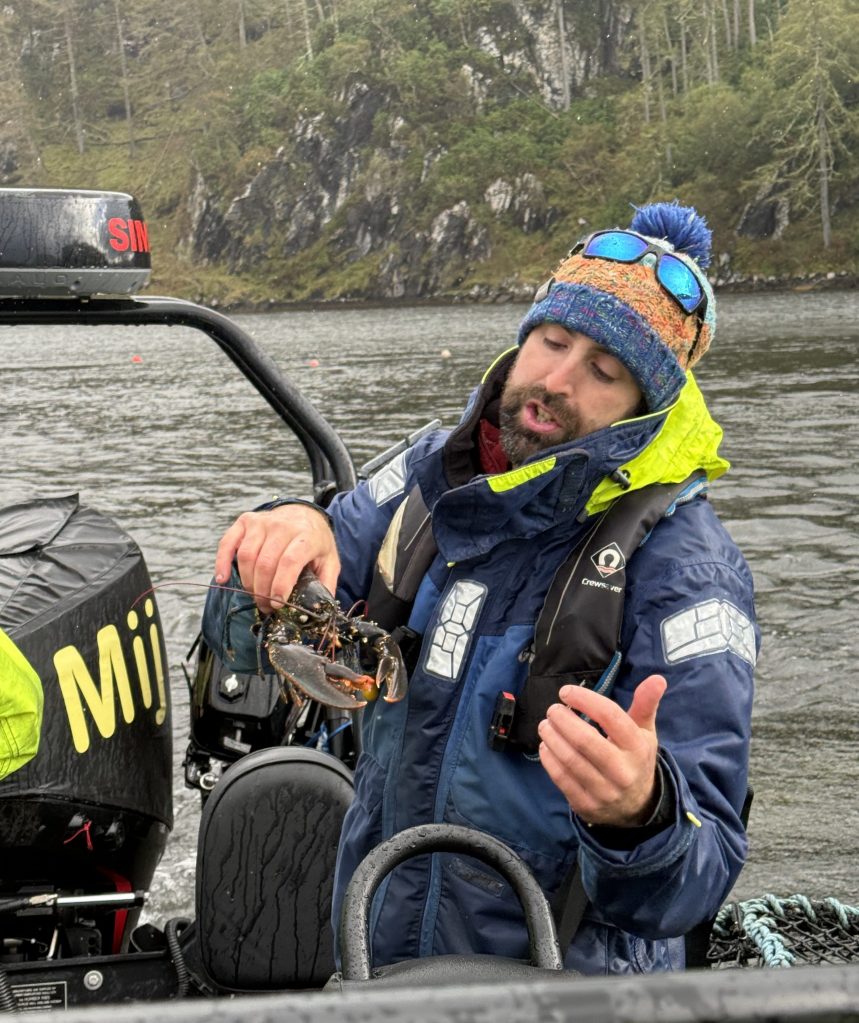
A magnificent specimen, held up for everyone to admire, with Matt explaining its features and behaviour, its impressive claws offered a useful reminder that not every ingredient encountered during a culinary adventure is necessarily enthusiastic about participating.
I was perfectly happy to maintain a respectful distance.
Seafood is one thing.
Having it defend itself is quite another.
A Different View of the Island
As the afternoon continued, the boat carried us past wooded headlands, sheltered inlets and rocky shores, distant islands revealing just how varied and beautiful this part of the Scottish coastline really is.
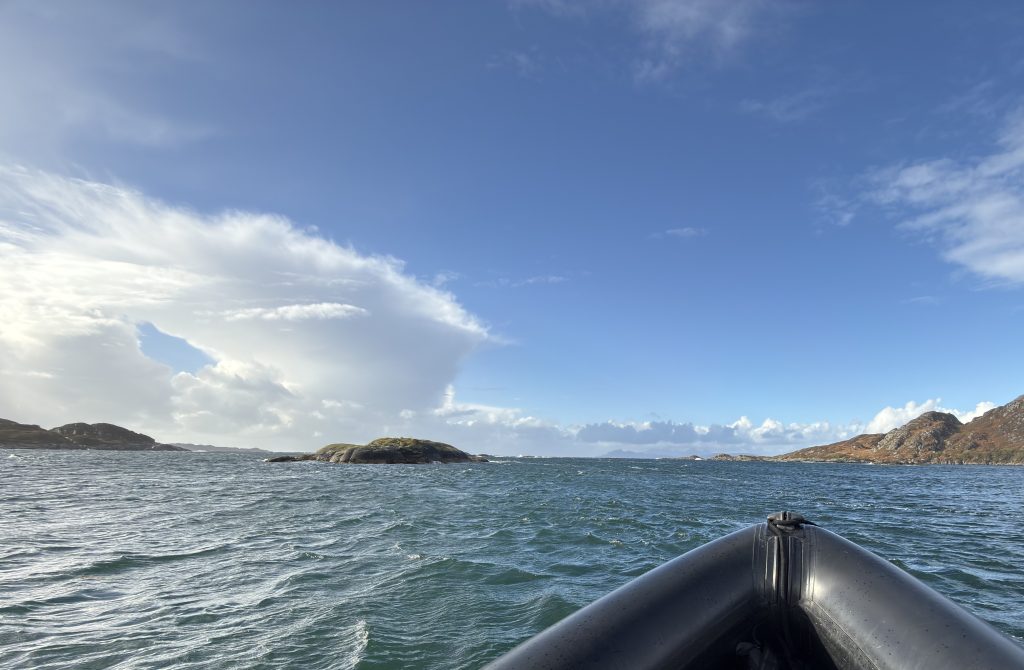
From the water, Eilean Shona and its neighbouring coastline felt wonderfully remote. The woodland descended almost to the shore, interrupted occasionally by exposed rock and narrow stretches of beach. Above it, the hills wore their autumn colours beneath an enormous, ever-changing sky.
At times, the sun illuminated entire sections of the landscape while neighbouring hills remained beneath dark cloud, I had spent months researching the island and the surrounding area, poring over maps, photographs and historical accounts, trying to imagine what it would actually feel like to be here, then the sky opened up and it chucked it down again!
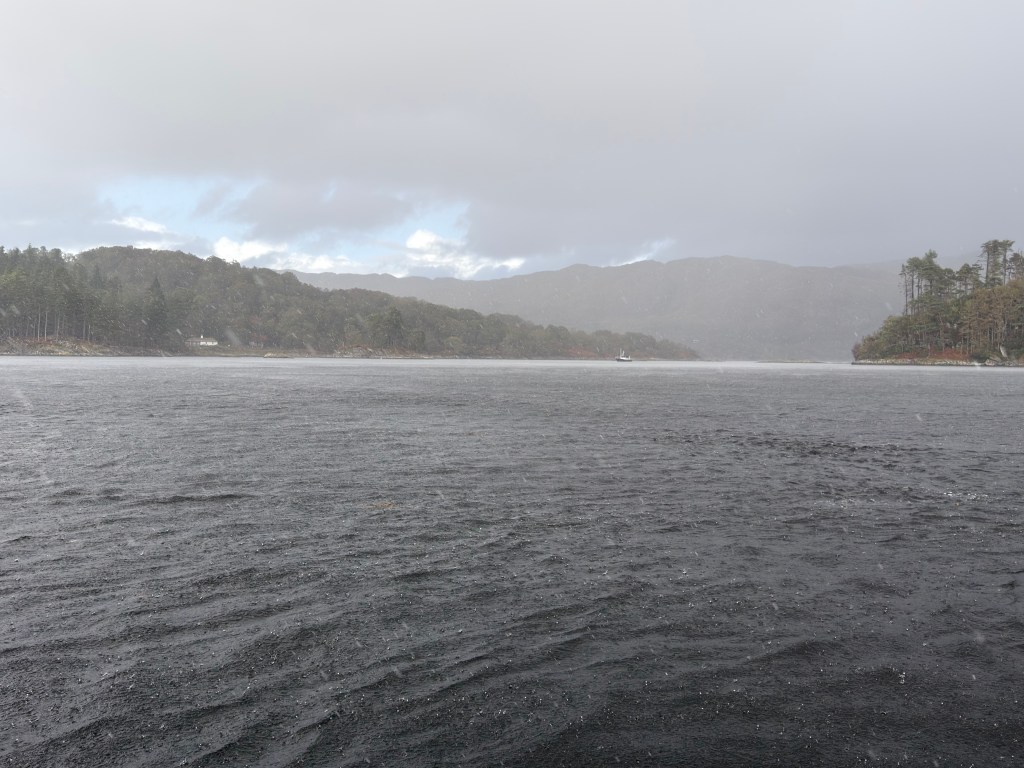
No amount of preparation quite captures the experience of travelling across these waters, with the wind on your face, the Highlands rising around you and the weather changing almost by the minute. This was what I’d come for.
Of course, I’d also come for the food.
And after a morning of artistic endeavour, an excellent seafood lunch and an afternoon exploring the coastline, I was beginning to develop a very healthy appetite for whatever the kitchen might have planned for us next.
From Waterproofs to Whisky – An Evening with Nick Strangeway
Having spent the afternoon experiencing approximately four seasons in twenty minutes aboard the RIB, returning to the warmth and comfort of Eilean Shona House was particularly appealing. It had already been a wonderfully varied day. A magnificent breakfast, three absorbing hours exploring egg tempera with Anna Koska, seafood chowder in the Village Hall and an afternoon discovering Loch Moidart from the water with Matt, the awesome guide.
By any reasonable standard, that would have constituted a fairly full programme.
Kitchen in the Wild, however, was not quite finished with us. At seven o’clock, we were gathering in the sitting room for a Classic Whisky Cocktails masterclass with Nick Strangeway, followed at eight by dinner cooked by Nathan Outlaw.
Now, I have always believed in continuing one’s education.
Particularly when the curriculum involves whisky!
Nick was one of the familiar faces I’d been so pleased to see again on the island, having met him at a previous Kitchen in the Wild event. Widely regarded as one of Britain’s most accomplished bartenders, he has spent decades exploring the history, ingredients and craftsmanship of drinks, bringing a genuine depth of knowledge to a subject that is sometimes treated as little more than an excuse to shake something enthusiastically in front of an audience.
With Nick, a cocktail is never simply a list of liquids poured into a glass. There is history, provenance, balance and an extraordinary understanding of how ingredients interact, and whisky provides a particularly interesting starting point.
Unlike a neutral spirit, it brings considerable character of its own: the influence of grain, fermentation, distillation, oak and maturation, together with the distinctive traditions of the regions and distilleries that produce it. Creating a successful whisky cocktail therefore involves rather more than finding something sweet to pour into it, it requires an appreciation of what is already there, and how other flavours can complement rather than overwhelm it.
A reassuring philosophy, I thought.
Especially after discovering the three miniature bottles of Nc’nean waiting for us at Tioram Cottage. Scotland was clearly providing opportunities for further study at an encouraging rate. The atmosphere in the sitting room was relaxed and convivial, with everyone settling in after the day’s activities, exchanging stories and preparing for another splendid evening.
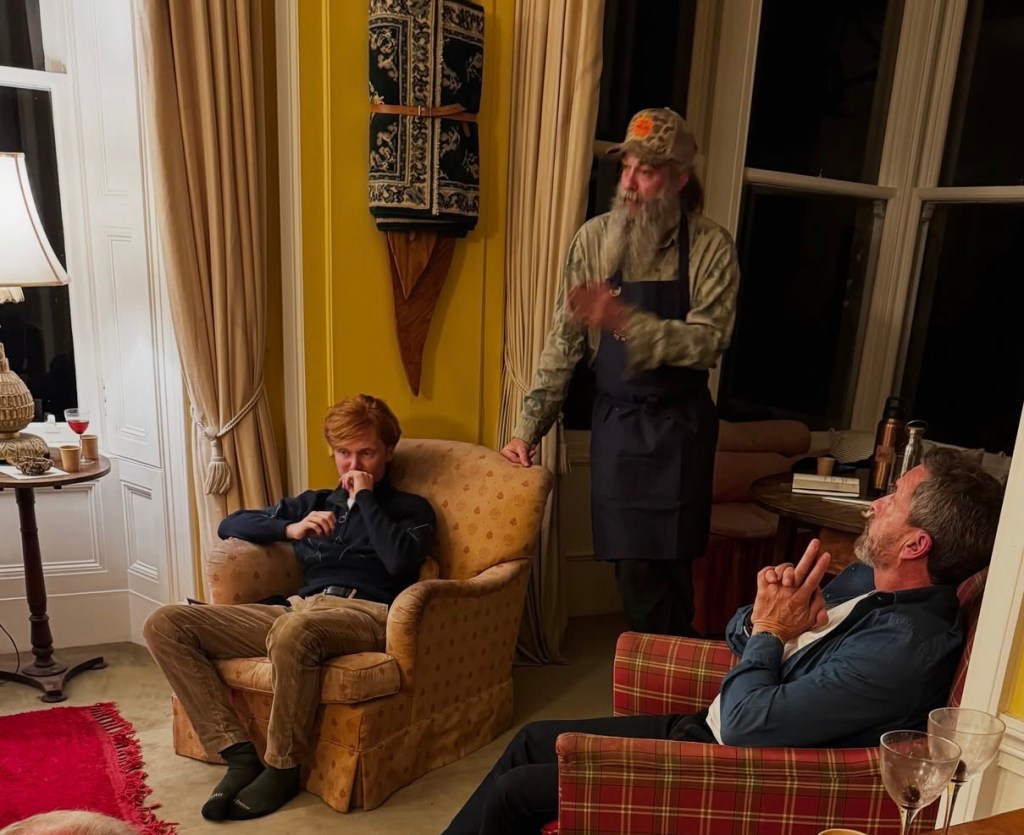
And there was something rather lovely about being back in the company of old friends. Val, Clare and Nick had already made my previous Kitchen in the Wild experience so memorable that joining them again felt less like attending an organised event and more like returning to a particularly interesting gathering of friends.
Admittedly, friends with somewhat more impressive credentials than the average dinner party, and friends who had a rather worrying ability to make the consumption of excellent food and drink appear educational.
A Few Little Things Before Dinner
One of the joys of these evenings was that dinner did not begin abruptly with everyone being marched into the dining room at the appointed hour, instead, we had time to gather, chat, enjoy our drinks and sample a succession of beautifully prepared little appetisers.
Nathan’s menu for the evening began with two rather splendid propositions:
Potted lobster on toast and crispy oysters with celery and grapes.
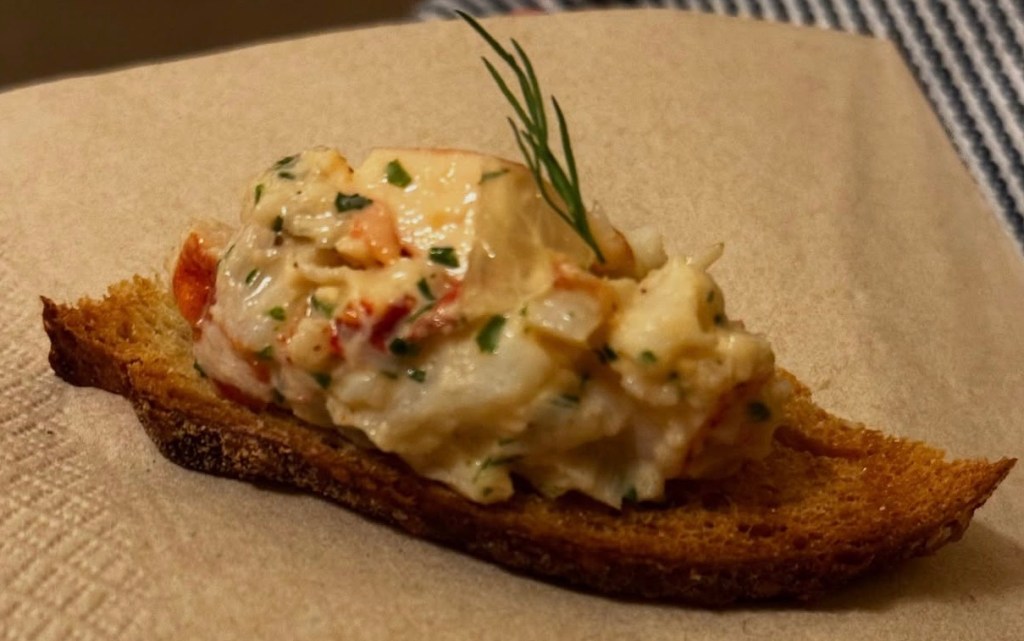
The lobster arrived generously piled onto a small piece of crisp, golden toast, its sweet flesh bound in a rich, creamy dressing with herbs and a little fresh dill, it was an excellent example of why Nathan is so highly regarded for his seafood cookery. There was no unnecessary complication, no elaborate architectural arrangement and certainly no attempt to disguise the principal ingredient.
Just beautiful lobster, thoughtfully prepared, with the toast providing exactly the contrast it needed.
Small enough to eat in a couple of mouthfuls, and good enough to make you wish somebody had produced an entire tray.
Then came the crispy oysters.
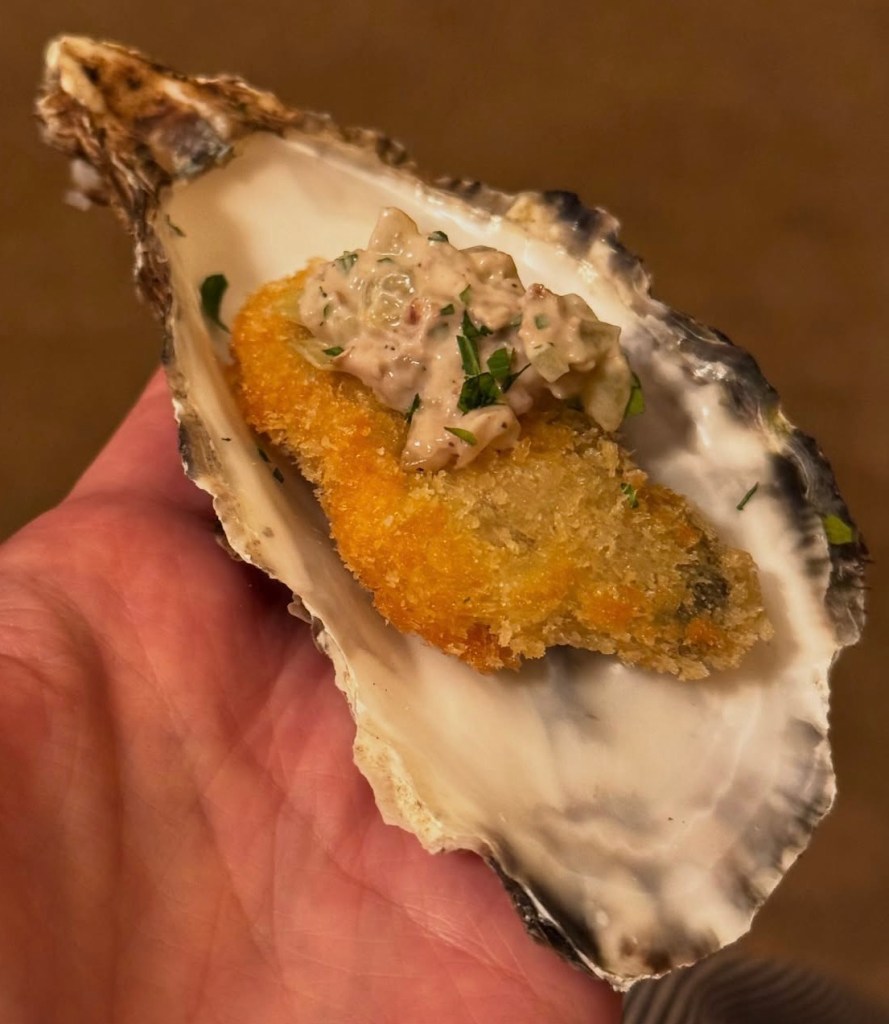
Now, an oyster served raw, with nothing more than a squeeze of lemon or a little mignonette, is a wonderful thing, but not mine!
But this was a rather different interpretation, presented in its magnificent natural shell, the oyster had been coated and cooked to produce a crisp, golden exterior, then topped with a delicate mixture of celery and grapes.
The combination was inspired, and bloody delicious!
Oysters have a distinctive marine richness, and cooking them this way introduces a particularly enjoyable textural contrast: a crisp coating giving way to the tender oyster within and the celery brought freshness and crunch, while the grapes offered little bursts of sweetness and acidity, cutting through the richness.
And serving the whole thing in its own shell was a lovely touch.
The original packaging, as it were.
Biodegradable, attractive, and conveniently designed to prevent the contents escaping, one suspects nature had been considering the hospitality industry long before we arrived.
The opening cocktail listed on the menu was a Raspberry Manhattan, a suitably elegant beginning to what was rapidly developing into a rather promising evening, and then it was time to head through for dinner.
Nathan Outlaw – A Seafood Masterclass Without Leaving the Table
The previous evening, Valentine Warner had introduced us to Kitchen in the Wild with a wonderful opening dinner.
Tonight it was Nathan Outlaw’s turn.
Nathan hardly needs an introduction to anyone with an interest in British seafood cookery. His career has been built around an exceptional understanding of fish and shellfish, developed through years of working with outstanding ingredients and some of the country’s most respected chefs. Having trained at Thanet College, he worked in London before moving to Cornwall, where his time with Rick Stein helped establish the direction his career would take. Interestingly he historically hated seafood, who could tell?
He went on to build his own highly acclaimed restaurants in Port Isaac, earning two Michelin stars for his former flagship Restaurant Nathan Outlaw — a remarkable achievement for a restaurant devoted entirely to seafood. His approach has always appealed to me: allowing superb ingredients to remain the stars of the plate, while bringing tremendous skill and judgement to the accompanying flavours.
There is often more sophistication in knowing what to leave out than in finding another six things to add.
And looking at the evening’s menu, we were in for something special.
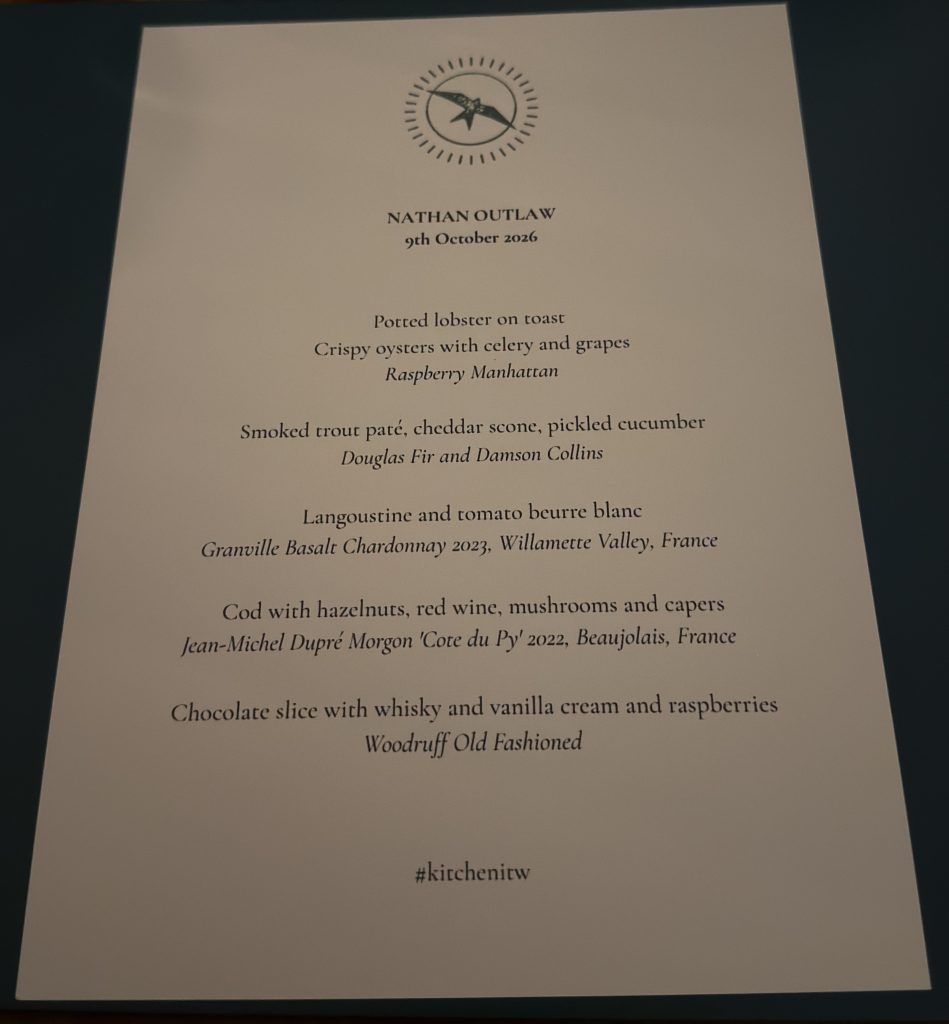
Once again, the dining room looked magnificent, its exuberantly coloured walls and candlelit table providing a wonderfully intimate setting. Menus were waiting at our places, the glasses were ready, and conversation flowed easily around a group that was already becoming increasingly comfortable in one another’s company.
A day’s shared experiences has that effect, particularly when those experiences include being bounced around a Scottish loch in the torrential rain.
Smoked Trout, Cheddar Scone and Pickled Cucumber
The first seated course was smoked trout pâté, cheddar scone and pickled cucumber, an appealing combination of rich smoked fish, savoury cheese and sharp, refreshing pickle. It continued the theme established by the evening’s appetisers: familiar ingredients, treated with care and brought together in ways that made perfect culinary sense.
The accompanying cocktail was a Douglas Fir and Damson Collins.
Douglas fir, with its wonderfully aromatic, resinous character, brought a particularly appropriate sense of the surrounding woodland into the drinks programme, while damson offered the sort of tart fruitiness that works so well in a refreshing Collins. It was a lovely example of how Nick’s approach complemented the setting. The drinks weren’t simply there to accompany the food; they had a personality and sense of place of their own.
And then came a dish I had been particularly looking forward to.
Langoustine and Tomato Beurre Blanc
Langoustines are amongst the finest shellfish found in British waters, sometimes called Dublin Bay prawns or Norway lobsters, they possess a delicate sweetness and firm, succulent flesh, requiring remarkably little intervention when the quality is right.
And this was a beautiful plate.
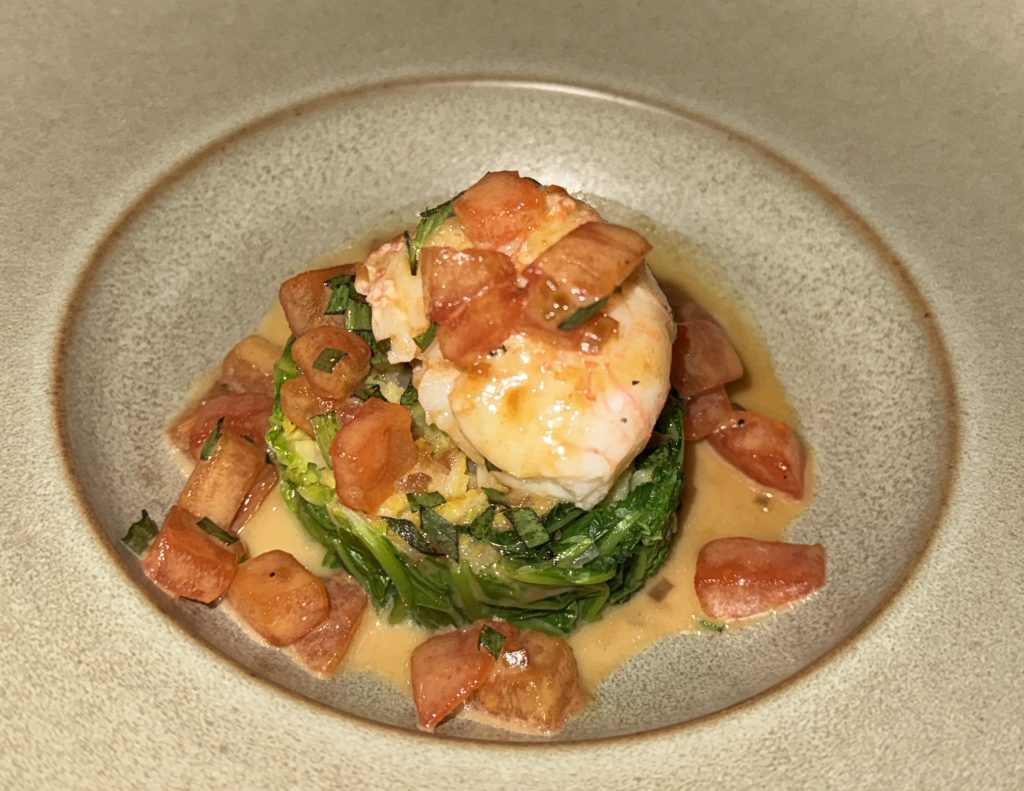
A generous piece of langoustine sat upon a carefully arranged bed of greens, surrounded by a glossy tomato beurre blanc. Small pieces of tomato (concasse), fresh herbs and the rich, pale orange sauce provided an attractive contrast to the langoustine’s delicate flesh.
A beurre blanc is traditionally made by emulsifying butter into a reduction, producing a sauce with richness, acidity and a beautifully silky texture. Here, the addition of tomato gave the classic preparation another dimension, bringing its gentle sweetness and acidity to a dish that was fundamentally about celebrating the langoustine.
And what a lovely balance it was.
The seafood remained the centre of attention, with the sauce providing richness without overwhelming its natural flavour.
A very Nathan Outlaw kind of dish, I thought, elegant, precise and utterly confident.
The printed wine pairing was Granville Basalt Chardonnay 2023, from Oregon’s Willamette Valley, a region particularly celebrated for its cool-climate wines. A fitting accompaniment to such delicate shellfish and a rich butter-based sauce.
Cod, Hazelnuts, Red Wine, Mushrooms and Capers
The next course presented an altogether different side of seafood cookery.
Now, pairing a substantial white fish with red wine might initially appear surprising to anyone brought up on the old convention that fish must always be accompanied by white wine.
Nathan had explained his wish to cook a cod dish, the variety being extremely difficult to get for his restaurants in Cornwall. Cod has a wonderful ability to work with deeper, more savoury flavours, particularly when its flesh is sufficiently thick and carefully cooked.
And Nathan’s dish was a magnificent demonstration.
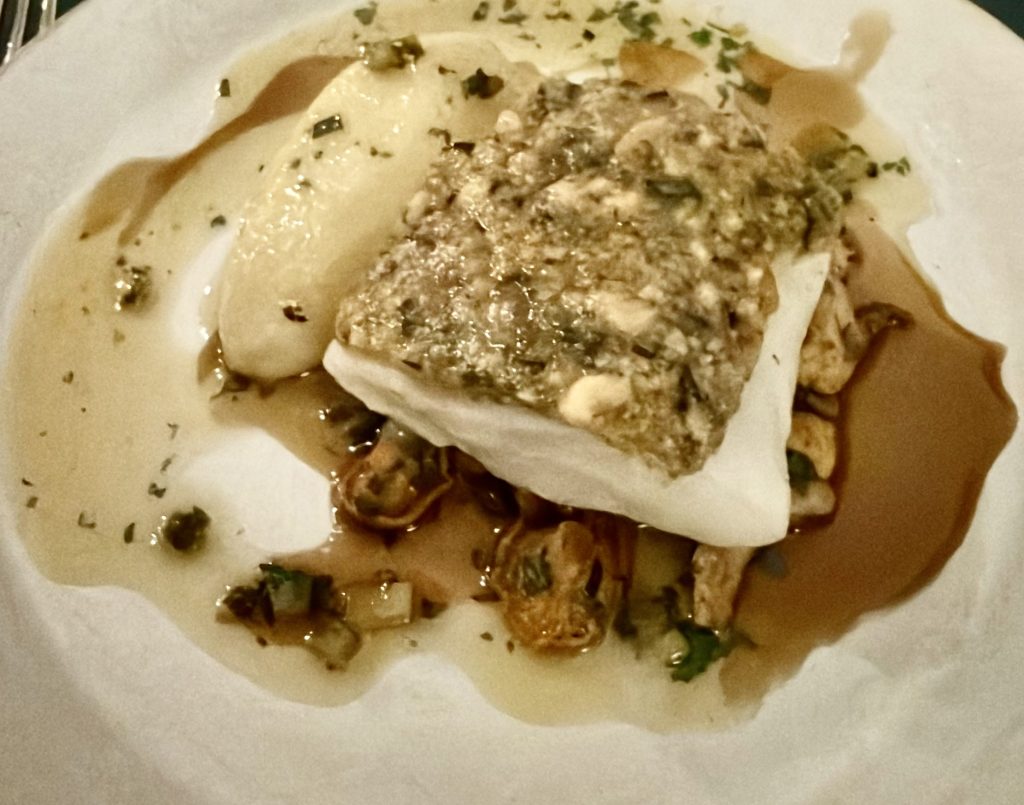
A beautifully cooked piece of cod occupied the centre of the plate, its thick white flakes contrasting with a savoury mixture of mushrooms beneath and a generous coating of finely chopped hazelnuts and herbs. Around it were two sauces: a lighter, buttery element and a deep, glossy red-wine reduction.
The composition was striking.
The hazelnuts introduced a gentle roasted character and subtle texture, while the mushrooms brought an earthy depth. Capers provided their distinctive sharp, salty punctuation, ensuring the dish never became too rich or heavy, and that red-wine sauce gave the whole plate an unexpected sense of warmth and substance.
It was the sort of fish dish that could quite comfortably hold its own against many traditional meat courses.
The wine pairing was Jean-Michel Dupré Morgon ‘Côte du Py’ 2022, from Beaujolais. Morgon is one of the region’s celebrated crus, and Côte du Py is particularly associated with structured, characterful Gamay wines.
A red wine alongside cod, scandalous, perhaps, to the more inflexible members of the old wine-and-food establishment, but rather splendid in practice, and a timely reminder that good cooking is not particularly interested in arbitrary rules.
The Man Behind the Menu
One of the pleasures of Kitchen in the Wild is the opportunity to meet the people responsible for creating the food, rather than experiencing their work solely through a restaurant menu.
Nathan spoke to the group during the evening alongside Tim, who has worked for him for over 15 years, and the photograph captures that lovely informal atmosphere: chefs and guests sharing the same space, with the extraordinary mural providing a suitably colourful backdrop.
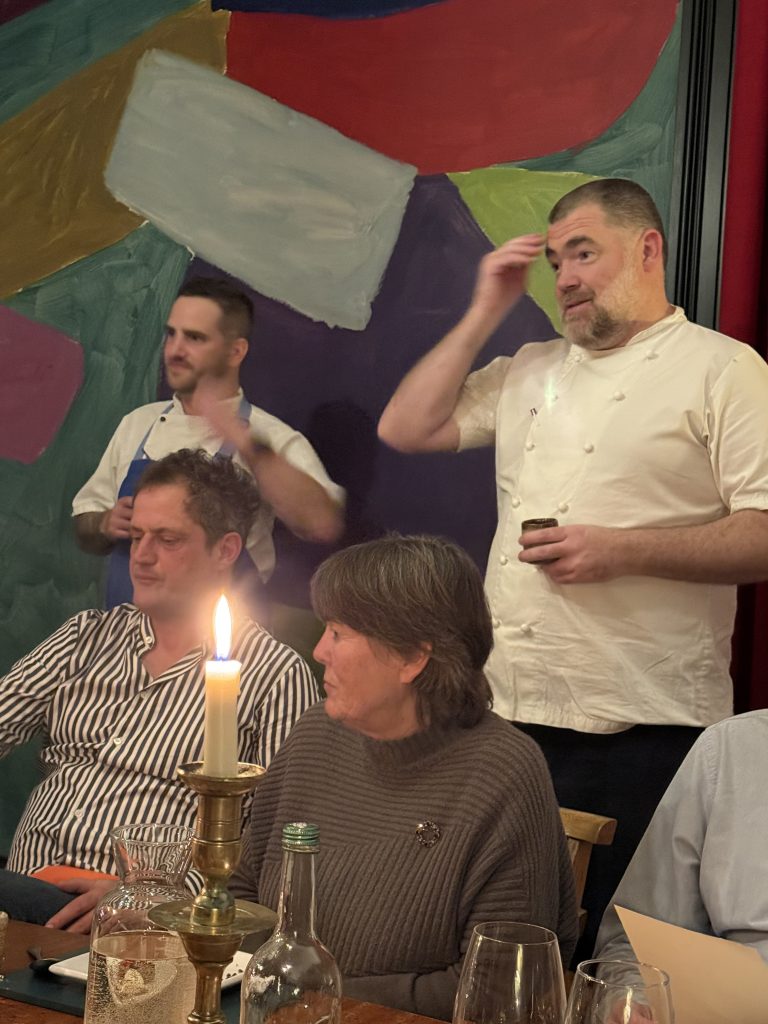
There was an enormous amount of skill involved in delivering an evening like this, and Nathan’s reputation may quite rightly have been a considerable draw, but the execution depended upon a dedicated team of talented chefs and supporting staff, all working together to ensure that each course appeared beautifully prepared and at precisely the right moment.
It is easy, when enjoying a relaxed evening around a candlelit table, to overlook the planning, preparation and sheer hard work taking place behind the scenes, particularly somewhere as remote as Eilean Shona, where forgetting an ingredient is unlikely to be resolved by popping down to the nearest supermarket.
The whole operation appeared effortless, which is, of course, generally a reliable indication that an extraordinary amount of effort has gone into it.
Chocolate, Whisky and a Rather Civilised Conclusion
And finally, dessert.
Chocolate slice with whisky and vanilla cream and raspberries.
A combination that promised richness, a touch of Highland spirit and enough fresh fruit to provide at least a theoretical argument for nutritional balance.
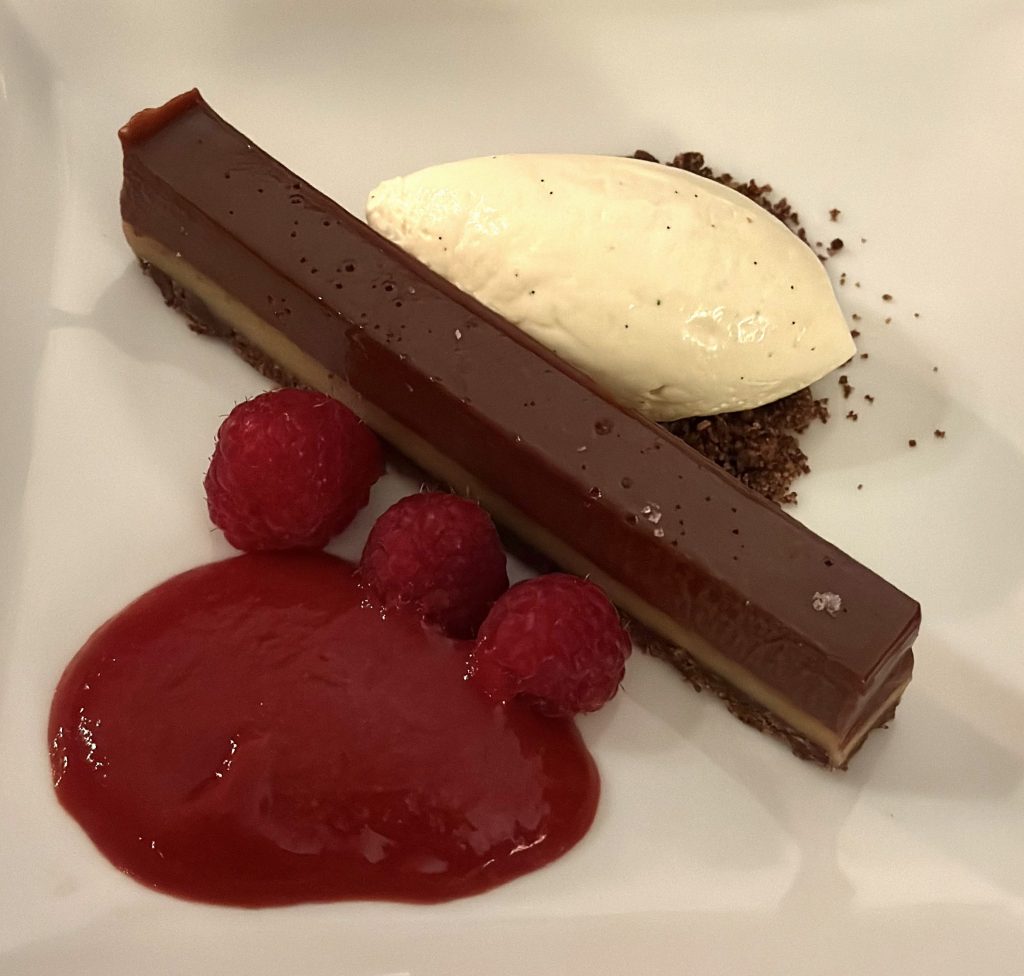
The presentation was beautifully restrained. A long, immaculate slice of chocolate dessert like a strip of Twix bar!, with distinct layers beneath a smooth, glossy chocolate surface, accompanied by a generous quenelle of vanilla cream, fresh raspberries and a vivid raspberry sauce.
The contrast of colours was striking: deep chocolate brown, pale cream and the brilliant red of the fruit, it tasted every bit as indulgent as it looked. The richness of the chocolate was balanced by the freshness and gentle acidity of the raspberries, while the vanilla cream provided a lovely soft counterpoint, whisky added a further dimension to a dessert that was, in all respects, a thoroughly satisfying conclusion to the meal.
And because Nick Strangeway was in residence, dessert was accompanied by a Woodruff Old Fashioned.
Woodruff is a fragrant woodland herb, traditionally appreciated for its sweet, hay-like aroma and subtle vanilla associations, and its inclusion brought another little connection to the surrounding natural world, while the Old Fashioned provided a fitting final expression of the evening’s whisky theme.
A lovely way to finish.
One Very Full Day
By the time we rose from the table, it was well after ten thirty, I’d begun the morning at six, wide awake and far too excited to sleep.
Since then, I’d enjoyed an exceptional breakfast, spent three hours discovering the art of egg tempera with Anna Koska, eaten a magnificent seafood chowder, explored Loch Moidart by RIB through several competing weather systems, attended a whisky cocktail masterclass and finished with a wonderful dinner from one of Britain’s finest seafood chefs.
Not bad for a Friday.
And all of it made possible by a remarkable collection of people, from the celebrated names we’d been so looking forward to meeting to the immensely capable chefs, organisers and island staff quietly ensuring that everything happened as it should. There was a warmth to the whole experience that went well beyond the food, the scenery or the splendid accommodation.
It was the pleasure of being amongst people who loved what they did, generously sharing that enthusiasm with the rest of us. Eventually, it was time to make my way back to Tioram Cottage, where Ruth, Tim and I were staying, and contemplate the prospect of another day.
The itinerary suggested that Saturday would offer a choice of walking or painting, a demonstration from Nathan and, later, a rather intriguing Fire Pit Dinner, I also noticed that the optional morning swim and sauna remained available, and naturally, I gave this some serious consideration.
For approximately the same three seconds as the previous morning.
Breakfast was at 7:30.
Some traditions are worth maintaining.
………………… Until Next Time …………….. L8ers …………………

