Kitchen In the Wild – Day One

Six O’Clock – Rather Too Excited to Sleep

Six o’clock. Wide awake.

Not because of an alarm, a passing vehicle or the familiar noises of everyday life, but simply because I was far too excited to stay in bed. After nineteen months of anticipation, and an excellent opening dinner courtesy of Val Warner the previous evening, I had finally spent my first night on Eilean Shona.

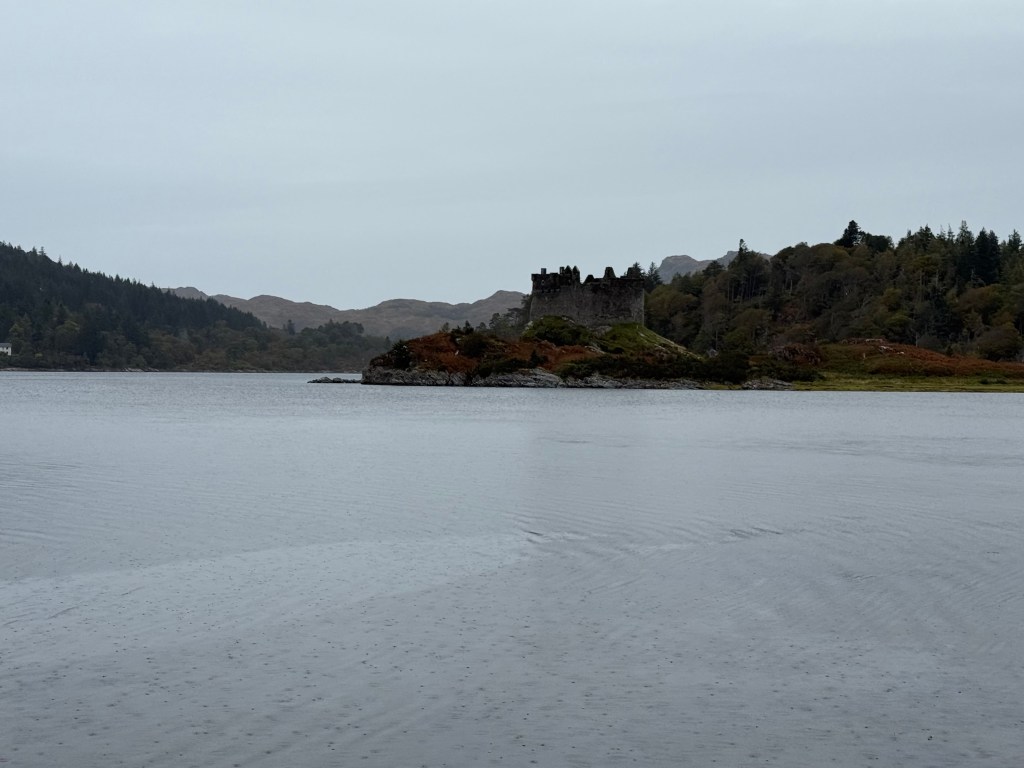
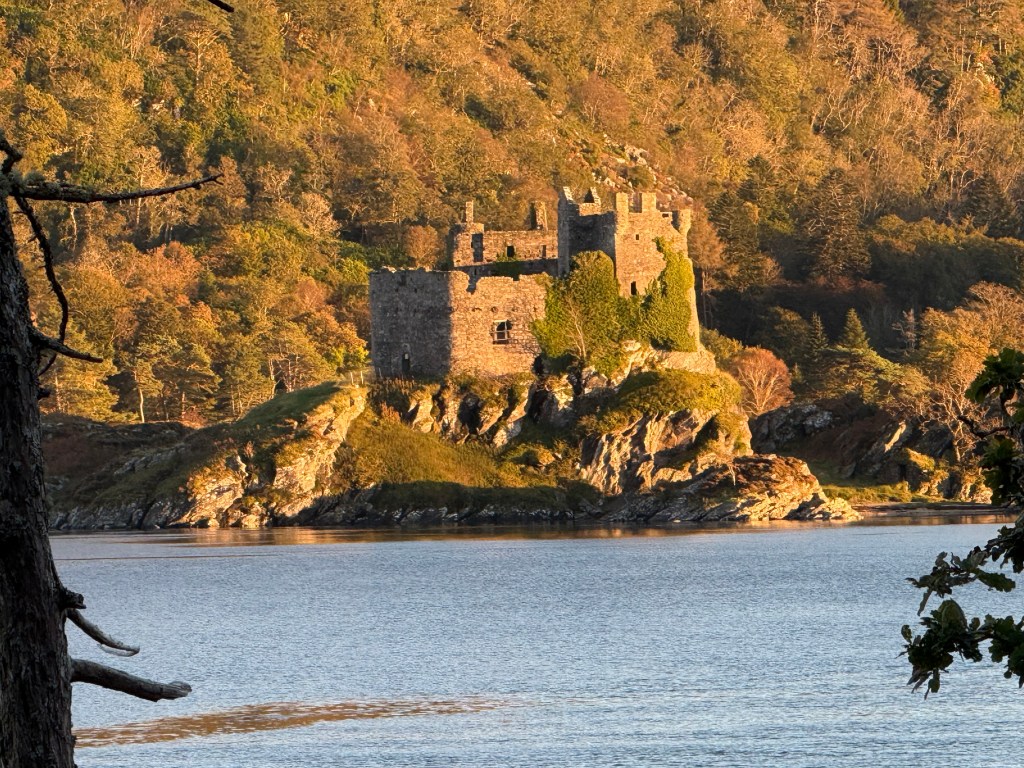
My home for the next few days was Tioram Cottage, a wonderfully comfortable stone-built house overlooking Loch Moidart, shared with Ruth and Tim, each of us occupying a separate bedroom. The cottage was generously appointed, with a large open-plan kitchen, dining and sitting area, comfortable sofas and an open fireplace. Its windows looked across the water towards the magnificent ruins of Castle Tioram.

There were also some thoughtful little touches, including fresh milk, drinking water and three miniature bottles of Nc’nean Organic Single Malt Scotch Whisky, produced on the nearby Morvern peninsula. I was particularly impressed by the provision of both whisky and fresh milk. Clearly, somebody understood that the needs of a gentleman can vary considerably according to the time of day.

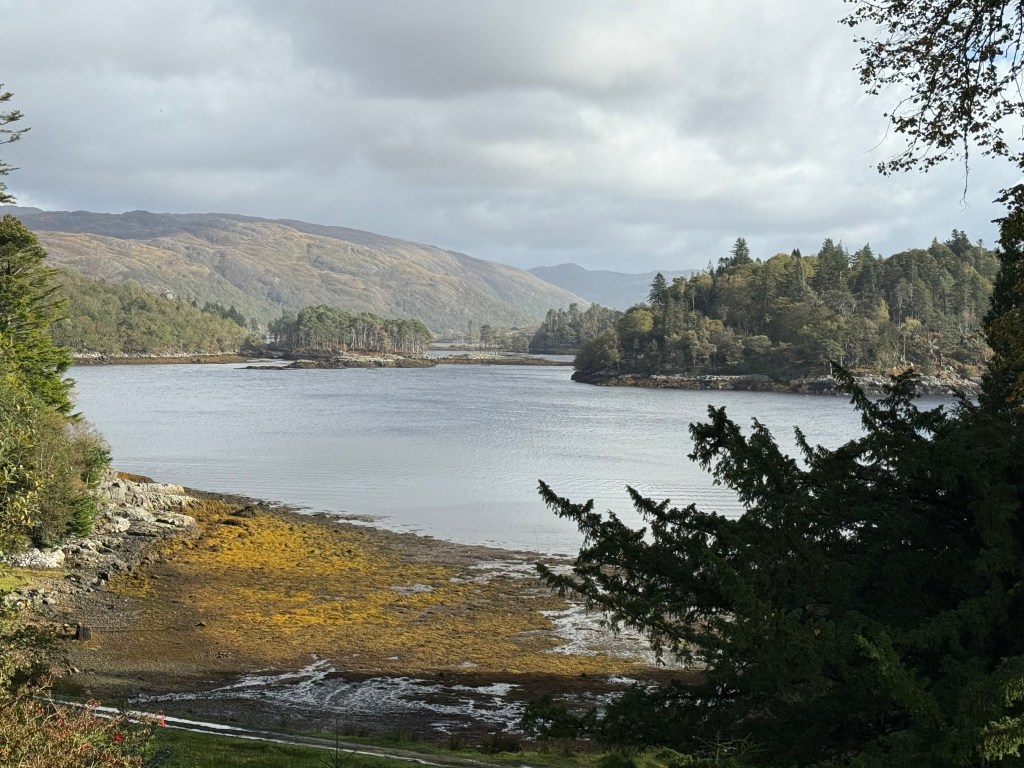
Outside, the island was slowly emerging from the darkness. Beyond the cottage lay woodland, sheltered bays, rocky coastline and the waters of Loch Moidart and for once, I had absolutely nowhere I needed to drive, a rather unfamiliar situation after four days of chasing castles, archaeological monuments and interesting places to eat across western Scotland.

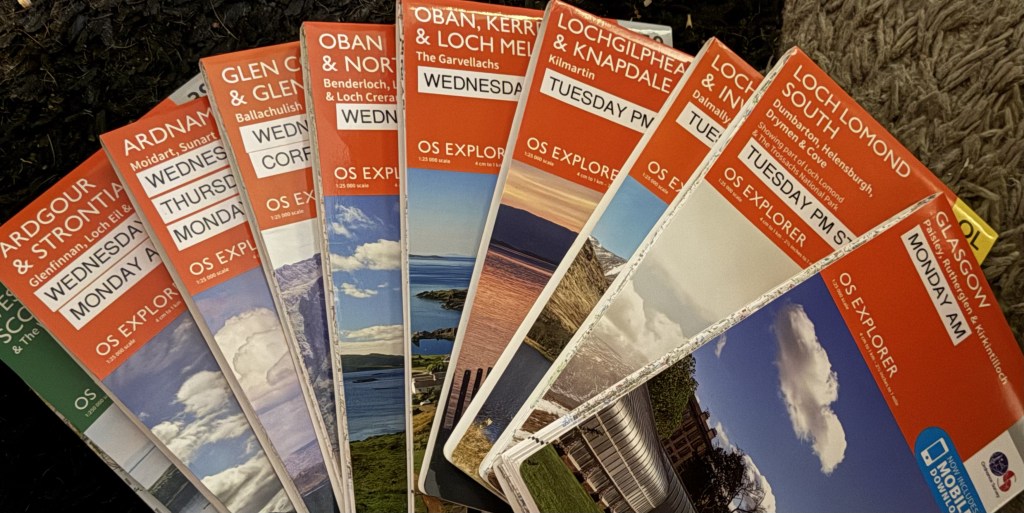
My carefully annotated OS maps could finally enjoy a well-earned rest, I couldn’t.

With another hour and a half before breakfast, I consulted the itinerary, an altogether more agreeable document than anything produced by the DVLA. Val and Clare had thoughtfully explained that we should enjoy the island at our own pace. There were activities, demonstrations, excursions and plenty of opportunities simply to relax. We were under no obligation to participate in everything.

An extremely civilised philosophy.

The first choice of the day rather neatly illustrated the point. From 7:30am, there was an optional swim and sauna down at Sail Loft beach, coinciding with the start of breakfast in the main house.

I considered both possibilities.

One offered invigorating immersion in the bracing waters of the Scottish Highlands, followed by the restorative warmth of a sauna, whilst the other offered a roaring log fire, freshly brewed Earl Grey and a breakfast menu that I’d already heard very promising things about.

As a man who had travelled all this way primarily because of his enthusiasm for excellent food, I felt it important to remain true to my principles, by the time breakfast began, I was already at Eilean Shona House.

First to arrive, naturally.

I appreciate that some people embrace the wild through physical endurance and exposure to the elements, but personally, I was perfectly happy to begin with a cup of tea.

A Roaring Fire and a Proper Scottish Breakfast

And what a lovely welcome awaited me.
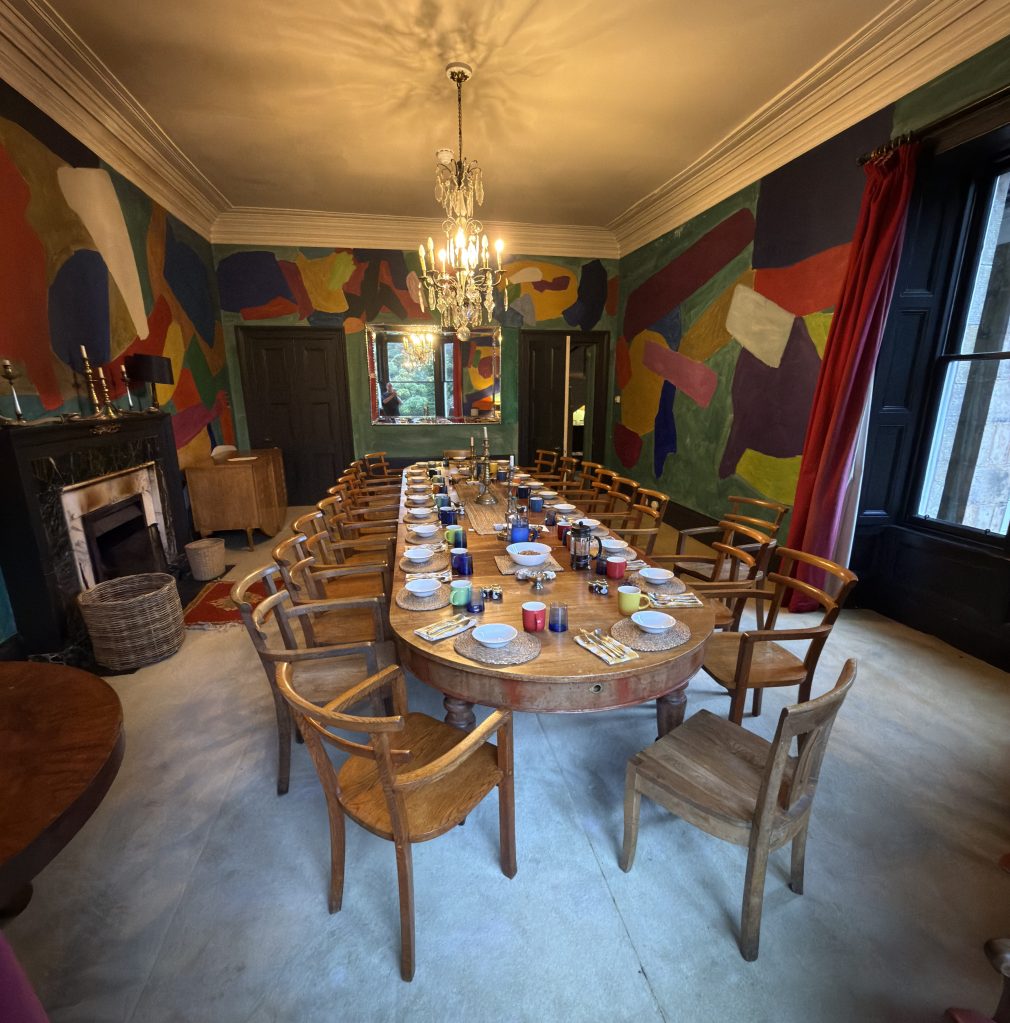
The house was wonderfully atmospheric in the early morning. A roaring log fire filled the room with warmth, the comfortable surroundings invited you to linger, and the dining room, with its magnificent abstract mural and long communal table, had been transformed overnight from the scene of our splendid first dinner into an equally inviting breakfast setting.

There was something particularly enjoyable about being first downstairs. The quiet before everyone gathered, the smell of toast, the fire crackling away and that wonderful anticipation of a day with no emails to answer, no traffic to negotiate and no pressing decisions beyond what to eat.

Admittedly, given the breakfast menu, that final responsibility was not entirely insignificant, and once again, there was the reassuring sense that everything had simply appeared as if by magic.

Of course, it hadn’t.

Behind the relaxed atmosphere was an extremely hardworking team of skilled chefs, house staff and organisers, quietly ensuring that everything ran beautifully. Meals were prepared, rooms looked after, activities coordinated and drinks produced, often before anyone had thought to ask.

And somebody had already grasped the importance of a properly timed cup of Earl Grey.

An excellent start to the day, and considerably less traumatic than a swim in Loch Moidart.
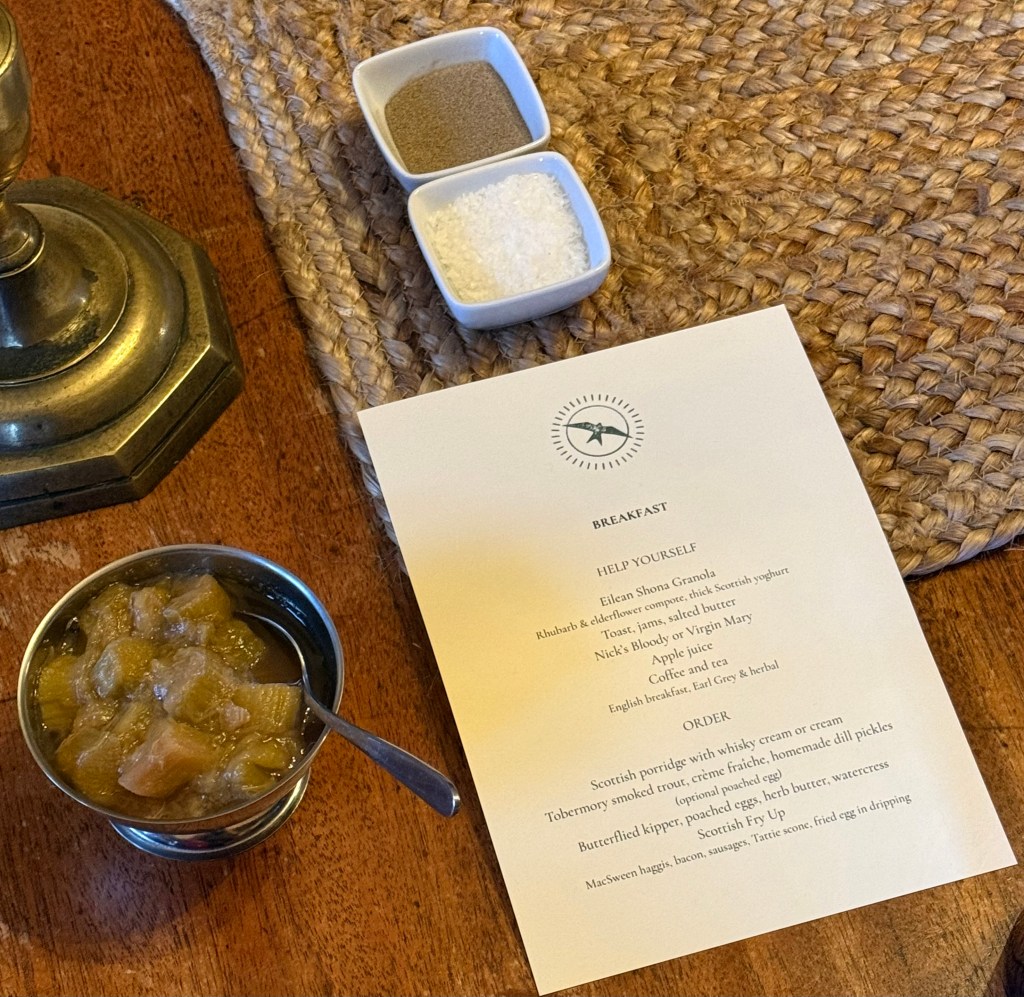
The breakfast menu was a thing of beauty.

On the help-yourself side were Eilean Shona granola, rhubarb and elderflower compote, thick Scottish yoghurt, toast, jams and salted butter. There was apple juice, tea and coffee, along with Nick’s Bloody or Virgin Mary. Given Nick Strangeway’s considerable credentials in the drinks department, even the prospect of a Bloody Mary at breakfast came with rather more pedigree than usual.

Then there were the cooked choices.

Scottish porridge with whisky cream or ordinary cream, Tobermory smoked trout with crème fraîche and homemade dill pickles, butterflied kipper with poached eggs, herb butter and watercress, or a full Scottish fry-up incorporating MacSween haggis, bacon, sausages, tattie scone and an egg fried in dripping.

Honestly, I could have spent the next four mornings investigating the menu and still felt I’d neglected something important.

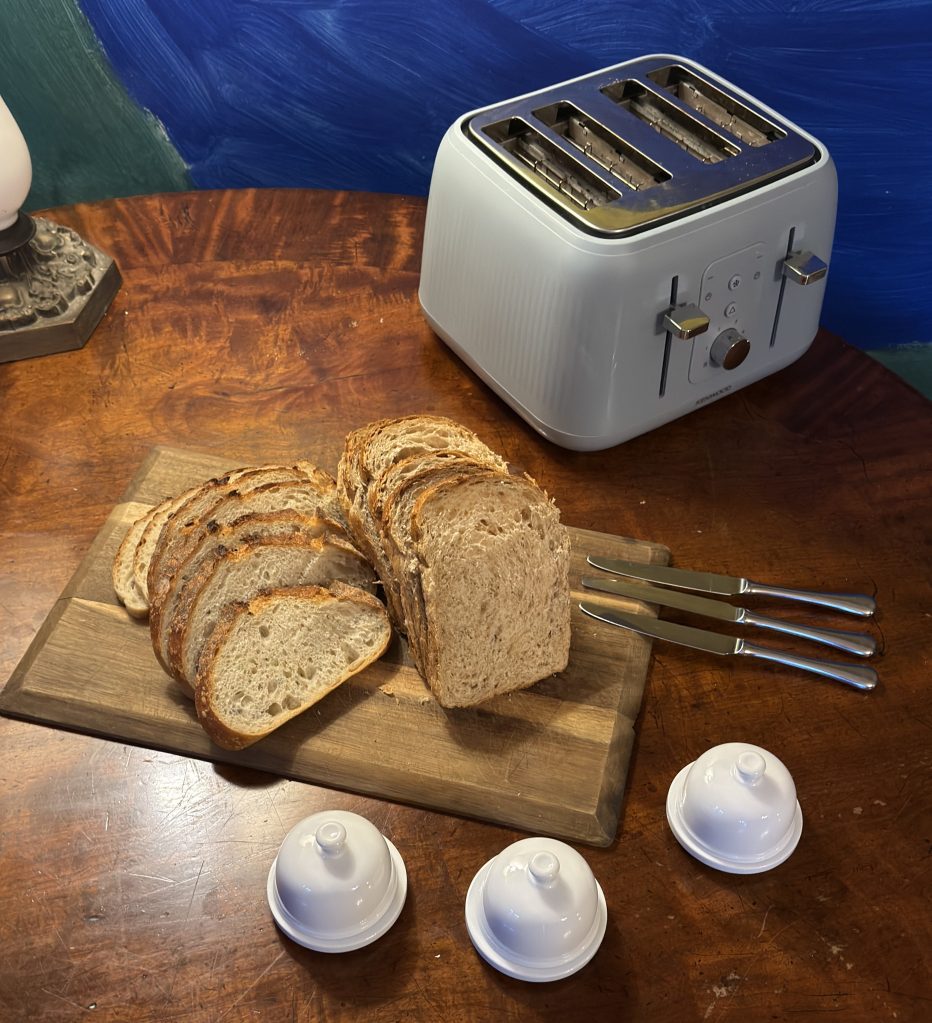
[INSERT PHOTO: 08:00 – Freshly sliced bread, toaster and breakfast preparations.]

The bread alone looked excellent, with generously sliced rustic loaves waiting alongside the toaster. There was something satisfyingly domestic about this arrangement. Extraordinary cooking in a remarkable house, but without losing the simple pleasures of making yourself a decent piece of toast.
The rhubarb and elderflower compote was particularly tempting, its soft fruit offering a combination of sweetness and gentle acidity. Alongside thick Scottish yoghurt and the house granola, it made a rather civilised beginning and was also exceedingly good, slathered on buttered toast.

But I had already made my decision about the main event.

Tobermory Smoked Trout – A Very Good Decision

I chose the Tobermory smoked trout, crème fraîche and homemade dill pickles, with the optional poached egg.

Optional?

Under what circumstances would a perfectly good poached egg be regarded as unnecessary?
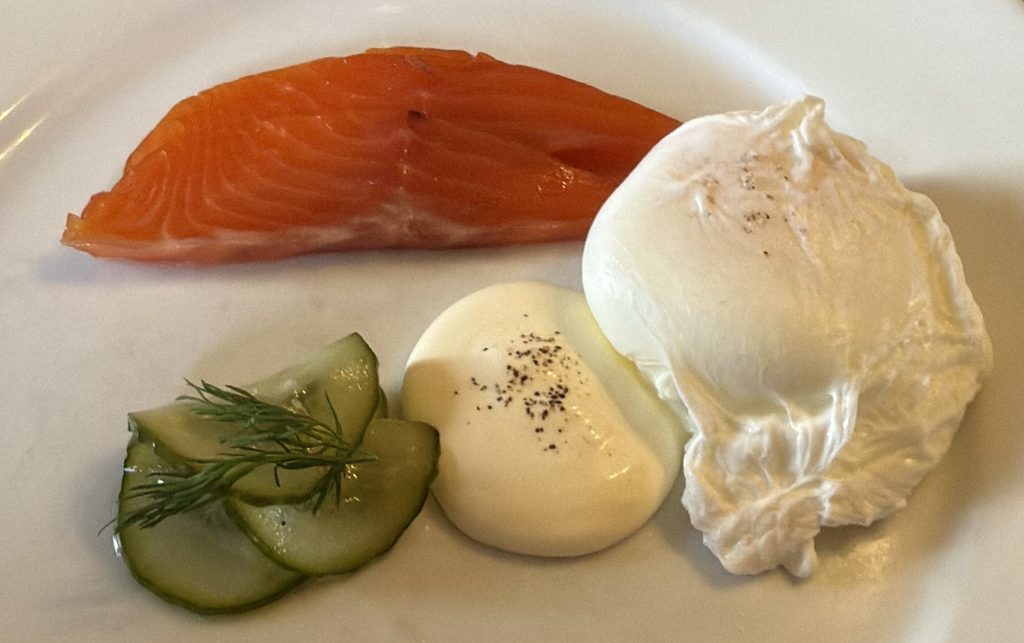
The plate arrived looking wonderfully restrained.

A generous piece of beautifully coloured smoked trout, its vivid orange flesh contrasting with the pale crème fraîche, delicate slices of homemade pickle and a perfectly formed poached egg.

The trout possessed the rich, gently smoky character that makes this style of fish so appealing. The crème fraîche added a welcome freshness and richness, while the crisp, lightly acidic pickles, scented with dill, provided the contrast needed to bring everything together.

And then there was the poached egg, a beautifully formed little parcel, its delicate white concealing the promise of a magnificent golden yolk. Some things simply belong together, and smoked fish, good bread and a properly poached egg are very high on my list.

It was an excellent breakfast, enjoyed beside a roaring fire, and I was beginning to appreciate just how pleasant it was to have an entire day ahead without the slightest responsibility for organising any of it.

An unusual sensation.

But one I felt I could learn to enjoy.

Egg Tempera – Three Hours in the Company of Anna Koska

At 9:30am, it was time to head to the Studio for an activity I’d been particularly looking forward to: a morning exploring the ancient art of egg-tempera painting with Anna Koska. Unlike most of the people I’d only recently met on the island, Anna was already something of a familiar presence, having discovered her extraordinary natural-history illustrations some months earlier, I’d become completely captivated by her work, and we’d been briefly exchanging comments on Instagram in the lead-up to the trip.

Her paintings have a quality that photographs, however accomplished, rarely achieve. She notices the tiny variations in colour, structure and texture that most of us simply overlook: the subtle translucency of a petal, the curve of a leaf, the extraordinary detail in the scales of a fish, or the delicate architecture of something as seemingly insignificant as a snail’s shell.

There is something wonderfully absorbing about her approach to the natural world, and now I was about to discover rather more about how she achieved it.

I should probably explain that my enthusiasm for beautiful botanical artwork does not necessarily indicate any corresponding ability to produce it.

Appreciation and execution are two entirely different disciplines.

An Ancient Technique, a Rather Unusual Ingredient

Egg tempera is one of the oldest established painting methods, used since antiquity and particularly associated with medieval and early Renaissance art. Before oil painting became dominant in Europe, it was the medium responsible for many of the extraordinarily detailed religious panels and altarpieces that survive today. Its essential ingredients are remarkably simple: powdered pigment, water and egg yolk.

The yolk acts as the binder, holding the coloured particles together and fixing them to the painting surface as the paint dries. It is a beautiful meeting of natural materials and artistic endeavour.

Although it does mean that, having already enjoyed a magnificent poached egg for breakfast, I was now about to spend the remainder of the morning investigating an entirely different application for its close relative.

Clearly, Kitchen in the Wild had decided to explore the versatility of eggs in some depth.
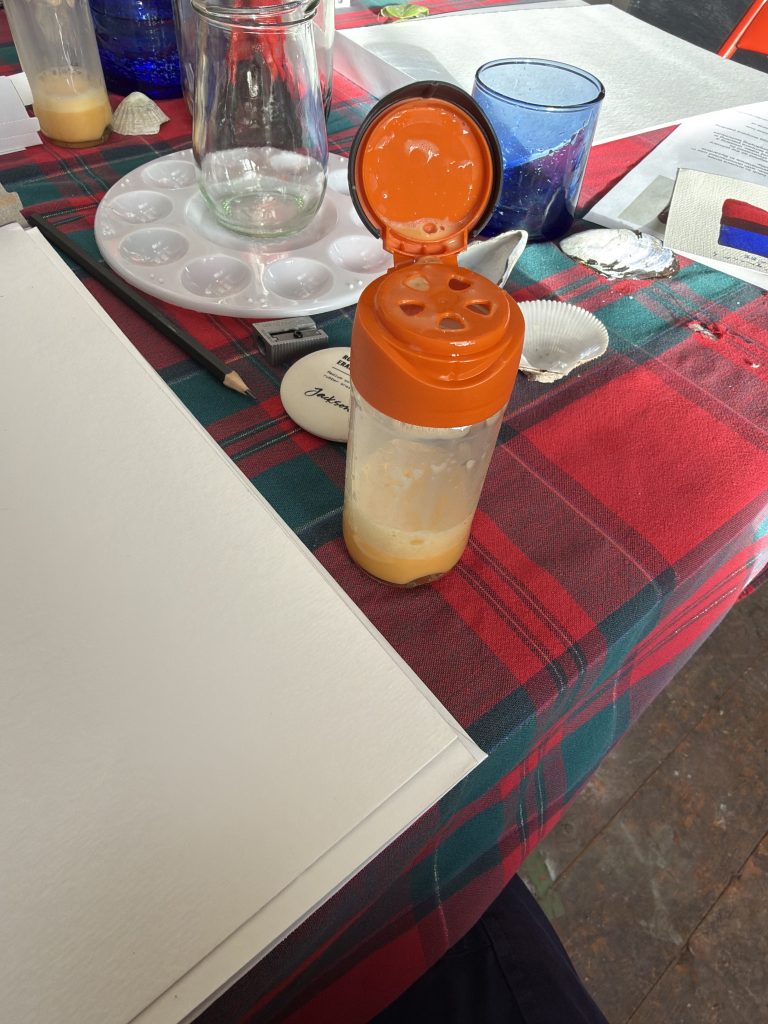
Our workspace had been prepared with paper, brushes, pigments, small containers and the various materials required to make our own paint, and what initially appeared quite straightforward rapidly developed into a fascinating lesson in the nature of colour itself.

The Extraordinary World of Pigments

One aspect I found particularly absorbing was Anna’s explanation of pigments. Long before artists could purchase conveniently packaged tubes of colour, their materials came from the natural world: coloured earths, minerals and other substances that could be processed and ground into fine powders.

Some colours were relatively inexpensive and readily available, earth pigments such as ochres and umbers could be obtained from iron-rich clays and mineral deposits.

Others were historically extraordinarily valuable.

Natural ultramarine, for example, was produced from lapis lazuli, much of it transported from mines in what is now Afghanistan. Its remarkable blue made it so prized that, in certain periods, it could cost more than gold. An artist’s palette could therefore represent not merely a collection of colours, but an astonishing network of geology, trade, craftsmanship and expense.

Even with modern pigments, differences in their composition, fineness and behaviour affect how the paint mixes, covers and responds to the brush.

I found this fascinating.

Something that appears so uncomplicated when looking at a finished painting turns out to involve a remarkable degree of material knowledge.

And then there was the egg.

The pigment is first mixed into a workable paste, while the yolk provides the binding medium. Combined in suitable proportions, they produce a paint that can be applied in beautifully fine, controlled layers. It dries relatively quickly, meaning that the artist cannot simply push wet paint around indefinitely, as might be possible with oils.

Instead, depth and subtlety are achieved gradually, through repeated applications, carefully judged colour and patient brushwork.

It was beginning to dawn on me that Anna’s extraordinary illustrations were not the result of somebody casually waving a paintbrush about for half an hour. There was rather more to it than that.

Learning to Look

What I enjoyed most about the session was the change of pace it encouraged.

The previous few days had involved covering considerable distances, searching out ancient monuments, photographing landscapes and attempting to absorb five thousand years of Scottish history. Now, for almost three hours, the objective was simply to stop, look carefully and concentrate.

To consider colour rather than merely recognise it.

To notice subtle changes in tone, how one shade sits beside another, how light alters what we think we’re seeing, and how even a seemingly simple natural form can contain an astonishing amount of visual information. There is a particular kind of calm that develops when you’re concentrating completely on a small piece of work, like a simple leaf!

The conversations around the table gradually gave way to quieter discussion, the occasional question, the gentle movement of brushes and the business of mixing and testing colours. Coffee appeared at appropriate intervals, which I regarded as an essential contribution to the creative process.

Anna guided us through the materials and technique with patience and enthusiasm, encouraging us to experiment while developing a better understanding of what we were actually trying to achieve. Choosing a brush was itself an education. Different sizes and shapes offered varying degrees of control, but egg tempera rewards a particularly considered approach, building colour through fine, deliberate marks rather than great sweeping applications.

At least, that was the theory.

My own approach occasionally suggested somebody attempting to decorate a very small fence.

Nevertheless, I became thoroughly absorbed. For somebody whose usual relationship with a paintbrush involves making sure there aren’t any visible drips on a skirting board, this was rather a revelation.

My Contribution to the World of Fine Art

By the end of the session, I had produced my own little egg-tempera creation.
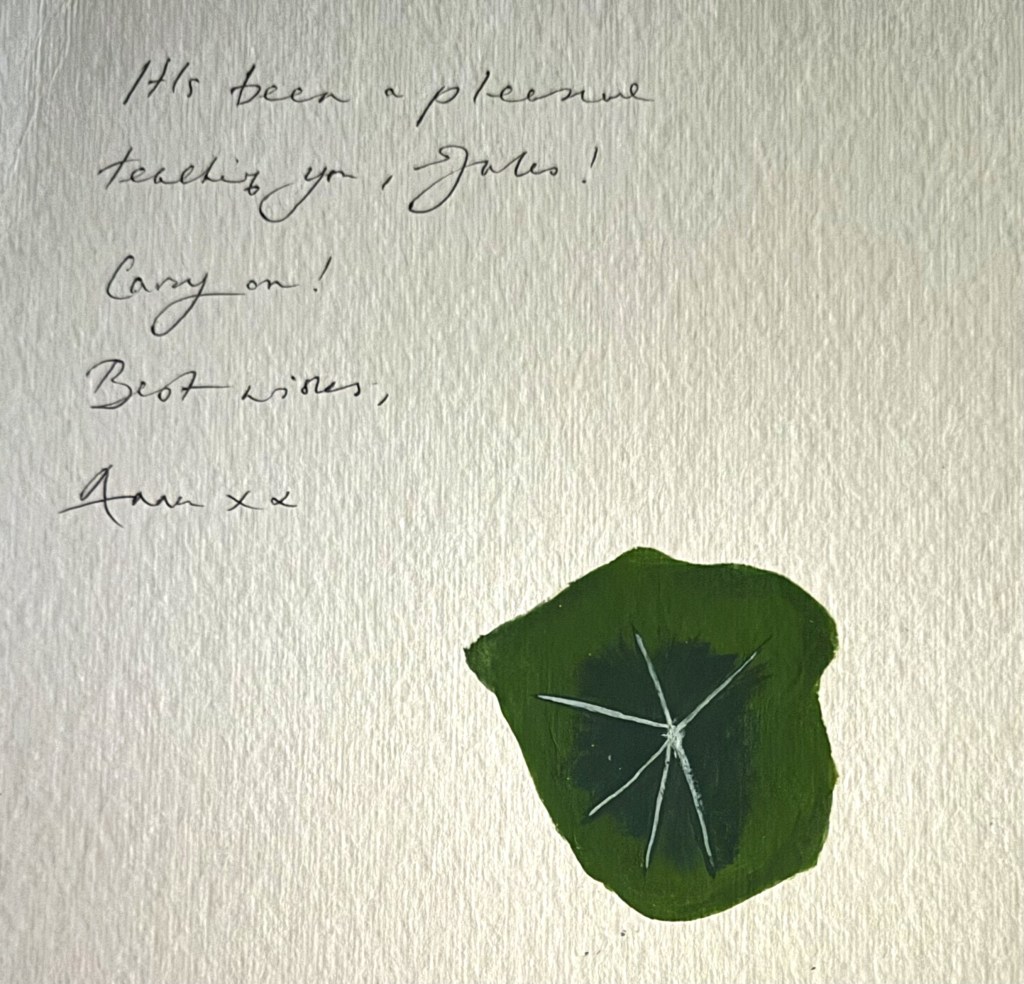
A small study involving variations of deep green, with fine pale lines radiating across its surface.

Was it likely to trouble the National Gallery’s acquisitions committee? Perhaps not immediately.

But I was rather pleased with it.

More importantly, it represented three thoroughly enjoyable hours spent discovering a new medium, developing a little patience and learning to appreciate the care behind an artist’s work.

Anna very kindly added a handwritten message to my painting:

“It’s been a pleasure teaching you, Jules! Carry on! Best wishes, Anna xx”

Which I thought was rather lovely.

And, being a reasonably perceptive chap, I decided to interpret “Carry on!” as encouragement rather than an urgent plea to keep practising.

A Very Special Gift

Anna also gave us all beautiful little paintings, created in egg tempera.
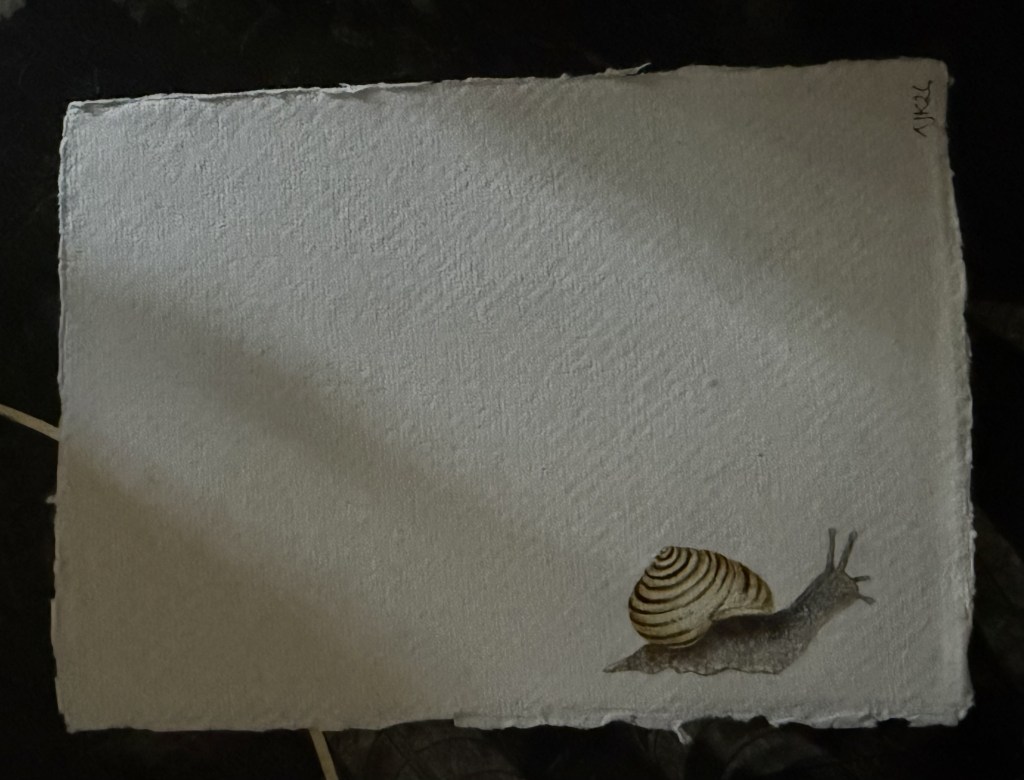
Now this was something quite different.

The painting was an incredibly thoughtful gift, and one I’ll treasure.

There was another lesson from the morning, too. Egg tempera is not a technique to be mastered in a few hours. Developing the sensitivity, precision and understanding of colour that Anna brings to her work takes years of observation, practice and patience.

Our three hours had been no more than the first tentative steps on what promised to be a very slow journey.

A journey undertaken, appropriately enough, at a snail’s pace, although judging by Anna’s beautiful little painting, even the snail was considerably further along than I was.

After months admiring Anna’s work from afar, it had been a real pleasure to spend the morning learning from her in person, and I came away with something rather more valuable than a rudimentary understanding of egg-tempera technique, a renewed appreciation for the importance of observation, patience and simply taking the time to look.

Three hours had disappeared almost without my noticing, which, considering my normal ability to become distracted by the prospect of lunch, was quite an achievement.

Fortunately, lunch was next.

And Kitchen in the Wild had something rather splendid waiting for us in the Village Hall.

Lunch in the Village Hall – Not Quite Cullen Skink

By lunchtime, we had gathered in the island’s village hall. There is something rather appealing about eating in a simple communal setting after a morning of activities. It suits the spirit of Kitchen in the Wild perfectly: wonderful food without the need for elaborate surroundings or unnecessary ceremony.

And what arrived was exactly the sort of lunch you want in the Highlands in October.

A generous bowl of rich seafood chowder, served with Saltine crackers.
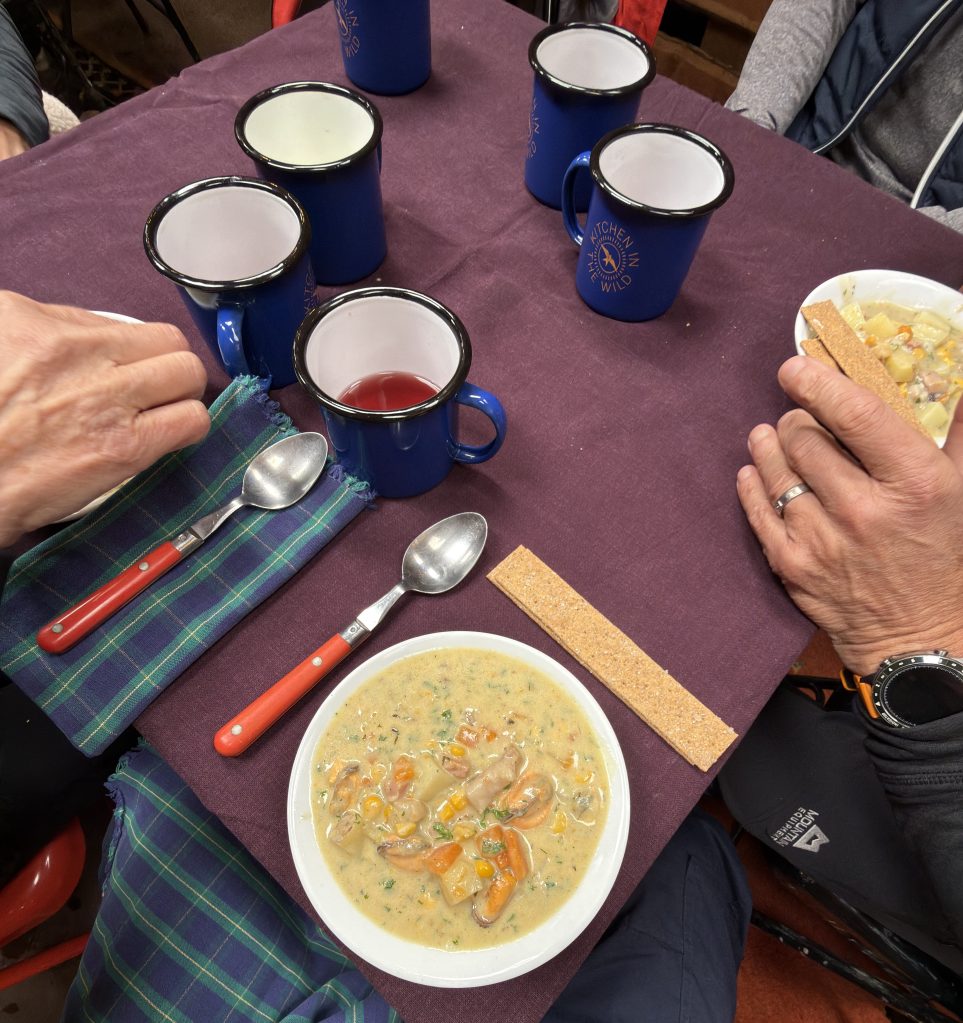
Now, I initially found myself thinking of Cullen skink, that celebrated Scottish soup traditionally made with smoked haddock, potatoes and onions.

But this wasn’t Cullen skink.

It was a considerably more varied seafood affair, with visible shellfish, chunks of vegetables, sweetcorn and finely chopped herbs in a creamy, deeply comforting broth. The bowl looked magnificent, its pale golden liquid dotted with orange, yellow and green, with pieces of seafood generously distributed throughout.

Alongside came long, crisp saltine crackers, providing something suitably crisp and salty with which to accompany the chowder.

Simple food, generously prepared, and precisely what the moment called for.

Our drinks were served in the blue enamel Kitchen in the Wild mugs, which were rapidly becoming part of the character of the whole experience. Practical, robust and delightfully informal.

There was also a pleasing contrast between the morning’s artistic pursuits and the straightforward pleasure of sitting around a table enjoying an excellent bowl of soup.

I may not have been able to produce a painting worthy of Anna’s approval, but I felt considerably more confident in my ability to appreciate a good chowder.

We all have our strengths.

A Stag, Some Sunshine and the Sound of Scotland

One of the pleasures of spending time on Eilean Shona is that its wildlife doesn’t appear to have received the memorandum about keeping a respectful distance from the guests, among the afternoon’s sights was a magnificent red deer stag, standing in the grassy woodland amongst the trees and autumn bracken.
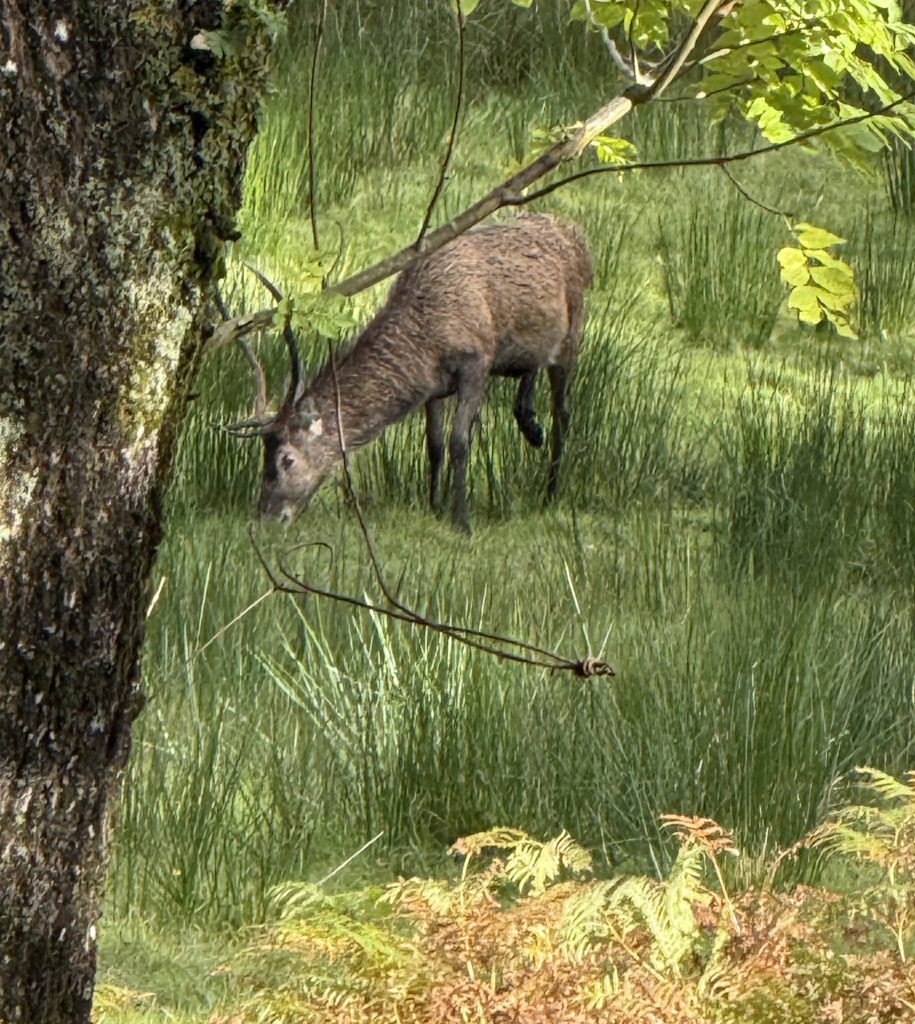
There is something particularly impressive about seeing a red deer in its natural surroundings. The stag’s antlers, dark neck and thickening autumn coat gave it an unmistakably commanding appearance, even while engaged in the comparatively undignified business of eating grass.

For a while, it seemed perfectly content to continue grazing.

Then it lifted its head.
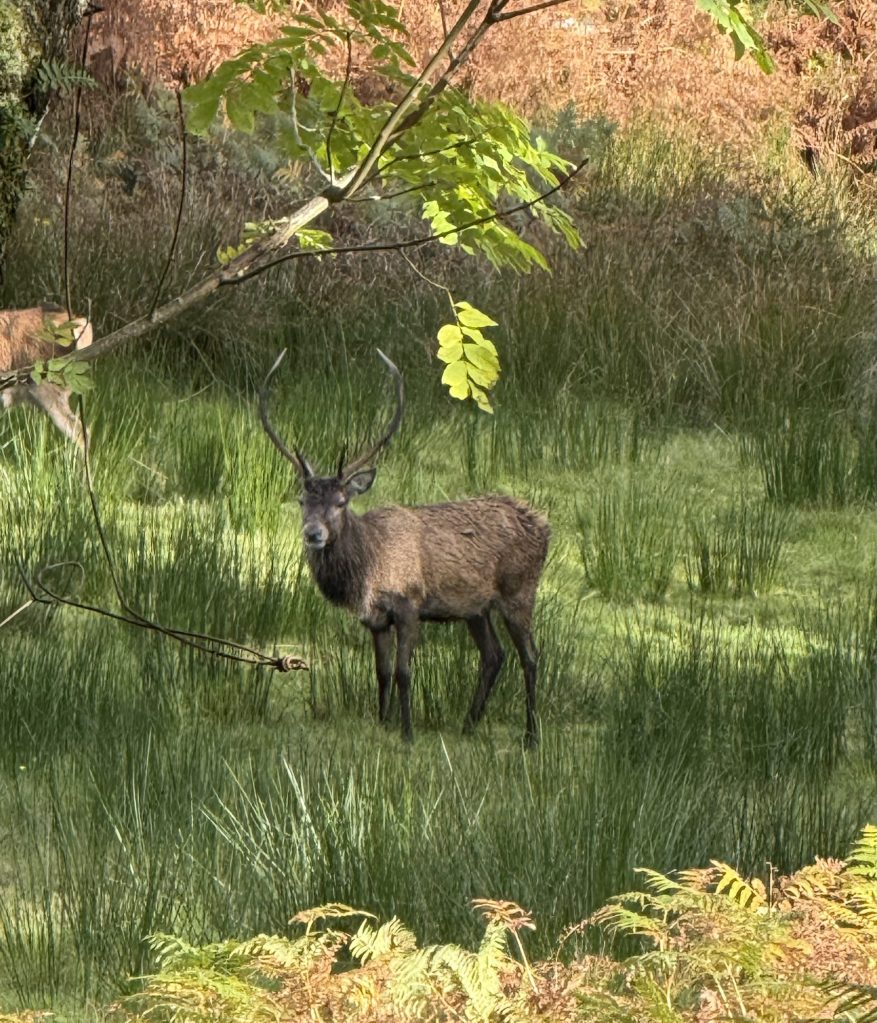
Quite magnificent.

The contrast between the dappled sunlight, lush green grass and copper-coloured bracken made the scene especially beautiful.

October is also the season of the red deer rut, when mature stags compete for access to females, their deep roaring calls carrying considerable distances across Highland glens. I had spent part of the previous day contemplating animal carvings made thousands of years ago in Kilmartin. Now here was the living subject, looking directly at me.

I felt the prehistoric artists had been onto something.

We were also treated to the unmistakable sound of the bagpipes, played by Matt, our naturalist and guide later that day, he was very good.
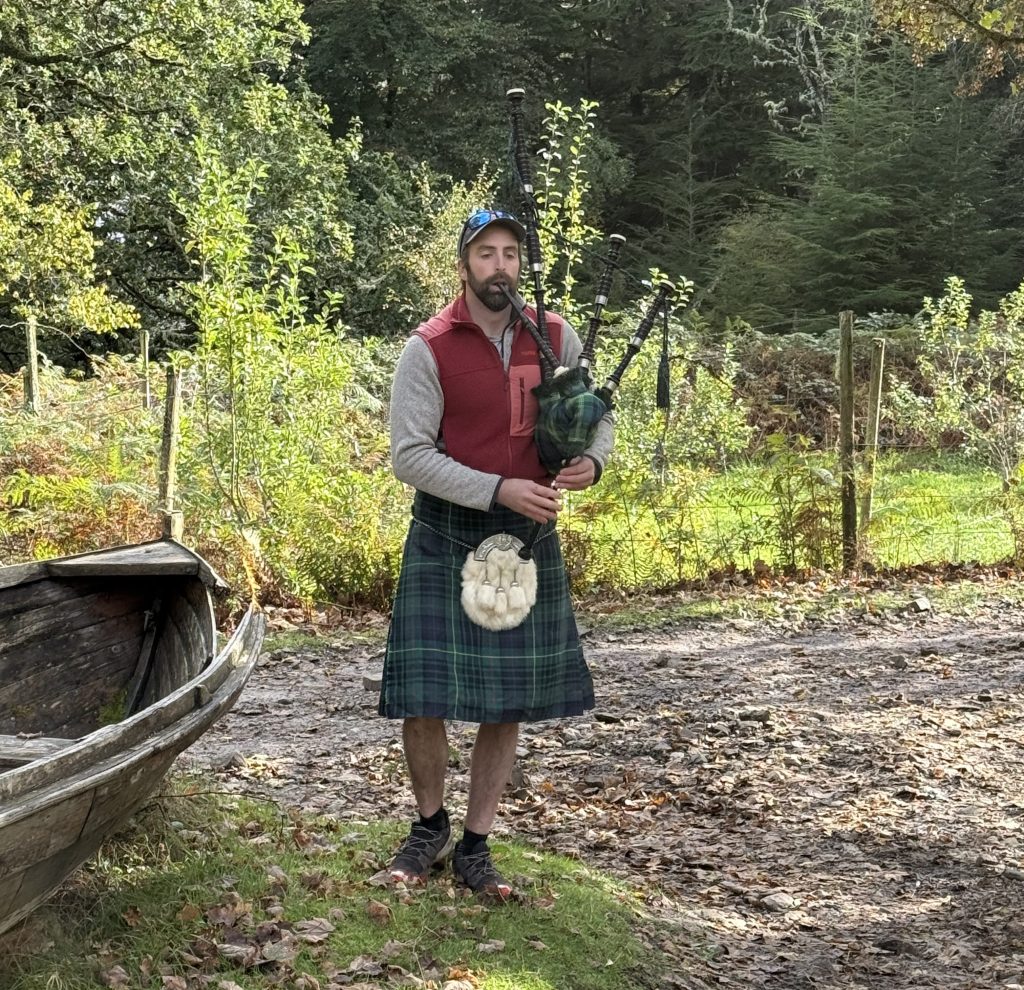
There are few sounds more closely associated with Scotland, although hearing pipes in the open air, surrounded by woodland and Highland scenery, is rather different from encountering them outside a busy tourist attraction.

Their music has a remarkable capacity to fill the landscape, and I have to say that the combination of tartan, a piper, a nearby stag and some unexpectedly beautiful sunshine suggested Scotland was making a determined effort to deliver the full promotional package.

All we needed now was a rainbow.

Although the weather had rather different plans for the afternoon.

The Afternoon – Life Jackets On

After lunch came our first proper expedition onto the water.

Matt Waterston’s expertise would now come into its own as we prepared to explore Loch Moidart and the surrounding coastline aboard the RIB, there is something undeniably exciting about travelling in a rigid inflatable boat. Particularly when you have spent the morning in the civilised surroundings of a beautiful house, enjoying poached eggs and experimenting with egg tempera.

Now it was time for waterproofs, life jackets and the altogether less predictable business of Scottish maritime weather.
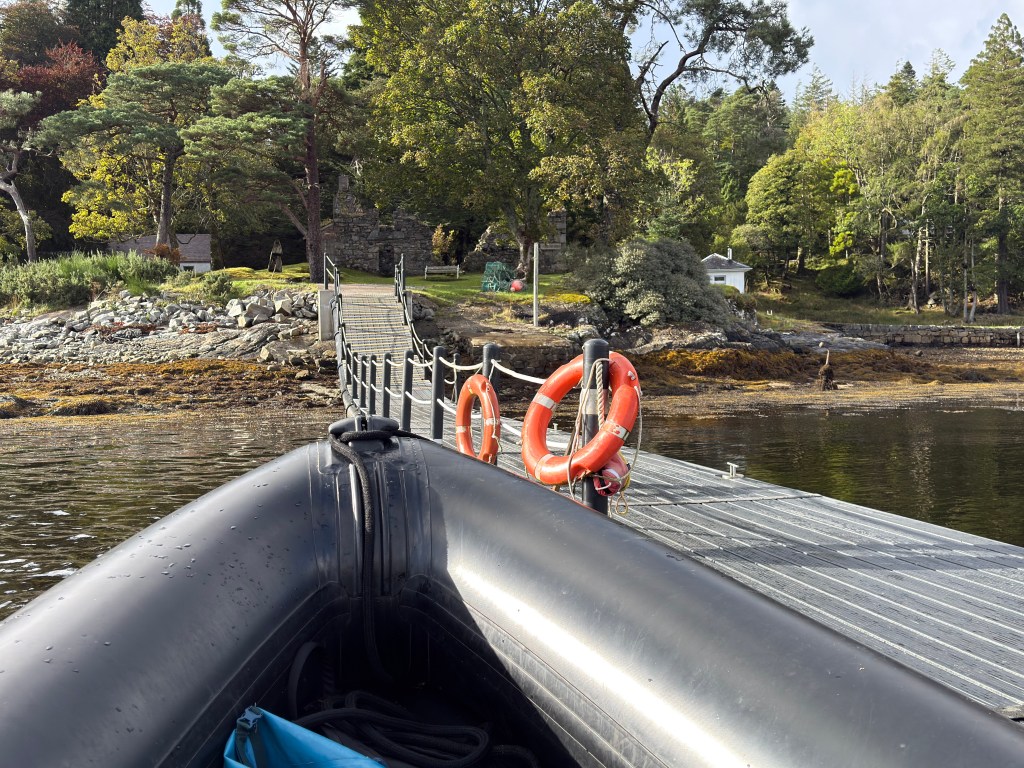
The island’s landing stage was framed by woodland, old stone buildings and shoreline exposed by the tide, in the sunshine it looked wonderfully peaceful. The sort of setting that encourages the entirely reasonable assumption that the weather might remain pleasant for the rest of the afternoon.

An assumption Scotland was about to correct.

Four Seasons in Twenty Minutes

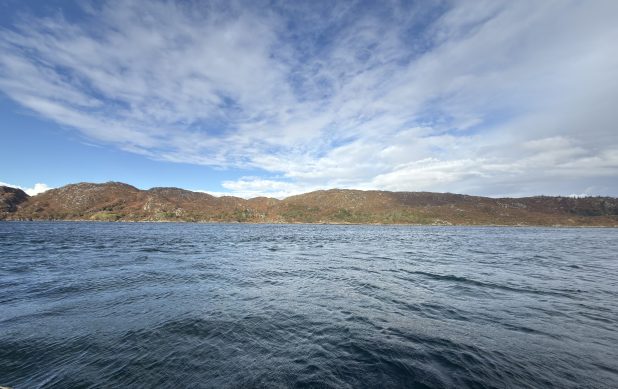
Setting off across Loch Moidart, we were treated to a remarkable demonstration of Highland meteorology.

One moment there was blue sky and sunshine illuminating the surrounding hills. The next, dark clouds were gathering, the wind was picking up and the water was developing an altogether more energetic character.

Then came intense rain.

Then sunshine again.

And, for good measure, another threatening bank of cloud.

It was as though somebody had decided to demonstrate all four seasons in approximately twenty minutes, without bothering to consult those of us sitting in the boat.
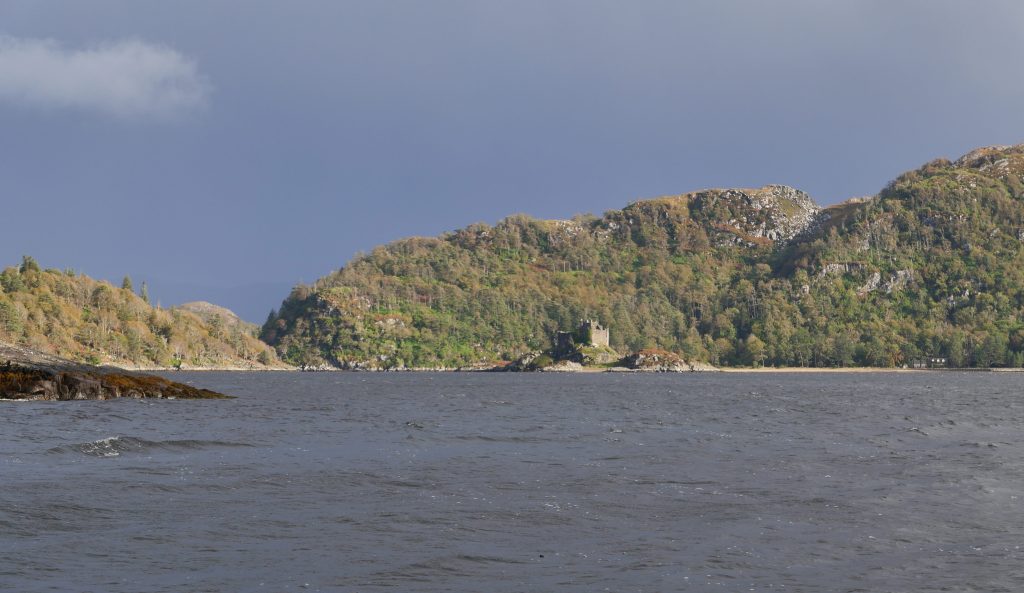
The changing conditions made the landscape look quite extraordinary. As sunlight moved across the hills, individual stands of trees glowed against the darker slopes, while the water shifted from a bright reflective blue to a much moodier slate grey.

The scenery was constantly transforming.

And, as we rounded one of the headlands, Castle Tioram appeared once again.
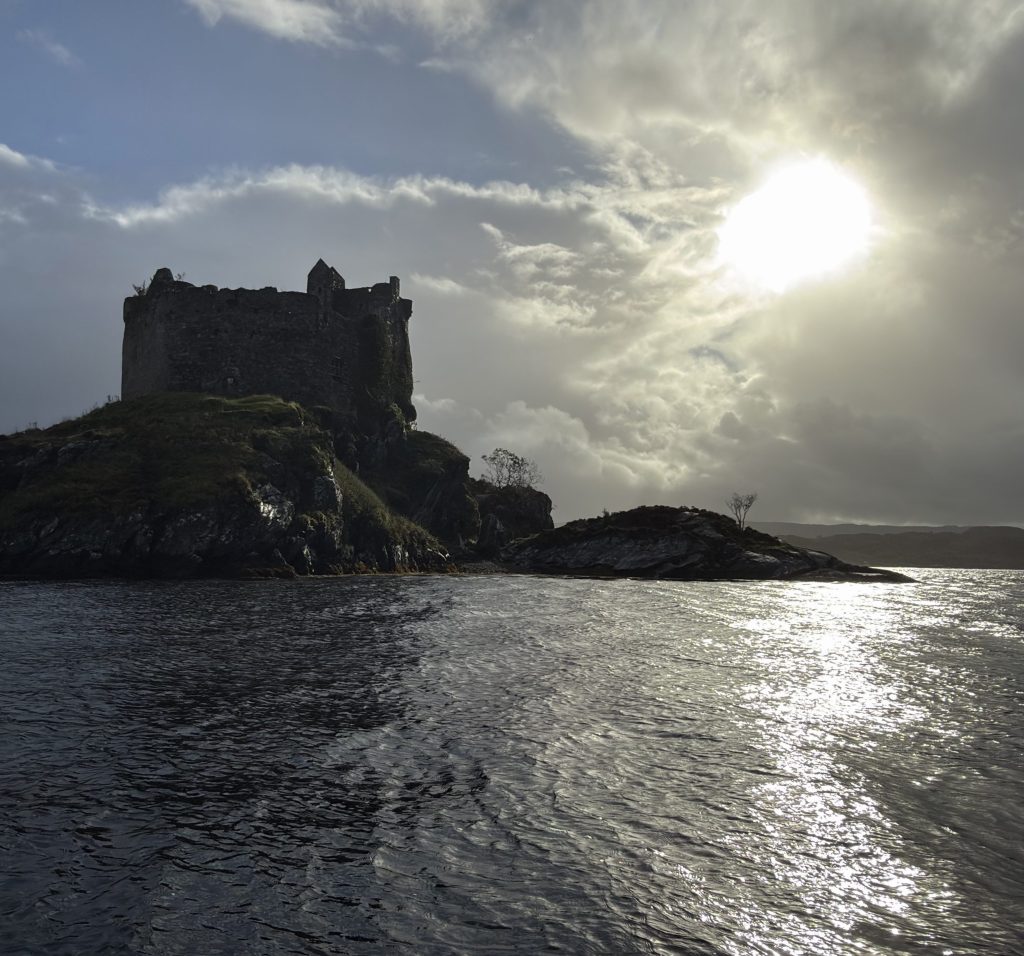
What an extraordinary sight.

The castle stood in silhouette upon its rocky island, the low autumn sunshine breaking through the clouds behind it and scattering silver light across the water. Having photographed it during the previous day’s journey, I was delighted to see it again from a different perspective, the weather had provided its own theatrical lighting.

Admittedly, it had also made certain that everyone aboard appreciated the practical value of waterproof clothing.

But one shouldn’t complain when Scotland offers this much atmosphere free of charge.

The Wildlife of Loch Moidart

Our expedition was about rather more than enjoying the scenery. The sheltered waters, rocky shores and islands of Loch Moidart support an extraordinary variety of wildlife, and exploring by boat gives you an entirely different perspective from anything available on land, and among the highlights was a seal resting on the exposed shoreline.
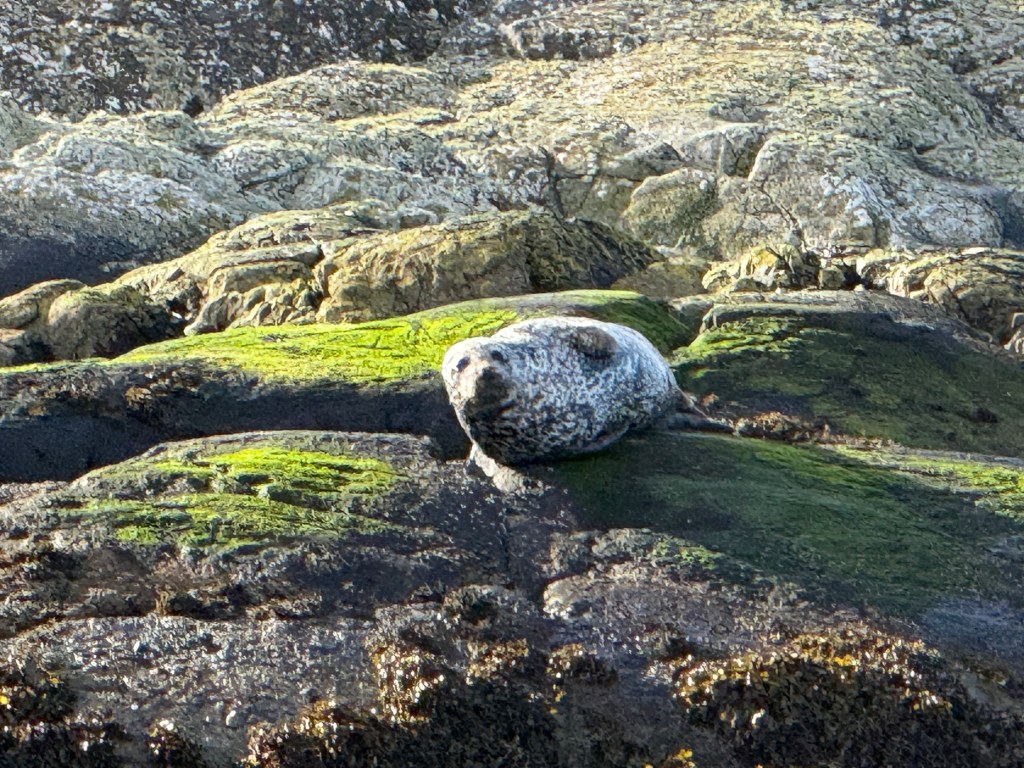
It appeared entirely untroubled by the conditions, occupying a comfortable-looking patch of rock with the air of an animal perfectly satisfied with its afternoon arrangements.

Seals are wonderfully expressive creatures, and there is something particularly appealing about observing one stretched out on the shoreline, apparently contemplating the world with considerably less urgency than most of us. The dark, wet rocks, bright green seaweed and beautifully mottled coat made a striking photograph.

Meanwhile, Matt helped bring the surrounding landscape and its wildlife into focus, drawing upon his considerable experience of exploring Scotland’s western coastline.

It was exactly the sort of expertise that made Kitchen in the Wild so appealing.

One moment we could be discussing the delicate details of botanical illustration with Anna Koska; a few hours later, we were out on the water discovering a completely different aspect of the same extraordinary environment.

And then, of course, there was the lobster.
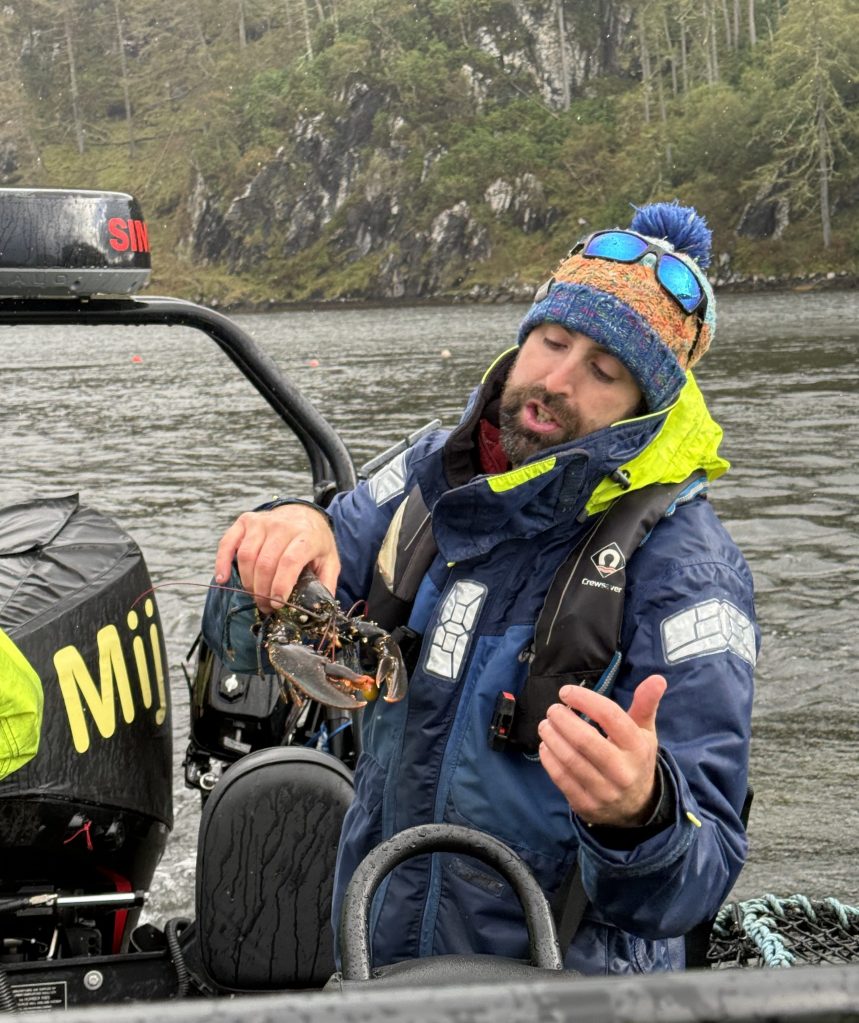
A magnificent specimen, held up for everyone to admire, with Matt explaining its features and behaviour, its impressive claws offered a useful reminder that not every ingredient encountered during a culinary adventure is necessarily enthusiastic about participating.

I was perfectly happy to maintain a respectful distance.

Seafood is one thing.

Having it defend itself is quite another.

A Different View of the Island

As the afternoon continued, the boat carried us past wooded headlands, sheltered inlets and rocky shores, distant islands revealing just how varied and beautiful this part of the Scottish coastline really is.
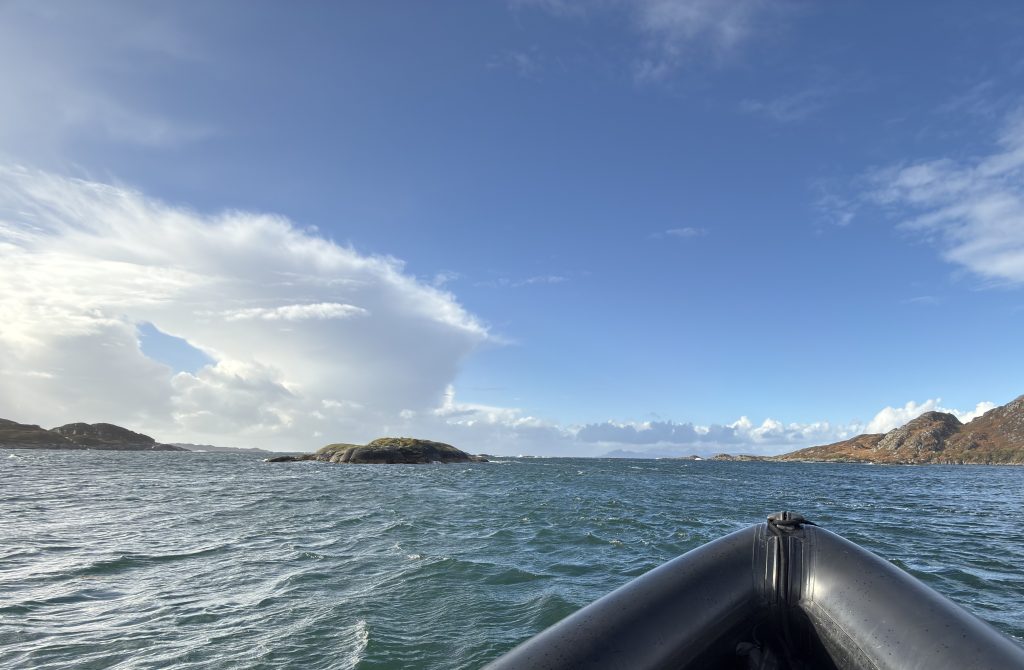
From the water, Eilean Shona and its neighbouring coastline felt wonderfully remote. The woodland descended almost to the shore, interrupted occasionally by exposed rock and narrow stretches of beach. Above it, the hills wore their autumn colours beneath an enormous, ever-changing sky.

At times, the sun illuminated entire sections of the landscape while neighbouring hills remained beneath dark cloud, I had spent months researching the island and the surrounding area, poring over maps, photographs and historical accounts, trying to imagine what it would actually feel like to be here, then the sky opened up and it chucked it down again!
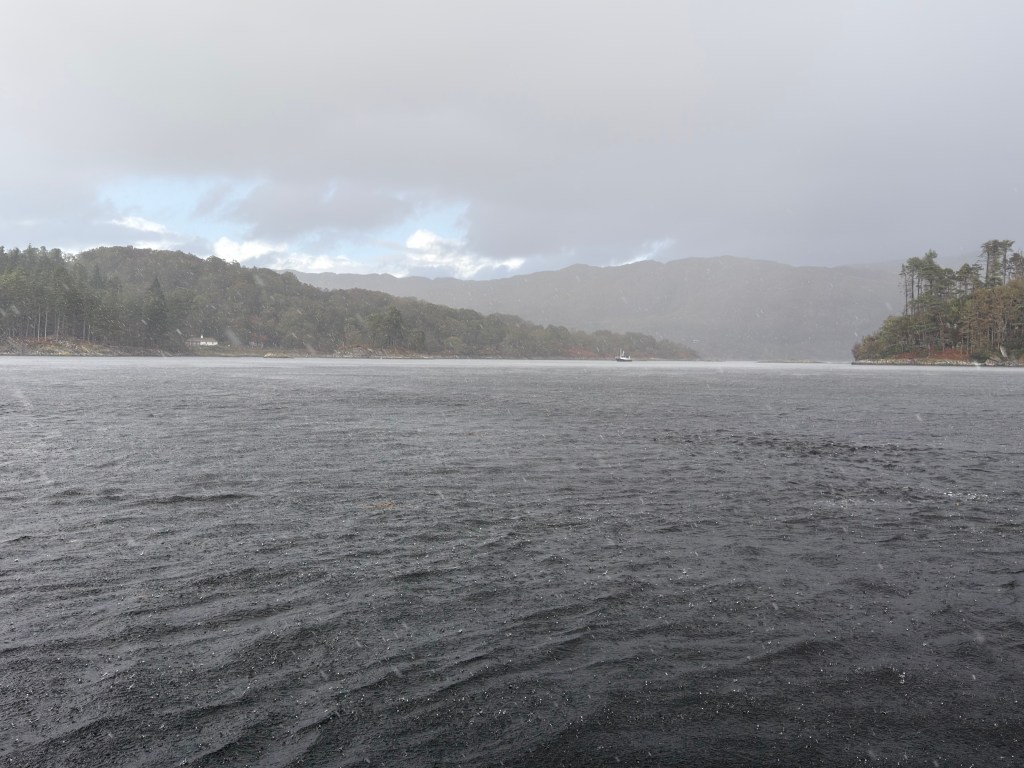
No amount of preparation quite captures the experience of travelling across these waters, with the wind on your face, the Highlands rising around you and the weather changing almost by the minute. This was what I’d come for.

Of course, I’d also come for the food.

And after a morning of artistic endeavour, an excellent seafood lunch and an afternoon exploring the coastline, I was beginning to develop a very healthy appetite for whatever the kitchen might have planned for us next.

From Waterproofs to Whisky – An Evening with Nick Strangeway

Having spent the afternoon experiencing approximately four seasons in twenty minutes aboard the RIB, returning to the warmth and comfort of Eilean Shona House was particularly appealing. It had already been a wonderfully varied day. A magnificent breakfast, three absorbing hours exploring egg tempera with Anna Koska, seafood chowder in the Village Hall and an afternoon discovering Loch Moidart from the water with Matt, the awesome guide.

By any reasonable standard, that would have constituted a fairly full programme.

Kitchen in the Wild, however, was not quite finished with us. At seven o’clock, we were gathering in the sitting room for a Classic Whisky Cocktails masterclass with Nick Strangeway, followed at eight by dinner cooked by Nathan Outlaw.

Now, I have always believed in continuing one’s education.

Particularly when the curriculum involves whisky!

Nick was one of the familiar faces I’d been so pleased to see again on the island, having met him at a previous Kitchen in the Wild event. Widely regarded as one of Britain’s most accomplished bartenders, he has spent decades exploring the history, ingredients and craftsmanship of drinks, bringing a genuine depth of knowledge to a subject that is sometimes treated as little more than an excuse to shake something enthusiastically in front of an audience.

With Nick, a cocktail is never simply a list of liquids poured into a glass. There is history, provenance, balance and an extraordinary understanding of how ingredients interact, and whisky provides a particularly interesting starting point.

Unlike a neutral spirit, it brings considerable character of its own: the influence of grain, fermentation, distillation, oak and maturation, together with the distinctive traditions of the regions and distilleries that produce it. Creating a successful whisky cocktail therefore involves rather more than finding something sweet to pour into it, it requires an appreciation of what is already there, and how other flavours can complement rather than overwhelm it.

A reassuring philosophy, I thought.

Especially after discovering the three miniature bottles of Nc’nean waiting for us at Tioram Cottage. Scotland was clearly providing opportunities for further study at an encouraging rate. The atmosphere in the sitting room was relaxed and convivial, with everyone settling in after the day’s activities, exchanging stories and preparing for another splendid evening.
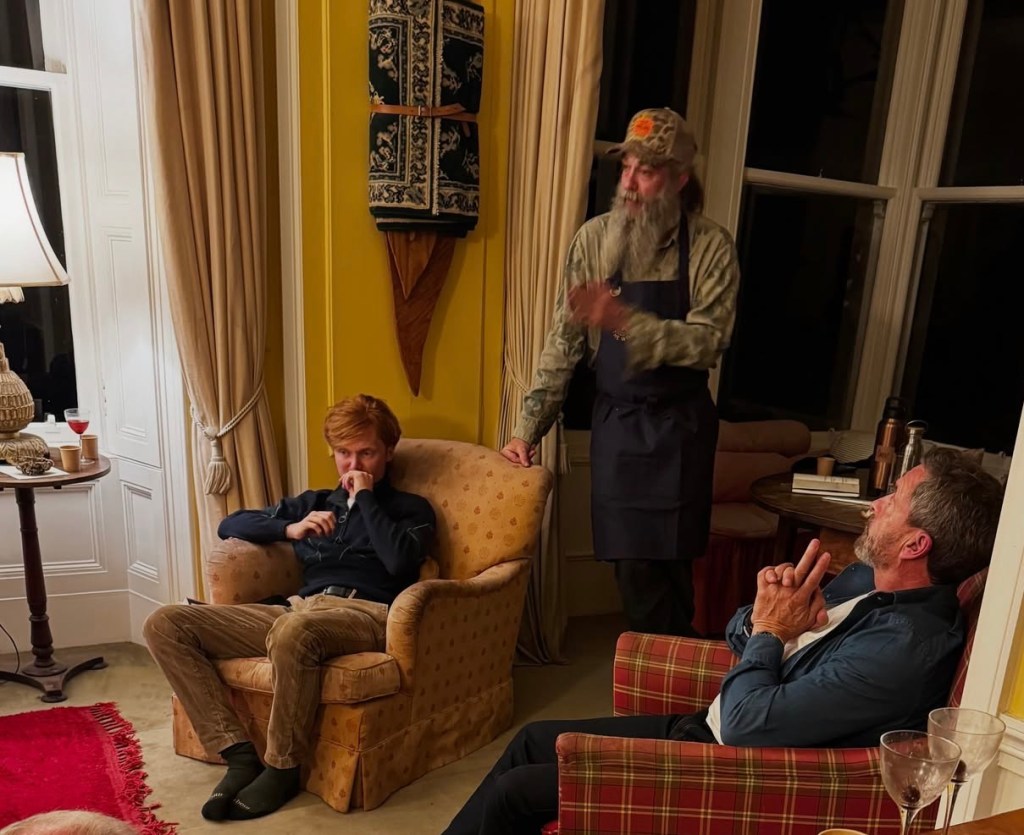
And there was something rather lovely about being back in the company of old friends. Val, Clare and Nick had already made my previous Kitchen in the Wild experience so memorable that joining them again felt less like attending an organised event and more like returning to a particularly interesting gathering of friends.

Admittedly, friends with somewhat more impressive credentials than the average dinner party, and friends who had a rather worrying ability to make the consumption of excellent food and drink appear educational.

A Few Little Things Before Dinner

One of the joys of these evenings was that dinner did not begin abruptly with everyone being marched into the dining room at the appointed hour, instead, we had time to gather, chat, enjoy our drinks and sample a succession of beautifully prepared little appetisers.

Nathan’s menu for the evening began with two rather splendid propositions:

Potted lobster on toast and crispy oysters with celery and grapes.
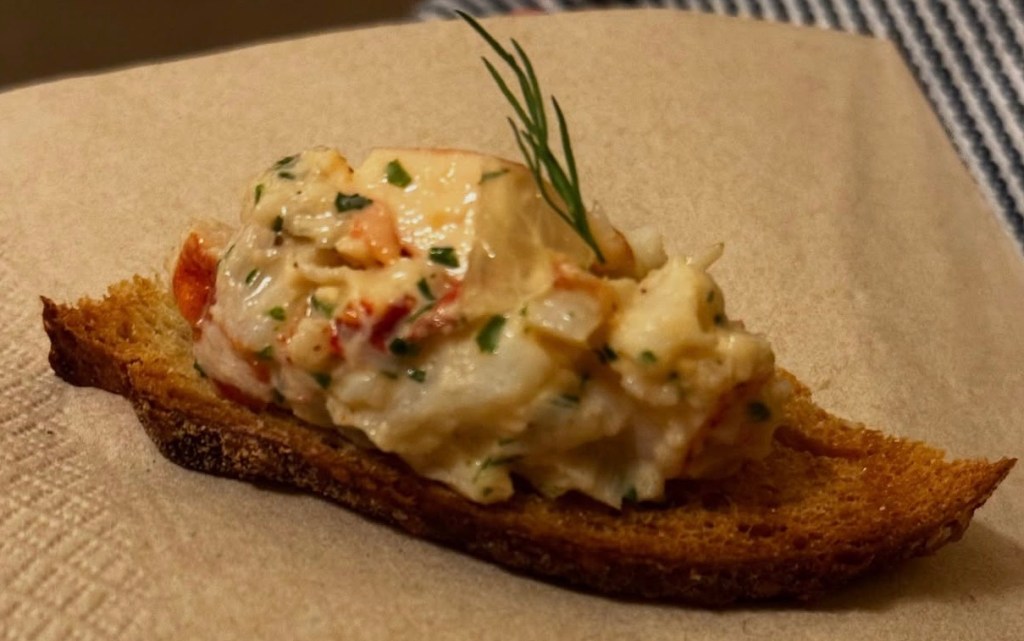
The lobster arrived generously piled onto a small piece of crisp, golden toast, its sweet flesh bound in a rich, creamy dressing with herbs and a little fresh dill, it was an excellent example of why Nathan is so highly regarded for his seafood cookery. There was no unnecessary complication, no elaborate architectural arrangement and certainly no attempt to disguise the principal ingredient.

Just beautiful lobster, thoughtfully prepared, with the toast providing exactly the contrast it needed.

Small enough to eat in a couple of mouthfuls, and good enough to make you wish somebody had produced an entire tray.

Then came the crispy oysters.
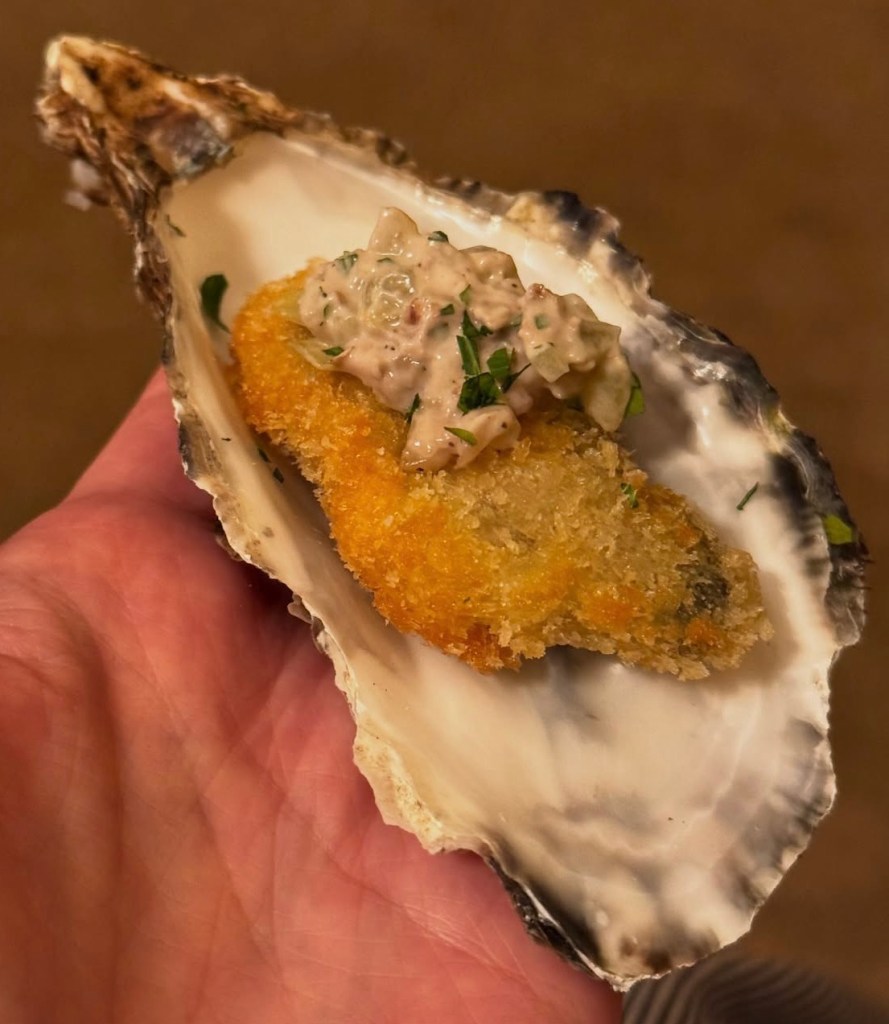
Now, an oyster served raw, with nothing more than a squeeze of lemon or a little mignonette, is a wonderful thing, but not mine!

But this was a rather different interpretation, presented in its magnificent natural shell, the oyster had been coated and cooked to produce a crisp, golden exterior, then topped with a delicate mixture of celery and grapes.

The combination was inspired, and bloody delicious!

Oysters have a distinctive marine richness, and cooking them this way introduces a particularly enjoyable textural contrast: a crisp coating giving way to the tender oyster within and the celery brought freshness and crunch, while the grapes offered little bursts of sweetness and acidity, cutting through the richness.

And serving the whole thing in its own shell was a lovely touch.

The original packaging, as it were.

Biodegradable, attractive, and conveniently designed to prevent the contents escaping, one suspects nature had been considering the hospitality industry long before we arrived.

The opening cocktail listed on the menu was a Raspberry Manhattan, a suitably elegant beginning to what was rapidly developing into a rather promising evening, and then it was time to head through for dinner.

Nathan Outlaw – A Seafood Masterclass Without Leaving the Table

The previous evening, Valentine Warner had introduced us to Kitchen in the Wild with a wonderful opening dinner.

Tonight it was Nathan Outlaw’s turn.

Nathan hardly needs an introduction to anyone with an interest in British seafood cookery. His career has been built around an exceptional understanding of fish and shellfish, developed through years of working with outstanding ingredients and some of the country’s most respected chefs. Having trained at Thanet College, he worked in London before moving to Cornwall, where his time with Rick Stein helped establish the direction his career would take. Interestingly he historically hated seafood, who could tell?

He went on to build his own highly acclaimed restaurants in Port Isaac, earning two Michelin stars for his former flagship Restaurant Nathan Outlaw — a remarkable achievement for a restaurant devoted entirely to seafood. His approach has always appealed to me: allowing superb ingredients to remain the stars of the plate, while bringing tremendous skill and judgement to the accompanying flavours.

There is often more sophistication in knowing what to leave out than in finding another six things to add.

And looking at the evening’s menu, we were in for something special.
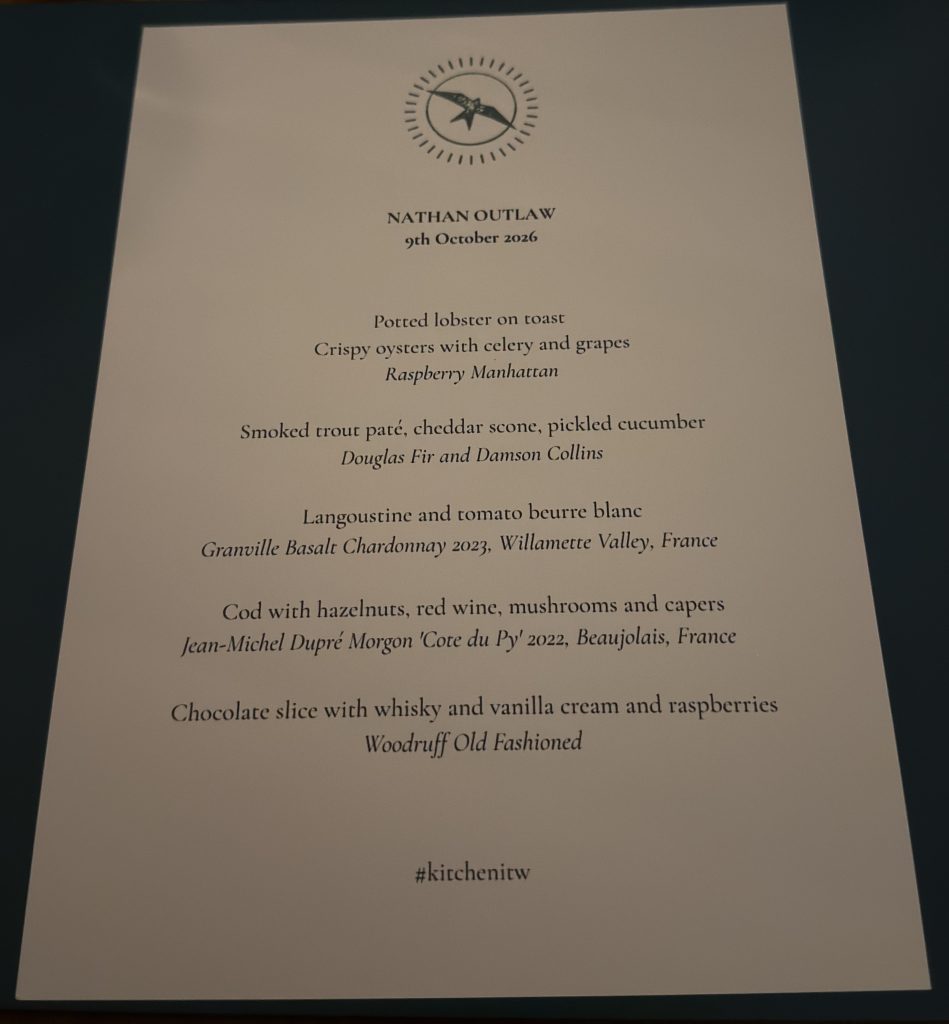
Once again, the dining room looked magnificent, its exuberantly coloured walls and candlelit table providing a wonderfully intimate setting. Menus were waiting at our places, the glasses were ready, and conversation flowed easily around a group that was already becoming increasingly comfortable in one another’s company.

A day’s shared experiences has that effect, particularly when those experiences include being bounced around a Scottish loch in the torrential rain.

Smoked Trout, Cheddar Scone and Pickled Cucumber

The first seated course was smoked trout pâté, cheddar scone and pickled cucumber, an appealing combination of rich smoked fish, savoury cheese and sharp, refreshing pickle. It continued the theme established by the evening’s appetisers: familiar ingredients, treated with care and brought together in ways that made perfect culinary sense.

The accompanying cocktail was a Douglas Fir and Damson Collins.

Douglas fir, with its wonderfully aromatic, resinous character, brought a particularly appropriate sense of the surrounding woodland into the drinks programme, while damson offered the sort of tart fruitiness that works so well in a refreshing Collins. It was a lovely example of how Nick’s approach complemented the setting. The drinks weren’t simply there to accompany the food; they had a personality and sense of place of their own.

And then came a dish I had been particularly looking forward to.

Langoustine and Tomato Beurre Blanc

Langoustines are amongst the finest shellfish found in British waters, sometimes called Dublin Bay prawns or Norway lobsters, they possess a delicate sweetness and firm, succulent flesh, requiring remarkably little intervention when the quality is right.

And this was a beautiful plate.
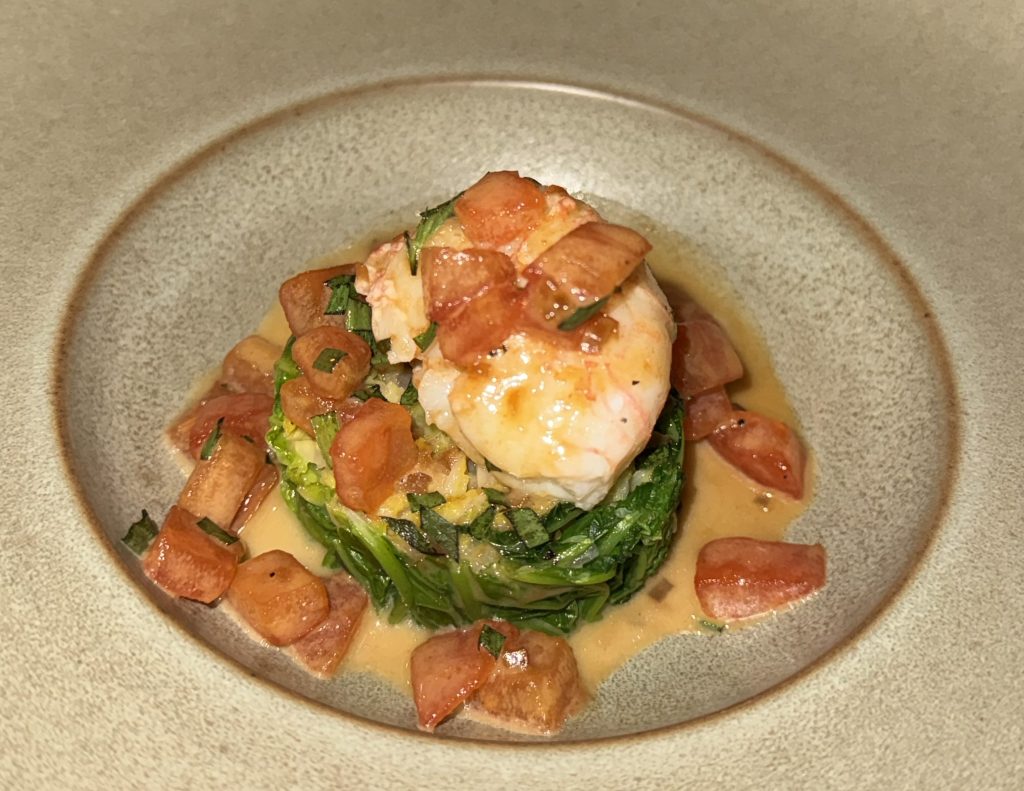
A generous piece of langoustine sat upon a carefully arranged bed of greens, surrounded by a glossy tomato beurre blanc. Small pieces of tomato (concasse), fresh herbs and the rich, pale orange sauce provided an attractive contrast to the langoustine’s delicate flesh.

A beurre blanc is traditionally made by emulsifying butter into a reduction, producing a sauce with richness, acidity and a beautifully silky texture. Here, the addition of tomato gave the classic preparation another dimension, bringing its gentle sweetness and acidity to a dish that was fundamentally about celebrating the langoustine.

And what a lovely balance it was.

The seafood remained the centre of attention, with the sauce providing richness without overwhelming its natural flavour.

A very Nathan Outlaw kind of dish, I thought, elegant, precise and utterly confident.

The printed wine pairing was Granville Basalt Chardonnay 2023, from Oregon’s Willamette Valley, a region particularly celebrated for its cool-climate wines. A fitting accompaniment to such delicate shellfish and a rich butter-based sauce.

Cod, Hazelnuts, Red Wine, Mushrooms and Capers

The next course presented an altogether different side of seafood cookery.

Now, pairing a substantial white fish with red wine might initially appear surprising to anyone brought up on the old convention that fish must always be accompanied by white wine.

Nathan had explained his wish to cook a cod dish, the variety being extremely difficult to get for his restaurants in Cornwall. Cod has a wonderful ability to work with deeper, more savoury flavours, particularly when its flesh is sufficiently thick and carefully cooked.

And Nathan’s dish was a magnificent demonstration.
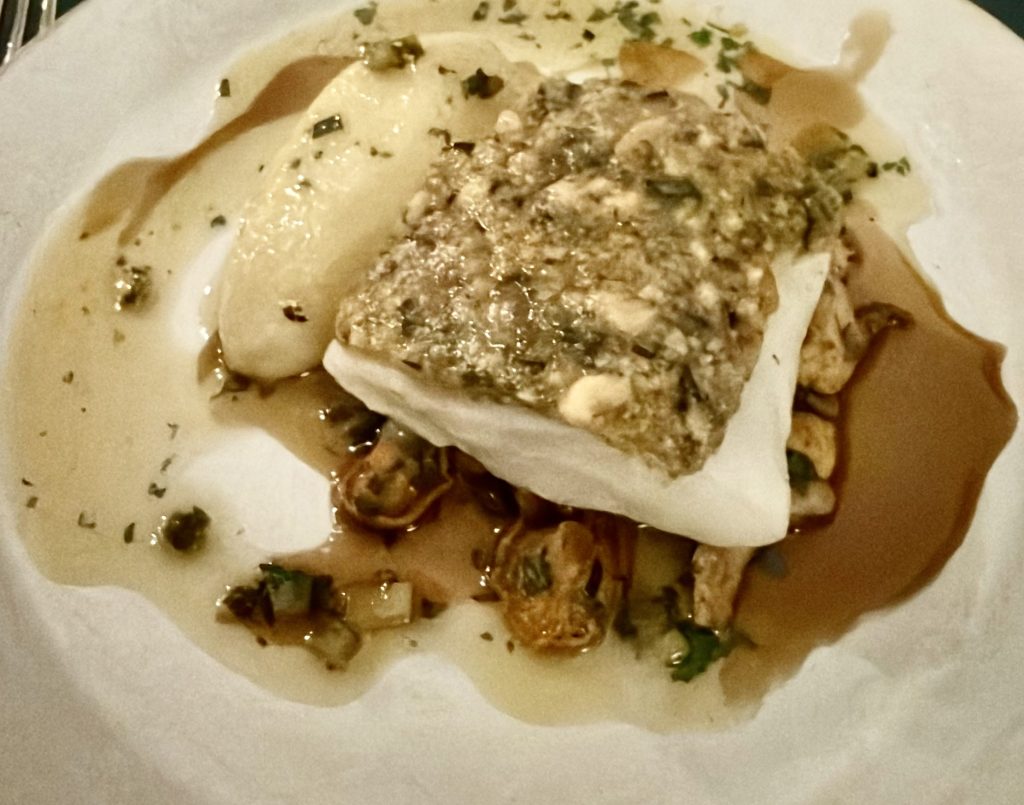
A beautifully cooked piece of cod occupied the centre of the plate, its thick white flakes contrasting with a savoury mixture of mushrooms beneath and a generous coating of finely chopped hazelnuts and herbs. Around it were two sauces: a lighter, buttery element and a deep, glossy red-wine reduction.

The composition was striking.

The hazelnuts introduced a gentle roasted character and subtle texture, while the mushrooms brought an earthy depth. Capers provided their distinctive sharp, salty punctuation, ensuring the dish never became too rich or heavy, and that red-wine sauce gave the whole plate an unexpected sense of warmth and substance.

It was the sort of fish dish that could quite comfortably hold its own against many traditional meat courses.

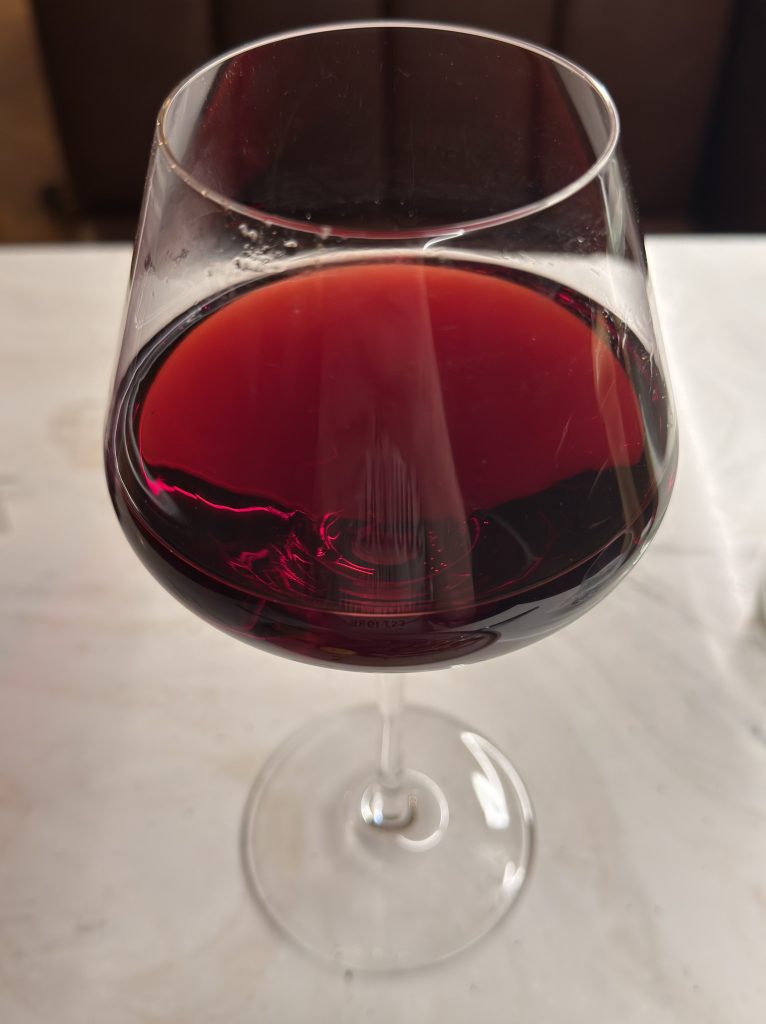
The wine pairing was Jean-Michel Dupré Morgon ‘Côte du Py’ 2022, from Beaujolais. Morgon is one of the region’s celebrated crus, and Côte du Py is particularly associated with structured, characterful Gamay wines.

A red wine alongside cod, scandalous, perhaps, to the more inflexible members of the old wine-and-food establishment, but rather splendid in practice, and a timely reminder that good cooking is not particularly interested in arbitrary rules.

The Man Behind the Menu

One of the pleasures of Kitchen in the Wild is the opportunity to meet the people responsible for creating the food, rather than experiencing their work solely through a restaurant menu.

Nathan spoke to the group during the evening alongside Tim, who has worked for him for over 15 years, and the photograph captures that lovely informal atmosphere: chefs and guests sharing the same space, with the extraordinary mural providing a suitably colourful backdrop.
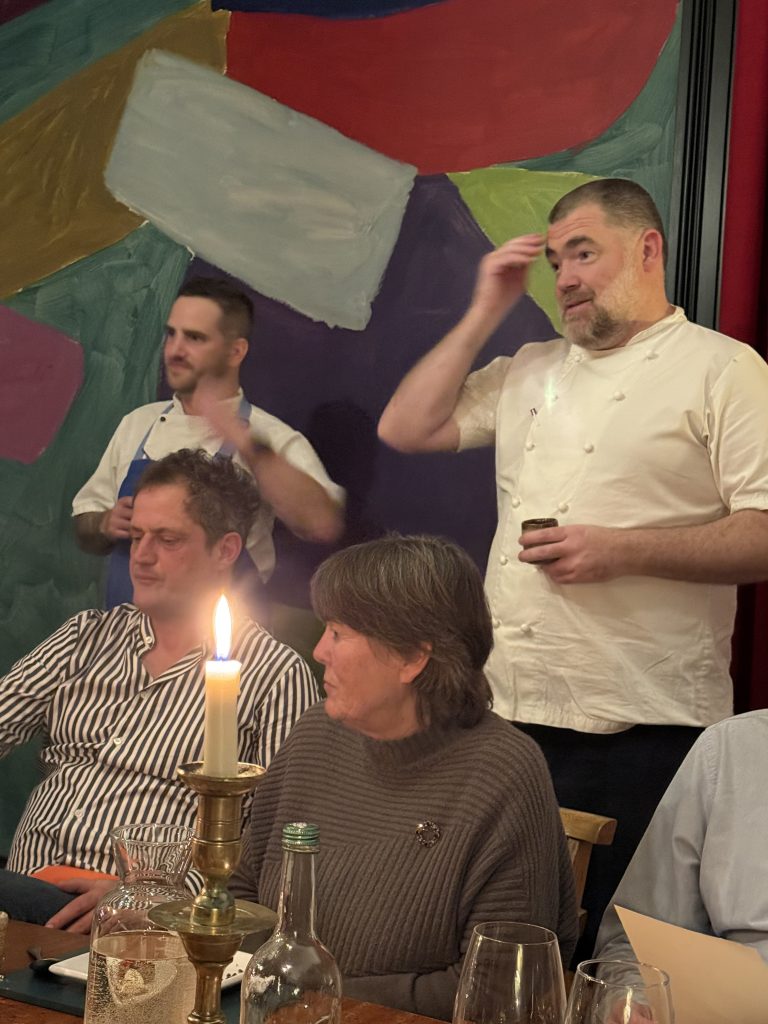
There was an enormous amount of skill involved in delivering an evening like this, and Nathan’s reputation may quite rightly have been a considerable draw, but the execution depended upon a dedicated team of talented chefs and supporting staff, all working together to ensure that each course appeared beautifully prepared and at precisely the right moment.

It is easy, when enjoying a relaxed evening around a candlelit table, to overlook the planning, preparation and sheer hard work taking place behind the scenes, particularly somewhere as remote as Eilean Shona, where forgetting an ingredient is unlikely to be resolved by popping down to the nearest supermarket.

The whole operation appeared effortless, which is, of course, generally a reliable indication that an extraordinary amount of effort has gone into it.

Chocolate, Whisky and a Rather Civilised Conclusion

And finally, dessert.

Chocolate slice with whisky and vanilla cream and raspberries.

A combination that promised richness, a touch of Highland spirit and enough fresh fruit to provide at least a theoretical argument for nutritional balance.
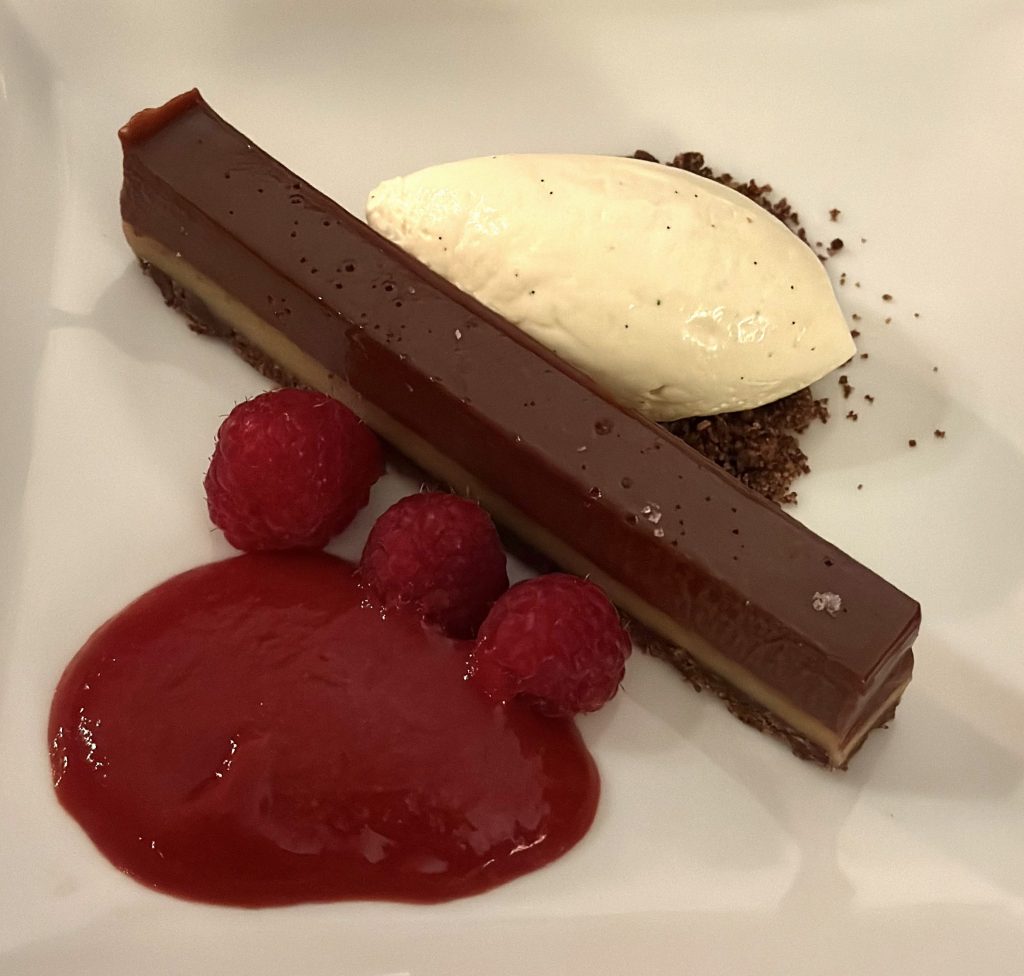
The presentation was beautifully restrained. A long, immaculate slice of chocolate dessert like a strip of Twix bar!, with distinct layers beneath a smooth, glossy chocolate surface, accompanied by a generous quenelle of vanilla cream, fresh raspberries and a vivid raspberry sauce.

The contrast of colours was striking: deep chocolate brown, pale cream and the brilliant red of the fruit, it tasted every bit as indulgent as it looked. The richness of the chocolate was balanced by the freshness and gentle acidity of the raspberries, while the vanilla cream provided a lovely soft counterpoint, whisky added a further dimension to a dessert that was, in all respects, a thoroughly satisfying conclusion to the meal.

And because Nick Strangeway was in residence, dessert was accompanied by a Woodruff Old Fashioned.

Woodruff is a fragrant woodland herb, traditionally appreciated for its sweet, hay-like aroma and subtle vanilla associations, and its inclusion brought another little connection to the surrounding natural world, while the Old Fashioned provided a fitting final expression of the evening’s whisky theme.

A lovely way to finish.

One Very Full Day

By the time we rose from the table, it was well after ten thirty, I’d begun the morning at six, wide awake and far too excited to sleep.

Since then, I’d enjoyed an exceptional breakfast, spent three hours discovering the art of egg tempera with Anna Koska, eaten a magnificent seafood chowder, explored Loch Moidart by RIB through several competing weather systems, attended a whisky cocktail masterclass and finished with a wonderful dinner from one of Britain’s finest seafood chefs.

Not bad for a Friday.

And all of it made possible by a remarkable collection of people, from the celebrated names we’d been so looking forward to meeting to the immensely capable chefs, organisers and island staff quietly ensuring that everything happened as it should. There was a warmth to the whole experience that went well beyond the food, the scenery or the splendid accommodation.

It was the pleasure of being amongst people who loved what they did, generously sharing that enthusiasm with the rest of us. Eventually, it was time to make my way back to Tioram Cottage, where Ruth, Tim and I were staying, and contemplate the prospect of another day.

The itinerary suggested that Saturday would offer a choice of walking or painting, a demonstration from Nathan and, later, a rather intriguing Fire Pit Dinner, I also noticed that the optional morning swim and sauna remained available, and naturally, I gave this some serious consideration.

For approximately the same three seconds as the previous morning.

Breakfast was at 7:30.

Some traditions are worth maintaining.

………………… Until Next Time …………….. L8ers …………………
Day Four – To the Edge of Britain, Then Into the Wild

Thursday 8 October 2026 | Ardnamurchan, Ancient Volcanoes and the Long-Awaited Journey to Eilean Shona

Nineteen Months, Several Guidebooks and a Slightly Excessive Amount of Planning

Thursday morning and the day had finally arrived. After nineteen months of anticipation, countless hours researching Scotland’s history, geography and culinary possibilities, and a considerable amount of time spent wondering whether I really needed another map, today was the day I would finally join Kitchen in the Wild on Eilean Shona. The official rendezvous wasn’t until about 4:00pm, however, which presented something of an opportunity. An entire morning and early afternoon to explore, naturally, I’d planned accordingly.

Those who know me will appreciate that I rarely approach a journey armed with nothing more than a vague sense of direction and a willingness to see what happens. My preparations had involved researching historic buildings, plotting possible routes, investigating ancient settlements, comparing viewpoints and producing my own rather substantial printed travel guide.

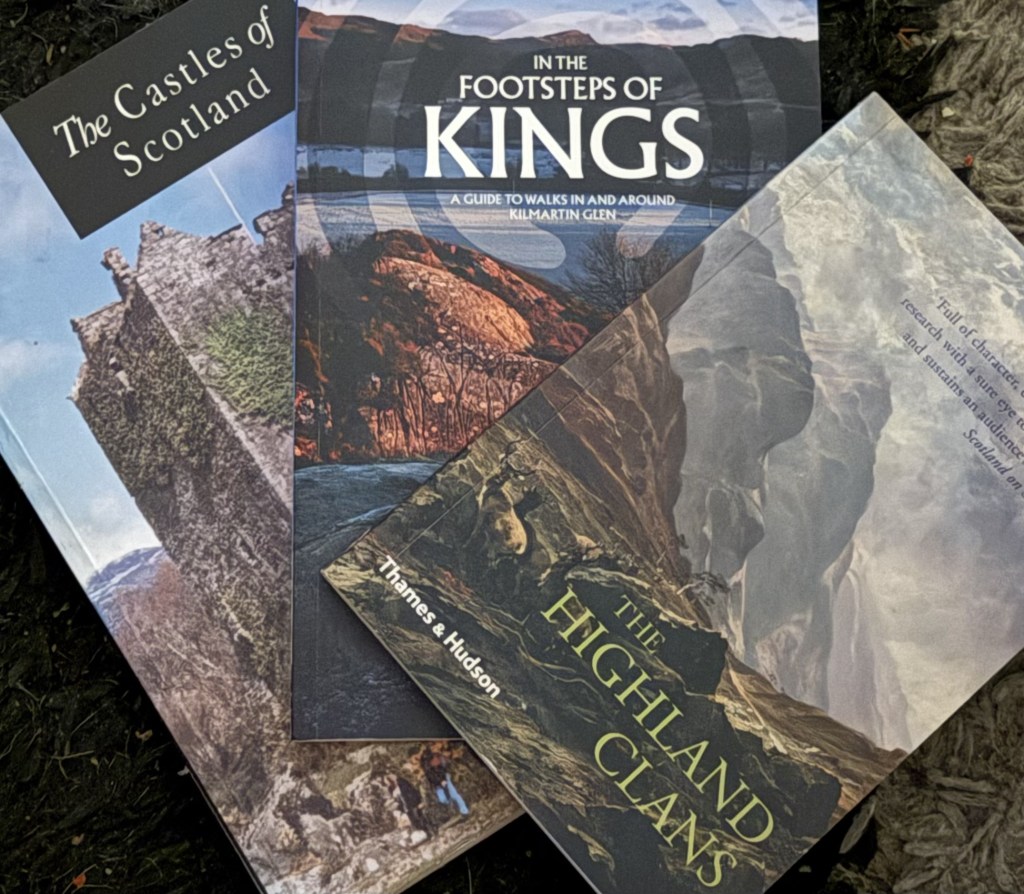
This was supplemented by a small library of Ordnance Survey Explorer maps, several books on Scottish castles, archaeology and Highland history, and enough supplementary reading material to suggest I was preparing for a fairly demanding examination.

I had maps for Monday, Tuesday, Wednesday and Thursday, with routes, diversions and potential stopping points carefully considered.

Whether all this preparation was strictly necessary for a holiday involving a few days of cooking on a remote Scottish island is debatable.

But I’d thoroughly enjoyed putting it together.

And if civilisation collapsed somewhere west of Fort William, I was reasonably confident I could navigate my way to the nearest prehistoric burial cairn to camp up for a few Millenia.

A Morning Worth Getting Up For

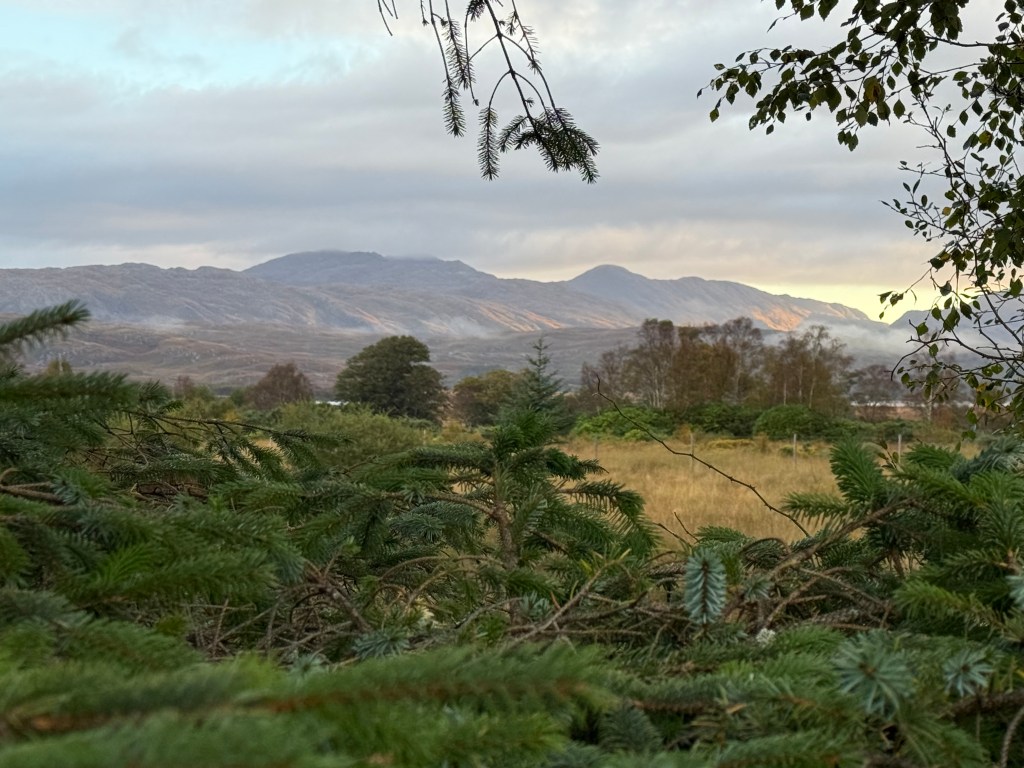
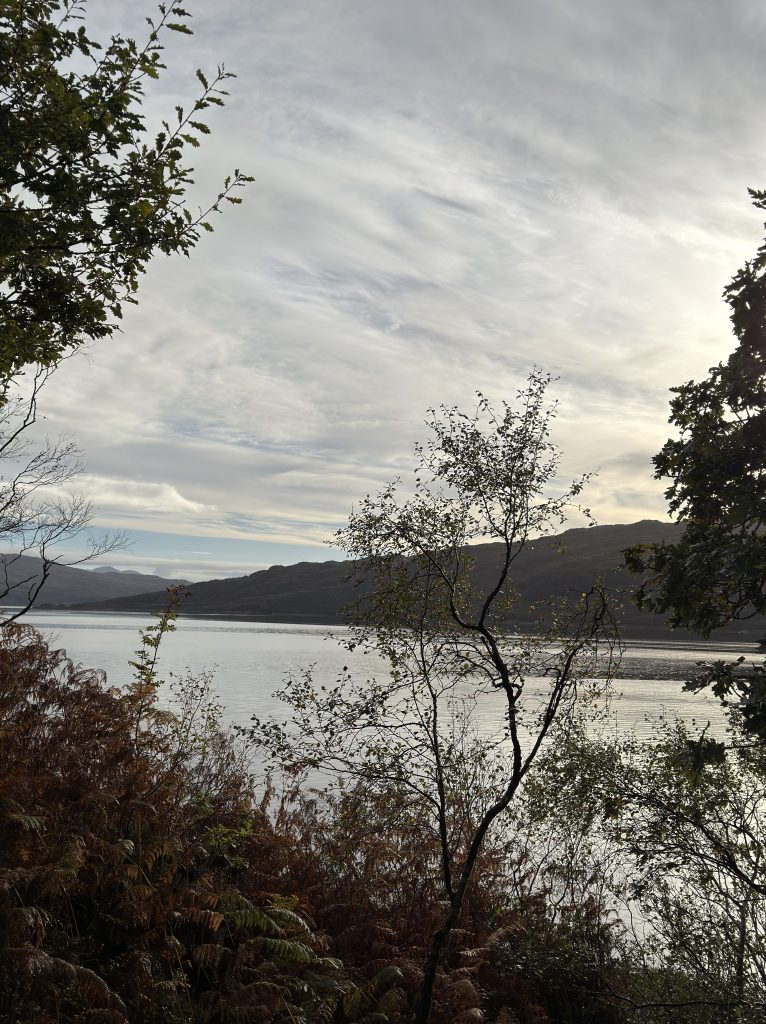
The morning view from Loch Shiel was a considerable improvement on the previous day’s rather enthusiastic rainfall. I went for a walk before breakfast, beyond the foreground of trees and cultivated ground, the hills stretched across the horizon beneath a wonderfully textured sky. Wisps of cloud clung to the higher slopes, while occasional breaks allowed the early light to pick out the folds and contours of the landscape.

It was the sort of view that makes you linger just a little longer before getting into the car.

The day’s principal objective was Ardnamurchan Lighthouse, situated at the most westerly point of mainland Britain.

Getting there involved driving through some exceptionally beautiful countryside, much of it along the sort of roads where passing another vehicle requires a degree of mutual understanding, occasional reversing and a willingness to accept that the person coming towards you might be considerably more confident than you are, but this was precisely why I’d allowed myself the extra days before the island adventure.

The journey was as much a part of the experience as the destination.

Along Loch Sunart – A Landscape With a Fiery Past

Heading west along the Ardnamurchan Peninsula, the scenery began to change once again.

Wooded slopes, sheltered stretches of water and little glimpses of the sea gradually gave way to a more rugged landscape. The road twisted around hillsides, occasionally opening onto magnificent views across Loch Sunart.

There is something rather special about this part of Scotland. It feels increasingly remote without ever becoming monotonous. Every bend seems to reveal another combination of mountains, water, woodland and rocky shoreline.

And there was another reason I’d been particularly interested in making this journey, I was about to drive through the remains of an enormous prehistoric volcano.

Well, prehistoric is rather understating matters.

Approximately 60 million years ago, during the early opening of the North Atlantic Ocean, Ardnamurchan was the site of substantial volcanic activity. As Greenland and Europe began moving apart, molten rock rose through the Earth’s crust, creating a vast volcanic complex. Over millions of years, erosion stripped away much of the original volcano, exposing the remarkable geological structures beneath.

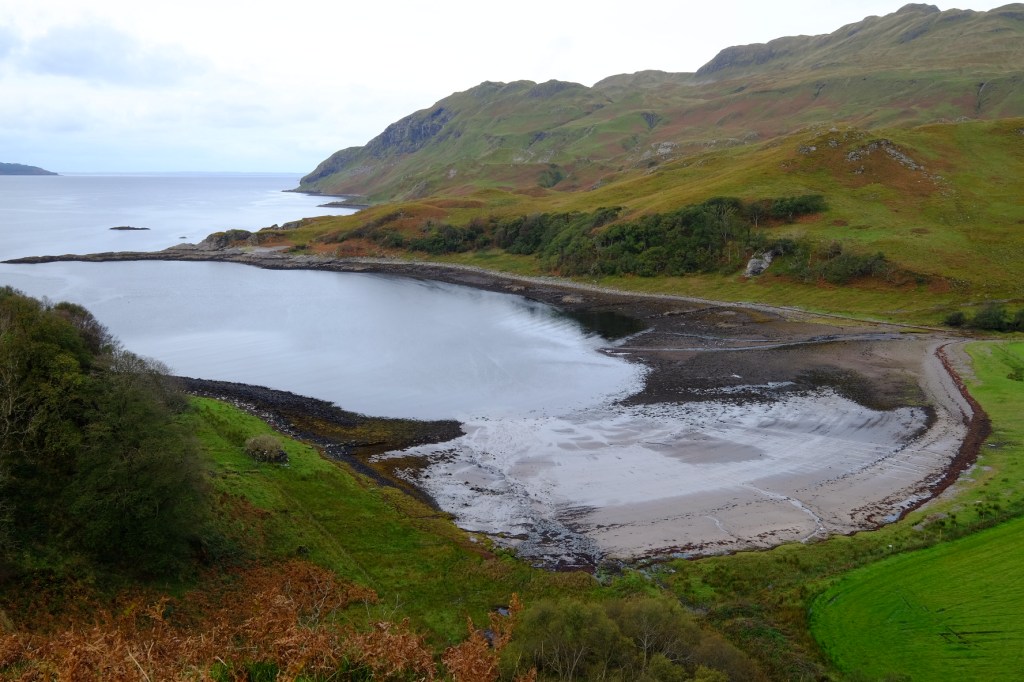
Today, the western peninsula contains one of Britain’s most celebrated examples of a volcanic ring complex: overlapping, roughly circular arrangements of igneous rock formed deep beneath the ancient volcanic system. The landscape I was driving through wasn’t simply picturesque Highland scenery.

It was the deeply eroded plumbing of a volcano.

And after the previous day’s investigation into 5,000 years of human history, I was beginning to appreciate that Scotland could make even the Neolithic seem relatively recent.

Land of the Rings – Ardnamurchan’s Ancient Volcano

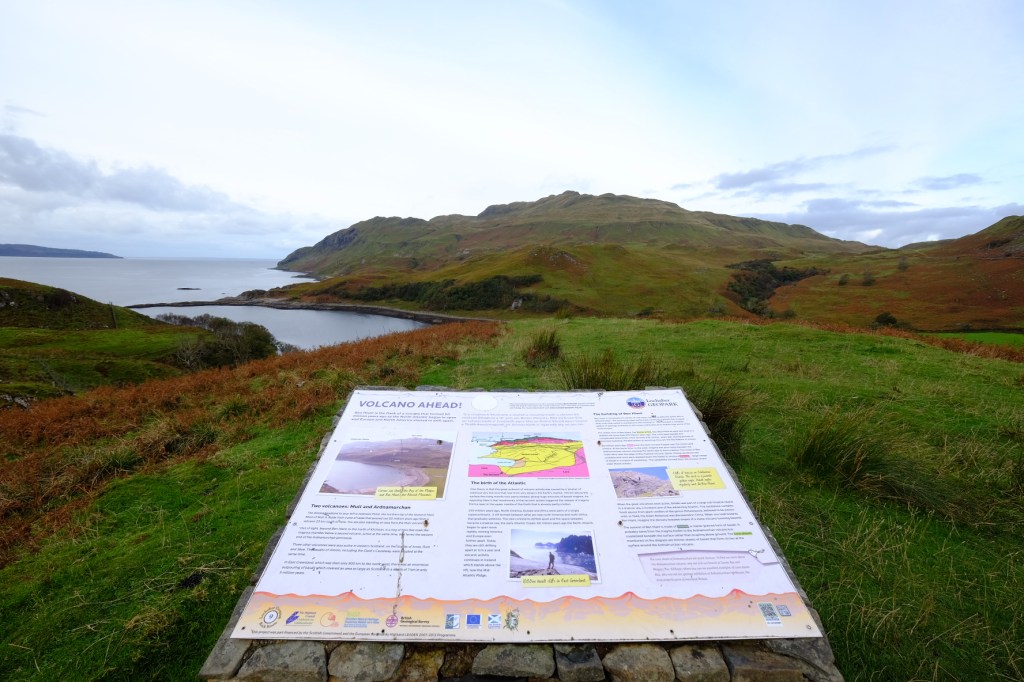
A stop at one of the geological viewpoints offered a particularly good opportunity to understand what I was looking at.

The information panel explained the origins of the surrounding mountains, including the overlapping volcanic centres that make Ardnamurchan internationally important to geologists. Much of the landscape’s distinctive shape is the result of resistant igneous rocks surviving while softer surrounding material was gradually worn away.

The great volcano itself disappeared long ago, but its underlying structures remain written across the hills, it was a stunning view, like all the views on this trip!

Looking out over the landscape, I found it extraordinary to imagine what this place must once have been like. Not quite the peaceful combination of grassy slopes, grazing animals and occasional passing cars that I was enjoying.

More molten rock, violent geological upheaval and generally rather poor conditions for a picnic!

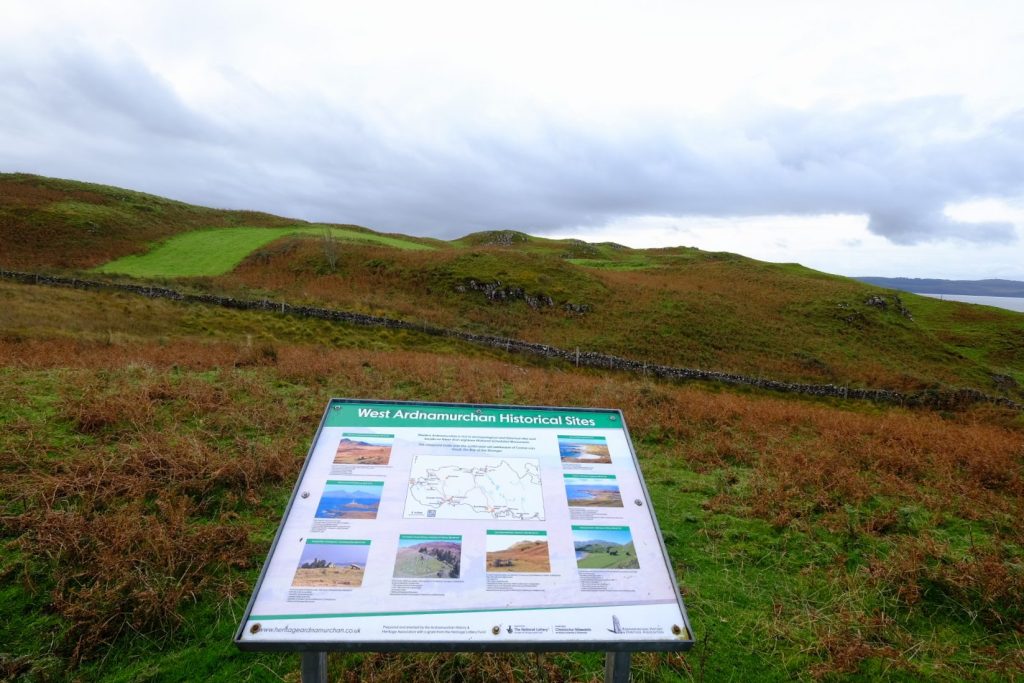
And then there was another rather splendid discovery: a second information board highlighting the archaeological heritage of western Ardnamurchan.

As well as its remarkable geology, this comparatively remote peninsula has evidence of human occupation stretching back thousands of years, including prehistoric remains, burial sites and later settlements.

Following my excursions around Kilmartin Glen, I was particularly pleased to discover that even here, among the remains of an ancient volcano, there were more archaeological possibilities waiting to be investigated, unfortunately, I did have somewhere to be at 4:00pm.

One has to draw the line somewhere.

Ardnamurchan Lighthouse – As Far West As You Can Go

Eventually, the road delivered me to Ardnamurchan Point, and what a place.

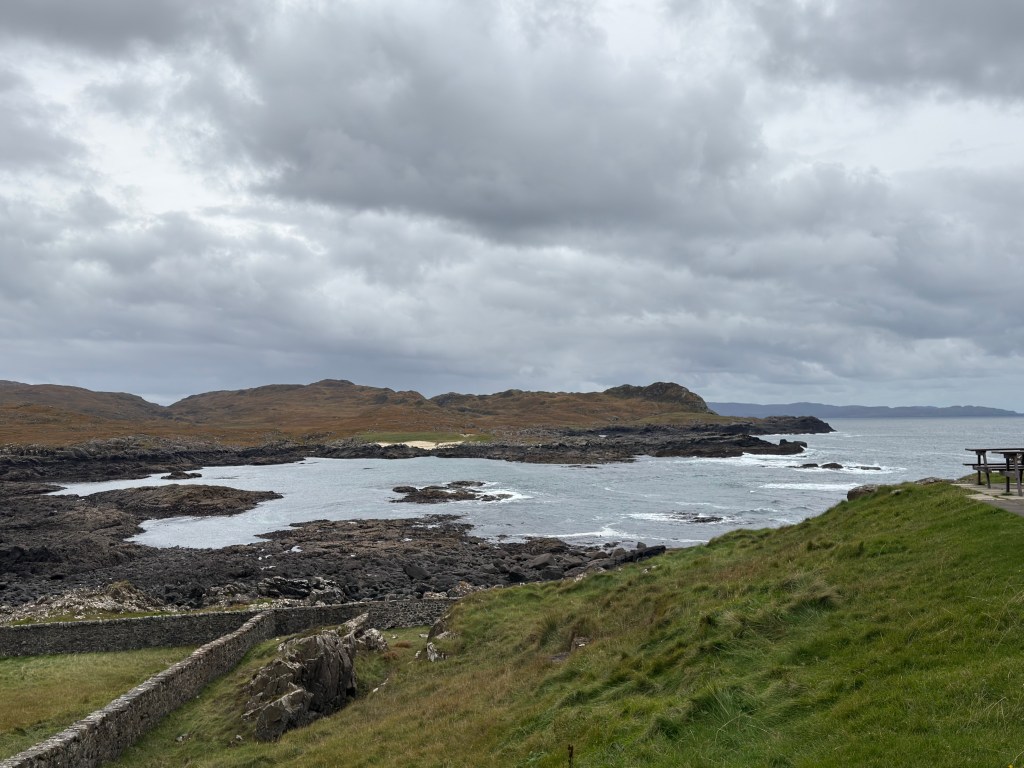
The landscape becomes increasingly exposed as you approach the headland. Trees give way to low vegetation, scattered rocks and open moorland, while the sea begins to dominate almost every direction.

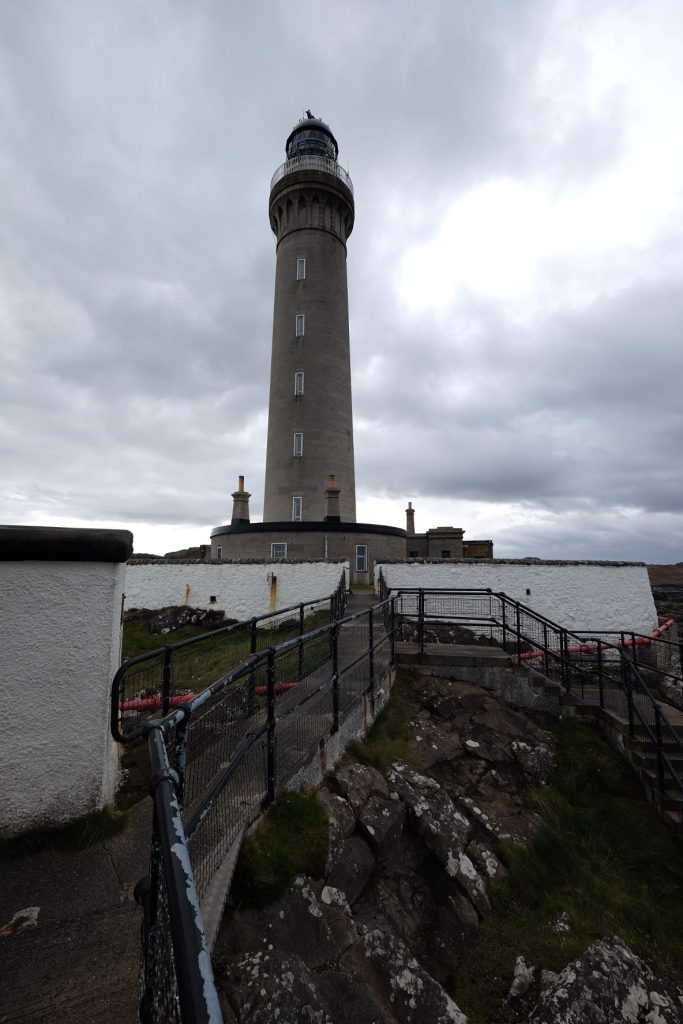
Then, rising above the rocky coastline, stands the magnificent Ardnamurchan Lighthouse.

Completed in 1849, the lighthouse was designed by Alan Stevenson, a member of Scotland’s extraordinary lighthouse-building dynasty and uncle of the author Robert Louis Stevenson. The Stevenson family were responsible for designing many of Scotland’s most important lighthouses, often in extraordinarily difficult and dangerous locations.

Ardnamurchan’s tower stands approximately 35 metres high, constructed from granite quarried on the Isle of Mull. Its architectural design incorporates unusual Egyptian-inspired details, particularly visible around the lighthouse buildings and upper structure, its light was first exhibited on 5 October 1849, meaning my visit came almost exactly 177 years after it first began guiding mariners through these hazardous western waters.

The station’s early years were not without incident. In 1852, a severe storm brought a lightning strike that damaged the tower, shattered windows and tore away sections of the surrounding walls and access road. The lighthouse was eventually automated in 1988, bringing an end to the era of permanently stationed keepers.

Today it remains an operational aid to navigation, watching over one of the wildest stretches of Britain’s coastline, and geographically speaking, *I couldn’t drive much farther west without requiring a boat.

(*Source: Northern Lighthouse Board – Ardnamurchan Lighthouse.)

The View From the Edge

Of course, as impressive as the lighthouse itself is, the surrounding scenery provides an equally compelling reason to visit.

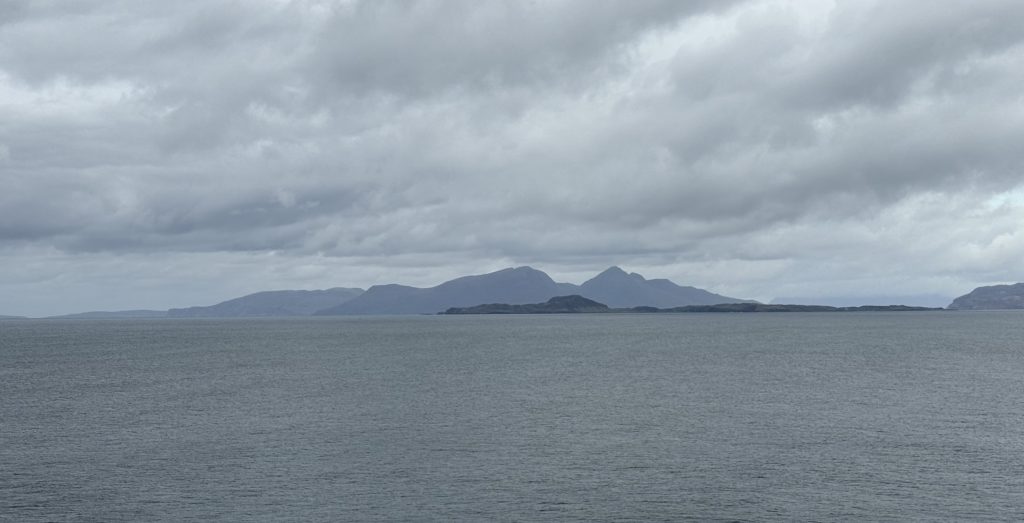
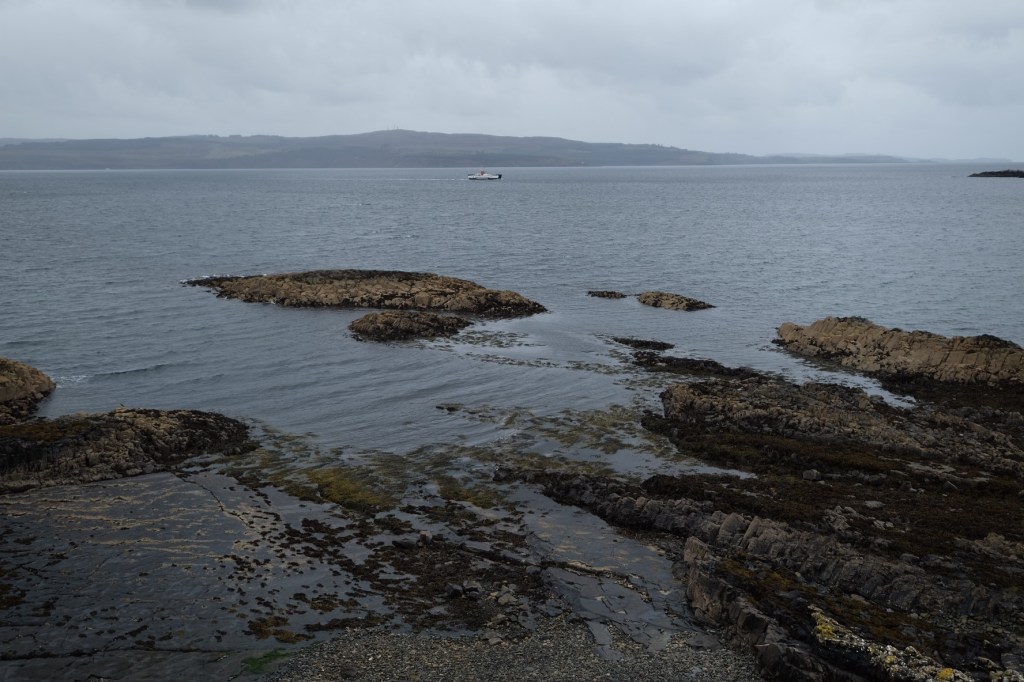
From Ardnamurchan Point, the views stretch across the waters of the Inner Hebrides towards the Small Isles and, in suitable conditions, beyond.

Muck, Eigg, Rum and the distant outline of Skye all form part of this remarkable western seascape.

The weather was doing its usual Scottish best to provide a little of everything.

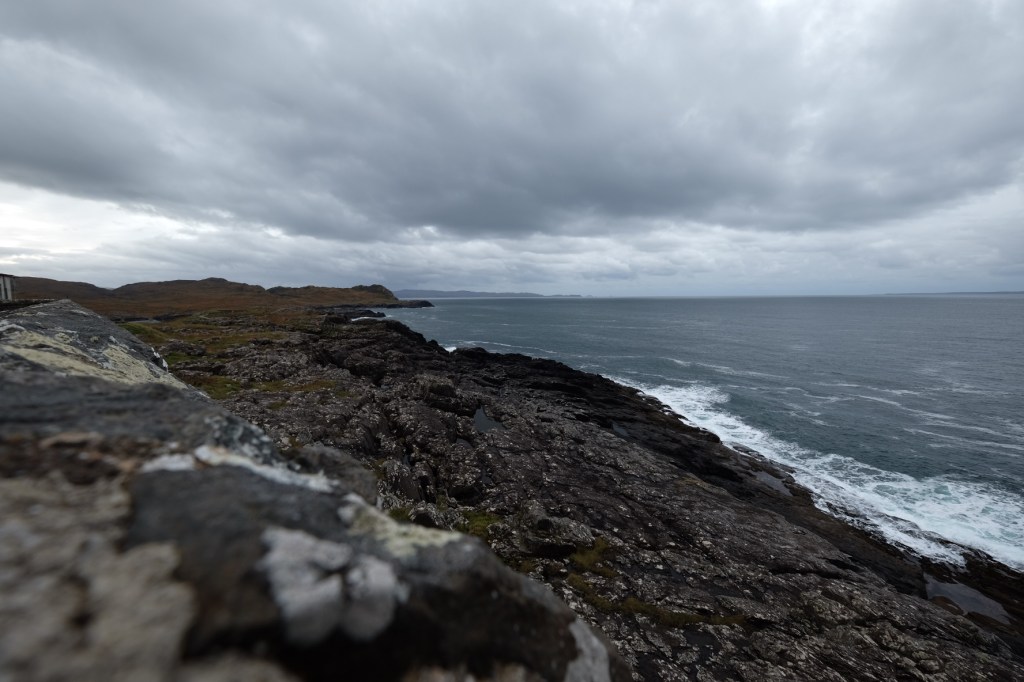
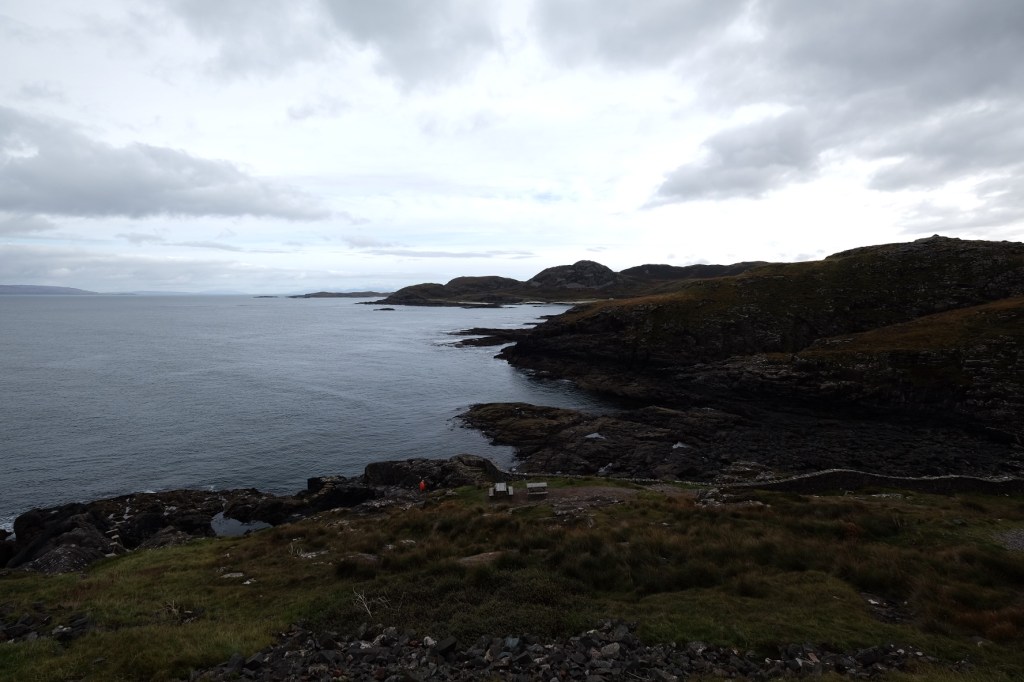
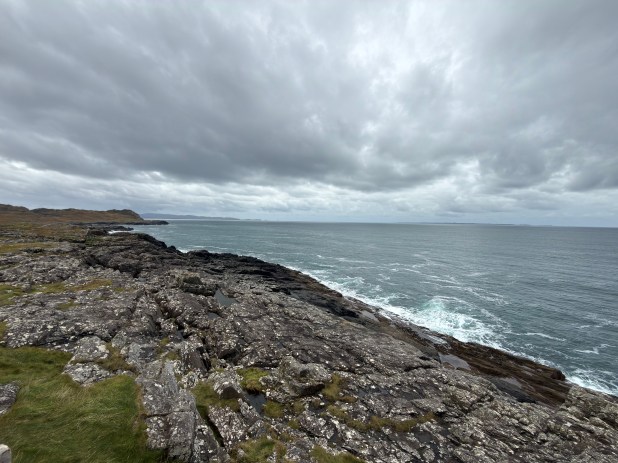
Great banks of cloud gathered over the Atlantic, occasionally allowing shafts of sunlight to illuminate the water. The sea appeared almost metallic beneath the grey sky, while the dark, jagged coastline offered an impressive reminder of the forces that had shaped this headland.

Standing there, I was struck by just how much history had passed through these waters.

For centuries, the western seaways were not barriers separating isolated communities but important routes connecting Scotland, Ireland, the Hebrides and Scandinavia.

Long before modern roads, these islands and coastal settlements were linked by boats carrying people, livestock, trade goods and occasionally considerably less welcome visitors.

Having spent the previous days exploring Viking history, medieval castles and the emergence of the early Scottish kingdoms, it was rather satisfying to look out across the very waters that had helped shape so much of that story.

A spectacular place.

Although perhaps not somewhere I’d particularly fancy being during a February gale.

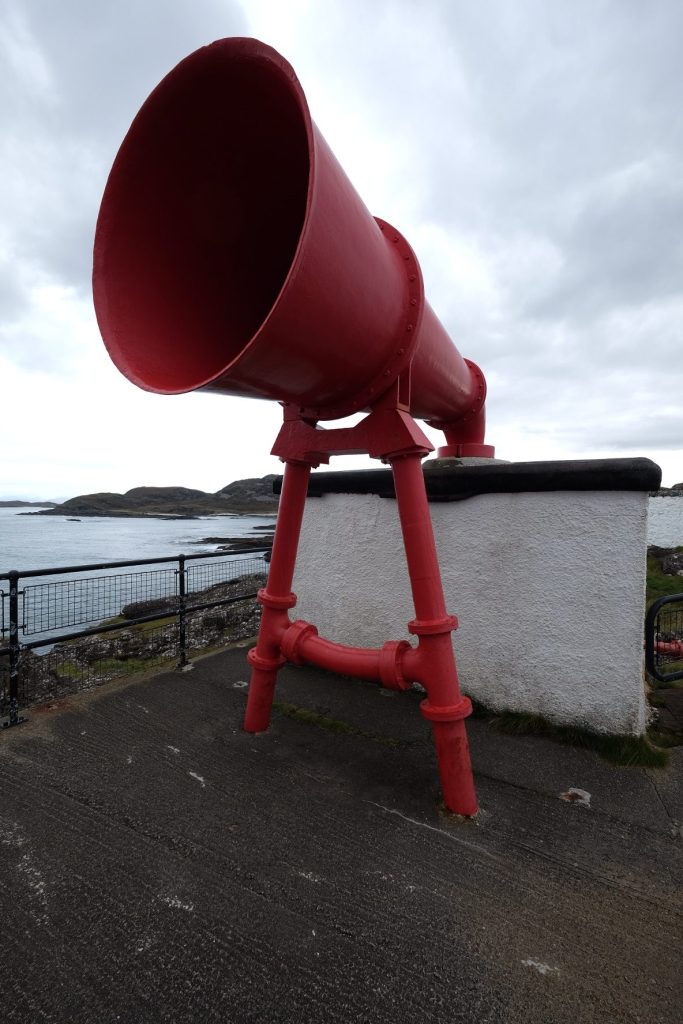
An Enormous Red Foghorn

While exploring the lighthouse complex, I also encountered a wonderfully conspicuous piece of maritime engineering.

The great red horn is a reminder that even the most powerful lighthouse has its limitations. Before modern electronic navigation, fog signals were an essential means of warning vessels approaching dangerous coastlines when visibility was too poor for a light to be seen, and this particular piece of equipment was not exactly designed with subtlety in mind.

It looked rather like an oversized musical instrument constructed for someone with an exceptionally serious disagreement with the neighbours, I was quite relieved it wasn’t demonstrating its capabilities!

Between the remote setting, the engineering, the exposed coastline and the views towards the Hebrides, Ardnamurchan had thoroughly justified the drive.

But there was another place nearby that I’d been keen to see, and it involved rather more sand than I had expected to encounter in the Highlands.

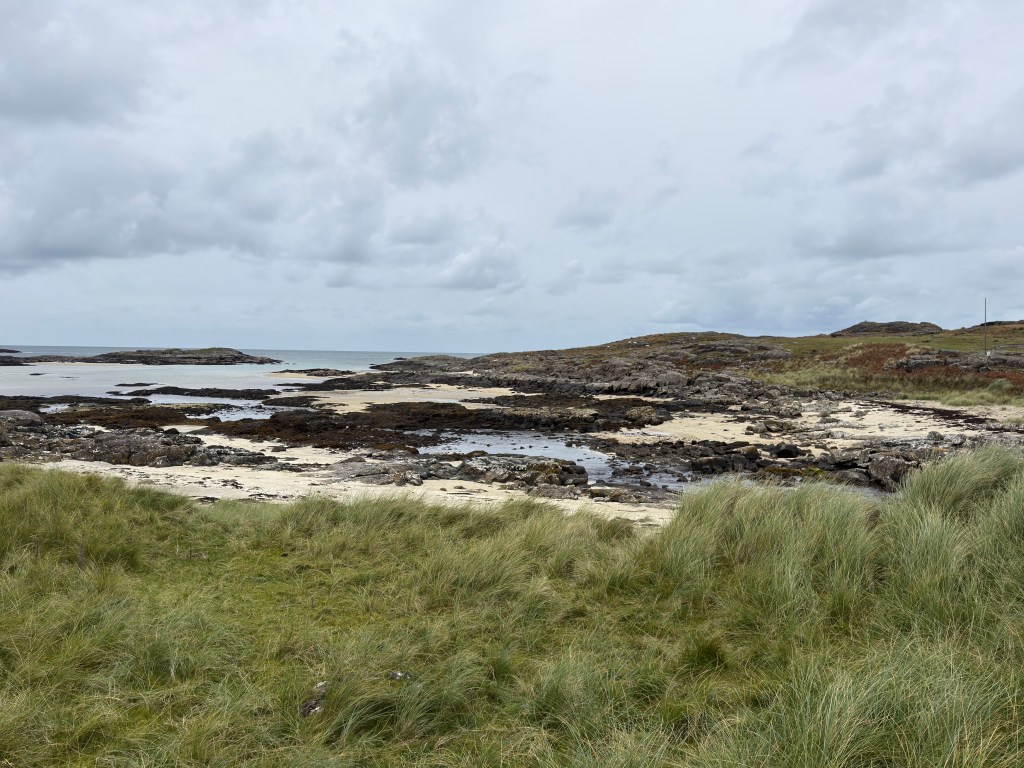
Sanna Bay – An Unexpected Highland Paradise

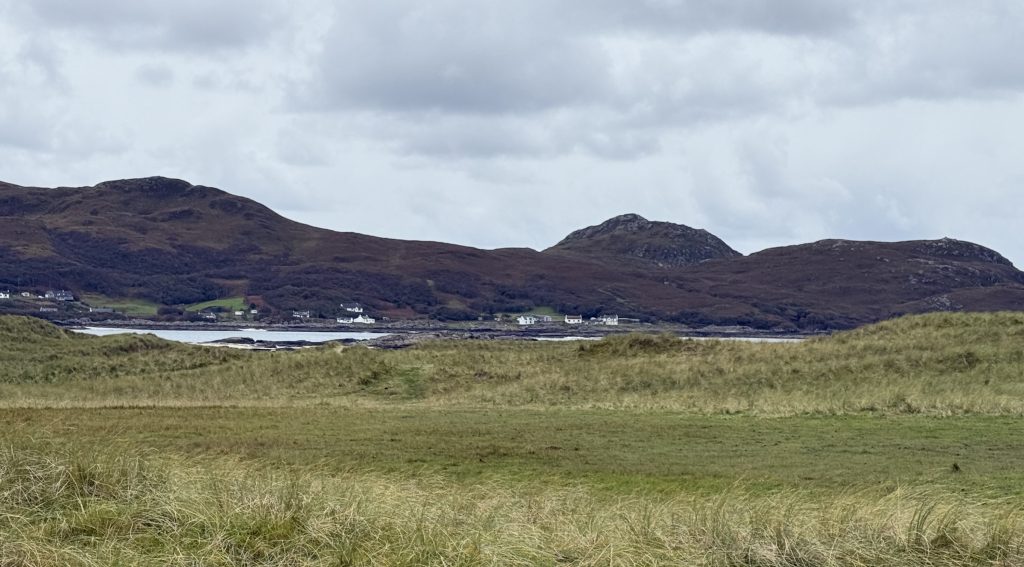
Not far from Ardnamurchan Point lies Sanna Bay, a beautiful stretch of coastline renowned for its pale sand, dunes and remarkable views towards the Small Isles. The surrounding area forms part of the ancient volcanic landscape, and the contrast between the dark, rugged hills and the lighter coastal scenery is particularly striking.

There is something almost improbable about finding beaches like these so far north, in fact on a bright summer’s day, the photographs could easily be mistaken for somewhere considerably warmer.

The surrounding landscape, however, is unmistakably Scottish: open hills, exposed rock, sweeping skies and the ever-present possibility that the weather might change its mind without consulting anyone.

What I particularly enjoyed about this part of the journey was the sheer variety.

Within a relatively short distance, I’d encountered ancient volcanic structures, historic coastal settlements, magnificent island views, secluded bays and one of Britain’s most remarkable lighthouses.

All on a Thursday morning, and all before lunch.

It was almost enough to make my extensive itinerary seem entirely reasonable.

The Return Journey – Priorities, Priorities

Unfortunately, time was now becoming a consideration. Kitchen in the Wild was due to begin at 4:00pm, and although I was thoroughly enjoying my explorations, I still had to retrace much of the peninsula before heading towards the Eilean Shona departure point.

The road back was every bit as enjoyable as the outward journey.

There is something rather wonderful about travelling the same Highland road in the opposite direction. Features you hadn’t noticed suddenly become obvious, familiar views take on an entirely different character, and occasionally the clouds part to reveal an entirely new landscape.

The sheltered waters of Loch Sunart gradually came back into view, its wooded slopes descending towards the shoreline, and somewhere along the way, I decided it was time for a cup of tea, not that I was particularly desperate for refreshment, you understand.

But I had spotted somewhere rather promising during my research.

An Excellent Discovery – The Lochview Tearoom

The Ardnamurchan Natural History Visitor Centre was an ideal place to break the return journey.

Situated near Glenborrodale, overlooking Loch Sunart, the centre celebrates the remarkable wildlife and natural environment of this remote peninsula.

Ardnamurchan is home to an extraordinary variety of species, including red deer, otters, pine martens, golden eagles and white-tailed sea eagles. Its ancient Atlantic oakwoods, sheltered lochs and rugged coastline provide some of the finest wildlife habitats in western Scotland. All thoroughly fascinating, of course, but my immediate attention was drawn to the Lochview Tearoom.

After several hours exploring windswept headlands, volcanic landscapes and historic maritime engineering, I felt I’d earned something considerably more civilised.

Tea.

And cake.

Specifically, an absolutely magnificent date, banana and walnut cake.

Moist, rich and wonderfully satisfying, with the natural sweetness of the fruit and the welcome texture of walnuts, it was exactly the sort of homemade cake that makes you reconsider whether a single slice is an adequate serving. It was delicious, that good I forgot to take a picture like I would usually do!

Indeed, had I not been expected elsewhere that afternoon, there was a reasonable chance I might have ordered another and spent the rest of the day investigating the establishment’s other baked offerings. A cup of tea, an excellent piece of cake and a beautiful Highland setting.

Sometimes the simplest stops turn out to be among the most enjoyable.

Suitably refreshed, it was time to resume the journey, I had an island to catch.

Towards Loch Moidart – The Final Miles

The remaining drive carried me away from the relative familiarity of Loch Sunart and towards the quieter roads leading to Loch Moidart, once again, the landscape changed.

Woodland gave way to open moorland, with rusty autumn bracken spreading across the hillsides. Occasional stretches of water appeared between the trees, while low mountains formed a seemingly endless succession of ridges along the horizon.

This was the Scotland I’d been hoping to find when I first began planning the journey. Not the grand tourist attractions or famous viewpoints, wonderful though those had been, but the quieter places in between. Little roads, isolated stretches of coastline and scenery that seems entirely unconcerned with whether anyone is there to admire it.

And somewhere ahead lay Eilean Shona.

The island that had started this entire adventure.

Nineteen Months Later – The Eilean Shona Jetty

Eventually, I arrived at the mainland departure point for Eilean Shona, near Dorlin on Loch Moidart, there was something wonderfully appropriate about the location. No bustling ferry terminal, enormous departure lounge or queue of cars waiting to board.

Just a small jetty, wonderfully peaceful surroundings and the waters of Loch Moidart stretching towards the island.

Eilean Shona is a private, car-free island of approximately 2,000 acres, with woodland, rocky coastline, sheltered beaches and a fascinating history of its own. Perhaps its most famous literary association is with J. M. Barrie, who rented the island in the 1920s. It is frequently associated with the imaginative world of Peter Pan, although the famous play itself predates Barrie’s visits.

The island’s great attraction is its relative isolation. Accessible by boat, without public roads or the usual trappings of modern tourism, it offers an opportunity to experience an increasingly rare combination of wilderness, tranquillity and genuine escape.

And for the next few days, it would also become the setting for something rather special.

Kitchen in the Wild.

The whole reason I’d started planning this adventure in the first place.

Espresso at the Jetty – The Outin Makes Another Appearance

Having arrived in good time, I found myself with a little while to wait before everyone gathered for the transfer, which presented an obvious opportunity. Out came the Outin portable espresso machine once again.

After its successful inaugural field test at Rest and Be Thankful, the little rechargeable device was rapidly establishing itself as one of my more inspired purchases. Water, a GRIND coffee capsule, a press of the button and a few moments later I had a freshly extracted espresso.

No café required, no electricity socket, no need to ask whether anyone had oat milk, just a decent coffee, a quiet Highland jetty and the prospect of finally reaching an island I’d been looking forward to visiting for nineteen months.

I was beginning to think this little machine might become a permanent travelling companion.

The Guests Begin to Arrive

Gradually, the quiet jetty began to acquire a little more activity. The other guests started arriving, bringing luggage, introductions and the unmistakable atmosphere of people who were about to embark upon something they had all been looking forward to. This was the moment when the trip began to feel quite different.

For the previous three days, I’d been travelling extensively, following my own itinerary and indulging whatever historical, geographical or culinary diversion happened to catch my attention.

Now I was meeting the people with whom I’d be sharing the next stage of the adventure, but there was one small complication.

I’m absolutely hopeless with names!

Faces? Usually fine.

Conversations? No problem.

But introduce me to several people in quick succession and I can almost guarantee that by the time the fourth person has told me their name, the first three have disappeared into some inaccessible filing cabinet within my brain. I can, apparently, retain obscure details about a sixth-century Scottish saint, the construction of a Victorian lighthouse and the geological origins of a 60-million-year-old volcano.

But remembering the name of someone I’ve just shaken hands with? Entirely different proposition.

Still, everyone seemed extremely enthusiastic, the introductions were underway and there was that lovely shared sense of anticipation which comes when a group of relative strangers gathers for a common adventure. After all, we had something rather important in common.

An appreciation of good food, beautiful surroundings and the opportunity to experience something a little out of the ordinary.

The Adventure I’d Actually Come For

Standing beside Loch Moidart, I found myself reflecting on just how much had happened since arriving in Scotland.

Glasgow’s extraordinary history, Bombay-inspired breakfasts, medieval cathedrals, ancient burial chambers, prehistoric animal carvings, standing stones, magnificent castles, Highland roads, excellent seafood, questionable lunch arrangements, an Italian sandwich that had more than compensated for them, and now a journey to the very western edge of mainland Britain.

I’d certainly made the most of those extra days, but this was where the original adventure truly began.

The maps had served their purpose. The guidebooks had been consulted, the diversions enjoyed and the hire car had transported me safely through an impressive selection of Scottish roads. Now it was time to leave all that behind.

Ahead lay several days of island life, exploring, eating and, I hoped, making some new friends. The boat would take us across Loch Moidart towards Eilean Shona, where the Kitchen in the Wild team was preparing to welcome us.

Nineteen months of waiting had finally come down to this.

One small jetty.

A gathering of enthusiastic strangers.

A collection of bags.

And one last espresso.

Kitchen in the Wild, Scotland 2026.

At last.

Although, before we departed, I really ought to have made another attempt at remembering everyone’s names…

A Little Bombay Before Several Thousand Years of Scotland (Part 2)

Day Two – Bombay Breakfast, Vikings and the Road to Ancient Scotland

After a thoroughly enjoyable first evening in Glasgow, Tuesday morning arrived, and with it the prospect of finally putting my meticulously researched Scottish itinerary into action. First, however, there was the rather important matter of breakfast.

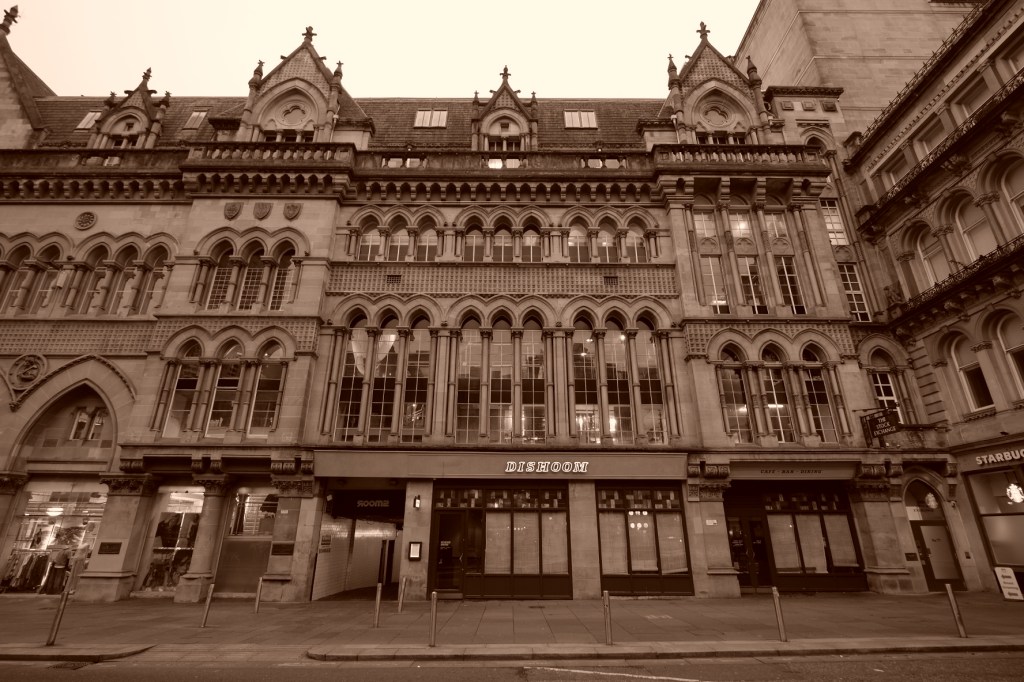
I’d already earmarked Dishoom, conveniently located around a 10-minute walk from the AC Hotel by Marriott. Their Bombay-inspired breakfast offering had caught my attention during my pre-trip research, and I thought it would make a splendid start to the day. I had purchased the book by the same title some time back and was thoroughly inspired by the stories within.

A little Indian influence in Scotland before heading off in search of prehistoric burial chambers, ancient standing stones and centuries of clan warfare. Why not?

Dishoom occupies part of Glasgow’s magnificent former Stock Exchange building, an extraordinary piece of Victorian architecture that makes quite an impression before you’ve even stepped through the door.

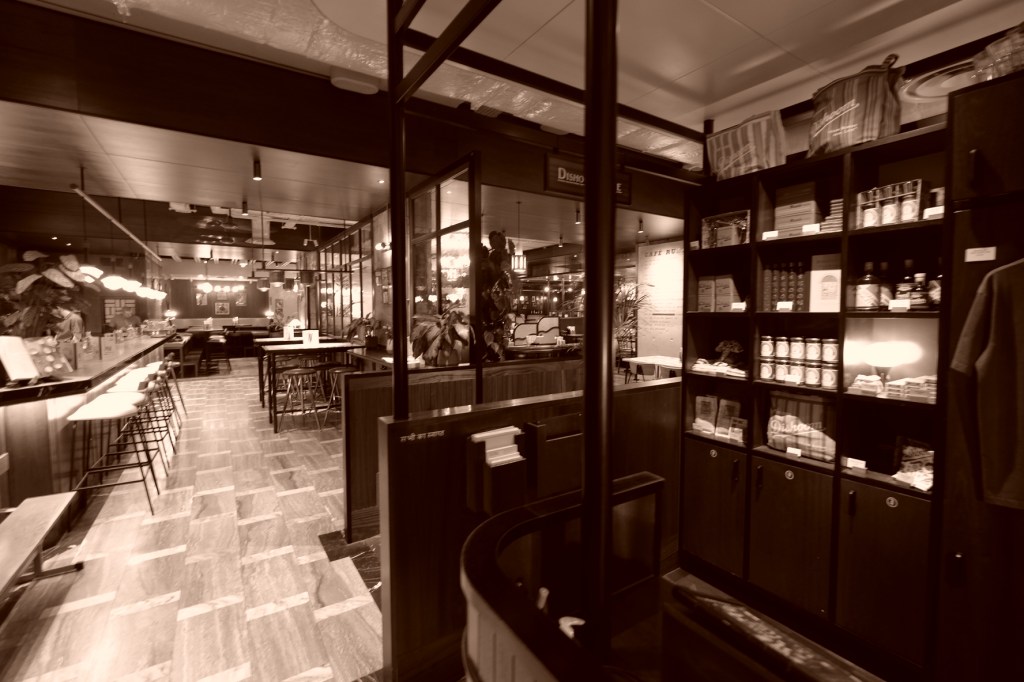
Inside, the atmosphere was warm and inviting, with its wonderfully eclectic mixture of old-fashioned furniture, patterned tables, framed photographs and the unmistakable character of a Bombay café.

Dishoom draws its inspiration from the Irani cafés that became such an important part of Bombay’s social and culinary history. Established largely by Persian immigrants, these were places where people from different communities and backgrounds could gather over tea, food and conversation. Once numerous, the original cafés have steadily declined in number, making Dishoom’s affectionate interpretation of them rather appealing. It certainly made a change from the usual hotel breakfast buffet.

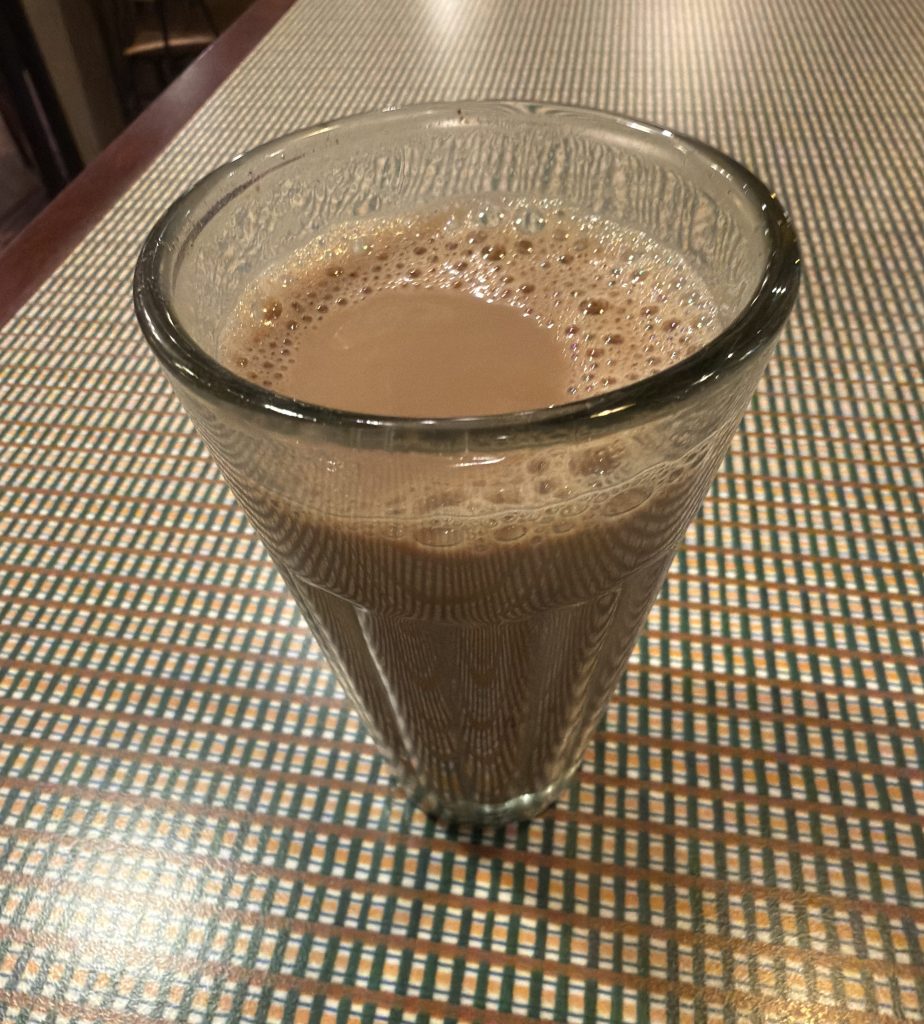
Naturally, there had to be chai.

Served in a simple glass, rich, warming and beautifully aromatic, it was just the thing to get the morning underway. There’s something wonderfully comforting about Indian chai, the combination of strong tea, milk, sweetness and warming spices producing a drink that feels considerably more indulgent than an ordinary cup of tea.

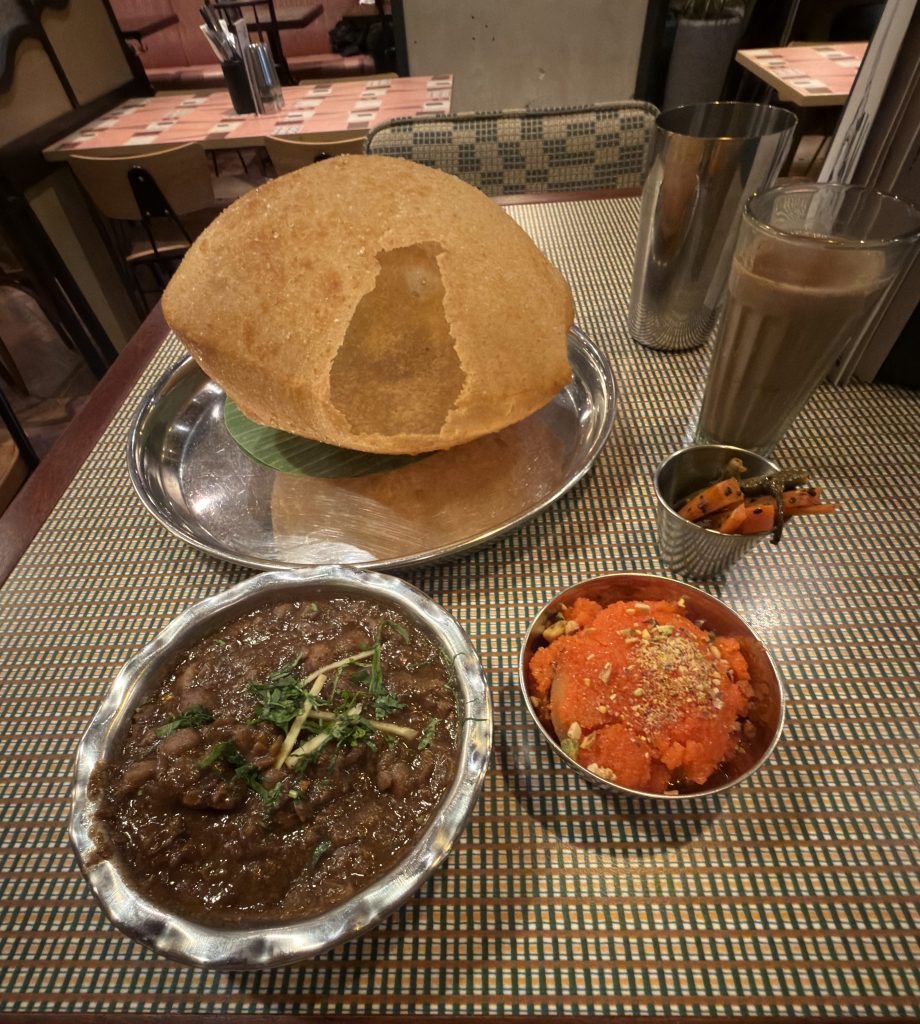
Breakfast itself was a wonderfully colourful affair. A richly spiced chickpea preparation, accompanied by a magnificent puffed puri, pickles and a portion of sweet halwa, Chole Puri Halwa, the chef’s favourite according to the menu.

The puri was quite a spectacle, arriving inflated like an edible balloon, its delicate golden shell practically demanding to be broken into.

The combination of savoury, spicy and sweet made for a rather interesting start to the day. A little of the chickpea curry scooped up with the bread, followed by something sweeter, another sip of chai, and suddenly the prospect of an ordinary bowl of cornflakes seemed deeply uninspiring.

Suitably fortified, it was time to turn my attention from Bombay to something rather older, as I was leaving a pristine paper cup was thrust in my hand, Chai to take-away, now that was service.

Glasgow Cathedral – Where the City’s Story Began

Suitably fortified by my rather splendid breakfast at Dishoom, it was time to check out of the hotel and get the adventure properly underway. A swift checkout was followed by the slightly less swift process of extracting the hire car from the multi-storey car park, whose narrow ramps and unforgiving concrete walls seemed designed to test both my driving skills and the limits of the rental insurance.

Car and driver eventually emerging unscathed, I set off for my next destination: Glasgow Cathedral.

This was somewhere I’d particularly wanted to explore. My pre-trip research into Scotland’s religious history, folklore and considerably darker past had revealed that Glasgow’s magnificent medieval cathedral had rather more stories to tell than its imposing architecture alone might suggest.

The cathedral is dedicated to St Kentigern, better known as St Mungo, Glasgow’s patron saint and a man whose story is an intriguing mixture of early Christianity, royal scandal and some fairly improbable miracles.

According to tradition, Mungo was born around the sixth century, the son of Princess Teneu (also known as Thenew), daughter of a British king, and a nobleman named Owain. His arrival into the world was apparently not universally celebrated. His mother, having become pregnant outside marriage, was condemned by her father and, according to later accounts, cast adrift in a boat without oars. Against considerable odds, she survived, eventually reaching the Firth of Forth, where Mungo was born.

Not perhaps the most conventional start to a distinguished ecclesiastical career.

The young Kentigern was subsequently raised under the protection of St Serf, traditionally associated with Culross, who is said to have given him the affectionate name Mungo, commonly interpreted as ‘dear one’.

He eventually travelled west, establishing a Christian community beside the Molendinar Burn, on the site associated with today’s cathedral. Around this early religious settlement, a community developed that would, over the centuries, become the great city of Glasgow.

But it’s the legends surrounding Mungo that make him particularly interesting.

His exploits are immortalised in Glasgow’s coat of arms, which features four rather unusual symbols: a bird, a tree, a bell and a fish carrying a ring in its mouth.

The bird represents a robin supposedly restored to life by the young Mungo after it had been killed by jealous fellow pupils. The tree recalls an occasion when he miraculously rekindled a sacred fire using a branch after the original flames had been extinguished. The bell is associated with his religious authority and a traditional story connecting it to Rome.

Then there’s the fish.

According to the legend, a queen of Strathclyde had lost a precious ring, which her suspicious husband subsequently demanded she produce. With her position becoming increasingly uncomfortable, she appealed to Mungo for assistance. He instructed a fish to be caught from the River Clyde, and there, rather conveniently, in the mouth of a salmon, was the missing ring.

A remarkable piece of divine intervention, although one suspects the salmon might have had a slightly different interpretation of events.

These stories survive largely through medieval religious biographies, most notably one written by Jocelin of Furness in the twelfth century, some 500 years after Mungo’s lifetime. They’re wonderful examples of Scotland’s early Christian folklore rather than events we can confidently establish as historical fact.

What is far more tangible is the magnificent cathedral itself.

Mungo is traditionally believed to have been buried here around AD 612, and his shrine became an important destination for medieval pilgrims. The great Gothic building we see today was developed largely during the twelfth and thirteenth centuries, with Bishop Jocelin initiating major expansion work in 1181.

Remarkably, Glasgow Cathedral is the only medieval cathedral on the Scottish mainland to have survived the Reformation with its principal structure intact, although its Catholic furnishings were subsequently removed.

So here I was, standing in a building whose origins stretched back to a sixth-century saint, whose supposed miracles still decorate the city’s official coat of arms, and whose final resting place helped give birth to Glasgow itself.

Not bad for a man whose career apparently began with resurrecting a robin.

And what a building it is.

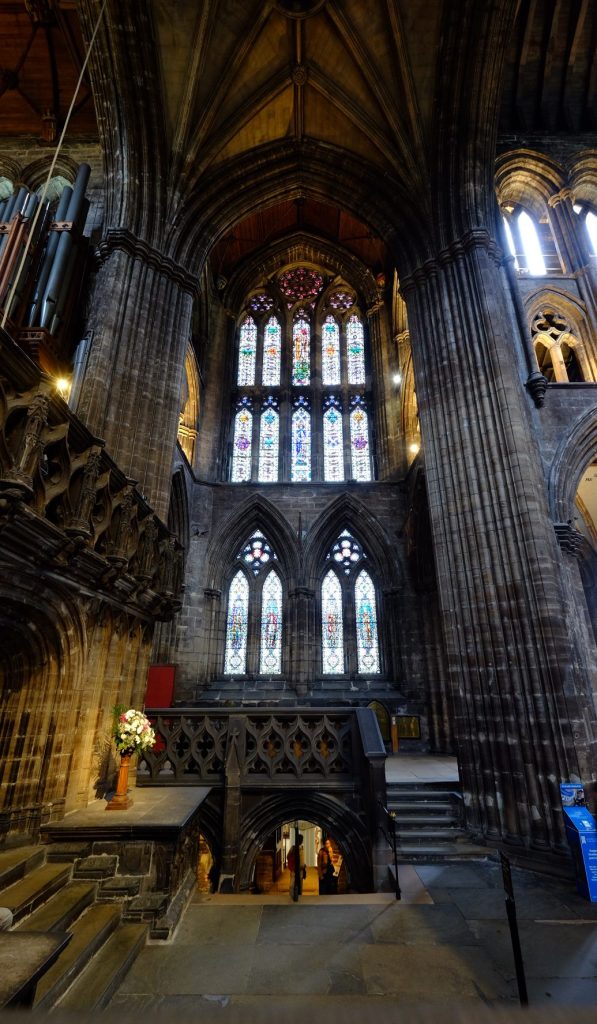
Stepping inside, your eyes are immediately drawn upwards. Great stone columns rise into pointed arches, intricate details emerge from the shadows and the sheer scale of the place makes you wonder quite how medieval craftsmen achieved such extraordinary results without the benefit of modern machinery.

What makes Glasgow Cathedral particularly remarkable is its survival. The Scottish Reformation of 1560 transformed the country’s religious landscape, bringing an end to papal authority and fundamentally changing the way people worshipped. Many medieval churches and cathedrals subsequently lost their furnishings, religious imagery and, in some cases, their very existence.

Glasgow, however, was fortunate. The cathedral survived substantially intact, although its Catholic furnishings and decoration did not escape the changes. Its continued use as a place of Protestant worship helped preserve one of Scotland’s finest examples of medieval Gothic architecture.

A rather impressive survivor, considering Scotland’s occasional enthusiasm for dismantling anything associated with the previous administration.

A Little Colour Amongst the Ancient Stones

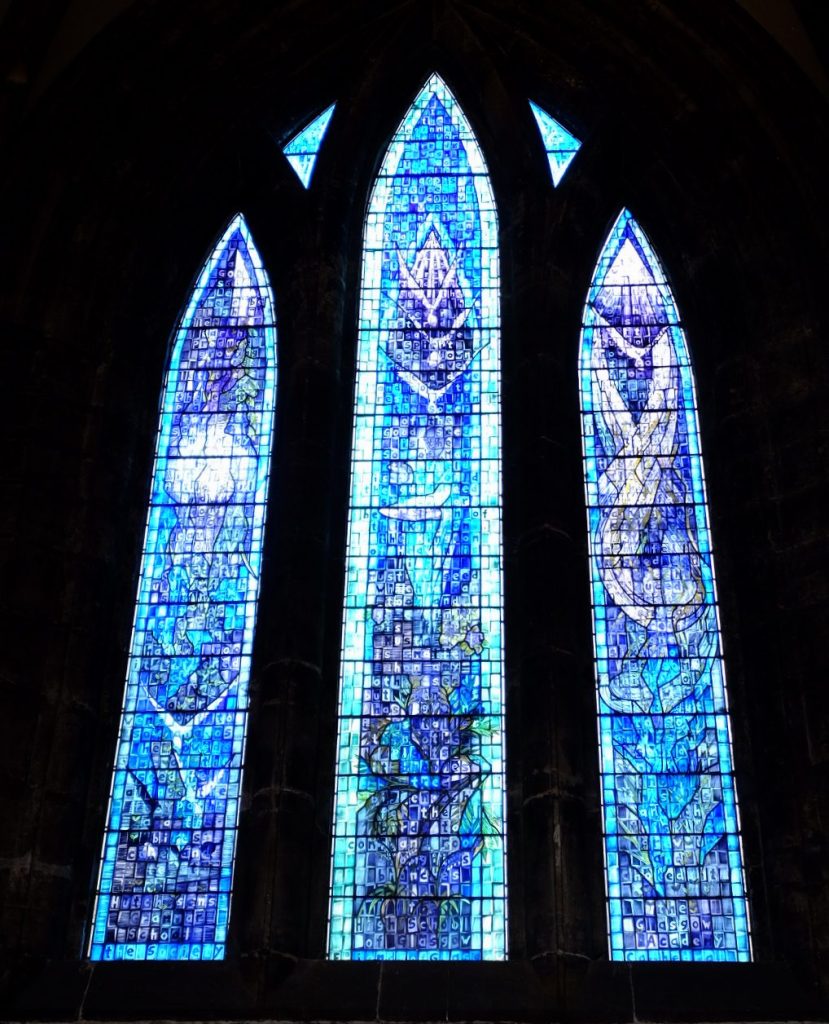
One of the things that particularly caught my attention was the stained glass. Set against centuries-old dark stonework, the extraordinary intensity of the colours creates an almost theatrical effect, especially when the light catches them.

Perhaps the most striking was a magnificent arrangement of brilliant blue windows, their modern design contrasting beautifully with the medieval architecture surrounding them.

Interestingly, much of the stained glass we see in Glasgow Cathedral today is relatively modern. The Reformation had swept away the medieval glazing, and although Victorian stained glass was introduced during the nineteenth century, much of this was subsequently replaced during the twentieth century.

The result is a fascinating combination of medieval craftsmanship and contemporary artistic expression, centuries apart but somehow entirely at home together.

I particularly liked the contrast. The building itself speaks of an age when faith was central to almost every aspect of daily life, while the windows demonstrate that even a cathedral approaching 900 years of age can accommodate something new.

Faith, Folklore and a Rather Dangerous Time to Be Different

My interest in Glasgow Cathedral wasn’t entirely architectural, however.

During the months leading up to this trip, I’d spent considerable time exploring Scotland’s darker religious history, particularly the relationship between Christianity, traditional folk beliefs and the persecution of those accused of witchcraft.

For centuries, Scotland’s communities had lived with a fascinating mixture of Christian teachings and much older beliefs. Fairies, healing charms, sacred wells, supernatural encounters and folk remedies were woven into everyday life, especially in rural communities. These weren’t necessarily regarded as contradictory beliefs by the people practising them. A person might attend church on Sunday and still seek assistance from a local healer, carry a protective charm or avoid a particular hillside after dark for fear of disturbing its otherworldly inhabitants.

Following the Reformation, however, religious authorities increasingly sought to regulate such practices, and the passing of Scotland’s Witchcraft Act in 1563 made witchcraft a capital offence.

The consequences could be devastating.

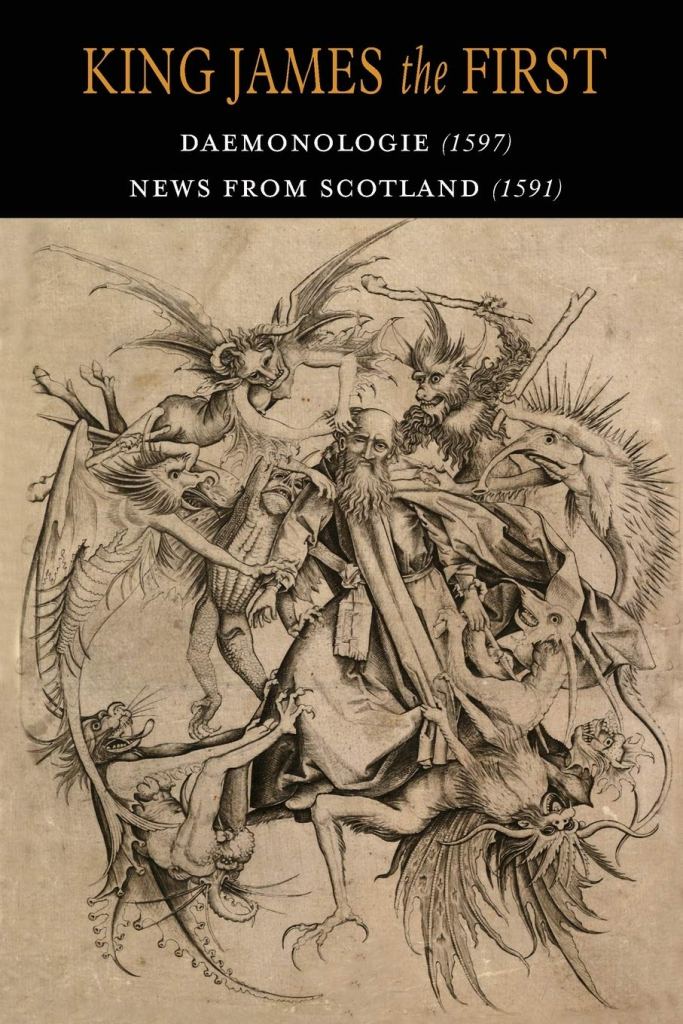
Scotland experienced several major periods of witch-hunting during the late sixteenth and seventeenth centuries. Accusations were frequently driven by local disputes, illness, misfortune, suspicion and fear, with women disproportionately represented among those prosecuted. Even King James VI developed something of an obsession with the subject, publishing his treatise Daemonologie in 1597, in which he argued for the reality of witchcraft and the need to suppress it.

An unfortunate time to fall out with the neighbours, particularly if your herbal remedies were more successful than the local physician’s.

Standing inside the cathedral, I found myself thinking about the extraordinary changes in belief that had taken place within these walls. The same building had witnessed medieval Catholic worship, the upheavals of the Reformation and the emergence of a very different religious Scotland.

And just outside, amongst the weathered gravestones, was a reminder that not everyone in sixteenth-century Glasgow was preoccupied with witches and the supernatural.

Some were attempting to drag medicine into the modern world.

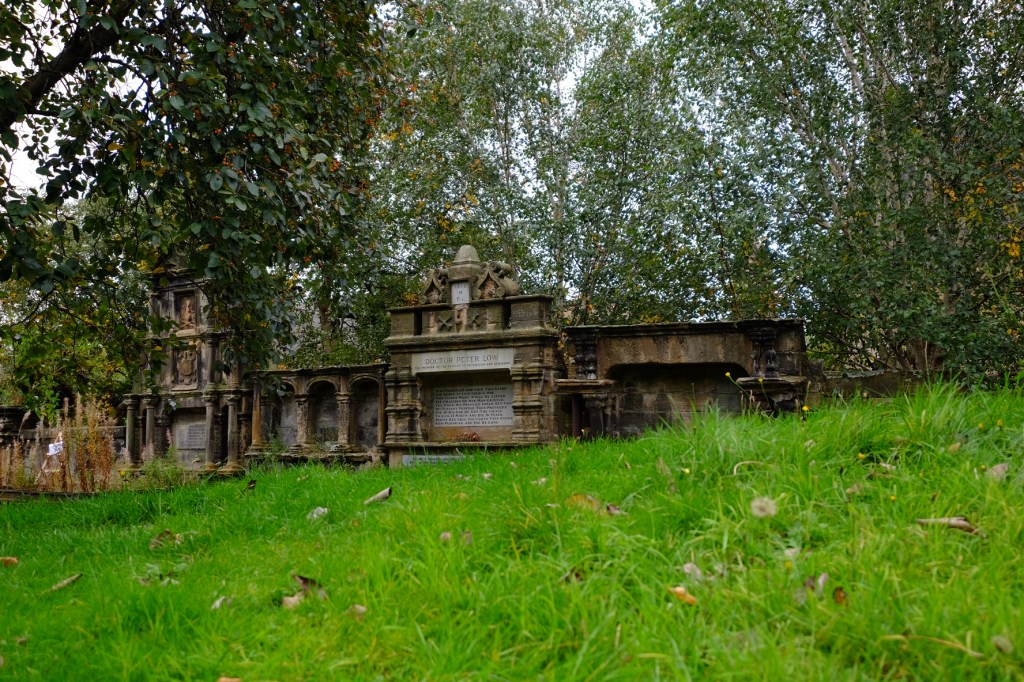
Doctor Peter Low – A Man Ahead of His Time

Among the monuments near the cathedral is an impressive memorial to Doctor Peter Low, a rather remarkable Scottish surgeon whose contribution to medicine deserves considerably wider recognition.

Born around the middle of the sixteenth century, Low spent time studying and practising surgery in France before eventually settling in Glasgow. In 1597 he published The Whole Course of Chirurgerie, an important surgical textbook that helped bring together contemporary medical and surgical knowledge in the English language.

Two years later, in 1599, he secured a royal charter from James VI establishing what would eventually become the Royal College of Physicians and Surgeons of Glasgow.

His ambition was to improve medical standards and ensure that those practising surgery and medicine were properly examined and qualified.

This was no small undertaking in an age when medical treatment could be something of a lottery, and the distinction between a trained practitioner, an enthusiastic barber and someone armed with a collection of questionable remedies wasn’t always reassuringly clear.

Low’s original organisation also had responsibility for examining and regulating practitioners, including surgeons and apothecaries, and its foundation represented an important step towards the professional medical institutions we recognise today.

His memorial is an intriguing survivor, tucked away amongst the older stones, and a reminder that Glasgow was developing a serious intellectual and scientific identity long before the Industrial Revolution transformed it into one of Britain’s great commercial cities.

What I particularly enjoyed was the historical contrast.

Here was a city in which religious authorities were grappling with witchcraft and supernatural beliefs while pioneering individuals such as Peter Low were simultaneously attempting to establish more rigorous standards in medicine.

Faith, fear, folklore and emerging science, all occupying much the same period of history.

Scotland in the sixteenth century was certainly never dull.

But fascinating as Glasgow had been, the clock was ticking. I still had an ambitious itinerary ahead of me, and after yesterday’s aviation-related disruption, I was determined to recover at least a little of my carefully prepared schedule.

It was time to leave the city behind.

Next stop, Dumbarton Rock, where the history was considerably older, the defences rather more imposing and the Vikings had once made themselves spectacularly unwelcome.

Leaving Glasgow – The Road to Dumbarton

With my exploration of Glasgow Cathedral complete, it was time to leave the city behind and begin the journey west.

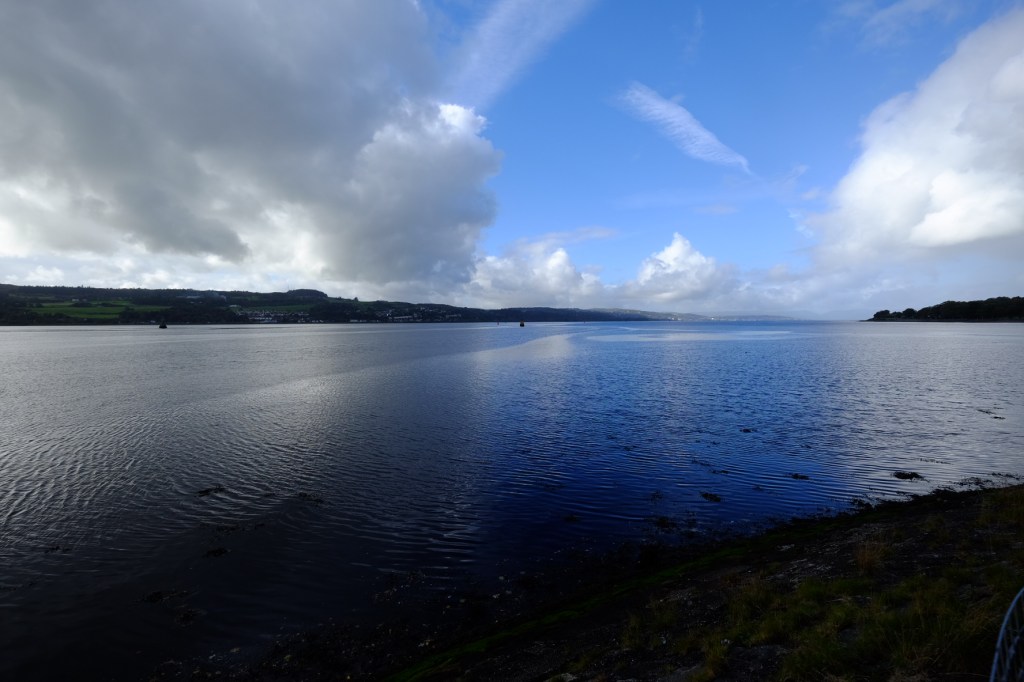
The drive towards Dumbarton provided a fascinating transition. Glasgow’s imposing Victorian buildings, busy streets and industrial heritage gradually gave way to a more open landscape, with the River Clyde becoming an increasingly prominent feature.

For centuries, the Clyde was the lifeblood of Glasgow’s prosperity. Its banks were once lined with shipyards, engineering works and heavy industry, producing some of the finest ships in the world. At its peak, the river was synonymous with Scottish industrial ambition, its shipbuilders helping Glasgow earn its reputation as the Second City of the Empire.

But heading west, the industrial landscape begins to soften. The river broadens, the surrounding hills become increasingly prominent and the sense of approaching a rather different Scotland begins to take hold.

And then, rising dramatically from the landscape, comes Dumbarton Rock.

It’s difficult to miss.

An enormous volcanic outcrop towering above the surrounding countryside, with the remains of one of Scotland’s most historically significant fortifications perched upon it.

Dumbarton Castle – Before Scotland Was Scotland

Dumbarton Rock is a remarkable place, and one I’d been particularly looking forward to photographing.

Long before the medieval castle was established, this great volcanic stronghold was known as Alt Clut, meaning ‘Rock of the Clyde’, and served as the principal fortified centre of the ancient Brittonic kingdom of Strathclyde.

Its position is extraordinary. Rising steeply above the confluence of the Rivers Clyde and Leven, the rock provided an almost naturally impregnable defensive position, commanding the surrounding landscape and an important route into Scotland’s interior.

In AD 870, however, even these formidable natural defences proved insufficient.

Viking forces led by Olaf and Ivar laid siege to Dumbarton Rock in an assault that reportedly lasted four months. Eventually the fortress fell, and according to contemporary Irish annals, the invaders returned to Dublin with an enormous quantity of treasure and captives, carried aboard a fleet said to number some 200 ships.

One can only imagine the reception committee.

The site subsequently became an important royal stronghold, with Alexander II developing the medieval castle during the thirteenth century as Scottish and Norwegian interests competed for influence along the western seaboard.

Its later history reads like a condensed account of Scotland’s political turbulence.

William Wallace was brought here following his capture in 1305 before being handed over to the English. In 1548, the five-year-old Mary, Queen of Scots, was sheltered within its defences before sailing to France. Then, in 1571, during the civil wars surrounding Mary’s reign, the castle was captured in an extraordinary night assault by Thomas Crawford of Jordanhill, whose men scaled the supposedly impregnable rock.

A Viking siege, medieval kings, William Wallace, Mary, Queen of Scots and an audacious military assault.

Not bad for one rather substantial lump of volcanic rock.

A Photographer’s Patience – Somewhat Tested

I was particularly keen to get a decent photograph of the castle, ideally capturing the great rock and its fortifications without too much modern-day interference.

Unfortunately, I wasn’t alone.

A group of people appeared to be conducting a dog-training session in precisely the area I had earmarked for my photographs.

Now, I have absolutely nothing against dogs. Or, for that matter, people training them. But I do have a particular dislike of people appearing in photographs of historic buildings, especially when I’m attempting to capture something that has stood for hundreds of years.

There’s something faintly irritating about composing a photograph of a magnificent medieval fortress, imagining Viking longships approaching along the Clyde, only to have someone in a fluorescent jacket wander into the foreground clutching a bag of dog treats.

Not quite the historical atmosphere I had in mind.

I spent a little time moving around, adjusting the composition and waiting patiently for suitable gaps in the canine activities.

Eventually, I managed to capture the views I wanted, although it did require rather more patience than I’d anticipated.

I suspect the Vikings had an easier time organising their invasion.

With Dumbarton duly photographed, it was time to continue the journey, there was, however, a small problem, I was getting hungry.

The Great Lunchtime Expedition – Or How Not to Find Lunch

I’d already identified a couple of potentially interesting places to stop for something to eat, so finding lunch shouldn’t have presented much of a challenge, famous last words!

The first was a Vietnamese establishment that had caught my attention during my research. I had visions of wonderfully fragrant broths, fresh herbs, perhaps a bánh mì with crisp pickled vegetables and a little chilli. Something light, interesting and full of flavour. Unfortunately, what I discovered bore rather little resemblance to the Vietnamese experience I’d been anticipating.

Burgers and baps appeared to be the order of the day.

Now, there’s absolutely nothing wrong with a decent burger, but when you’ve mentally prepared yourself for the flavours of Vietnam, a bap comes as something of an anticlimax, never mind, time for plan B.

The second establishment looked promising, and I approached with renewed optimism, only to discover that it was closed on Tuesdays, naturally, today was Tuesday.

Two attempts, no lunch!

For someone who’d spent months researching medieval castles, prehistoric monuments, Scottish folklore and the finer points of Highland clan warfare, my inability to locate a decent sandwich was becoming mildly embarrassing, clearly, the 55-page guide had overlooked something important.

Out came the phone for a little emergency culinary research, and before long I’d found something that looked considerably more promising. There was just one slight complication, it meant heading back towards Glasgow. Not exactly the most efficient use of a carefully constructed itinerary, but there are times when culinary considerations must take precedence over geographical common sense. Besides, I’d already lost Stirling Castle to yesterday’s fog. I wasn’t about to lose Tuesday’s lunch to a burger and a locked door.

And that was how I discovered “Mootz”.

Mootz – Now That’s a Sandwich!

Mootz specialises in freshly prepared Italian “schiacciata” sandwiches, and one look at the menu suggested my little detour might prove rather worthwhile.

Schiacciata, originating in Tuscany, is a wonderful olive-oil-enriched flatbread, with a beautifully golden exterior and a light, airy interior. When made properly, it provides the perfect foundation for a generously filled Italian sandwich, and generous appeared to be something of a speciality here.

The menu was full of tempting combinations featuring mortadella, prosciutto, stracciatella, mozzarella, pistachio pesto and assorted other delicious ingredients.

The signature Mootz caught my attention: mortadella, stracciatella, pistachio pesto and crushed pistachios.

A beautifully simple combination, allowing the individual ingredients to shine. The richness of mortadella, the wonderfully creamy stracciatella and the distinctive nutty flavour of pistachio all wrapped in that magnificent bread.

It looked substantial, to say the least.

But, after considerable deliberation, I settled on the Huckleberry, a rather magnificent creation consisting of pistachio mortadella, apricot-glazed ham, porchetta, tomato carpaccio, mozzarella, chimichurri and chilli oil, all generously packed between two substantial slices of freshly baked schiacciata.

This wasn’t so much a sandwich as a carefully engineered construction project.

With my precious cargo safely aboard, it was time to leave Glasgow behind for the second time that day.

I had a particular destination in mind for lunch. Somewhere considerably more scenic than a city-centre pavement, and somewhere I could finally test another of my recent acquisitions.

My little portable espresso machine was about to earn its place in the luggage.

Loch Lomond – An Island with a History of Its Own

Heading north along the A82, the urban landscape gradually disappeared, replaced by wooded hillsides, distant mountains and increasingly impressive views across Loch Lomond.

The loch is the largest freshwater lake in Great Britain by surface area, extending for approximately 36 kilometres from its southern reaches towards the Highland mountains. Its character changes dramatically along its length. To the south, the water is broad and comparatively gentle, scattered with numerous islands, while farther north the mountains close in and the landscape takes on a much wilder appearance.

One island in particular had caught my attention during the pre-trip research.

Inchmurrin.

At approximately 120 hectares, Inchmurrin is the largest freshwater island in the British Isles, and, naturally, it has a rather interesting history.

Named after St Mirin, the early Christian saint associated with Paisley, the island was once an important possession of the Earls of Lennox. During the fourteenth century, a castle was established near its southern end, providing the powerful Lennox family with a secluded island stronghold. Its history became entangled with the political turbulence surrounding Scotland’s medieval aristocracy and the Stewart dynasty. The castle eventually fell into ruin, but its remains survive as another reminder that Scotland’s beautiful landscapes frequently conceal a more complicated past.

I rather liked the idea of an island within a loch, with its own castle, history and centuries of intrigue. And, of course, there was something particularly appropriate about encountering it while travelling towards another island altogether, Eilean Shona, where the culinary part of this adventure was still waiting for me.

But that was a few days away.

For now, I had lunch to consider, and the landscape was becoming increasingly spectacular.

Rest and Be Thankful – A Rather Appropriate Place for Lunch

Continuing along Loch Lomond towards Tarbet, I turned left onto the A83, heading west into the magnificent landscape of the Arrochar Alps. Here the road begins to climb through Glen Croe, winding between imposing mountain slopes towards one of Scotland’s most wonderfully named locations: the Rest and Be Thankful.

The name originates from the eighteenth-century military road constructed through the glen as part of a wider network intended to improve military access through the Highlands.

The old route involved a considerable climb, and travellers reaching the summit were encouraged to stop and appreciate their achievement. An inscription commemorating repairs undertaken by the 93rd Regiment in 1768 helped preserve the wonderfully simple sentiment.

Rest and Be Thankful

Considering the view, it seemed only polite to comply. This was where I finally stopped for my rather delayed lunch.

Surrounded by towering mountains, with the dramatic sweep of Glen Croe stretching away below, I unwrapped my magnificent Mootz sandwich.

And what a setting I’d chosen.

The landscape was spectacular, with great banks of cloud drifting across the mountains, occasional bursts of sunlight illuminating the slopes and the ever-present possibility of the weather deciding to provide a little additional entertainment.

After two failed attempts to find lunch, an unscheduled return towards Glasgow and rather more driving than anticipated, the sandwich tasted all the better for the effort.

The combination of ingredients was inspired. Delicate, silky mortadella provided a lovely richness, complemented by the sweetness of the apricot-glazed ham and the deeper, savoury character of the porchetta. Fresh mozzarella brought a welcome creaminess, while the finely sliced tomato added moisture and a little acidity to balance the cured and roasted meats.

Then came the chimichurri, that wonderfully vibrant herb-based sauce, cutting through the richness with its fresh, garlicky sharpness, while the chilli oil delivered a gentle background warmth.

And holding this magnificent collection together was the schiacciata itself. Golden and lightly crisp on the outside, wonderfully soft and airy within, with that distinctive olive oil character that makes good Italian flatbread such a pleasure to eat.

It was an absolute triumph of contrasting flavours and textures: rich, sweet, savoury, creamy, fresh and just a little spicy, with each ingredient contributing something rather than simply competing for attention.

Sometimes the simplest things are the most enjoyable.

Although I wasn’t quite finished.

Espresso in the Wild – The Inaugural Field Test

Now came another important moment in the adventure.

The first proper outdoor test of my new Outin portable espresso machine.

I’d bought this clever little rechargeable device specifically for the trip, imagining freshly made espresso in some wonderfully remote Scottish setting. Now here I was, surrounded by Highland mountains, armed with my GRIND coffee capsules and absolutely no need to locate a coffee shop.

For those unfamiliar with it, the Outin is a compact battery-operated espresso maker capable of heating water and extracting coffee without requiring mains electricity. It accepts compatible capsules or ground coffee, making it particularly appealing for travelling, camping or finding yourself miles from the nearest decent café.

A little water, a capsule, a press of the button and the machine set about producing a proper espresso.

There’s something immensely satisfying about enjoying good coffee somewhere like this.

No queue, no barista asking for your name and, perhaps most importantly, no paper cup informing you that you’re having an inspirational day.

Just an Italian sandwich, freshly extracted espresso and one of the finest views Scotland could offer.

Civilisation, I decided, is more a state of mind than a geographical location, the name of the viewpoint seemed particularly appropriate.

After my slightly ridiculous lunchtime expedition, I was indeed resting, and extremely thankful.

The Road to Kilmartin – Lochs, Puffers and Five Thousand Years of History

With lunch finally enjoyed and the coffee experiment declared a success, it was time to pack away my little mobile coffee shop and continue west.

The road carried me deeper into Argyll, where the landscape seemed determined to become more spectacular around every corner. The towering mountains gradually softened into wooded hillsides, great stretches of water appeared between the trees, and the late afternoon sunshine was beginning to cast that wonderful golden light across the countryside.

I was also becoming increasingly aware that my camera was rather interfering with my carefully planned timetable. Every bend seemed to reveal another scene demanding attention.

Not that I was complaining.

A Brief Encounter with Loch Fyne

One particularly lovely stop was beside Loch Fyne, where I pulled in near the famous Loch Fyne Oyster Bar.

With the sun beginning to sink behind the surrounding hills, the view was magnificent. The loch stretched away into the distance, its waters reflecting the warm evening light, while great sweeps of cloud filled the sky overhead.

Loch Fyne is Scotland’s longest sea loch, extending for around 40 miles inland from the Sound of Bute. Its sheltered waters have long supported fishing and shellfish production, and its oysters are particularly celebrated.

The Loch Fyne Oyster Bar itself grew out of a small roadside business established in the late 1970s, helping bring the region’s exceptional seafood to a much wider audience.

Under different circumstances, this would have warranted a considerably longer investigation. Possibly involving oysters. Almost certainly involving something else from the menu.

Unfortunately, time was marching on, and having already travelled rather further than originally intended in pursuit of a sandwich, I thought it prudent not to embark on another culinary expedition.

A few photographs, a moment to enjoy the view, and I was on my way.

The Vital Spark – A Little Maritime Nostalgia

Continuing towards Inveraray, another unexpected photographic opportunity presented itself in the form of a wonderful old vessel named Vital Spark, her distinctive red-and-black hull standing out beautifully against the waters of Loch Fyne.

The name immediately evokes Scotland’s famous Clyde puffers, those sturdy little steam-powered cargo vessels that once carried essential supplies from the Clyde to the remote communities of the western Highlands and islands.

Coal, food, building materials, whisky barrels and almost anything else required by isolated settlements travelled aboard these remarkably versatile boats. Their shallow draught and flat bottoms allowed them to reach small harbours and even beach themselves where proper docking facilities were unavailable.

The puffers also became immortalised through Neil Munro’s fictional character Para Handy, the gloriously self-important skipper of the Vital Spark, whose adventures and frequent misunderstandings became a much-loved part of Scottish literature and television.

A captain whose confidence in his own abilities was, shall we say, not always entirely justified.

And this particular Vital Spark has quite a history of her own.

Built in 1944 as VIC 72, a wartime naval victualling vessel, she subsequently spent decades working as a cargo boat around Scotland’s western islands under several different names. Eventually brought to Inveraray in 2001, she was renamed Vital Spark in 2006 in honour of Neil Munro’s much-loved fictional puffer.

Although originally steam-powered, she was later converted to diesel, so she’s not quite the traditional steam puffer her appearance might suggest. Nevertheless, her working-boat character and distinctive profile make her a wonderful surviving reminder of the vessels that once provided a lifeline to Scotland’s remote coastal communities.

Not bad for a lady approaching her 82nd birthday.

There was something wonderfully atmospheric about her sitting quietly against the pier, with the wooded hills and calm waters of Loch Fyne providing a magnificent backdrop.

Quite how Para Handy would have coped with my increasingly revised itinerary is anyone’s guess, although I suspect he’d have found a perfectly reasonable explanation for every delay, preferably one that involved blaming somebody else.

And speaking of waterways, my next photographic diversion was waiting a little farther along the road.

Crinan – A Shortcut Through Scotland

As the afternoon slipped towards evening, I made my way to Crinan, a beautiful little settlement overlooking the Sound of Jura and the western entrance to the Crinan Canal.

By now, the light was changing rapidly. The sky had taken on soft shades of gold and blue, the rocky shoreline was beautifully silhouetted against the water, and distant islands appeared almost suspended beneath the clouds.

It was the sort of scene that makes you forget you’ve been driving for most of the day.

The canal itself has a fascinating history. Designed by the great civil engineer John Rennie and opened in 1801, it provides a nine-mile navigable shortcut between Ardrishaig on Loch Fyne and Crinan on the Sound of Jura.

Before its construction, vessels travelling between the Clyde and the western islands faced the considerably longer and potentially hazardous journey around the Mull of Kintyre.

The canal, with its 15 locks, transformed that journey, becoming an important commercial route for fishing vessels, cargo boats and, later, the Clyde puffers.

Not surprisingly, it acquired the rather splendid description of Britain’s most beautiful shortcut.

Standing beside the quiet harbour, looking at the boats, old stonework and canal locks, it wasn’t particularly difficult to understand why.

There was a lovely stillness about the place. Boats rested in the sheltered basin, their masts rising against the wooded hills, while the old lock gates and surrounding buildings provided a glimpse of the canal’s working past.

After the bustle of Glasgow, the dog-training activities at Dumbarton and the unexpected lunchtime expedition, Crinan felt wonderfully peaceful.

I could easily have spent considerably longer here, exploring the shoreline and photographing the changing light, but there was one small problem.

I still hadn’t reached my hotel.

Kilmartin – At Last!

A short drive later, I finally arrived in Kilmartin.

And, almost on cue, the weather decided that I’d enjoyed quite enough sunshine for one day.

The sky had turned decidedly grey, the roads were wet, and there stood the wonderfully traditional white frontage of the Kilmartin Hotel, looking rather inviting after a long day’s travelling.

I’d made it.

The hotel sits in the heart of a landscape I’d spent months researching, surrounded by one of Britain’s most remarkable collections of prehistoric monuments. Within just a few miles are ancient burial cairns, standing stones, stone circles and mysterious cup-and-ring carvings, many dating back thousands of years.

There is also Dunadd, once an important royal centre of the Gaelic kingdom of Dál Riata, where a footprint carved into the rock is traditionally associated with the inauguration of early Scottish kings. From prehistoric ceremonial landscapes to the emergence of early Scottish kingship, an astonishing amount of history is concentrated in this relatively small corner of Argyll.

And here I was, finally in the middle of it.

After months of research, countless maps, historical investigations and enough printed material to suggest I was preparing a doctoral thesis rather than a holiday, the real exploration was about to begin.

There was, however, something rather satisfying about simply arriving.

Looking back over the day, I’d managed to squeeze in a Bombay-inspired breakfast, an extraordinary medieval cathedral, a pioneering surgeon, Viking invasions, a rather unsuccessful search for lunch, one magnificent Italian sandwich, an espresso overlooking the Highlands, Loch Fyne, a characterful old puffer and a beautiful evening beside the Crinan Canal.

Not bad for a Tuesday.

But the ancient stones, mysterious burial chambers and several thousand years of Scottish history would have to wait until morning. For now, I had a hotel to check into, a camera to put away and, quite possibly, a well-earned glass of something Scottish to contemplate.

Five thousand years of history weren’t going anywhere overnight.

At least, I sincerely hoped not.

………………… Until Next Time ………………. L8ers ………………………
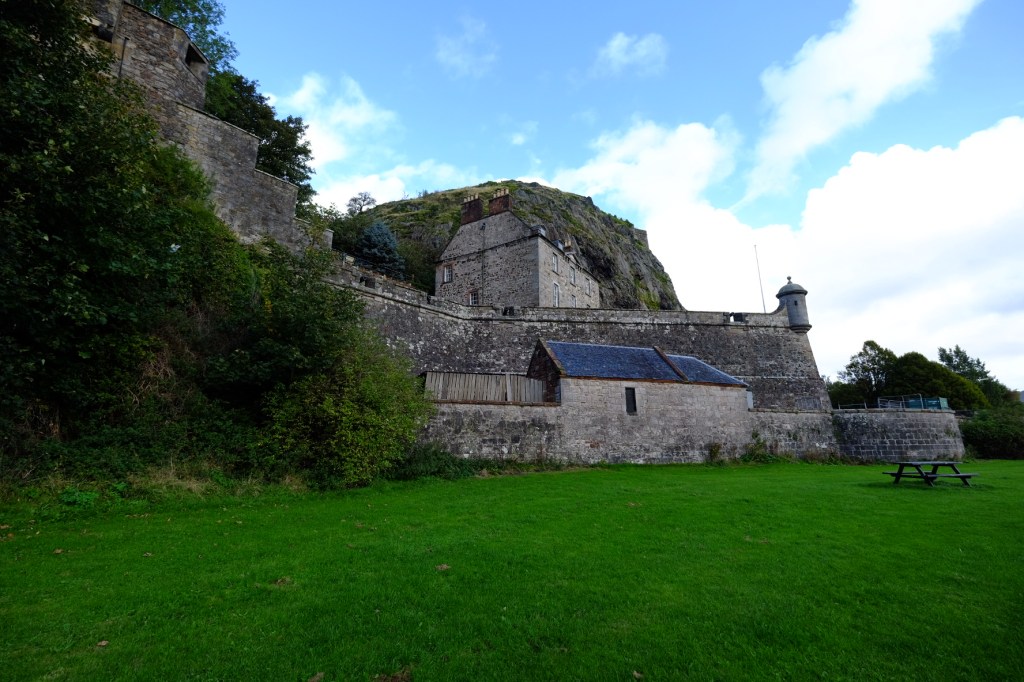
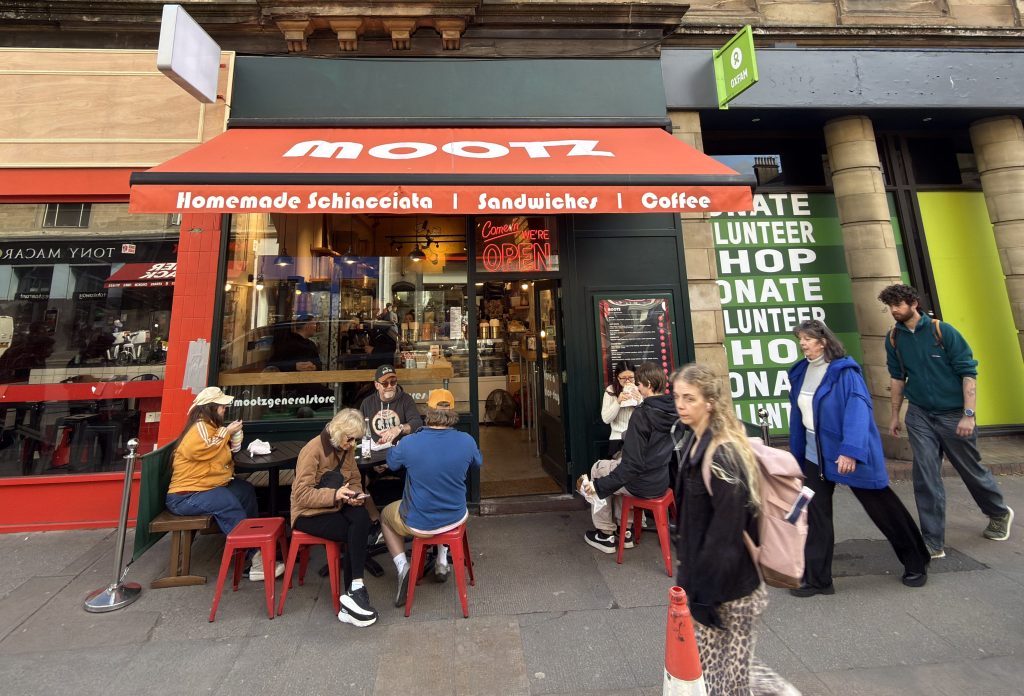
Wild Scotland: Witches, Whisky, Ancient Stones & Michelin Stars (Part 1)

It all started in March 2025 with an email landing in my inbox. The subject line? Kitchen in the Wild. Now, that got my attention.

I’d been on one of their adventures to Norway back in 2023 and had an absolute blast, so naturally, I was intrigued. But this one promised something rather special. An island off the west coast of Scotland, with none other than Nathan Outlaw, a chef with two Michelin stars, joining us as a special guest. Well, things were looking interesting already!

Apparently, it had taken the organisers 15 months to track down the perfect location, and from the description, it sounded as though they’d struck gold. Remote enough to escape the modern world, with no light pollution, meaning skies bursting with stars. Wildlife in abundance, a forager’s paradise and a fisherman’s heaven. Scallops, crabs, oysters and lobsters, all practically queuing up to be ‘thermidored’.

A remote Scottish island, spectacular scenery, incredible seafood and a two-Michelin-starred chef thrown into the mix. What could possibly go wrong?

Or, more to the point, where do I sign?

One year and seven months later, departure day had finally arrived. Of course, I’d hardly been sitting around twiddling my thumbs in the meantime. What started as a simple idea to add a few days of exploration before the main event had developed into something of a historical obsession, culminating in a professionally printed, full-colour guide running to more than 55 pages. Some people buy a guidebook. Apparently, I have to write my own.

Scotland, as I was discovering, has rather more to offer than spectacular scenery, whisky and the occasional deep-fried Mars bar. Beneath those beautiful Highland landscapes lies a history that is as fascinating as it is frequently bloody. Ancient kingdoms, warring clans, ruined castles, witchcraft, superstition and enough murder and betrayal to keep a television scriptwriter employed for life. I was hooked.

My research had taken me down several rather unexpected rabbit holes. There were the great Highland clans, particularly the Campbells, MacDonalds and Stewarts, whose centuries of feuding, shifting allegiances and occasional enthusiasm for slaughter had helped shape the Scotland we know today. Then came the darker world of witchcraft and folklore: accusations of sorcery, fairy beliefs, folk healers and the persecution of supposed witches. Following Scotland’s Witchcraft Act of 1563, such accusations could carry the death penalty. An unfortunate time to be a little eccentric, particularly if your neighbours didn’t like you.

But perhaps the most intriguing discovery was Kilmartin Glen in Argyll, an extraordinary landscape where the story of human settlement stretches back thousands of years. Here, long before the Highland clans were fighting over castles and territory, prehistoric communities were constructing elaborate burial cairns, carving mysterious cup-and-ring symbols into rock and raising enormous standing stones. Some of these monuments are around 5,000 years old, older even than Stonehenge’s famous stone circle. Their precise purpose, and whether particular alignments held ceremonial or astronomical significance, continues to fascinate archaeologists. Whatever the answers, our ancestors were clearly up to something rather more ambitious than simply finding somewhere to park a large rock.

The more I read, the longer my list of places to visit became. Castles appeared on the itinerary, followed by ancient burial grounds, standing stones and sites associated with Scotland’s darker folklore. Before long, my modest little detour had developed into a full-blown historical expedition. I had maps, routes, background notes and enough printed material to suggest I might be planning an archaeological dig rather than a culinary holiday.

And so, with the research complete, the guides printed and a hire car waiting in Glasgow, the first few days were all mapped out. I would be heading west, into Argyll, following a trail through centuries of Scottish history before eventually making my way towards the remote island and the culinary adventure that had started this whole thing.

First, though, there were a few castles to investigate, some ancient stones to ponder and several thousand years of history to catch up on.

Nathan Outlaw and the lobsters would have to wait.

Monday Morning – Best-Laid Plans

It was five o’clock on Monday morning. My intended 3:30 start had somehow passed me by, and I stirred to check the time. Today was the day. A 10:10 flight to Glasgow and the culmination of months of planning, research and anticipation. I was excited, although perhaps not quite as organised as my meticulously prepared itinerary might suggest!

Fortunately, the taxi arrived on time, and I was soon heading towards Heathrow, looking forward to a few days of independent exploration before joining a group of like-minded people whose common passion was food.

The journey, however, had other ideas.

Unusual fog conditions had apparently scattered aircraft and their respective crews far and wide, resulting in our eventual arrival at Glasgow Airport more than two hours behind schedule.

Not a major disaster, you might think. But I’d put together a rather ambitious timetable of places to visit, with Stirling Castle first on the list. By the time I’d collected the hire car, it was obvious that Stirling would have to wait. I had a dinner reservation that evening, and there are some things in life that simply cannot be compromised.

A change of plan was required. Fortunately, Glasgow was somewhere I’d wanted to explore anyway, and with a little rearranging, I could still make something of the afternoon.

Chocolate, Coffee and Other Essentials

First on the revised itinerary was Bare Bones Chocolate, a small artisan chocolate maker in the heart of Glasgow that I’d first discovered watching Rick Stein on television. He’d visited their operation, been suitably impressed and subsequently cooked using their chocolate. Naturally, this warranted further investigation.

I’d already sampled some through mail order and was rather taken with it, so the opportunity to visit in person was too good to miss.

Founded by Cameron and Lara, Bare Bones is a fascinating little business built around a simple philosophy: exceptional chocolate begins with exceptional cacao, and the people who grow it deserve just as much consideration as those who eventually get to eat it.

Their approach is genuinely bean-to-bar, meaning they undertake the entire chocolate-making process themselves, starting with the raw cacao beans rather than buying in ready-made chocolate to melt down and repackage. Everything is produced in their Glasgow workshop in small batches of around 30kg, with an almost obsessive attention to detail.

Cameron, a mechanical engineer by background, has even modified and developed some of the equipment used in production, including a Giesen coffee roaster adapted specifically for cacao. There’s something wonderfully appealing about that level of dedication.

And then there’s the cacao itself.

Rather than blending beans from numerous unidentified sources to achieve a standardised chocolate flavour, Bare Bones celebrates single-origin cacao, allowing the distinctive characteristics of individual growing regions to shine through. Much like wine or speciality coffee, the variety of cacao, where it’s grown, the surrounding environment and how it’s fermented and dried all influence the finished flavour.

Take their Madagascan chocolate, for example. The beans originate in the Sambirano region in the northwest of Madagascar, where cacao grows beneath the shade of tropical fruit trees. The resulting 70% dark chocolate has distinctive fruity characteristics, with notes of raspberries, cherries and maple syrup.

Their Honduran milk chocolate, meanwhile, offers something quite different, with flavours reminiscent of raisins, fudge and double cream. Then there’s cacao from the Dominican Republic, where Bare Bones works with beans supplied through ÖKO Caribe, an organisation supporting farmers through agricultural training, improved growing practices and more stable prices.

This is chocolate with provenance, character and a story behind it, rather than simply a percentage printed on a wrapper.

The production process is equally interesting. After roasting, the beans are cracked, their outer husks removed and the remaining cacao nibs slowly ground with a little cocoa butter and sugar in a traditional stone grinder known as a melanger.

This process can take up to 72 hours, gradually refining the texture and mellowing some of the sharper flavours. The chocolate is then allowed to age for two or three weeks before being tempered, giving the finished bar that lovely glossy appearance and distinctive snap when broken.

Rather more involved than opening a large bag of chocolate buttons!

Environmental responsibility is also clearly part of their thinking. Their cacao is sourced from farms and cooperatives, with an emphasis on organically grown produce and relationships that recognise the importance of the growers. In Madagascar, for instance, the cooperative supplying their cacao has been involved in initiatives encouraging shade-grown cultivation, protecting the surrounding rainforest habitat and reducing soil erosion.

Even the packaging has been carefully considered. The colourful outer boxes are produced from recycled paper, including recycled coffee cups, while the inner wrappers are plant-based and compostable. All their packaging is designed to be recyclable or compostable after use.

I rather like that. If you’re going to produce something special, why not consider the whole journey, from the farmer growing the cacao to the wrapper left behind after you’ve thoroughly enjoyed the contents?

Another attraction, particularly for a dark chocolate enthusiast like myself, is their refreshingly short ingredient lists. No soya lecithin, vegetable fats or unnecessary additives, just carefully selected ingredients and a great deal of patience.

Dark chocolate also has another interesting attribute. Cocoa contains naturally occurring plant compounds called flavanols, which have been studied for their effects on blood vessel function and circulation. Although the quantity retained varies considerably depending on how chocolate is processed, I feel this provides an entirely reasonable scientific justification for enjoying a square or two of particularly good dark chocolate.

Possibly three. Best not to leave the research half-finished. There was, however, another reason for my interest.

For this adventure I’d acquired an Outin rechargeable portable espresso machine, a rather clever little battery-operated device capable of producing a very respectable espresso without the need for a kitchen, mains electricity or a barista. Perfect for a trip involving remote Scottish landscapes.

My plan was to pair some excellent single-origin chocolate with a freshly extracted espresso, preferably somewhere overlooking a magnificent Highland loch. I’d also packed some home-compostable Nespresso-compatible pods from GRIND, having enjoyed their coffee in the Heathrow business lounge earlier that morning.

Wilderness is all very well, but there’s absolutely no reason to lower one’s standards.

Glasgow – A City with a Rather Colourful Past

Chocolate interests satisfied, I continued exploring.

One of the things that had become apparent during my pre-trip research was just how much history lies beneath the surface of Glasgow. The city is perhaps better known for its industrial heritage, magnificent Victorian architecture and mercantile wealth, but dig a little deeper and there’s a considerably darker, and occasionally rather amusing, story waiting to be discovered.

Glasgow Cross was a particularly interesting place to start.

Dominating the junction stands the magnificent seven-storey Tolbooth Steeple, dating from the 1620s and now standing somewhat forlornly on its own. Originally, it formed part of a much larger building housing the Town Clerk’s office, council chambers, courts and city prison.

It was, in effect, the administrative and judicial heart of Glasgow, where civic decisions were made and justice dispensed. Sometimes rather enthusiastically.

Witches, thieves and murderers all passed through the Tolbooth’s judicial machinery, with public executions forming a particularly grim chapter in the city’s history.

Not everyone incarcerated there had an entirely miserable time, however.

The debtors apparently developed something resembling an exclusive gentlemen’s club, electing their own ‘provost’ and establishing rules governing their little community. They even attempted to prevent the jailer from admitting anyone they considered unsuitable.

One regulation from 1789 required prisoners fortunate enough to regain their freedom to treat their fellow inmates to a shilling’s worth of liquor.

Imagine being released from prison only to discover you still had to buy everyone a round before you could leave!

Outside the Tolbooth, the paved area known as the ‘plainstanes’ became a fashionable gathering place for Glasgow’s wealthy merchants, particularly the Tobacco Lords. These gentlemen, enriched by Glasgow’s transatlantic tobacco trade and its connections to the economy of slavery, were apparently rather fond of displaying their prosperity, parading around in scarlet cloaks, powdered wigs and carrying gold-topped canes.

Subtlety clearly wasn’t fashionable.

Glasgow Cross was also a major communications and transport hub, with stagecoaches arriving from Edinburgh and London, bringing travellers, newspapers and news from the wider world.

As Glasgow expanded westwards, the old Tolbooth gradually lost its importance. The remaining main building was finally demolished in 1921, leaving its extraordinary steeple standing alone, a reminder of the days when Glasgow Cross was the beating heart of the city.

A City That Wears Its Art on Its Walls

Wandering through the surrounding streets, something else caught my attention: Glasgow’s remarkable collection of street art.

Now, I appreciate that graffiti can be a divisive subject, but some of what I encountered was on an entirely different level. Huge, colourful murals occupied entire sides of buildings, transforming otherwise unremarkable streets and forgotten corners into an enormous open-air gallery.

What began as a Glasgow City Council initiative in 2008 to brighten neglected spaces developed into something considerably more ambitious, with the official City Centre Mural Trail launching in 2014.

Artists including Smug, Rogue One and Ejek have helped establish Glasgow as a city where art isn’t necessarily confined to galleries, museums or somewhere requiring an admission ticket.

One of the most striking examples is Smug’s extraordinary depiction of St Mungo, Glasgow’s patron saint, on High Street. The saint is portrayed as a modern-day figure holding a robin, a reference to one of the miracles traditionally associated with him.

Elsewhere, an enormous girl peers through a magnifying glass on Mitchell Street, while a magnificent collection of Scottish wildlife occupies a building on Ingram Street.

There’s humour here, but also history and some powerful social commentary.

The Strathclyde University Wonderwall, covering more than 1,000 square metres, celebrates the university’s achievements, while another mural pays tribute to Charles Rennie Mackintosh, one of Glasgow’s most celebrated creative talents.

Other works carry a more contemporary message. Bow Down, Honour the Roots, created by the Fearless Collective during the COP26 climate conference in 2021, depicts Indigenous people from the Amazon alongside imagery celebrating cultural identity and environmental protection.

What I particularly enjoyed was the element of surprise. Turn a corner, wander down an unfamiliar street, and you might suddenly find yourself confronted by an enormous work of art.

Unlike the great Victorian buildings that have stood for generations, street art is constantly evolving. Murals appear, others disappear, buildings change and the city continues to reinvent itself.

There’s something rather wonderful about that.

From Ancient Glasgow to Modern Glasgow – and Dinner

Time was passing rather quickly, and I was discovering that Glasgow deserved considerably more attention than my hastily rearranged afternoon could possibly provide. It was definitely somewhere I wanted to return to. My research had already uncovered countless places beyond the usual visitor attractions, and I’d barely scratched the surface.

But enough sightseeing. It was time to eat.

I’d booked a table at the highly recommended Ardnamurchan, a restaurant specialising in Scottish produce, and one whose menu I’d been examining with considerable enthusiasm for months. The walk there was pleasant, if slightly damp, and revealed yet another side of the city.

The weathered stone and historic architecture gradually gave way to a more contemporary Glasgow. Neon signs, unfamiliar brands and fast-food outlets competed for attention, sometimes with remarkably similar establishments positioned right next door to one another.

An interesting contrast to the world of powdered wigs, gold-topped canes and debtors demanding a farewell drink.

Ardnamurchan – A Taste of Scotland

Ardnamurchan celebrates traditional Scottish ingredients, showcasing the country’s exceptional natural larder, both animal and vegetable, with a particular emphasis on quality and provenance.

Having studied the menu for months, I was rather looking forward to this.

Stepping through the door, I was immediately encouraged by how busy it was. A Monday evening, and the restaurant was already buzzing. Always a promising sign.

The welcome was wonderfully warm, and the delicious aromas drifting from the kitchen immediately set me trying to identify what was being cooked.

I have a habit of mentally dissecting dishes before I’ve even seen them. A waft of something roasting, a hint of seafood, perhaps a reduction bubbling away somewhere. It’s rather like trying to read the menu through your nose.

Decisions made I settled down and started to think about the week ahead, the day had been delayed, Heathrow business lounge had been a godsend, filtering the masses waiting to escape was a respite and the facilities, food and drink had been exemplary, ‘GRIND’ coffee being of particular interest, I had some off their home-compostable Nespresso® compatible pods with my Outin expresso machine in my case.

Being a fond favourite of mine, Scallops was the obvious 1st choice, I did look at the other options

Settling down with the menu, I finally had a moment to reflect on the day.

It certainly hadn’t gone entirely to plan. Stirling Castle had been sacrificed to the aviation gods, and my carefully constructed itinerary had required some fairly rapid surgery. On the positive side, I’d discovered rather more of Glasgow than originally intended, acquired some excellent chocolate and made it to dinner in one piece.

Even Heathrow’s business lounge had played its part, providing a welcome refuge from the delayed departure, with excellent facilities, food and drink. The GRIND coffee had been a particular highlight, and I still had those pods tucked away ready for my portable espresso machine. But now there were more important decisions to make.

Being a particular favourite of mine, scallops were the obvious first choice. I did study the other starters, naturally, but sometimes the heart knows what it wants.

And mine was firmly set on the scallops.

Dinner, a Little Indulgence and Plans for Tomorrow

The menu was a wonderful celebration of Scotland’s natural larder, and choosing wasn’t entirely straightforward. The hand-dived Hebridean scallops were particularly tempting, paired on the menu with crisp pork belly, burnt apple chutney, fresh apple, pickled shallots and an Inch’s cider cream. A combination that seemed designed specifically to test my ability to resist ordering them.

For the main course, however, there was considerably less deliberation. Ardnamurchan Estate Wild Venison Pavé, served with redcurrant jus, buttered fondant potato, braised chicory, sweet mustard gel and carrot and apricot purée. Now that sounded rather special.

And when it arrived, it certainly looked the part.

The venison was beautifully presented, generously portioned and cooked a magnificent pink, with a lovely caramelised exterior. The rich, glossy redcurrant jus brought everything together, while the sweetness of the carrot and apricot purée provided a welcome contrast to the game. The braised chicory offered a slightly bitter counterpoint, and that golden fondant potato, crisp on the outside and wonderfully soft within, was a little triumph in its own right.

A glass of red wine completed proceedings rather nicely.

What a delightful way to end a day that had started rather earlier than intended and hadn’t exactly followed the carefully prepared script. The food was excellent, the atmosphere warm and welcoming, and Ardnamurchan had delivered precisely what I’d hoped for: wonderful Scottish ingredients treated with care, confidence and just enough imagination to make the experience memorable.

I left feeling very content indeed. Although, looking back at the dessert menu, I did notice something called Tablet Choc Ice, featuring homemade Scottish tablet, chocolate ice cream, popping candy and white chocolate. Perhaps a compelling reason for a return visit!

A Damp Walk and Tomorrow’s Adventure

The walk back to the AC Hotel by Marriott was pleasant, if a little damp. Glasgow’s streets glistened under the evening lights, and the city had taken on a rather different character from the bustling place I’d explored earlier in the day.

I was reflecting on just how much I’d enjoyed Glasgow. What had initially felt like a frustrating disruption to the itinerary had turned into a thoroughly enjoyable afternoon and evening. Sometimes the unexpected diversions are every bit as rewarding as the carefully planned destinations.

Tomorrow, however, was another matter.

The historical expedition I’d spent so many months researching was finally about to begin in earnest. There were ancient landscapes to explore, castles to discover and several thousand years of Scottish history waiting for my attention. With the hire car collected, my ridiculously comprehensive printed guides ready and the camera batteries charged, I was determined to make the most of the days ahead. But first, breakfast.

Hopefully, tomorrow’s itinerary would prove slightly more resilient than today’s.

And if not, at least I’d be starting it properly fed.

………………… Until next time ………………. L8ers …………………………..