Having finally arrived on Eilean Shona, it was time to exchange the relative solitude of several days exploring Scotland for something rather different.
People, and not just any people, as it turned out.
One of the things I’d been looking forward to most about Kitchen in the Wild was the opportunity to catch up with some familiar faces. I’d previously attended another event with Valentine Warner, Clare Isaacs and Nick Strangeway, so there was a lovely sense of returning to something I already knew would be rather special.
There is something reassuring about arriving somewhere remote and discovering a few old friends, particularly when those friends happen to include a celebrated chef, one of Britain’s most accomplished food-event organisers and a man who knows more about making a proper cocktail than most of us will ever know about drinking one!
Although I’m perfectly prepared to continue my research into the latter!
The atmosphere was wonderfully informal from the outset. This wasn’t going to be one of those rather stiff culinary experiences where guests sit reverentially while a famous chef presents something impossibly small on an enormous plate, Kitchen in the Wild operates on a different philosophy altogether.
It’s about bringing people together in extraordinary surroundings, sharing food, stories, experiences and an enthusiasm for the natural world. The boundaries between chefs, hosts, artists and guests are deliberately relaxed, creating something closer to a particularly well-organised house party, albeit a house party where the catering arrangements are in an entirely different league.
And the more I discovered about the people who had gathered on Eilean Shona, the more I appreciated just how unusual this particular collection of talent really was.
Valentine Warner and Clare Isaacs – The Masterminds
At the heart of it all were Valentine Warner and Clare Isaacs, founder of wearesprout.
Val is considerably more than a television chef. A trained artist who subsequently pursued cooking, he became widely known through his BBC series What to Eat Now, bringing an infectious enthusiasm for seasonal ingredients, fishing, foraging and the pleasures of cooking things that actually taste of where they come from. His books ( I own all 6 ) and broadcasting have consistently explored the relationship between food and the natural environment. He’s equally at home discussing an unusual wild mushroom, the merits of a particular fish or the botanical complexities of a good gin, which makes him an ideal person to spend several days with on a remote Scottish island.
Clare, meanwhile, possesses a rather extraordinary talent for making seemingly improbable culinary adventures actually happen.
After a decade working in the music industry, she helped pioneer the idea of putting chefs centre stage at festivals. Her subsequent career has included overseeing the food programme at Wilderness, bringing the celebrated Meatopia festival to London and Dublin, and collaborating with Valentine on Kitchen on the Edge in Norway’s spectacular Lofoten Islands.
Through wearesprout, she has developed an impressive international network of chefs, artists, makers and hospitality professionals, creating intimate food-led experiences in remarkable locations. The fact that we were all about to spend several days together on a private Scottish island was testament to that ability. And she make a perfect Earl Grey with Lemon, (thanks Sprout).
I suspect Clare could organise a Michelin-starred dinner halfway up Ben Nevis if somebody gave her sufficient notice.
Possibly even without it.
Nick Strangeway – An Old Friend and a Very Good Reason to Have a Cocktail
Another familiar face was Nick Strangeway, whose presence made the gathering feel even more like a reunion.
Nick is something of a legend in British cocktail circles, although I suspect he’d be happier being called a bartender than a mixologist.
Having worked alongside the influential Dick Bradsell during the emergence of London’s modern cocktail scene, Nick went on to establish an international reputation for his knowledge of spirits, flavour and the history of drinks. In 2008, he was named International Bartender of the Year at Tales of the Cocktail.
He’s also one of the co-founders of Hepple Spirits, alongside Val and their fellow collaborators, creating remarkable spirits inspired by the wild juniper and other botanicals growing on the Hepple Estate in Northumberland. Hepple Gin was to form a component of many of the unique and stunning cocktails we were to sample over the coming days. It’s a fascinating meeting of science, nature and traditional distilling, demonstrating that a gin can be every bit as considered and ingredient-driven as a dish prepared by a great chef.
Having enjoyed Nick’s company at a previous event, I was particularly pleased to see him again. I should probably clarify that this was entirely because of his delightful personality and not simply because he makes exceptionally good drinks.
Although the two are, admittedly, difficult to separate.
Nathan Outlaw – A Master of Seafood
Our special guest chef was Nathan Outlaw, one of Britain’s most highly regarded seafood specialists.
Nathan’s restaurants in Port Isaac, Cornwall, have earned international acclaim, with his cooking built around an uncompromising commitment to the quality, sustainability and seasonality of British fish and shellfish. His flagship restaurant, Outlaw’s New Road, has held two Michelin stars, an achievement that places him amongst the country’s most distinguished chefs.
What makes his approach particularly appealing is its apparent simplicity. Rather than overwhelming an exceptional ingredient with unnecessary complications, Nathan allows the fish itself to remain the centre of attention, using carefully judged combinations of flavour, texture and technique.
It’s an approach that requires enormous skill. There is, after all, nowhere to hide when the principal attraction is a beautifully cooked piece of fish. Nathan and Valentine are also longstanding friends, having previously travelled and cooked together for their television series Hook It, Cook It.
Reuniting them on an island surrounded by Scotland’s magnificent coastal waters seemed an inspired idea.
Jon Spiteri – A Man Who Helped Change British Dining
Then there was Jon Spiteri.
Now, for anybody with an interest in the history of modern British restaurants, this was a particularly significant addition to the gathering. Jon was one of the three original founders of St. JOHN, alongside chef Fergus Henderson and restaurateur Trevor Gulliver. Before its opening, Jon had managed the dining room above Soho’s famous French House, where Fergus and Margot Henderson had established a devoted following.
In October 1994, Jon, Fergus and Trevor opened St. JOHN in a former smokehouse near Smithfield Market in London, what followed was nothing short of a culinary revolution.
St. JOHN became internationally celebrated for its pioneering nose-to-tail philosophy, championing traditional British cooking, forgotten cuts, offal and a respect for the entire animal at a time when much of fashionable restaurant culture was heading in a very different direction. Bone marrow and parsley salad became one of its defining dishes, while its uncompromisingly straightforward approach to food helped influence an entire generation of chefs.
It remains one of London’s most important and distinctive restaurants. Jon wasn’t simply somebody who had worked there.
He had helped create it, rather extraordinary company for dinner, I thought.
Johnny Kiernan – The Next Generation of St. JOHN Thinking
There was another interesting connection in the shape of chef Johnny Kiernan.
Johnny’s professional background includes working at St. JOHN, Rochelle Canteen and Llewelyn’s, three establishments associated with thoughtful, ingredient-led British cooking. He subsequently became Head Chef at Lettice Events, developing his experience across intimate private dining, weddings and large-scale culinary events, before establishing himself independently.
His cooking celebrates seasonal produce, generosity and an uncomplicated appreciation of good ingredients. What particularly appealed to me was having Jon and Johnny together in the same gathering.
One had helped establish St. JOHN and its influential philosophy; the other represented a later generation of chefs who had worked within that tradition and carried its principles into their own cooking.
A rather lovely continuity.
And certainly more interesting than discovering that two people at a dinner party happened to have attended the same school!
Tim Barnes – The Talent Behind Outlaw’s Fish Kitchen
Also amongst the culinary talent was Christian Timothy Barnes, known as Tim.
Tim’s career is an excellent example of what can happen when natural ability meets an opportunity and a great mentor. He originally joined Nathan Outlaw’s operation as a kitchen porter, gradually became involved in food preparation and, encouraged by Nathan, undertook formal training as a chef. He progressed through the business to become Head Chef at the Michelin-starred Outlaw’s Fish Kitchen in Port Isaac, taking responsibility for the day-to-day running of one of Cornwall’s most respected seafood restaurants.
That is quite a journey.
Working so closely with Nathan, Tim has developed an intimate understanding of seafood cookery, the importance of exceptional produce and the precision required to deliver consistently outstanding food. It also demonstrated that Kitchen in the Wild hadn’t simply assembled a collection of famous names.
There was serious culinary expertise throughout the team, including people whose work normally happens behind the scenes rather than in front of television cameras.
Anna Koska – Bringing the Natural World to Life
Next in this remarkable collection of talents was Anna Koska, the acclaimed natural-history artist and illustrator.
Anna has spent more than 25 years capturing the extraordinary beauty and intricacy of fruit, vegetables, plants, animals and the natural world, illustrating more than 100 books along the way.
Working in watercolour, pen and ink, oils and especially ‘egg tempera‘, she produces exquisitely detailed images that combine artistic sensitivity with the observational precision of a natural historian.
Her own books, From Field & Forest and From Coast & Cove, explore the changing seasons and the sometimes overlooked details of the British countryside and coastline.
I particularly liked the inclusion of an artist amongst so many culinary professionals, as it reinforced the idea that Kitchen in the Wild wasn’t simply about eating.
It was about looking more closely, appreciating the environment, understanding ingredients and perhaps rediscovering some of the curiosity about the natural world that everyday life has a habit of squeezing out of us.
Although, given my own artistic abilities, I suspected any attempt to draw a recognisable botanical specimen might result in something resembling a particularly distressed cabbage.
Matt Waterston – A Life Less Ordinary, Preferably Outdoors
And completing this rather extraordinary gathering was Matt Waterston, an experienced outdoor adventurer, sea-kayaking and mountain guide, and founder of MW Guiding.
Matt’s relationship with the great outdoors goes considerably beyond enjoying the occasional pleasant walk. His adventures have included cycling across Canada and living in the Arctic, although despite exploring some of the world’s most remarkable landscapes, he’s remained convinced that Scotland’s west coast takes some beating.
An opinion I was rapidly coming to share.
Based near Arisaig, Matt established MW Guiding in 2021, specialising in bespoke adventures across the western Highlands and surrounding coastline. His activities range from guided sea-kayaking expeditions and overnight bothy trips to mountain walking, Munro ascents, mountain biking and wildlife encounters.
Rather more ambitious, I suspect, than my occasional stroll around the garden to inspect the progress of the tomatoes.
What makes Matt particularly interesting, however, is his connection with the landscape itself.
Together with his wife Hannah, he featured in Tide Life, a beautifully filmed short documentary produced by the internationally respected paddlesports company NRS. The film explores their life on Scotland’s west coast, their passion for the surrounding environment and the extraordinary relationship between the landscape and those who choose to make it their home.
Matt also knows Eilean Shona and its surrounding waters particularly well. His previous guided kayaking trips around the island have included encounters with its resident wildlife, including seals and their pups, offering visitors an entirely different perspective on this remarkable environment.
There was something rather reassuring about having someone with that level of experience leading our outdoor explorations, after all, I had already demonstrated a remarkable ability to complicate a straightforward lunch stop, so allowing somebody else to take responsibility for navigating the Scottish wilderness seemed an entirely sensible arrangement.
Together, Matt and Anna Koska brought a wonderful additional dimension to Kitchen in the Wild.
Anna’s extraordinary artistic eye reveals the intricate beauty of plants, animals, fish and the changing seasons, while Matt’s experience provides an opportunity to get out into the landscape and appreciate those things in their natural surroundings.
One helping us look more closely, the other helping us explore more deeply and both reinforcing something that makes Kitchen in the Wild rather special: exceptional food may bring everyone together, but the surrounding natural world is every bit as important to the experience.
Although I was still very much looking forward to dinner!
A Rather Extraordinary House Party
Taken together, this was an exceptional gathering.
A chef and broadcaster whose enthusiasm for wild food has inspired countless people; an event creator who has brought together some of the world’s finest culinary talent; a Michelin-starred seafood master; one of the founding figures behind one of Britain’s most influential restaurants; outstanding chefs from its wider culinary tradition; an internationally celebrated drinks expert; and an artist whose work reveals the natural world in exquisite detail.
And here they all were, on a small island off Scotland’s western coast, sharing their knowledge, cooking, conversation and enthusiasm with a relatively intimate group of guests.
The remarkable thing was how relaxed it all felt.
There was no sense of being separated from the experts or attending a succession of formal demonstrations. We were simply going to spend time together, exploring, eating, drinking, learning and undoubtedly enjoying a fair amount of laughter along the way. For me, the added pleasure of catching up with Valentine, Clare and Nick made it feel like renewing an old acquaintance, while meeting the others promised a fascinating few days ahead.
The only slight problem was remembering everybody’s name.
I had spent months researching five thousand years of Scottish history, producing detailed guides and memorising the locations of prehistoric monuments scattered across Argyll, yet introduce me to six people in quick succession, on top of the 15+ guests some traveling as far as America and my brain apparently decides that names are entirely optional information. Still, I felt sure we’d all become properly acquainted soon enough, particularly with several days of extraordinary food and wine ahead.
And our first evening was about to begin in considerable style.
Valentine Warner was in the kitchen.
The menu had arrived.
And the opening dinner suggested that nobody was planning to ease us gently into the proceedings.
Welcome to Kitchen in the Wild.
Let the feasting commence.
The First Evening – Valentine Sets the Table
With introductions underway, luggage deposited and the first awkward moments of meeting a roomful of new people gradually disappearing, we gathered for our opening dinner at Eilean Shona House.
There is something rather lovely about the first supper of an experience like this. Everyone arrives with different expectations, different backgrounds and, in my case, a slightly unreliable grasp of everybody’s names. Yet bring people together around a table, offer them something good to drink and serve a beautiful meal, and conversation generally takes care of itself.
The house provided a wonderful setting. Its comfortable sitting room, warm lighting, painted timber walls and relaxed atmosphere made it feel less like arriving at a hotel and more like being welcomed into a particularly interesting private home.
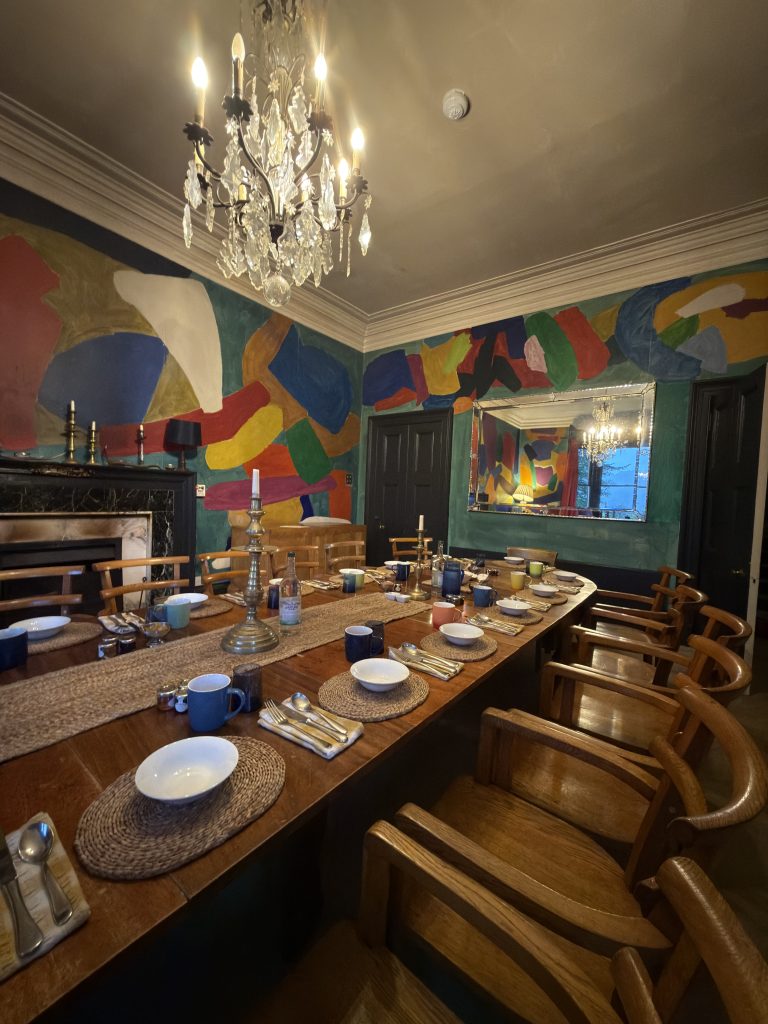
And this evening, Valentine Warner was responsible for dinner.
The printed menu was a promising piece of reading in its own right.
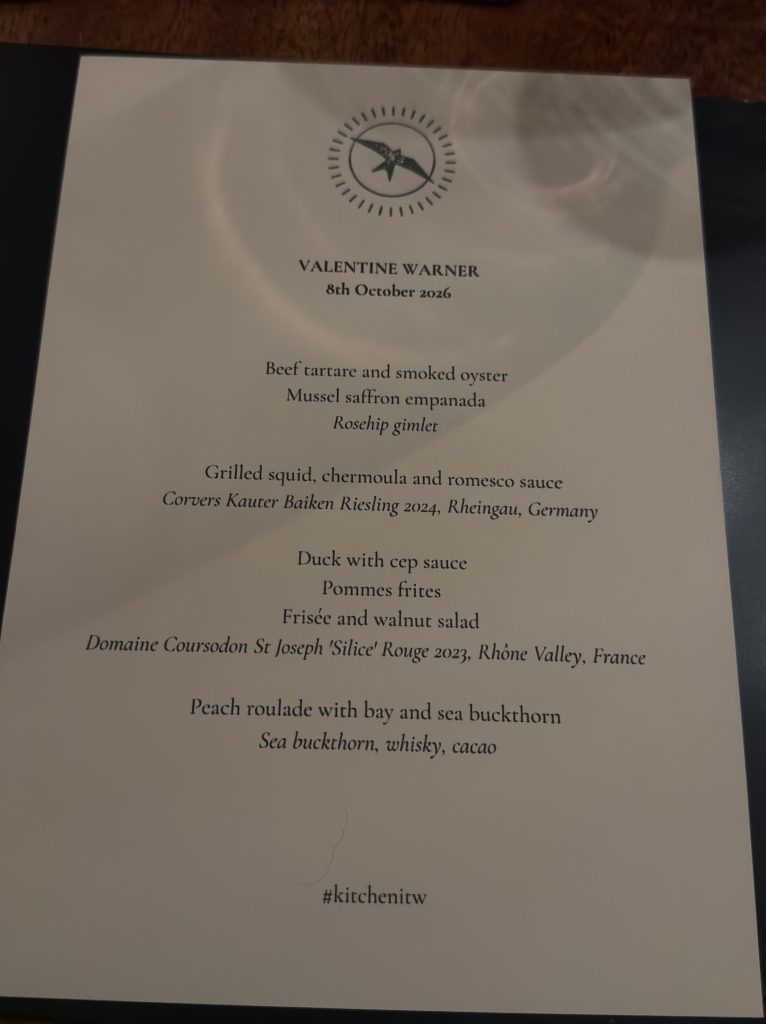
It brought together seafood, game, autumnal ingredients and some intriguing combinations of flavours, accompanied by carefully chosen wines and cocktails. No decisions to make, no menu anxiety and no wondering whether somebody else’s choice would turn out to be better.
For once, I was entirely happy to relinquish control.
A Little Something to Begin
The evening opened with three distinctly different canapés: beef tartare and smoked oyster, a mussel and saffron empanada, and a rosehip gimlet to sip.
The pairing of beef tartare with smoked oyster was particularly intriguing. Beef and oyster have a long culinary association, but introducing smoke to the oyster added another savoury dimension to the combination: the richness of the beef meeting the saline character of the shellfish.
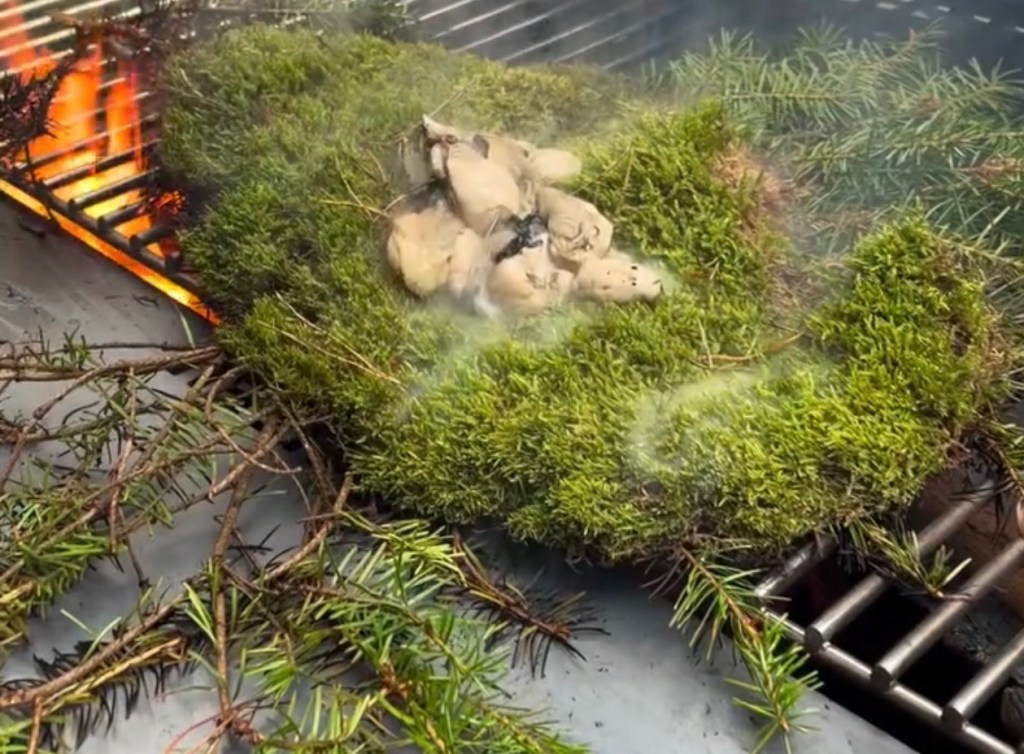
The mussel and saffron empanada offered something quite different, bringing together sweet shellfish, the distinctive perfume of saffron and the pleasure of a pastry-wrapped mouthful.
And then there was the rosehip gimlet.
With Nick Strangeway amongst our company, drinks were always likely to be rather more interesting than a hurried gin and tonic. The inclusion of rosehip seemed especially appropriate for October in the Highlands, drawing upon an ingredient associated with hedgerows, autumn and the natural world beyond the windows.
It was an assured beginning. A few carefully considered flavours, an excellent drink and the promise of considerably more to follow.
Grilled Squid, Chermoula and Romesco
Our first plated course was grilled squid with chermoula and romesco sauce, accompanied by Corvers Kauter Baiken Riesling 2024 from Germany’s Rheingau.
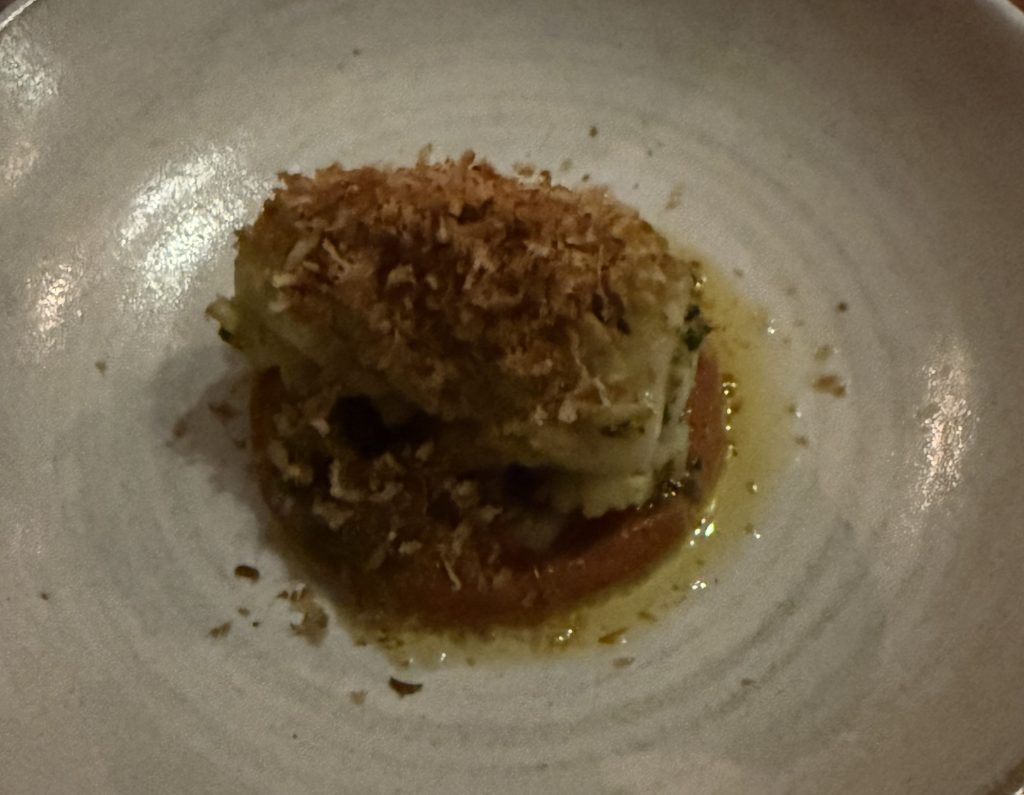
The dish was presented with a pleasing lack of fuss, its components gathered in the centre of a beautiful, pale ceramic bowl. Beneath the golden topping and squid lay the warm reddish tones of the romesco, with a little of the dressing collecting around the base.
The choice of accompaniments was inspired.
The two sauces made particularly good companions for the squid. Chermoula brought the fragrant, citrus-led freshness of North African cooking, with its lively combination of herbs, garlic and warm spices. Romesco offered a contrasting character: roasted red peppers, garlic and nuts creating a rich, gently smoky sauce with a mellow peppery warmth and just enough acidity to keep everything lively.
Together, they gave the delicately sweet grilled squid a wonderful balance of freshness, depth and warmth, each contributing something quite different without overwhelming the seafood.
Together, they provided a wonderful contrast to the delicacy of the squid.
The Riesling was an equally thoughtful choice. Its freshness and aromatic character made it a natural companion for seafood and the mildly spicy Romesco and assertive herbal flavours.
It was a dish that neatly illustrated Valentine’s approach to cooking: ingredients and influences drawn from different places, brought together through an understanding of what makes them work, with a bit of punch.
By this point, I was very much looking forward to what came next.
Duck, Cep Sauce and a Magnificent Platter
The main course was announced simply enough:
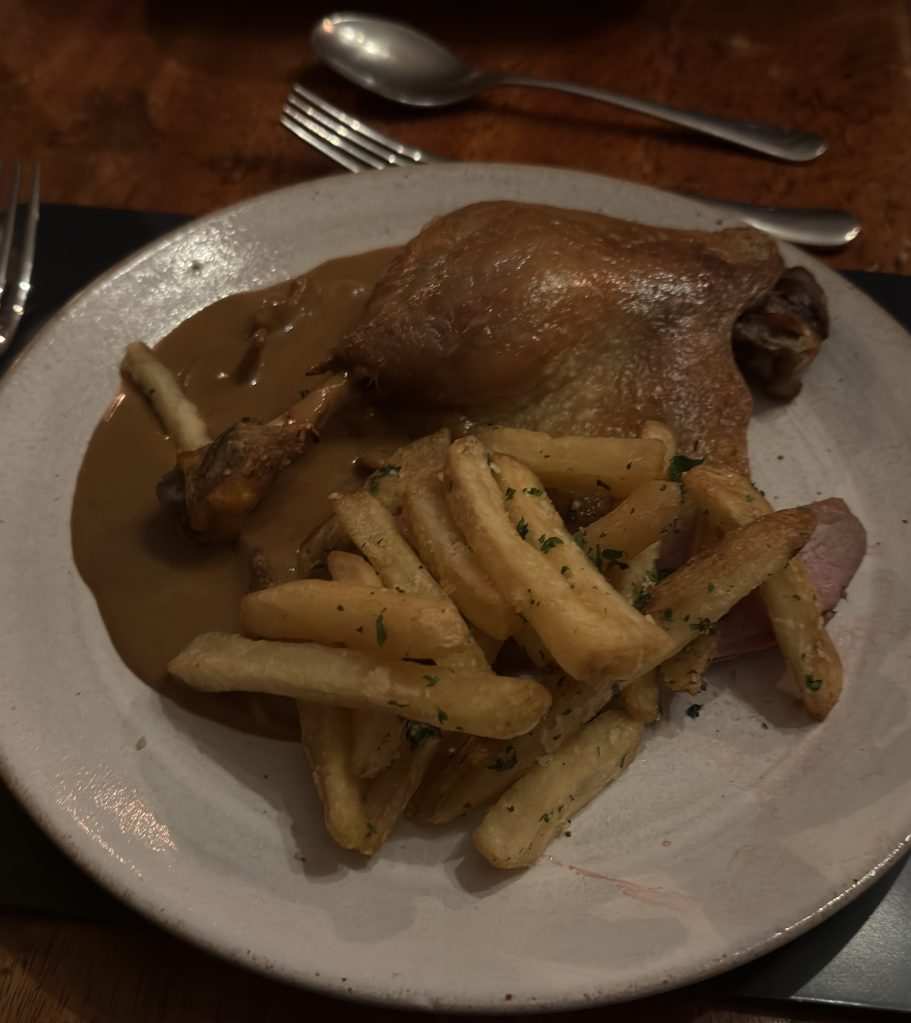
Duck with cep sauce, pommes frites, and frisée and walnut salad.
What arrived at the table, however, was rather more spectacular than those few words might suggest.
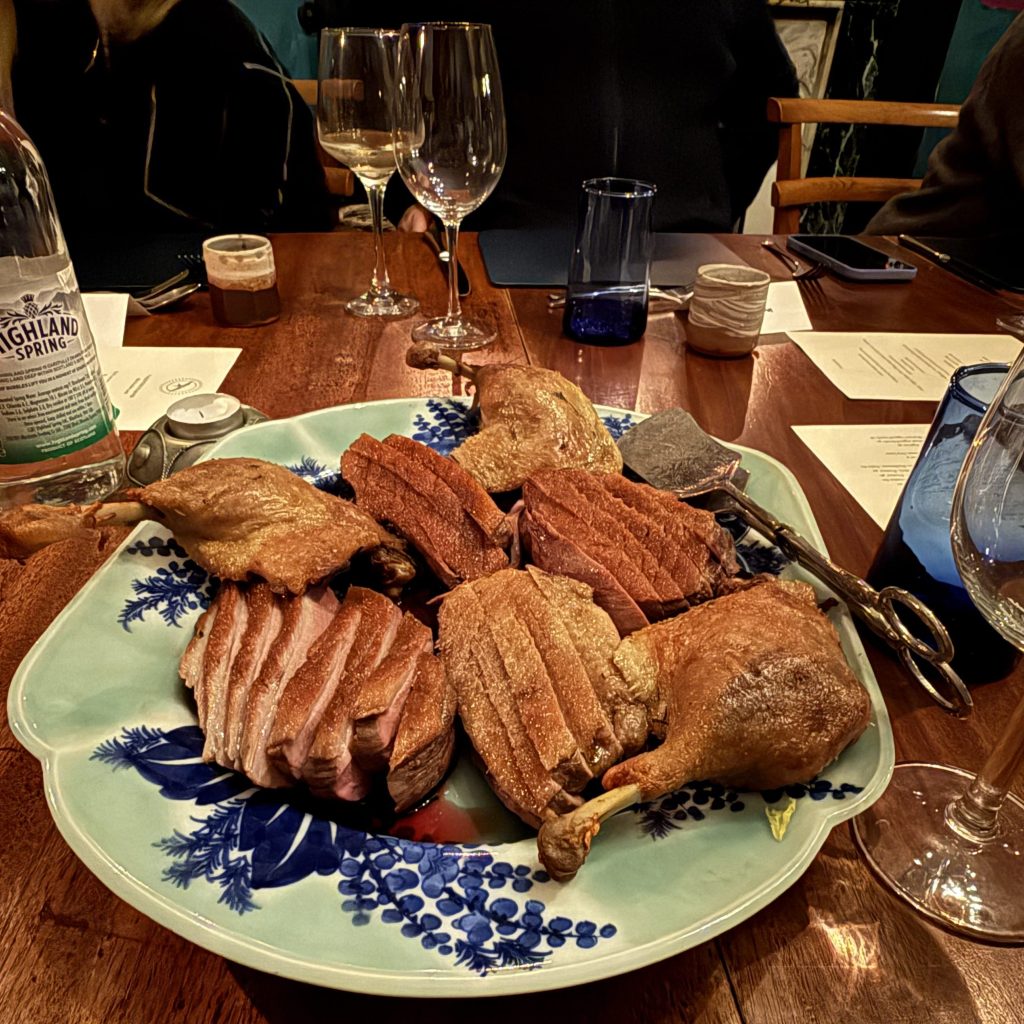
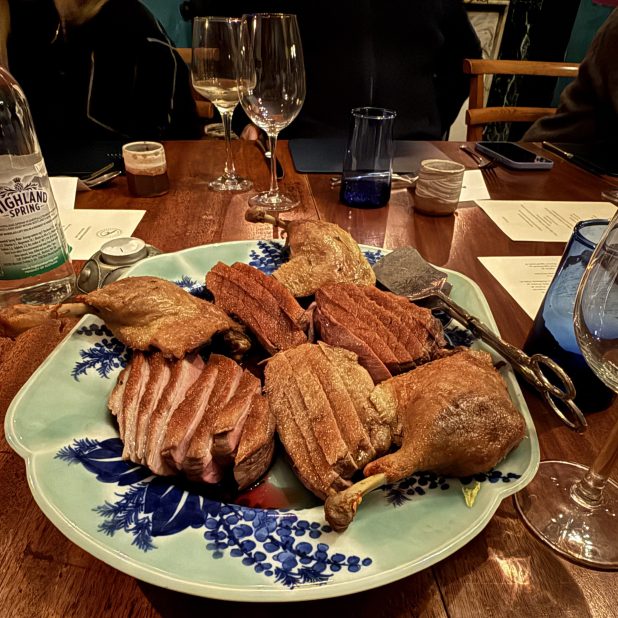
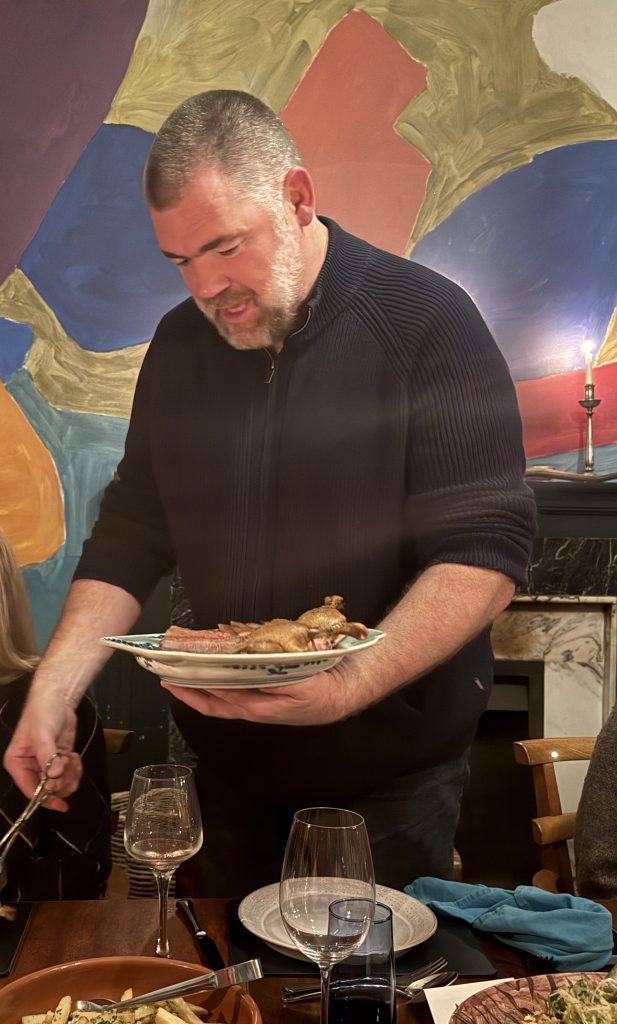
Several generous platters of duck appeared, beautifully browned skin gleaming in the dining-room light. The breasts had been carefully carved into thick slices, revealing the rosy meat beneath, while the legs retained their wonderfully crisp-looking skin.
Presented together on handsome blue-and-white platters, it was an exceptionally appetising sight.
There is something deeply satisfying about this style of serving. Rather than individual portions emerging from the kitchen as identical little arrangements, the food arrived as a magnificent centrepiece to be shared.
It immediately became part of the occasion.
The duck was accompanied by a cep sauce, bringing the rich, earthy, woodland character of porcini mushrooms to the meat. It was a wonderfully appropriate autumnal combination, particularly given our location amongst Eilean Shona’s extensive woodland.
Alongside came pommes frites and a frisée and walnut salad. The crisp, slightly bitter leaves and walnuts provided contrast to the richness of the duck, while the chips fulfilled their traditional and thoroughly important responsibility of making an excellent meal even better.
The accompanying red was Domaine Coursodon Saint-Joseph ‘Silice’ Rouge 2023, from France’s northern Rhône Valley.
Made from Syrah, Saint-Joseph is particularly well suited to dishes of this character, its savoury, peppery qualities providing a lovely partner for duck and the earthy depth of the cep sauce.
A glorious main course, generous, beautifully presented and entirely without unnecessary complication.
It is sometimes easy to forget, amid the more theatrical end of modern gastronomy, just how wonderful a plate of properly cooked meat, an excellent sauce and good potatoes can be.
Not that I have ever needed much persuading on the subject of potatoes!
Peach, Bay and Sea Buckthorn
Dessert brought the evening back towards the wilder, more botanical influences that make Kitchen in the Wild so distinctive.
The menu described it as peach roulade with bay and sea buckthorn, followed by the flavours of sea buckthorn, whisky and cacao.
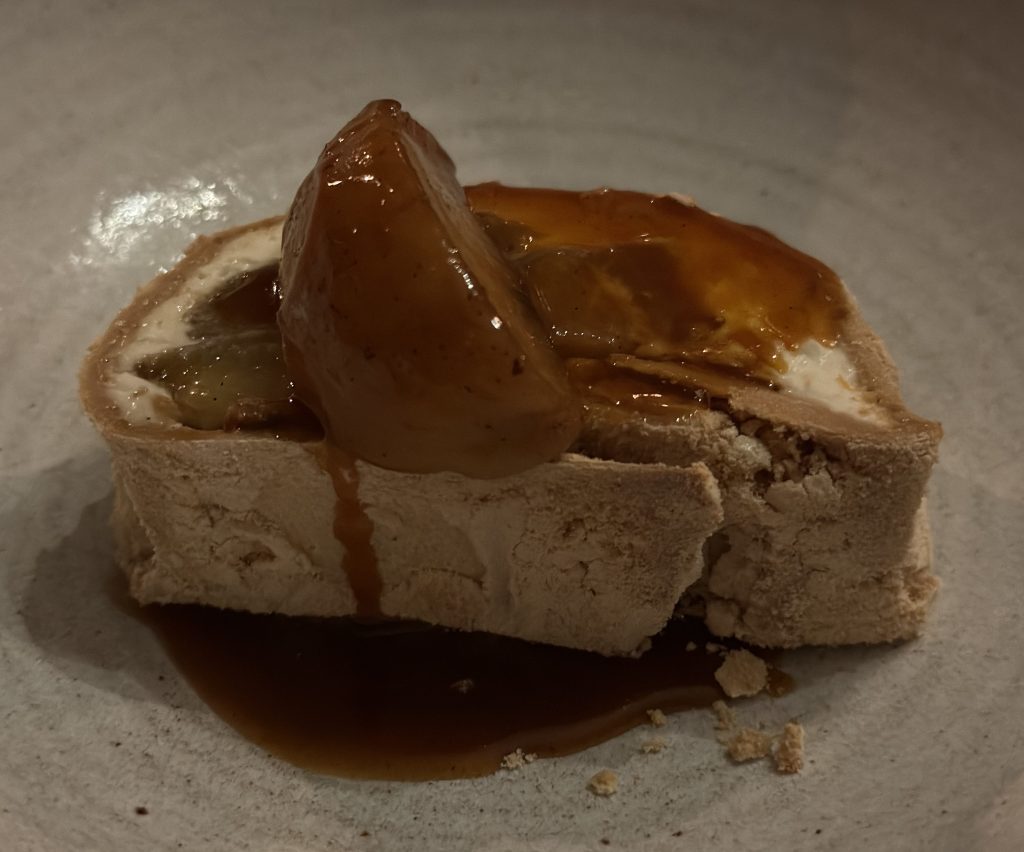
The roulade arrived in a pale ceramic bowl, topped with glossy, amber-coloured peach and surrounded by a rich-looking sauce.
It was an interesting combination.
Peach offers fragrant, familiar sweetness, but bay and sea buckthorn introduce rather less conventional flavours. Bay has a gentle aromatic quality that can be surprisingly effective in sweet preparations, while sea buckthorn, with its vivid orange berries and pronounced sharpness, brings an unmistakable brightness.
Native to parts of Britain’s coastline, sea buckthorn is one of those ingredients that seems particularly appropriate to an event celebrating the relationship between food and landscape.
The addition of whisky and cacao to the final flavour combination gave the dessert a distinctly grown-up character.
It was a fitting conclusion to a menu that had moved confidently between land and sea, familiar pleasures and more adventurous ingredients.
More Than Just a Dinner
By now, the room had settled into the comfortable rhythm of a very good evening. Conversation was flowing, plates had been cleared, and those tentative first introductions had given way to the sort of relaxed exchange that only seems to happen when people are gathered around a long table with no immediate reason to leave it.
What struck me most was the atmosphere, for all the remarkable professional achievements represented in the room, there was none of the formality that sometimes accompanies high-profile food events.
Everyone was simply there to enjoy themselves, share their enthusiasm and take part in something rather special.
And behind the scenes, of course, an enormous amount of work was taking place.
Valentine’s dinner might have carried his name, but creating an experience of this quality requires a considerable supporting cast: skilled chefs preparing and finishing dishes, people ensuring service flows effortlessly, those organising drinks, looking after guests, managing the house and dealing with the thousand-and-one practical details that most of us never even notice.
The best hospitality has a wonderful way of making all that effort appear almost invisible.
Over the coming days, I would come to appreciate that aspect of Kitchen in the Wild just as much as the food itself, particularly the people who seemed capable of producing a cup of Earl Grey at precisely the moment I began thinking one might be rather nice.
An essential skill, and one that deserves considerably more recognition in the hospitality industry.
But for now, I was simply enjoying the moment.
Outside, darkness had settled over Loch Moidart. The mainland, the car, the maps and my increasingly ambitious sightseeing itinerary were all somewhere behind me. I had finally arrived on Eilean Shona.
The food had been exceptional, the company fascinating and the setting every bit as atmospheric as I’d hoped, and this was only the first evening.
After nineteen months of anticipation, Kitchen in the Wild had begun in considerable style. Tomorrow would bring our first full day on the island, with time to discover more of its extraordinary landscape, wildlife and culinary possibilities, and for once, I had absolutely no intention of making an itinerary.
Well, perhaps not a printed one.
………………….. Until Next Time ………….. L8ers ……………..

